
Larnaca Marina is about to become one of the most closely watched addresses in Cyprus real estate. On 3 July 2026, the Cyprus Ports Authority unveiled a €415 million redevelopment programme for the Larnaca port and marina — a phased, two-decade plan that will reshape the city’s waterfront and, with it, the property market around it. For anyone weighing a purchase in Larnaca, understanding this project is no longer optional. It is the single biggest factor in where prices go next.
This guide explains what Larnaca Marina is today, what the new redevelopment actually commits to, the realistic timeline, and — most importantly — what it means for buyers and investors. We will keep the hype where it belongs: nowhere. As Cyprus’ #1 property marketplace, index.cy tracks every district with data rather than promises, and Larnaca deserves a clear-eyed look.
Larnaca Marina sits at the heart of the city’s seafront, a short walk from the Finikoudes promenade, the old town, and Larnaca International Airport — one of only two international gateways on the island. For decades it has been a modest working marina: a few hundred berths, a cluster of boatyards, and a waterfront that never quite matched the ambition of the city behind it.
That underdevelopment is exactly why the opportunity exists. Larnaca has long been the most affordable of Cyprus’ coastal districts, with average apartment prices well below Limassol and Paphos. Yet it offers the same Mediterranean coastline, a genuine year-round community, and the shortest airport transfer of any major Cypriot city. The marina has been the missing piece — a tired asset in a prime location.
Larnaca’s wider market has already been moving. Residential prices in the district rose roughly 8% in the most recent full year of data, with apartments leading the way. You can see the current picture in our Larnaca property market analysis and browse live stock among properties for sale in Larnaca. The redevelopment now adds a structural catalyst on top of that momentum.
The plan unveiled in July 2026 is materially different from the version many buyers remember. The government terminated its earlier unified concession with private developer Kition Ocean Holdings in 2024, then transferred responsibility for both the port and the marina to the Cyprus Ports Authority. The redevelopment is now structured as three parallel subprojects covering the marina land, the marina infrastructure, and the port itself.
The headline numbers are worth knowing precisely. Of the €415 million total, around €205 million is earmarked for the port, roughly €190 million for the marina land and adjacent areas, and approximately €20 million for the marina infrastructure. The overall programme runs to 2045, with the full master plan due to be completed by 2029, according to the Cyprus Mail.
Crucially, the marina is not becoming a private enclave. The Ports Authority will own infrastructure, maintenance, and strategic management, while the commercial and tourism elements — hotels, restaurants, office space, a conference centre, and recreation facilities — will be financed largely by private investors under a common planning framework. Early works focus on the unglamorous but essential: landscaping, relocating the existing boatyards to the northern section of the port, and creating public open spaces, green areas, and parking before any commercial building begins.
The stated strategic aim is twofold: strengthen Larnaca’s role in shipping, and reconnect the city to its waterfront with continuous public access between the marina and the port. For residents and property owners, that second goal matters most. A walkable, open seafront is precisely the kind of amenity that lifts nearby property values.
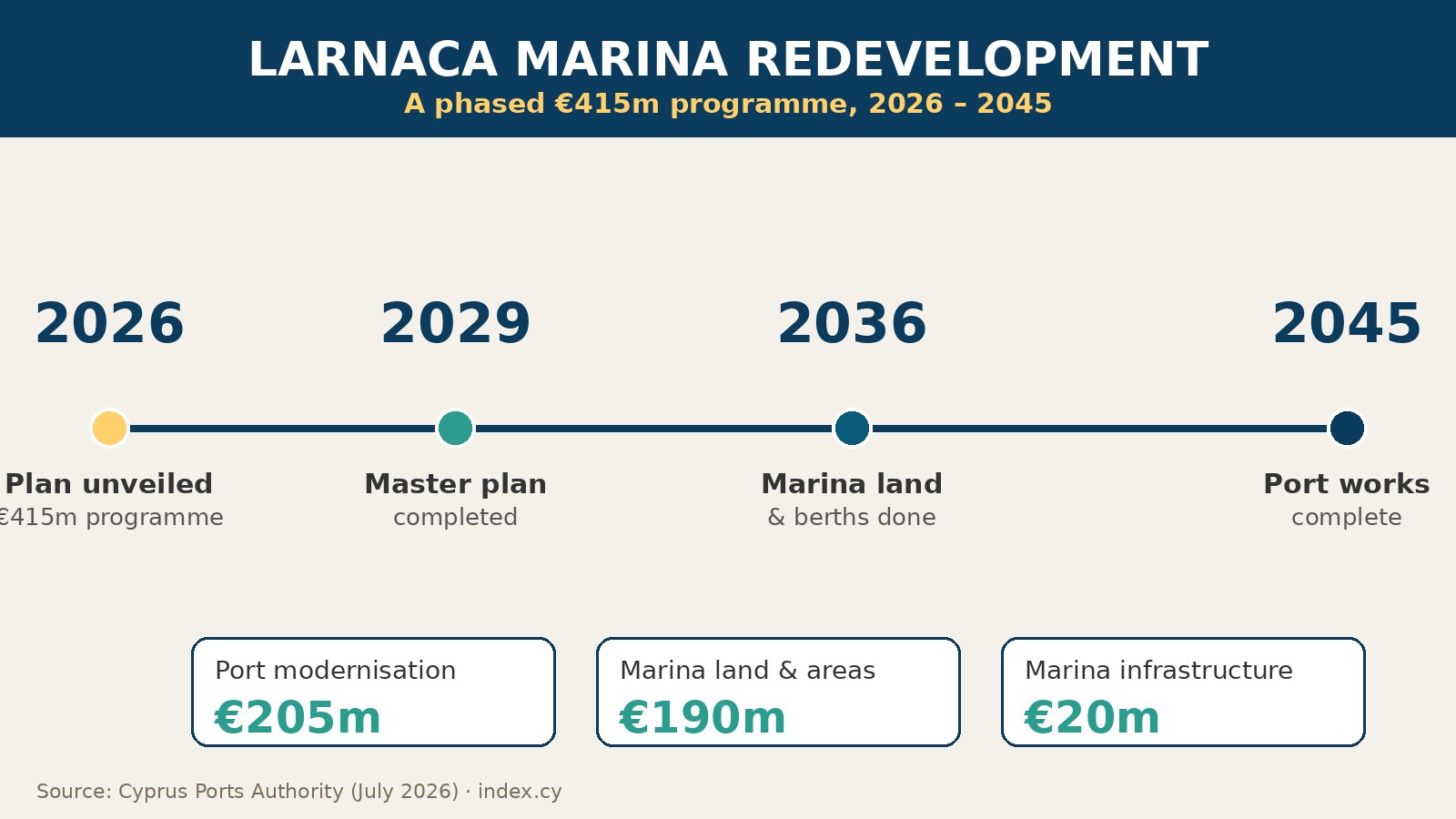
The most important thing a buyer can understand about this project is that it is a marathon, not a sprint. The Ports Authority has been transparent about a phased rollout, and anyone pricing in a “finished marina” today is getting ahead of the facts.
| Phase | Period | Focus | Est. spend |
|---|---|---|---|
| Master plan & early works | 2026–2029 | Planning, landscaping, boatyard relocation, public spaces | Within marina land budget |
| Marina land development | 2027–2036 | Hotels, restaurants, offices, conference centre, recreation | ~€190m |
| Marina infrastructure | 2027–2036 | Berth upgrades, expansion toward ~200-boat capacity | ~€20m |
| Port modernisation | 2027–2045 | New quays, expanded breakwater, extra berths, new basin | ~€205m |
The takeaway is straightforward. The marina land and infrastructure — the parts most visible to property buyers — are scheduled across 2027 to 2036. The heaviest port works land between 2036 and 2045. This is a long arc, and the value it creates will be released gradually. That is good news for early buyers who are patient, and a warning to anyone expecting an overnight transformation. The ports authority first outlined this separate-but-parallel approach in May 2026.
Waterfront regeneration projects tend to follow a familiar pattern: prices near the site begin rising on announcement, well before a single crane appears, then step up again as amenities actually open. Larnaca is now firmly in that first phase. The 2026 unveiling is the kind of catalyst that draws investor attention to a district that was already quietly outperforming.
The effect will not be uniform. Properties within walking distance of the seafront — around Finikoudes, Mackenzie beach, and the old town — stand to benefit most directly from a reopened, upgraded waterfront. New developments are already clustering in these zones, and you can explore current projects through complexes and developments in Larnaca. Apartments with sea views or short walks to the promenade are the clearest beneficiaries.
At the same time, transparency demands a caveat. Announcements are not completions, and Cyprus has seen ambitious waterfront plans slip before — the terminated Kition concession is a live reminder. A sensible buyer treats the redevelopment as a strong tailwind, not a guarantee, and pays a price justified by today’s fundamentals rather than 2036’s brochure renderings. For the full framework, our guide to real estate investing in Cyprus walks through how to value a catalyst like this without overpaying for it.
Numbers anchor good decisions. Larnaca remains the value pick among Cyprus’ coastal districts, and the marina project sits on top of already-attractive pricing rather than replacing it.
Typical Larnaca apartment stock trades in the region of €2,100–€2,400 per square metre, with prime seafront and brand-new units commanding more, and older inland resale apartments less. Rental yields in the district commonly land in the 5–7% range — reaching up to 8% in sought-after Mackenzie — supported by airport-driven demand, a stable long-term rental base, and summer holiday lets. For live, district-specific figures, see our data on the average price for a 2-bedroom apartment in Larnaca.
Set against Limassol — where seafront apartments routinely cost two to three times as much — Larnaca’s entry point is its defining advantage. A waterfront regeneration of this scale in a Limassol-priced market would already be baked into values. In Larnaca, much of the upside is still ahead, precisely because the district has been overlooked. That gap between price and potential is the investment case in a single sentence.
Before committing to any specific unit, it is worth pressure-testing the asking price against comparable sales. Our free instant property report gives you an independent read on whether a listing is fairly priced — useful discipline in a market where a headline project can tempt sellers to over-ask.
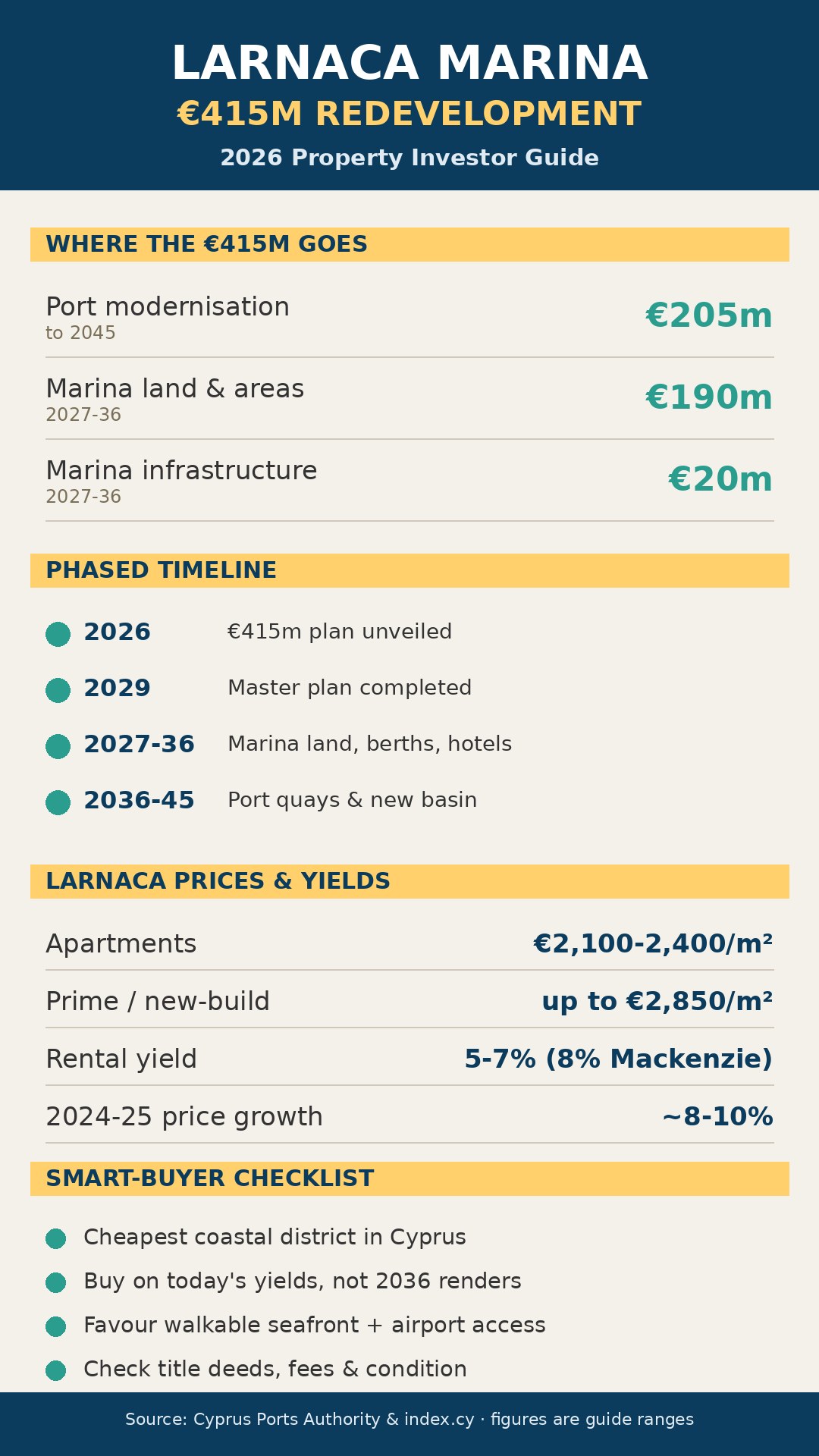
Opportunity and risk travel together, and a two-decade project rewards a clear head. Four principles keep buyers on the right side of the ledger:
For financing questions and the full step-by-step process from offer to completion, our broader Larnaca buyer’s guide covers the practical mechanics in detail.
For the right buyer, the case is genuinely compelling. Larnaca combines the lowest coastal entry prices in Cyprus, healthy rental yields, an international airport on the doorstep, and now a €415 million, state-backed reason to expect the waterfront to improve steadily over the next decade. Few districts offer that mix of affordability and catalyst at the same time.
The honest counterweight is time and execution risk. Value from a project like this is released over years, not months, and the plan’s later phases stretch to 2045. Buyers who need quick capital appreciation, or who cannot tolerate a long hold, are better suited elsewhere. Larnaca Marina rewards patience, local knowledge, and disciplined pricing — not speculation.
What is the Larnaca Marina redevelopment? It is a €415 million, phased programme unveiled in July 2026 by the Cyprus Ports Authority to redevelop Larnaca’s marina and port. It covers marina land, marina infrastructure, and port modernisation, and runs to 2045 with a master plan due by 2029.
When will Larnaca Marina be finished? There is no single completion date. Marina land and infrastructure works are scheduled across 2027–2036, while the larger port modernisation runs to 2045. The full master plan is expected to be completed by 2029.
Will Larnaca property prices rise because of the marina? Waterfront regeneration typically supports nearby values, and Larnaca prices were already climbing before the announcement. However, gains are likely to be gradual and location-specific, and no rise is guaranteed — buy on current fundamentals.
Is Larnaca cheaper than Limassol for property? Yes. Larnaca is the most affordable of Cyprus’ coastal districts, with apartment prices typically a fraction of comparable Limassol seafront stock — a key part of the marina investment case.
Larnaca Marina is no longer a tired working harbour with big talk attached to it. With a concrete €415 million redevelopment programme now on the table, running to 2045 under public ownership with private commercial partners, the city’s waterfront finally has a credible path forward. For buyers, that turns Larnaca from “cheap coastal district” into “cheap coastal district with a catalyst.”
The smart approach is neither to dismiss the project nor to overpay for it. Buy on today’s yields and comparable prices, favour walkable seafront locations, verify every deed and cost, and let the redevelopment work as long-term upside. Start by exploring properties for sale in Larnaca and running the numbers on any listing that catches your eye — the data, not the renderings, should make your decision.