
If you own a rental property in Cyprus, 2026 is the year your tax bill changed. The comprehensive tax reform that came into force on 1 January 2026 rewrote several rules that directly affect landlords—most notably, it abolished the Special Defence Contribution (SDC) on rental income and raised the tax-free threshold. For investors weighing a buy-to-let purchase, understanding exactly how rental income is taxed is now essential to calculating real, after-tax returns.
This guide breaks down the three layers of tax that can apply to Cyprus rental income, walks through the 2026 changes, and shows you a worked example so you can estimate your own liability with confidence.

Rental income in Cyprus is never taxed by a single flat rate. Instead, up to three separate charges can apply, and knowing which ones affect you is the first step to an accurate calculation.
The big story for 2026 is that SDC on rents is gone for everyone. That removes a charge that used to add roughly 2.25% to the tax bill of Cyprus-domiciled landlords. What remains is income tax on your profit and the 2.65% GHS contribution—both of which we explain in detail below.
Cyprus approved its most significant tax overhaul in decades at the end of December 2025, effective from 1 January 2026. Several changes matter specifically to property owners.
For a Cyprus-domiciled landlord, the combined effect is meaningful. A charge that once applied to gross rent has disappeared, and more of your profit now falls inside the 0% band. For a deeper look at how these rules sit alongside transfer fees, VAT, and capital gains, see our guide to navigating taxes and legalities in Cyprus real estate.
Your net rental profit is added to your other taxable income and taxed at Cyprus’s progressive personal income tax rates. These are the bands that apply from 1 January 2026:
| Taxable income (€) | Tax rate |
|---|---|
| 0 – 22,000 | 0% |
| 22,001 – 32,000 | 20% |
| 32,001 – 42,000 | 25% |
| 42,001 – 72,000 | 30% |
| Over 72,000 | 35% |
Two points are easy to miss. First, the bands apply to your total taxable income, not to rental income in isolation—so if you already earn a salary, your rental profit is effectively taxed on top of it. Second, the tax is charged on net profit after allowable deductions, not on the rent you collect. Those deductions, covered below, can substantially reduce the figure that reaches these bands.
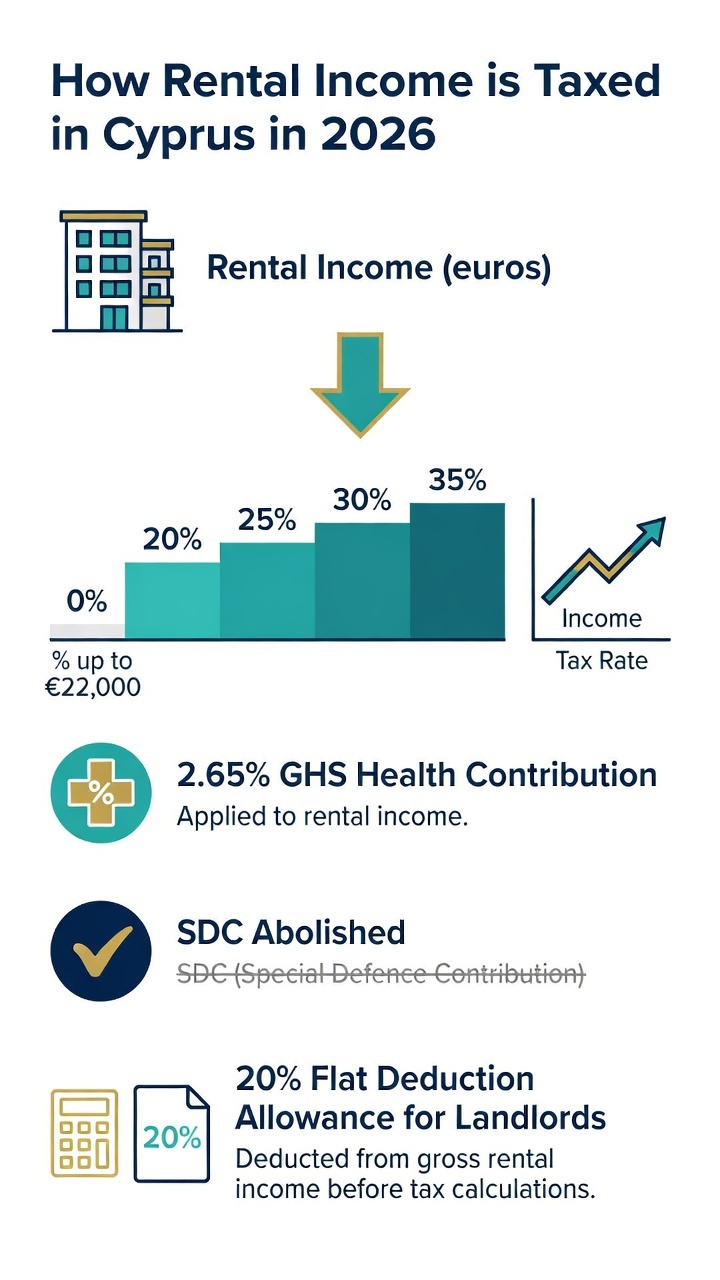
While SDC on rents has been abolished, the General Healthcare System contribution has not. Every Cyprus tax resident—including non-domiciled residents—pays 2.65% of gross rental income toward GHS, with no exemption available.
This is an important distinction for anyone relying on non-dom status. Non-doms are exempt from SDC (and were even before the 2026 reform), but they are not exempt from GHS. The 2.65% applies to your gross rent before any deductions, and GHS contributions are capped once your total annual income across all sources reaches €180,000.
Because GHS is calculated on gross rent while income tax is calculated on net profit, the two charges behave very differently. GHS is predictable and unavoidable; income tax depends heavily on how many deductions you can claim.
Cyprus gives landlords several ways to reduce taxable rental profit. Used together, they can bring a healthy gross rent down to a modest taxable figure.
These deductions apply for income tax purposes only—they do not reduce the gross figure used to calculate your 2.65% GHS contribution. Keeping clean records of interest paid and building cost is worthwhile, because the capital allowance in particular compounds into real savings over a multi-year hold. If you are still shaping your financing, our guide to buy-to-let investing in Cyprus covers how leverage interacts with yield and tax.
The 2026 reform touched far more than rental income. This overview walks through the headline personal and business tax changes that took effect on 1 January 2026.
Numbers make this concrete. Imagine you own a two-bedroom apartment in Limassol—a district where average two-bedroom values support strong rents—and you let it long-term for €1,600 per month, or €19,200 per year. Assume you are a Cyprus-domiciled resident with no mortgage and no other income, and the building portion cost €200,000.
Total tax on €19,200 of rent: €508.80, or about 2.65% of gross—entirely the GHS charge. Under the pre-2026 rules, an effective 2.25% SDC would have added roughly €324 on 75% of the gross rent, so this landlord is now materially better off.
The picture changes if you have a salary or other income that already fills the tax-free band, because your rental profit would then be taxed at 20% or higher. That is exactly why the deductions above matter so much.
Not every landlord fits the standard resident profile. A few situations deserve specific attention.
Because residency, domicile, and treaty rules interact in ways that depend on your personal circumstances, this is the point at which a licensed Cyprus tax advisor earns their fee. This guide is general information, not tax advice—treat it as a map, not a final answer.
Rental income is declared on your annual personal income tax return, filed with the Cyprus Tax Department. GHS contributions on rent are generally settled alongside your income tax, either through self-assessment or, in some cases, withholding by a corporate or government tenant. Keeping monthly records of rent received, interest paid, and property expenses throughout the year makes filing far simpler than reconstructing figures at the deadline.
For landlords building a portfolio rather than holding a single unit, structuring and record-keeping become strategic rather than administrative. Our comprehensive guide to real estate investing on index.cy looks at how tax fits into overall returns, and you can browse current opportunities among apartments for sale across Cyprus or properties for sale in Limassol to model your own numbers.
The 2026 reform made Cyprus a friendlier place to earn rental income. SDC on rents is gone, the tax-free threshold is higher, and generous deductions mean many small landlords will pay little more than the 2.65% GHS charge on their gross rent. Larger earners and non-residents face a more layered calculation, but the underlying framework is transparent and, by European standards, competitive.
Run your own numbers before you buy, confirm your residency and domicile position with a qualified advisor, and factor the real after-tax yield—not the headline gross yield—into every decision.
This article provides general information on Cyprus rental income taxation and does not constitute tax or legal advice. Tax rules change and depend on individual circumstances; consult a licensed Cyprus tax advisor before acting. Sources: PwC Cyprus Tax Summaries — Income Determination and PwC Cyprus Tax Summaries — Other Taxes.