
If you are searching for houses for sale in Paphos, you are looking at one of the most active resale and new-build markets in Cyprus. Paphos consistently accounts for roughly 30–35% of all foreign property purchases on the island, and detached houses are the single most requested property type on index.cy when buyers filter by this district. The reasons are straightforward: compared with Limassol, Paphos delivers 30–40% more house per euro, a deeper inventory of resale stock, and some of the most liquid expat communities in the Eastern Mediterranean.
This 2026 guide breaks down what a “house in Paphos” actually means on the ground, what you should expect to pay in each area, how the buying process works for foreign and local buyers, what fees and taxes apply, and how rental yield stacks up if you plan to let the property when you are not using it. Every price range comes from live listings on houses for sale in Cyprus, from the Central Bank of Cyprus Residential Property Price Index, and from the Department of Lands and Surveys quarterly transaction data.
Paphos is a district, not a town. When you filter for properties for sale in Paphos you are looking across a coastline that stretches from Pissouri in the east to the Akamas peninsula in the north, plus inland villages that climb into the Troodos foothills. That variety is the reason Paphos can serve very different buyer profiles on the same budget — a retired UK couple shopping in Tala, a Scandinavian family relocating to Peyia, and a Cypriot first-time buyer in Geroskipou are all looking at the same listings page.
In local real estate language, a house in Paphos typically falls into one of four categories:
Most 2026 listings describe a “Paphos house” as a 3-bedroom detached property with a pool, garden and a title deed (or a clear path to one). If you want the lighter, higher-volume end of the market, filter for cheap houses and villas in Cyprus and set a Paphos filter. If you want the luxury end, our sister article villas for sale in Paphos covers the €500K+ segment in more depth.
Paphos house prices have risen every year since 2020, but more gently than Limassol. Based on our analysis of active listings on the houses for sale in Cyprus page and Central Bank of Cyprus index data, the Paphos district delivered a compound annual price growth of roughly 6–8% for detached houses between 2020 and 2025, and Q1 2026 has continued that line. The table below summarises typical 2026 asking prices for 3-bedroom detached houses with a pool, by micro-market.
| Paphos area | Typical 3-bed house price (EUR) | Price per sqm (EUR) | Primary buyer profile |
|---|---|---|---|
| Coral Bay | €480,000 – €1,100,000 | €3,000 – €5,000 | Holiday-rental investors, coastal lifestyle |
| Peyia (hillside) | €420,000 – €950,000 | €2,700 – €4,500 | UK/EU expats, sea-view buyers |
| Tala | €360,000 – €780,000 | €2,300 – €3,600 | Retirees, long-term residents |
| Kissonerga | €300,000 – €620,000 | €2,000 – €3,100 | Value buyers, new-build hunters |
| Chloraka | €310,000 – €700,000 | €2,100 – €3,300 | Walk-to-beach expats |
| Konia | €320,000 – €650,000 | €2,100 – €3,200 | British expats, year-round residents |
| Kato Paphos / Geroskipou | €260,000 – €580,000 | €1,900 – €3,000 | Budget house buyers, rental investors |
| Tsada / Kathikas | €240,000 – €520,000 | €1,700 – €2,800 | Village house buyers, renovation projects |
| Polis / Latchi | €320,000 – €900,000 | €2,200 – €4,200 | Quiet coastal, retirement |
These are asking-price ranges, not transaction prices. Based on a review of comparable sales reported to the Department of Lands and Surveys, final sale prices on Paphos houses tend to settle 4–7% below the asking price for resale stock and 0–2% below for new builds. For a live view of the market, open the houses for sale in Cyprus page and filter for Paphos plus your target budget.
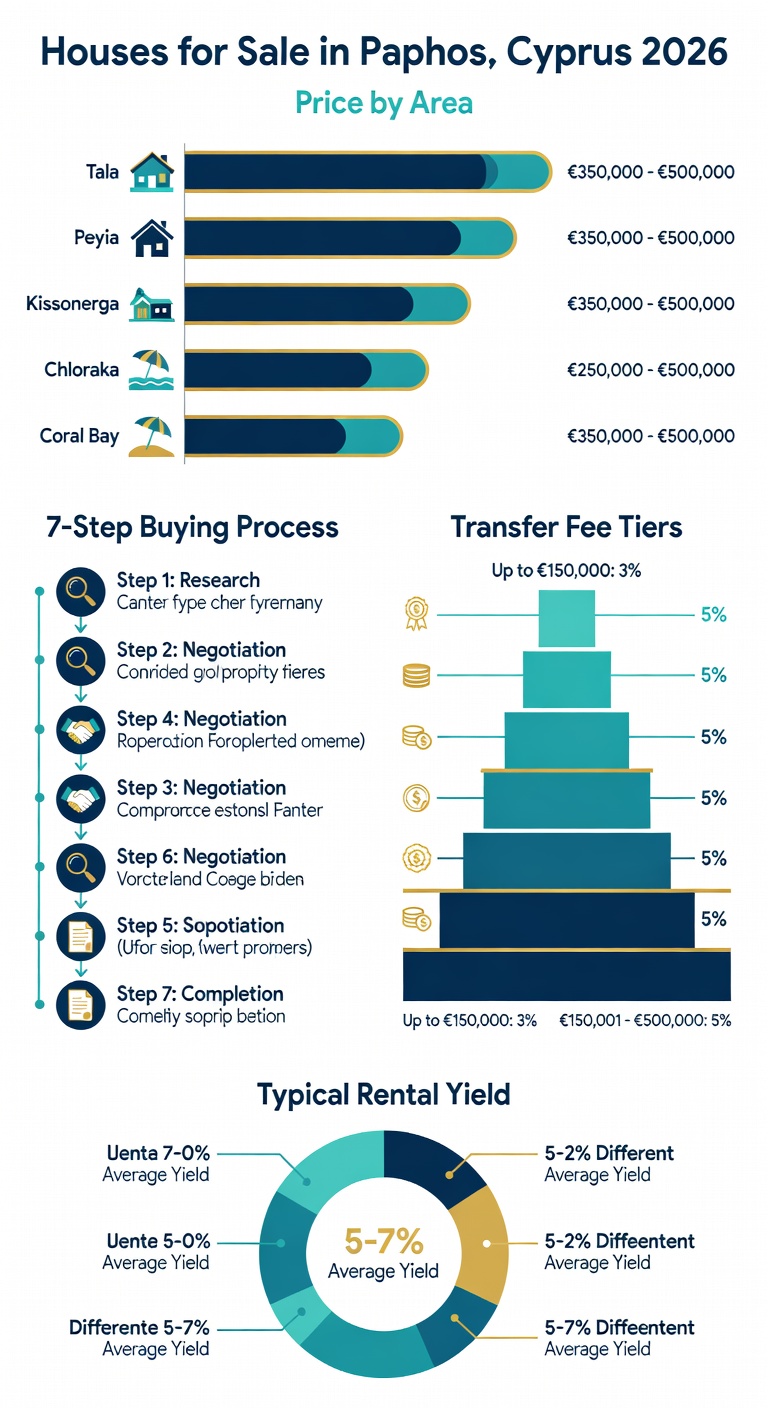
Different areas in Paphos suit very different buyers. Here is how the main micro-markets compare in 2026.
Tala sits about 5 km north of Paphos town at an elevation of 300 metres. It is the single most established expat community in the Paphos district, with a long-running British and Northern European population, a strong rental market for long-term lets, and a walkable village square. Expect 3-bed detached houses with a pool from around €360,000 at the entry end, up to €780,000 for larger homes with panoramic sea views. Tala is the area most buyers pick when they plan to actually live in Paphos full-time rather than use the house as a holiday home.
Peyia (Pegeia) covers the hillside above Coral Bay. It has the best concentration of sea-view houses in the district: most listings above the main road have a direct view of the Mediterranean, and the area is one of the strongest in Cyprus for short-term holiday rental yield. Entry-level 3-bed houses start around €420,000; anything with a genuinely unobstructed sea view and a private pool will usually sit between €600,000 and €950,000. If you are buying primarily for rental income, Peyia combined with Coral Bay is the obvious first place to look.
Kissonerga is a coastal village between Paphos town and Coral Bay that has become the main new-build belt of the district. Over the last three years, more than 60% of new house permits issued in Paphos were for projects in or around Kissonerga, according to the Department of Town Planning. Entry prices start around €300,000 for a 3-bed new-build house with a pool, which is 20–25% cheaper than equivalent stock in Peyia or Coral Bay. Buyers who want a new-build Paphos house with full title deed on delivery should filter for complexes and projects in Paphos and concentrate on this corridor.
Konia and Chloraka are the two most practical “live in Paphos” villages. Both are within a 10-minute drive of Paphos town, both have full daily services — schools, clinics, supermarkets — and both are walkable. Prices sit between Tala and Kissonerga at €310,000–€700,000 for a typical 3-bed house with pool. Chloraka is stronger for coastal-walkers (it runs down to the sea); Konia is stronger for British expats who want a quiet year-round base.
Inland and higher up, Tsada and Kathikas are the main wine-country villages of the Paphos district. Houses here are often traditional stone properties needing renovation, or new-builds on generous plots with views across the valley. This is where the genuine value buys are in 2026: 3-bed stone houses from €240,000, new-build houses from €380,000, and near-zero direct competition from international investors. These villages are for buyers who want real Cyprus rather than resort Cyprus.
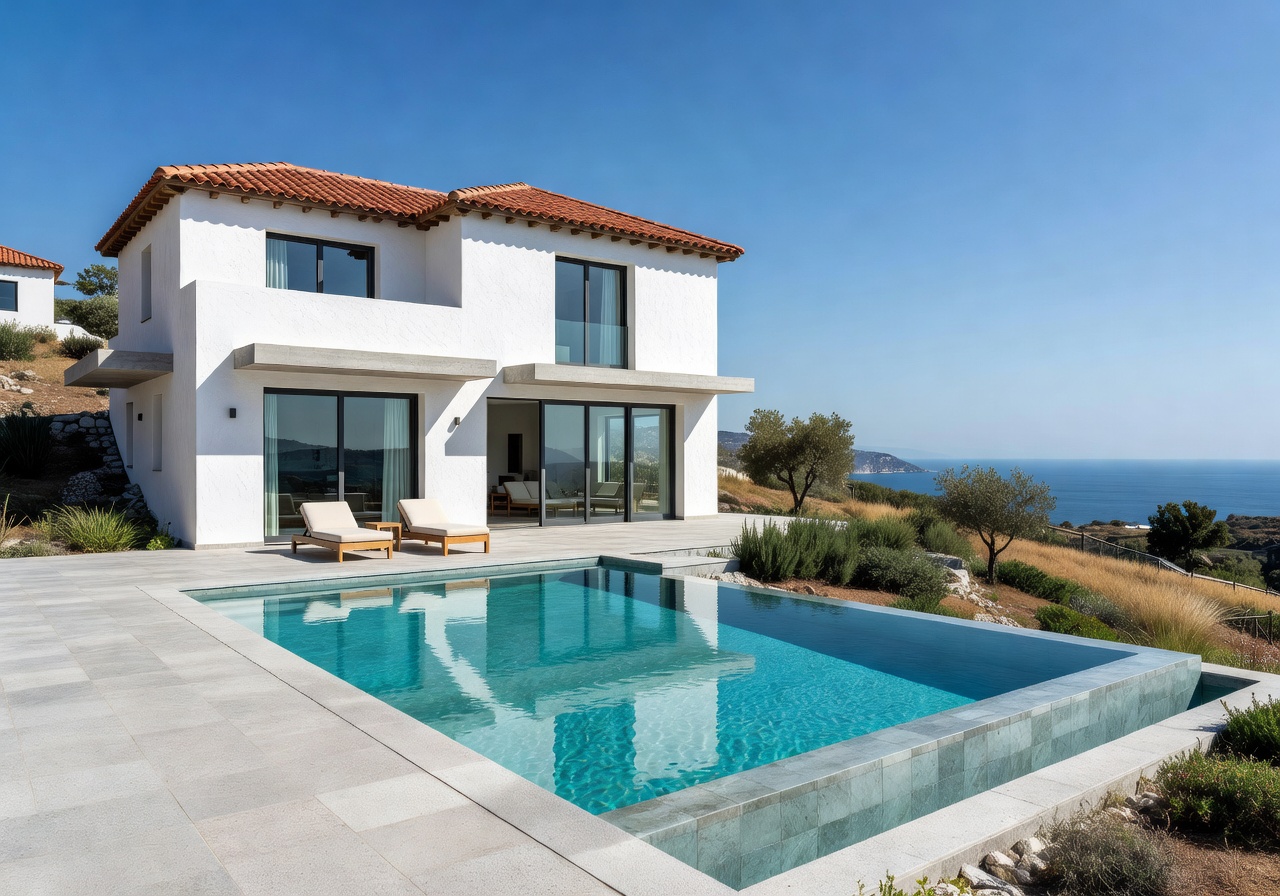
Buying a house in Paphos follows the same legal framework as the rest of Cyprus, but there are practical differences worth knowing. The process is designed to be safe for foreign buyers and is regulated by the Department of Lands and Surveys and, for non-EU nationals, the Council of Ministers. Whether you are coming from the UK, the EU, or a third country, you will move through seven main steps.
The headline price of a house in Paphos is rarely the total cost. Budget an additional 8–11% of the purchase price to cover transfer fees, stamp duty, VAT (where applicable), legal fees, and first-year municipal charges. The main cost lines in 2026 are:
| Cost item | Rate (2026) | Notes |
|---|---|---|
| Transfer fees (resale) | 3% up to €85,000; 5% €85,001–€170,000; 8% above €170,000 | Waived on new-builds with VAT; reduced 50% on qualifying resales |
| VAT (new-build only) | 19% standard, 5% reduced rate on first home up to 130 sqm | Reduced 5% VAT was tightened in 2023 — check eligibility |
| Stamp duty | 0.15% up to €170,000; 0.20% above €170,000 | Paid within 30 days of contract signing |
| Legal fees | 0.8–1.2% of purchase price | Independent lawyer, separate from seller’s |
| Land Registry transfer fee | €0.03 per €1,000 of value | Capped at €50 |
| Immovable Property Tax (annual) | Abolished 2017 | No annual IPT in 2026 |
| Municipal / community tax | €85–€300/year | Varies by municipality (e.g. Peyia vs Paphos Town) |
| Title deed issuance (new-build) | 3% – 8% transfer fee tier at deed stage | Deferred until deed is issued |
A concrete example: on a €450,000 resale house in Tala, you should budget roughly €13,500 in transfer fees, €900 in stamp duty, €4,500 in legal fees and about €250 in Land Registry / first-year council charges. That is a total of around €19,150, or 4.3% of the purchase price, in one-off closing costs. New-build houses shift the number but rarely reduce it — VAT at the reduced 5% rate on a qualifying first home plus the waived transfer fees land at a similar total. For a detailed comparison of tax implications by property type, see our Cyprus property tax guide.
For a visual sense of what a typical Paphos house tour feels like in 2026 — layout, outdoor space, finish quality — this walkthrough of a modern Paphos property is a useful reference:
Roughly 40–45% of foreign buyers of Paphos houses in 2025 used a Cyprus-based mortgage, according to Central Bank of Cyprus lending data. The main Cypriot lenders — Bank of Cyprus, Hellenic Bank, Astrobank, Alpha Bank Cyprus, Eurobank Cyprus — all offer mortgages to non-residents, with loan-to-value (LTV) ratios that differ based on residency and income source.
Expect 6–10 weeks from application to approval. Most Cypriot banks will want audited accounts or tax returns for the last two years, 3–6 months of bank statements, and a signed contract of sale. For the fine print on rates and criteria by lender, see our full Cyprus mortgage guide and cross-check affordability against current apartment investment returns if you are comparing Paphos against Limassol.
Rental yield on Paphos houses in 2026 depends almost entirely on location and rental strategy. Based on our analysis of active listings on index.cy combined with short-term rental data from public booking platforms, the following ranges are realistic. All numbers are gross yield, before tax and management fees.
| Area & strategy | Gross annual yield | Notes |
|---|---|---|
| Peyia / Coral Bay — short-term rental | 6.0–8.5% | Strong May–October season; requires licensing as self-catering |
| Tala / Konia — long-term rental | 4.5–5.5% | Steady year-round demand from expats |
| Kissonerga / Chloraka — long-term rental | 4.0–5.0% | Newer stock, younger tenant profile |
| Paphos Town / Geroskipou — long-term rental | 4.5–5.5% | Local Cypriot tenants, lower vacancy |
| Tsada / Kathikas — short-term (boutique) | 4.5–6.5% | Niche market — slower but higher nightly rates |
For a full picture of short-term rental economics, including licensing, cleaning costs and seasonality, our Airbnb Cyprus guide breaks down the full P&L. For a pure long-term rental benchmark, our long-term rent in Cyprus guide covers standard lease terms, deposit norms and tenant protections.
After thousands of successful transactions tracked through the index.cy marketplace, the same handful of mistakes come up repeatedly. They are avoidable with a little preparation.
Paphos is not the right answer for every Cyprus house buyer. It is the right answer for buyers who want coastal or village lifestyle, affordable-to-mid-range pricing, a strong expat support network, and access to a predictable short-term rental market. It is less compelling if you want a high-growth capital market, dense urban amenities, or a tax-optimised headquarters base.
| Factor | Paphos | Limassol | Larnaca | Nicosia |
|---|---|---|---|---|
| Median 3-bed house price (2026) | €370,000 | €620,000 | €340,000 | €310,000 |
| Expat concentration | High | Medium | Medium | Low |
| Short-term rental demand | High | Medium-High | Medium | Low |
| Year-round liveability | High | High | High | Medium-High |
| Appreciation last 5 years | +35% | +55% | +30% | +25% |
| Airport access | 30 min (Paphos) | 45 min (Larnaca) | 10 min (Larnaca) | 45 min (Larnaca) |
If you are still weighing districts, compare the Paphos numbers in this guide against our Limassol property for sale guide, Larnaca buyer’s guide and Nicosia buyer’s guide. For a broader framework on where to buy overall, the best areas to buy property in Cyprus walks through the ranking criteria.
In 2026, houses for sale in Paphos remain one of the best-value detached-house markets in the Eastern Mediterranean. Prices are rising at a sustainable pace, inventory is deep across resale and new-build, foreign-buyer infrastructure is mature, and the rental market — both long and short term — is liquid. For most buyers, the right move is to shortlist 2–3 areas, run the numbers honestly, and move quickly once a good property surfaces, because well-priced Paphos houses in areas like Peyia, Tala and Konia are not sitting on the market long.
Ready to shortlist? Browse live properties for sale in Paphos, drill down to houses for sale in Cyprus, and run an instant property report on any listing you are serious about. For agencies publishing Paphos inventory, see information for agencies; for developers listing new projects, see information for developers.
For independent market data, the Central Bank of Cyprus Residential Property Price Index and the Cyprus Statistical Service (CyStat) both publish quarterly reports on Paphos residential pricing. Both confirm what the live listings show: Paphos is a healthy, liquid, steadily appreciating house market heading into mid-2026.