Limassol is the most active development market in Cyprus. Of the roughly 11,000 building permits issued island-wide in 2024, Limassol accounted for the largest share of high-rise and high-value residential projects on the south coast. New towers, gated complexes and boutique developments are launching in clusters from Agios Tychonas through the city centre to Zakaki, and the developers behind them now control a meaningful slice of the city’s housing supply.
That makes choosing the right property developer in Limassol one of the most important decisions a buyer can make. Whether you are looking at a sea-view penthouse near the marina, a family villa in Mouttagiaka, or an off-plan apartment in the Town Centre, the developer’s track record will shape your delivery date, your title deed timeline, the build quality and ultimately your resale value.
This guide walks through how the Limassol developer landscape works in 2026, what to look for before signing a reservation, the off-plan buying process step by step, and how to compare projects on complexes and projects in Limassol to find the right fit. It is written for buyers who want to make a confident decision, not a rushed one.
The Limassol Property Developer Landscape in 2026
Limassol’s developer ecosystem is unusually concentrated. A handful of large, established groups dominate the high-rise and luxury segments, while dozens of mid-sized and boutique developers handle low-rise apartment buildings, townhouse rows and individual villas in the suburbs.
Three structural shifts define the 2026 market:
Tower density is plateauing along the seafront. After a decade of rapid high-rise construction between Limassol Marina and the Olympic Residence, planning approvals for new towers above 20 storeys in the strictest seafront zones have become slower. Developers have responded by moving inland and east toward Pyrgos and Agios Tychonas, where height limits are more flexible and land values are lower.
Mid-market product is expanding fastest. The strongest demand in 2025 to 2026 came from the €350,000 to €650,000 two and three-bedroom apartment segment, driven by relocating tech professionals, Cypriot upgrade-buyers and EU expat demand. Developers have shifted pipeline toward this range.
Build-to-rent and serviced residences are emerging. A small but growing cluster of Limassol developers is partnering with operators on hotel-branded residences and rental-managed apartments, particularly in Germasogeia and Neapolis.
Limassol property is roughly 25 to 35 percent more expensive per square metre than Paphos or Larnaca, depending on the zone. For current benchmarks, see our average house prices in Limassol, which are updated from live listing data and give a useful reality check on developer pricing.
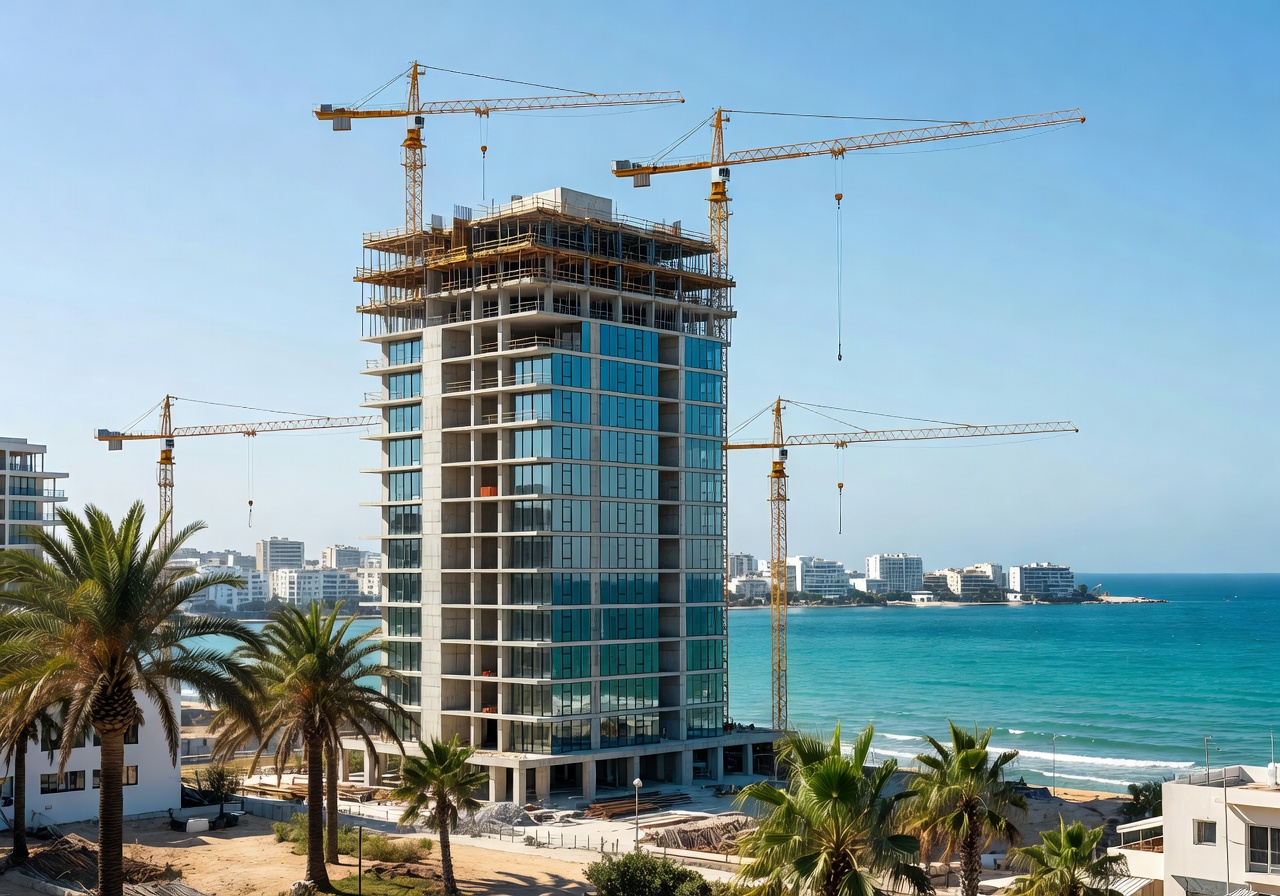
Limassol’s eastern seafront has become the densest cluster of new residential developments in Cyprus.
What Property Developers in Limassol Actually Do
The phrase “property developer” covers more activity than buyers often realise. In Cyprus, a developer typically handles the full chain from land acquisition through to sale and, in some cases, post-handover management. A clear understanding of where one developer’s role ends and another company’s begins will save you confusion later.
A typical Limassol developer’s responsibilities include:
Land acquisition and zoning. Securing the plot, confirming building density, height allowances and setbacks under the local planning zone.
Architectural design and engineering. Either in-house or contracted to a registered architect and structural engineer.
Planning and building permits. Submitting plans to the local Town Planning office and obtaining the building permit.
Construction. Either self-built with their own crews or sub-contracted to a main contractor.
Sales and marketing. Direct sales teams, agency partners, and listings on marketplaces.
Title deeds and handover. Liaising with the Department of Lands and Surveys to issue separate title deeds for each unit after completion.
Some developers also offer post-completion services like rental management, snagging and warranty support, but these are extras, not standards. Always ask explicitly.
Developer vs. real estate agency vs. marketplace
Buyers often blur three different parties. They are not the same:
A property developer builds and sells projects they own.
A real estate agency is a licensed intermediary that earns commission on resale and primary listings.
A marketplace like index.cy aggregates listings from developers, agencies and private sellers in one searchable database, without commission bias.
Index.cy is a marketplace, not an agency. We list projects from 100+ companies including most major Limassol developers, and we operate on a pay-per-listing model, meaning we have no commission incentive to push any specific project. If you want to compare developer offerings side by side, that neutrality matters.
Where Limassol Developers Are Building in 2026
Limassol’s development activity is not evenly distributed. Six zones absorb the bulk of new project launches, and each has a distinct buyer profile, price band and risk profile.
Zone
Profile
Typical New-Build Price
Buyer Profile
Limassol Marina & Old Town
Ultra-prime, branded
€8,000 to €18,000/m²
High-net-worth, branded residence buyers
Neapolis & Town Centre
Urban high-rise
€4,500 to €7,500/m²
Tech professionals, investors, urban couples
Germasogeia & Tourist Area
Resort-style
€4,500 to €8,500/m²
Holiday home, lifestyle, rental investors
Agios Tychonas & Pyrgos
Suburban premium
€4,000 to €6,500/m²
Families, expat relocators
Mouttagiaka & Parekklisia
Hill villas
€3,500 to €5,500/m²
Family buyers, repeat buyers
Zakaki, Linopetra, Polemidia
Affordable mid-market
€2,800 to €4,200/m²
First-time buyers, value seekers
These ranges shift quarter by quarter and are wider in practice. A tower with full sea view will sit at the top of any band. For live, listing-level data, browse Limassol properties for sale to see what is actively trading, and the most expensive apartments in Cyprus for the very top of the market.
The strongest 2026 launch pipeline is concentrated in three areas: the eastern seafront stretch from Limassol Marina toward Agios Tychonas (premium high-rise), the Neapolis to Town Centre zone (mid- to high-rise residential and mixed-use), and the Zakaki to Erimi corridor (mid-market low-rise developments serving the new casino and stadium districts).
How to Evaluate a Property Developer in Limassol
The single biggest predictor of whether your purchase goes smoothly is the developer’s track record. A polished marketing brochure is almost no signal. A finished, fully titled, occupied previous project is a very strong one.
Use this seven-point evaluation framework before signing any reservation form:
Completed projects you can visit. Ask for the addresses of three projects the developer has completed in Limassol in the last ten years. Drive past them. Walk the common areas if possible. Talk to a current owner if you can.
Title deed delivery record. Ask the developer’s lawyer or sales team how long, on average, it took to issue separate title deeds after completion on their last three projects. Cyprus has a long history of “trapped buyers” who waited years for deeds. A developer with a sub-12-month track record is materially safer.
Company registration and financial standing. Look up the developer at the Cyprus Department of Registrar of Companies. Check that the company is active and the directors are consistent across years.
Bank guarantee or specific performance. A reputable Cyprus developer will either offer a bank guarantee on stage payments or, more commonly, register the contract of sale with the Department of Lands and Surveys (Specific Performance Law, Cap. 232). The latter creates a legal lien protecting your interest.
Existing mortgages on the land. Before stage payments begin, your lawyer should confirm whether the underlying land carries a developer mortgage, and obtain a release commitment from the bank for your specific unit.
Build quality at a similar price point. Spec sheets are similar across developers. €4,500/m² gets you broadly comparable finishes. Inspect a completed unit at the same band; the difference shows in window seals, balcony drainage, lift quality, and corridor finishes.
Communication and snagging culture. Ask owners in completed projects how the developer responded to defects in the first 12 months. The Cyprus snagging culture varies enormously between groups.
For a deeper buying-side checklist, our comprehensive due diligence guide covers the legal layer in detail: search registry checks, encumbrances, planning permits and contract registration.
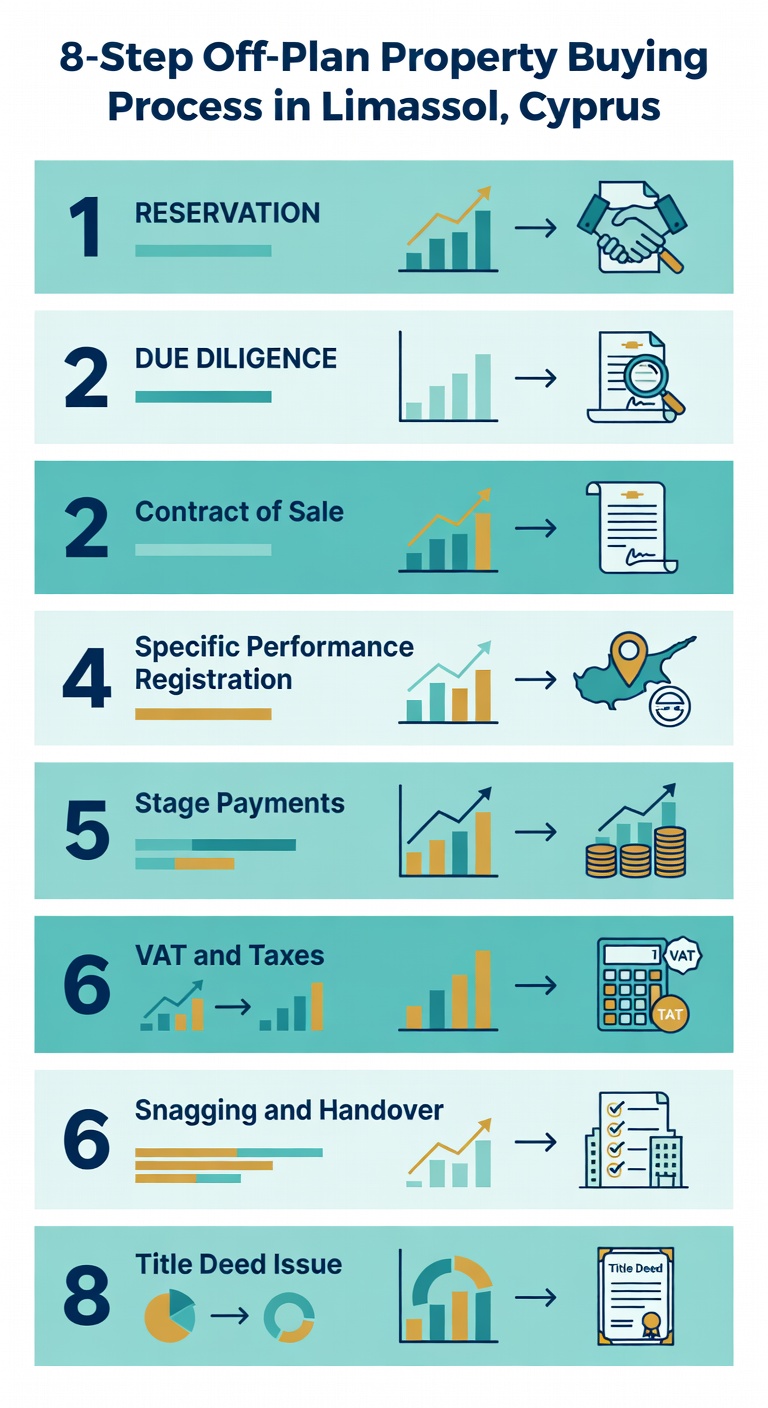
The 8-step off-plan buying process every Limassol buyer should follow before handover.
The Off-Plan Buying Process: Step by Step
Most new-build sales in Limassol are off-plan, meaning you commit before the building is finished. The process has eight steps and typically runs 18 to 36 months from reservation to handover.
Reservation. You sign a reservation form and pay a small deposit (typically €5,000 to €20,000) that holds the unit for 14 to 30 days. The reservation is refundable if your lawyer finds material issues during due diligence.
Due diligence. Your lawyer reviews the title, planning permit, building permit, contract draft and encumbrances. They check the developer’s company standing and any existing land mortgage. Expect 2 to 3 weeks for a thorough review.
Contract of sale. Once due diligence is clean, you sign the contract of sale. The standard first stage payment after signing is 25 to 35 percent of the purchase price, depending on construction stage.
Specific Performance registration. Your lawyer registers the signed contract at the Department of Lands and Surveys within six months. This is critical: it creates a legal claim to the property even before the title deed exists.
Stage payments. Subsequent payments are tied to construction milestones: completion of foundations, frame, weatherproofing, internal works and final delivery. Each stage is certified by the developer’s architect; demand independent verification on big-ticket purchases.
VAT and transfer fees. Cyprus charges 19 percent VAT on new builds, with a reduced 5 percent rate available for primary residences up to 130 m² (subject to current rules; verify with your lawyer at the time of purchase). Resale properties are VAT-exempt but pay transfer fees.
Snagging and handover. When the building is ready, a snagging inspection identifies defects. The developer fixes them, then issues the keys and the unit’s certificate of final approval.
Title deed issue. This is the slowest step. After the building is fully approved and all units are paid, the Department of Lands issues separate title deeds. Modern Limassol developers target 6 to 18 months; older industry averages were several years.
The leverage you have in this sequence is heavily front-loaded. The reservation and contract stage is when you can negotiate price, payment schedule, finishing upgrades and snagging terms. Once stage payments start, your bargaining position weakens significantly.
Costs, Contracts and Legal Protections
Beyond the headline price, every Limassol off-plan purchase carries a stack of additional costs. Budget for these from the outset:
VAT — 19 percent standard, or 5 percent reduced rate for qualifying primary residences.
Stamp duty — 0.15 percent on the first €170,000 and 0.20 percent on the balance, capped at €20,000 per contract.
Specific Performance registration fee — approximately €50 to €100 plus a small percentage of contract value.
Legal fees — typically 1.0 to 1.5 percent of purchase price for a competent property lawyer.
Mortgage arrangement fees (if financing) — commonly 0.5 to 1.0 percent of loan, plus valuation and life insurance costs.
Title transfer fees — payable when the title deed is finally issued, on a tiered scale (currently halved by government incentive on most transactions). For the latest rates, see our Cyprus property tax guide.
Connections and meters (electricity, water, internet) — typically €1,000 to €2,500 in total at handover.
The contract of sale is the document that protects you. Three clauses warrant special attention:
Penalty for late delivery. A standard clause requires the developer to compensate you (often around 0.5 to 1 percent of price per month delayed beyond the agreed completion date, sometimes capped). Without this, slippage is your problem, not theirs.
Specifications schedule. The contract should attach a detailed finishings list for flooring, kitchen, sanitary ware, windows, A/C by brand or equivalent, not vague language like “high-quality finishes”.
Defects liability period. Cyprus law gives buyers statutory rights, but a well-drafted contract will specify a 12-month snagging period and a longer structural warranty. Make sure both are present.
How to Compare Limassol Developer Projects on index.cy
The fastest way to build a credible shortlist is to compare projects rather than developers in the abstract. A developer with two excellent projects and one troubled one is common in Limassol; what matters is the specific project you are buying into.
Index.cy aggregates listings from most major Limassol developers and dozens of mid-sized and boutique groups. Three workflows make the comparison process efficient:
Browse new-build clusters. Start at complexes and projects in Limassol to see grouped, project-level pages. Each project page shows the developer, location, available unit mix, price range and delivery timeline.
Filter by zone and price. Use the Limassol for-sale search with zone filters (Marina, Neapolis, Germasogeia, Agios Tychonas, etc.) and a price band that matches your budget. Cross-check prices against the most expensive villas in Cyprus and the average-price insights to see where each project sits versus market.
Run an instant property report. Once you have shortlisted two or three units, generate an instant property report on each. The report aggregates comparable sales, location scoring and pricing benchmarks so you are not relying on the developer’s narrative alone.
If you are a developer rather than a buyer, our information for developers explains how project listings work and how to reach a qualified audience without paying commission.
Common Mistakes Buyers Make with Limassol Developers
A few patterns recur across deals that go wrong. None are exotic; they are the predictable result of skipping steps under time pressure.
Trusting the show flat. Show flats are typically built to a higher specification than the standard delivery. Insist on the exact written specifications schedule and inspect a completed unit, not the show flat.
Paying outside the contract. Any payment to the developer should be against an invoice referencing the contract and routed through the developer’s company account. Cash payments or off-contract “upgrades” are red flags.
Underestimating delivery slippage. Limassol projects routinely run 3 to 9 months late. Build a buffer into your moving plan, your bridging finance and your rental cover.
Ignoring the management company. The building’s common-area management company is usually a sister entity of the developer, and your service charges flow to it. Ask for the budget and the historical fee schedule before signing.
Buying without independent legal counsel. Some developers will recommend a lawyer. Use your own. The few thousand euros you save by sharing legal counsel can cost six figures if title or contract issues emerge.
A simpler safeguard sits underneath all of this: do not let the developer set the timeline for your decision-making. If the unit is right, it will still be right after your lawyer has done their work.
Frequently Asked Questions
Are property developers in Limassol regulated?
Construction and planning are regulated by the Limassol municipal town planning office and by the Cyprus government’s building regulations. Developers themselves are regulated as Cyprus companies (registered at the Department of Registrar of Companies) but are not required to hold a special “developer licence”. This makes individual due diligence important.
What is the typical deposit for an off-plan Limassol apartment?
A reservation deposit of €5,000 to €20,000 is typical, followed by 25 to 35 percent on signing the contract. Subsequent stage payments are tied to construction milestones.
Can I get a mortgage on an off-plan property in Limassol?
Yes. Most Cyprus banks lend against off-plan units, typically up to 70 percent loan-to-value for primary residences and 60 percent for second homes or investment property. The bank will draw down the loan in line with stage payments. See our Cyprus mortgage guide for current rates and eligibility.
How long does it take to get a title deed from a Limassol developer?
Modern, well-run Limassol developers target 6 to 18 months after building completion. Older projects across Cyprus historically took years and produced the well-known “trapped buyers” issue. Always ask for the developer’s last three projects’ actual deed timelines.
Should I buy off-plan or completed?
Off-plan offers the best entry pricing and unit selection but carries delivery and developer risk. Completed property is more expensive but eliminates timeline uncertainty and lets you inspect what you are actually buying. For first-time buyers, completed property is usually the safer starting point.
The Bottom Line on Property Developers in Limassol
The Limassol developer market in 2026 is mature, concentrated and varied. The strongest projects come from a small number of established groups; the value opportunities often come from disciplined mid-sized developers in less-saturated zones. Either way, the path to a confident purchase is the same: verify the company, inspect a completed project, register your contract, and use a marketplace like index.cy to keep your comparison neutral.
Start by browsing live complexes and projects in Limassol, shortlist two or three that match your budget and zone, and run an instant property report on each before you book a viewing. The hour you spend on that workflow is the highest-ROI hour you can spend on a Limassol property purchase.
We are not a Real Estate agency and do not operate as an Agency.
Cookie Consent
Cookie Consent. We use cookies to improve your experience, analyze traffic, and personalize content. By clicking "Accept," you consent to our use of cookies. Cookie PolicyPrivacy Statement
Functional
Always active
The technical storage or access is strictly necessary for the legitimate purpose of enabling the use of a specific service explicitly requested by the subscriber or user, or for the sole purpose of carrying out the transmission of a communication over an electronic communications network.
Preferences
The technical storage or access is necessary for the legitimate purpose of storing preferences that are not requested by the subscriber or user.
Statistics
The technical storage or access that is used exclusively for statistical purposes.The technical storage or access that is used exclusively for anonymous statistical purposes. Without a subpoena, voluntary compliance on the part of your Internet Service Provider, or additional records from a third party, information stored or retrieved for this purpose alone cannot usually be used to identify you.
Marketing
The technical storage or access is required to create user profiles to send advertising, or to track the user on a website or across several websites for similar marketing purposes.