
The cost of living in Cyprus is one of the first questions every expat, remote worker, and property investor asks before making the move. And for good reason — understanding your monthly expenses determines everything from which district you choose to whether buying or renting makes more financial sense.
Cyprus offers a unique proposition in the Mediterranean: a high quality of life at costs significantly lower than Western Europe, the UK, or Scandinavia. The island combines 340 days of sunshine, EU membership, English as a widely spoken language, and a tax system that actively attracts international residents.
In this guide, we break down the real cost of living in Cyprus for 2026 — backed by current data across all five districts. Whether you’re considering buying an apartment or renting while you explore, you’ll find the numbers you need to plan confidently.
The short answer: a single person can live comfortably in Cyprus on €1,200–€1,800 per month, depending on the district and lifestyle. A couple or small family should budget €2,000–€3,200. These figures include rent, food, transport, utilities, and basic leisure — but exclude school fees, major healthcare, or mortgage payments.
Compared to the UK, the cost of living in Cyprus is roughly 25–35% lower overall. Rent is the biggest savings driver: a two-bedroom apartment in Limassol costs about 40–50% less than a comparable flat in London. Groceries and dining out are similarly cheaper, while utilities and internet are comparable to European averages.
That said, costs vary dramatically between districts. Limassol — Cyprus’s most cosmopolitan city — is the most expensive. Nicosia and Larnaca offer the best value. Paphos sits in between, with a large expat community that has pushed certain costs slightly above average.
Rent is typically the single largest monthly expense for anyone living in Cyprus. Prices have risen steadily since 2023, driven by growing demand from international workers and investors. Here’s what you can expect to pay for a furnished two-bedroom apartment in each district as of early 2026.
| District | 2-Bed Apartment (City Centre) | 2-Bed Apartment (Outside Centre) | 1-Bed Apartment (City Centre) |
|---|---|---|---|
| Limassol | €1,100–€1,500/month | €750–€1,000/month | €800–€1,100/month |
| Nicosia | €650–€900/month | €450–€650/month | €500–€700/month |
| Paphos | €700–€1,000/month | €500–€750/month | €550–€800/month |
| Larnaca | €600–€850/month | €400–€600/month | €450–€650/month |
| Famagusta | €550–€800/month | €350–€550/month | €400–€600/month |
Limassol commands the highest rents because of its waterfront position, tech-sector employers, and international demand. If you’re searching for better value without sacrificing coastal living, Larnaca is worth serious consideration — rents are 30–40% lower with a similar Mediterranean lifestyle.
Keep in mind that these are averages. A newly built apartment near the Limassol marina will cost significantly more than an older unit on the outskirts. For those willing to commit long-term, buying property in Cyprus as a foreigner often works out cheaper than renting after 5–7 years.
Groceries in Cyprus are affordable by European standards, especially if you shop at local supermarkets like Alphamega, Papantoniou, or Lidl. A single person should budget €250–€400 per month for groceries, depending on dietary preferences and cooking habits.
Here’s a sample of common grocery prices in Cyprus in 2026:
Dining out is one of Cyprus’s great advantages. A meal at a mid-range restaurant costs €12–€20 per person, while a traditional taverna lunch — think grilled halloumi, souvlaki, and salad — runs €8–€14. A couple eating out twice a week at mid-range restaurants would spend roughly €200–€350 per month.
Local produce is excellent and affordable, particularly during growing season (April–October). Imported specialty items — think certain Asian ingredients or premium European cheeses — cost more, similar to other small island economies.
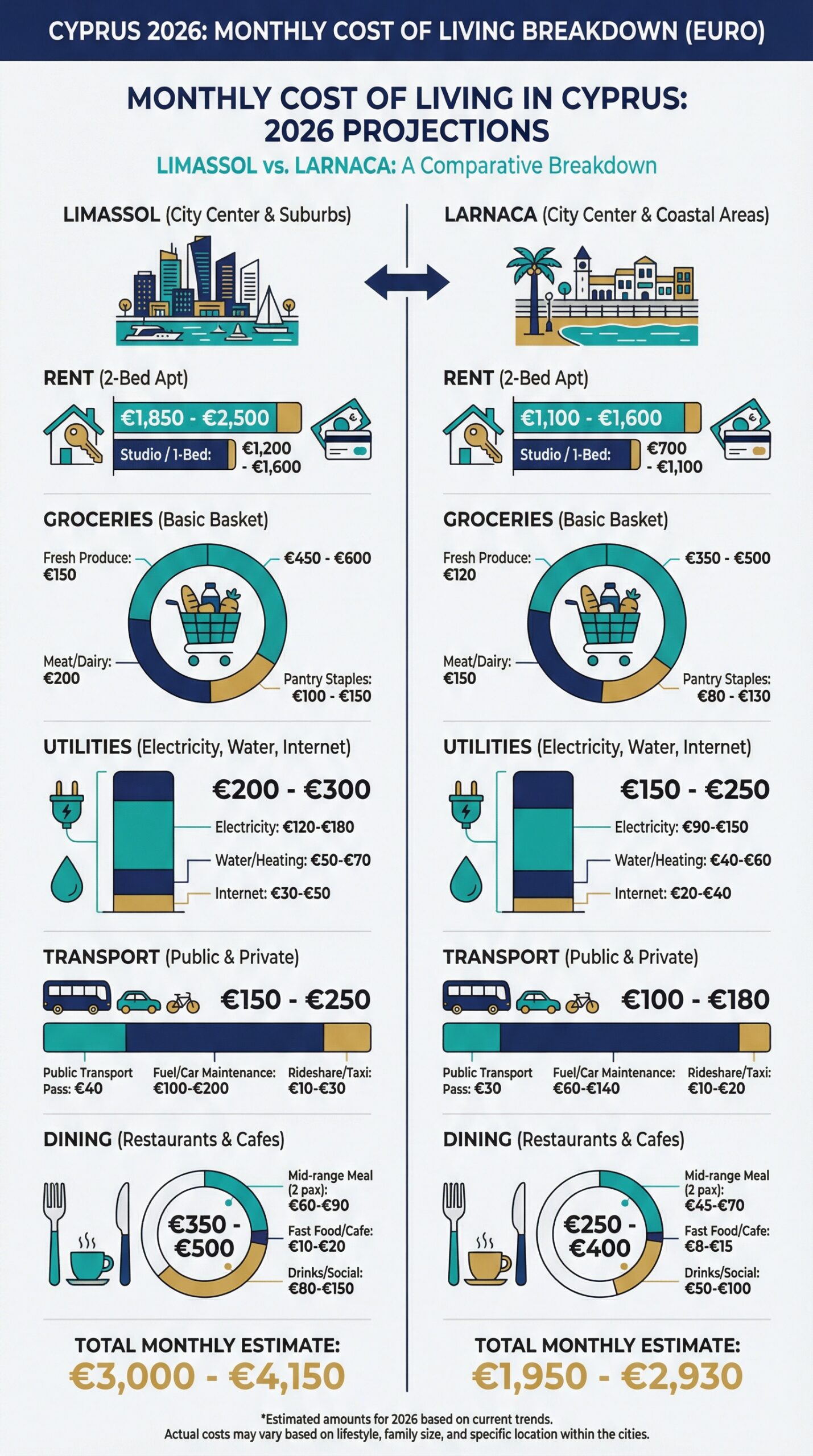
Utilities in Cyprus are moderate, though electricity can be a notable expense during summer months when air conditioning becomes essential. Here’s what a typical two-bedroom apartment costs monthly:
| Utility | Monthly Cost (2-Bed Apartment) | Notes |
|---|---|---|
| Electricity | €80–€180 | Higher in summer (A/C); lower with solar panels |
| Water | €20–€35 | Government-regulated rates |
| Internet (fibre) | €30–€50 | 100–500 Mbps widely available |
| Mobile phone | €15–€35 | Major providers: Cyta, Epic, PrimeTel |
| Gas (cooking) | €15–€25 | Bottled gas is standard |
The biggest variable is electricity. Cyprus has some of the highest electricity rates in the EU, driven by oil-based generation. However, the government has been expanding solar subsidies, and many newer buildings — particularly in Limassol complexes and modern developments — include rooftop solar panels that significantly reduce bills.
Internet infrastructure has improved dramatically. Most urban areas now have access to fibre connections at speeds between 100 and 500 Mbps, making Cyprus increasingly attractive for remote workers. Rural areas may still rely on slower DSL, so check connectivity before committing to a property outside city limits.
Cyprus is fundamentally a car-dependent island. Public transport exists — primarily intercity buses and limited local routes — but most residents, especially expats, rely on private vehicles. Understanding transport costs is essential when budgeting your cost of living in Cyprus.
A household with one car should budget €200–€400 per month for fuel, insurance, maintenance, and road tax combined. If you live and work in the same city, this drops closer to €150–€250.
One important consideration for property buyers: proximity to your workplace and amenities directly impacts transport costs. A slightly more expensive apartment near the city centre may actually save you money versus a cheaper property on the outskirts that requires daily driving. Our instant property report can help you evaluate location trade-offs before making a decision.
Hearing from people who have already made the move can put these numbers into real-world perspective. This video offers a firsthand look at what daily life costs in Cyprus from an expat’s point of view.
Cyprus operates a public healthcare system called GESY (GHS — General Healthcare System), introduced in 2019. All legal residents who contribute to social insurance are eligible. GESY covers GP visits, specialist consultations, hospital care, prescriptions, and some dental services.
The system is funded through payroll contributions: employees pay 2.65% of their salary, employers contribute 2.90%, and self-employed individuals pay 4.00%. For retirees living on a pension, the contribution rate is 2.65% of pension income.
Many expats supplement GESY with private health insurance for faster access to specialists and private hospital facilities. Private insurance plans typically cost €600–€1,500 per year for an individual, depending on age and coverage level. Comprehensive family plans range from €2,000–€4,500.
Overall, healthcare costs in Cyprus are reasonable compared to the US, UK, or Western Europe — and the quality of care at private hospitals in Limassol and Nicosia is generally considered high.
Choosing the right district is arguably the most impactful financial decision you’ll make when moving to Cyprus. Here’s a practical comparison of monthly costs for a couple renting a two-bedroom apartment, including all major categories.
| Category | Limassol | Nicosia | Paphos | Larnaca | Famagusta |
|---|---|---|---|---|---|
| Rent (2-bed, centre) | €1,300 | €775 | €850 | €725 | €675 |
| Groceries | €550 | €500 | €500 | €480 | €460 |
| Utilities | €150 | €140 | €135 | €130 | €125 |
| Transport | €300 | €280 | €260 | €250 | €240 |
| Dining & Leisure | €400 | €300 | €320 | €280 | €250 |
| Total (couple) | €2,700 | €1,995 | €2,065 | €1,865 | €1,750 |
Limassol is the priciest district, driven largely by premium rent. However, it also offers the highest concentration of international companies, restaurants, and beach lifestyle. Browse Limassol properties if you’re considering buying to reduce your long-term housing costs.
Nicosia is the capital and offers the best value for city living, with rents 35–40% below Limassol. It’s ideal for those working in government, finance, or professional services. See our Nicosia property market analysis for the latest trends.
Paphos is the expat favourite, with a large British and European community. Costs sit between Limassol and Nicosia. The district offers excellent value for villa buyers — check Paphos listings to see current availability.
Larnaca offers coastal living at significantly lower costs. With a €1.2 billion port and marina redevelopment underway, it’s emerging as a smart investment destination. Read our Larnaca market overview for a deeper look.
Famagusta — specifically the Paralimni and Protaras area — is the most affordable district. It’s popular with retirees and seasonal residents who want beach access without premium prices. Explore Famagusta properties to see what’s on the market.
One of the most important financial decisions for anyone moving to Cyprus is whether to rent or buy. The answer depends on your timeline, residency plans, and upfront capital.
If you plan to stay in Cyprus for fewer than 5 years, renting is usually the better financial choice. Transaction costs for buying property — including transfer fees, stamp duty, and legal fees — total approximately 5–8% of the purchase price. These costs need time to amortise before buying becomes cheaper than renting.
For longer stays, buying almost always wins. Consider a two-bedroom apartment in Larnaca at €150,000. Monthly mortgage payments (at current rates around 3.5–4.5%) would be approximately €700–€800 — comparable to rent, but you’re building equity. After 5–7 years, total cost of ownership drops below the cumulative cost of renting.
Cyprus also offers a significant advantage for property buyers from non-EU countries: purchasing property worth €300,000+ qualifies you for a permanent residency permit. This makes buying a dual-purpose decision — both a financial investment and an immigration strategy.
For a comprehensive breakdown of taxes, fees, and the buying process, read our complete guide to Cyprus property taxes and legalities.
The cost of living in Cyprus in 2026 remains competitive by European standards. A single person can live well on €1,500 per month outside Limassol, while a couple should budget €2,000–€2,700 depending on district and lifestyle. Compared to the UK, most expats report saving 25–35% on their overall monthly expenses.
The key variables are rent (or mortgage), district choice, and whether you drive. Get these three decisions right, and Cyprus offers an exceptional quality-to-cost ratio — sunshine, Mediterranean food, safe communities, and a growing economy.
Ready to explore your options? Browse apartments for sale across Cyprus or use our instant property report to evaluate any listing before you commit. Whether you’re buying or renting, having the data makes all the difference.