What this guide covers
- What the Limassol House Market Actually Looks Like in 2026
- Limassol House Prices in 2026 by Neighborhood
- Best Limassol Neighborhoods to Buy a House
- Agios Athanasios — For Year-Round Family Life
- Germasogeia & Potamos Germasogeias — For Walk-to-Beach Living
- Mouttagiaka — For Families with Schools
- Ypsonas & Kolossi — For Value and Space
- Souni & Pyrgos — For Sea Views at Hillside Prices
- Agios Tychonas & Amathus — For Prestige and Capital Preservation
- The 7-Step Process to Buy a House in Limassol
- Costs, Taxes & Fees on a Limassol House Purchase
- Financing a Limassol House Purchase
- New Builds vs Resale Houses in Limassol
- Rental Yield & Investment Case for Limassol Houses
- The Bottom Line on Buying a House in Limassol
Limassol is the most expensive — and the most competitive — house market in Cyprus. If you are looking at houses for sale in Limassol in 2026, you are shopping in a district where detached-house prices have risen every year since 2019, where an average family home now trades above €430,000, and where the seafront strip from the Old Port to Amathus commands price-per-square-meter premiums that rival small European capitals. This guide explains what your money actually buys in each Limassol neighborhood today, how the buying process works, what fees and taxes to budget for, and where expats and investors typically end up.
The numbers and ranges here are grounded in live listings on index.cy, Cyprus’ #1 property marketplace, and in the latest published data from the Cyprus Statistical Service (CyStat) and the Central Bank of Cyprus Residential Property Price Index. Where relevant, we link straight to the filtered houses for sale in Cyprus and Limassol properties for sale pages so you can move from reading to shortlisting in a single click.
What the Limassol House Market Actually Looks Like in 2026
“Limassol” on a listing site is a district, not a single town. The Limassol district stretches along 60km of southern coastline from Pissouri in the west to Governor’s Beach in the east, and inland through wine-country villages to the Troodos foothills. When you filter for houses for sale in Limassol, you are looking at detached stock across at least fifteen distinct micro-markets, each with its own buyer profile, price point, and lifestyle trade-off.
The Limassol house market breaks down into four broad zones:
- Seafront & Tourist Area — Germasogeia Tourist Area, Agios Tychonas, Amathus, Potamos Germasogeias. Premium prices, holiday-rental demand, marina access.
- Urban & Suburban — Agios Athanasios, Mesa Geitonia, Zakaki, Mouttagiaka. Family houses, walking access to schools and amenities.
- Affordable West & North — Ypsonas, Kolossi, Erimi, Trachoni, Kato Polemidia. Newer detached stock at 25–40% lower prices than the seafront.
- Hillside & Village — Souni, Pyrgos, Parekklisia, Finikaria, Foini. Larger plots, cooler summers, rural feel, often with sea views.
Most 2026 listings described as a “house” in Limassol are detached properties of 150–400 sqm on plots of 250–1,200 sqm, with three to five bedrooms and — almost always — a private garden. Roughly 60% have a private pool. Anything smaller or attached typically sits in the apartment, maisonette, or townhouse category. Anything above 500 sqm on a plot larger than 1,500 sqm is generally marketed as a villa — covered separately in our villas for sale in Cyprus guide.
For a broader market-level view across all property types, our property for sale in Limassol guide covers apartments and commercial alongside houses.
Limassol House Prices in 2026 by Neighborhood
Detached-house prices in Limassol rose roughly 7–9% year-on-year through 2025 and into the first quarter of 2026, according to the Central Bank of Cyprus Residential Property Price Index. The pace has moderated compared to the 12%+ peaks of 2022–2023, but Limassol still leads every other Cyprus district in both transaction volume and price growth. CyStat transaction data shows roughly 1,200 house sales closed in the Limassol district in 2024 — more than Paphos, Larnaca, and Famagusta combined.
The table below summarises typical asking prices for 3–4 bedroom detached houses — the most searched segment of the Limassol house market — grouped by neighborhood.
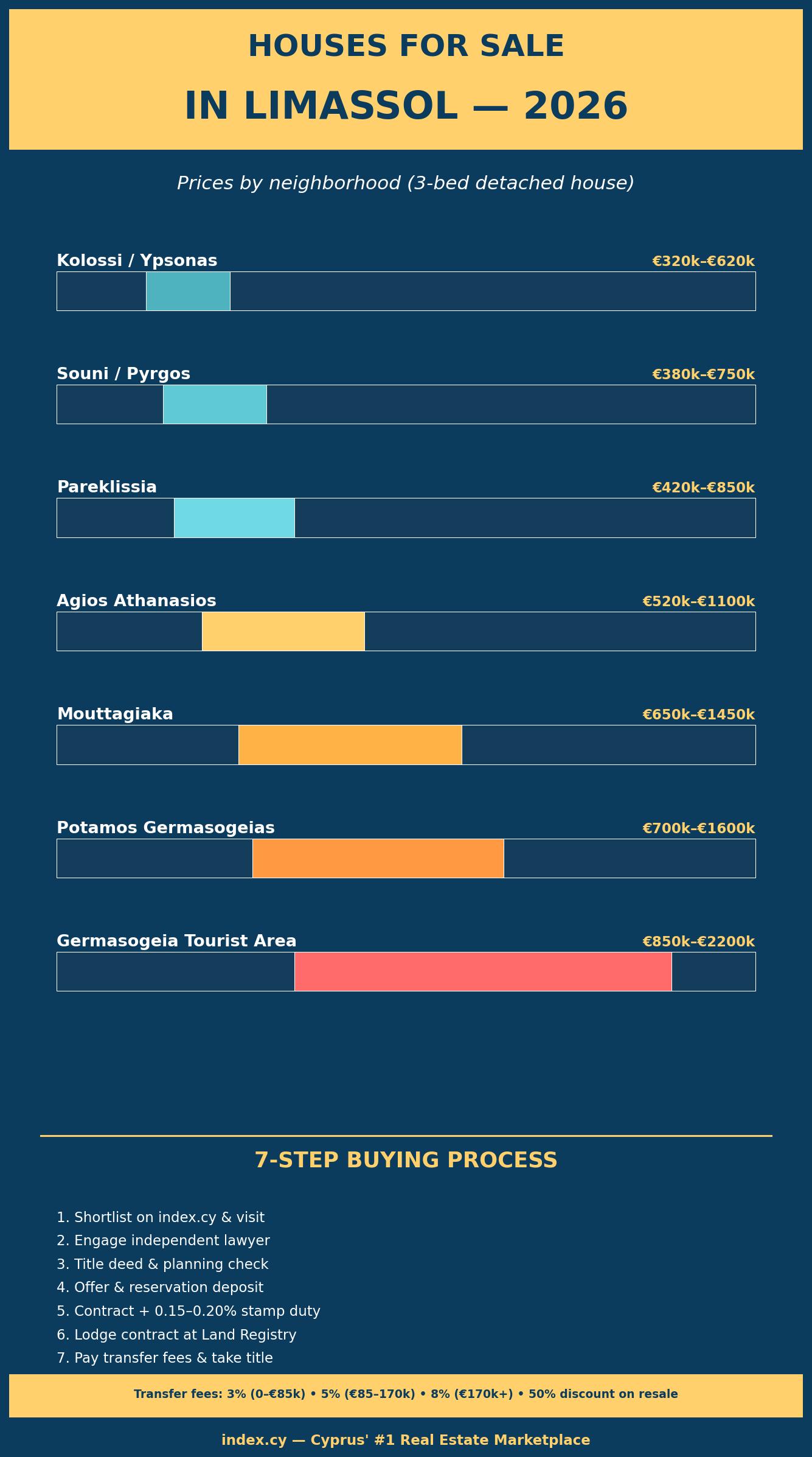
| Limassol neighborhood | Typical house price (EUR, 3–4 bed) | Price per sqm (EUR) | Buyer profile |
|---|---|---|---|
| Germasogeia Tourist Area | €850,000 – €2,200,000 | €4,800 – €7,500 | Luxury buyers, marina access |
| Agios Tychonas / Amathus | €900,000 – €3,000,000+ | €5,000 – €8,500 | Premium, branded residences |
| Potamos Germasogeias | €700,000 – €1,600,000 | €4,200 – €6,200 | Expat families, walk-to-beach |
| Mouttagiaka | €650,000 – €1,450,000 | €3,800 – €5,500 | Family buyers, good schools |
| Agios Athanasios | €520,000 – €1,100,000 | €3,000 – €4,400 | Locals + expats, central |
| Mesa Geitonia / Zakaki | €500,000 – €1,000,000 | €2,900 – €4,200 | Investors, rental yield |
| Parekklisia | €420,000 – €850,000 | €2,600 – €3,800 | Value buyers, newer stock |
| Souni / Pyrgos (hillside) | €380,000 – €750,000 | €2,400 – €3,500 | Sea-view hunters, retirees |
| Ypsonas / Kolossi (west) | €320,000 – €620,000 | €2,000 – €3,000 | Budget buyers, first-time |
These ranges reflect asking prices on current listings, not final transaction prices. Based on recent sold comparables, resale Limassol houses tend to close 3–6% below the asking price, while new builds typically sell at 0–2% below asking in hot neighborhoods. For live data, see our insights on the average price of a house in Limassol and price per sqm for houses in Limassol.
Best Limassol Neighborhoods to Buy a House
The “best” Limassol neighborhood depends entirely on whether you want a year-round family home, a holiday residence, or a yielding investment. Below are the six Limassol neighborhoods that capture the largest share of house enquiries on the marketplace in 2026 — with what each is actually good at.
Agios Athanasios — For Year-Round Family Life
Agios Athanasios is the Limassol neighborhood most associated with long-term expat and Cypriot family residence. You get walking access to English-medium private schools (Foley’s, ISL), a strong mix of retail and services along Makariou Avenue, and a detached-house stock that skews newer than central Limassol. A 3-bedroom house on a 400 sqm plot typically trades between €550,000 and €850,000 here, depending on age and proximity to the motorway interchange.
Germasogeia & Potamos Germasogeias — For Walk-to-Beach Living
The Germasogeia corridor — particularly Potamos Germasogeias and the lower parts of Germasogeia — is where expats who want to walk to the beach but not live inside the tourist strip actually end up. Detached houses here typically cost 20–30% more than in Agios Athanasios but carry stronger long-term capital growth and the option of short-term holiday rentals during April–October.
Mouttagiaka — For Families with Schools
Mouttagiaka sits between Amathus and Agios Tychonas and has become the default choice for international families relocating to Limassol. The neighborhood is close to The American Academy Limassol and The English School of Kyrenia, the plots are generous (typically 500–900 sqm), and the housing stock is predominantly 2000s-to-new-build. Expect €650,000 to €1.45 million for a 3–4 bedroom detached house with pool.
Ypsonas & Kolossi — For Value and Space
If price per square meter matters more than beach proximity, the western suburbs are where you will get the most house for the money. Ypsonas and Kolossi deliver new or near-new 3-bedroom detached houses on 400–600 sqm plots for €320,000 to €620,000 — roughly half the price of equivalent stock in Germasogeia. The trade-off is a 15–20 minute drive to the seafront. You can also compare against the broader cheap houses and villas for sale in Cyprus inventory.
Souni & Pyrgos — For Sea Views at Hillside Prices
Hillside Limassol — Souni, Pyrgos, Parekklisia, Finikaria — offers the best sea-view-per-euro ratio in the district. A 3-bedroom detached house with a clear Mediterranean view from Souni typically costs €450,000 to €750,000, roughly 40% less than an equivalent view in Agios Tychonas. The trade-off is a 10–15 minute drive to the coastal amenities and a cooler micro-climate that buyers either love or find inconvenient in winter.
Agios Tychonas & Amathus — For Prestige and Capital Preservation
The Amathus strip east of the Four Seasons is the premium end of the Limassol house market. Budgets start around €900,000 for a modest detached house and routinely exceed €3 million for branded-residence-adjacent villas with private beach access. This is the segment attracting Middle Eastern, Israeli, and Western European capital into Limassol complexes and projects. Expect limited inventory, long selling cycles, and the strongest capital-preservation story in Cyprus.
The 7-Step Process to Buy a House in Limassol
Buying a house in Limassol is a straightforward legal process provided you engage an independent lawyer early. The same seven steps apply whether you are a Cypriot citizen, an EU buyer, or a non-EU foreign buyer — the only non-EU-specific addition is an Interior Ministry permit that is approved as a formality in almost every case.
- Shortlist and visit. Build a shortlist from [properties for sale in Limassol](https://index.cy/for-sale/limassol/), filter by budget and neighborhood, and visit 6–10 houses over 2–3 days.
- Engage an independent Cyprus property lawyer. Do not use the seller’s or developer’s lawyer. Expect fees of 1.0–1.5% of the purchase price plus VAT.
- Commission an inspection and valuation. A [property inspection service](https://index.cy/inspection/) and an [instant property report](https://index.cy/report/) should happen before you sign anything.
- Due diligence on title, planning, and encumbrances. Your lawyer runs a Land Registry search, confirms the title deed status, checks planning and building permits, and verifies the property is free of encumbrances. Read our [due diligence guide](https://index.cy/articles/a-comprehensive-guide-to-due-diligence-when-buying-property-in-cyprus) before this step.
- Offer and reservation deposit. A reservation deposit (typically €5,000–€20,000) takes the house off the market for 2–4 weeks while contracts are prepared.
- Contract signing and stamp duty. Sign the sale contract, pay 0.15% stamp duty on the first €170,000 and 0.20% above that, and lodge the contract at the Land Registry for specific performance.
- Completion and title transfer. Pay the balance, pay transfer fees (3/5/8% tiered, with a 50% discount on resale), and receive the title deed — typically 2–6 weeks after contract signing for a resale, longer for off-plan.
Total timeline from accepted offer to title transfer: typically 6–12 weeks for a resale, 12–24 months for an off-plan purchase with staged payments. Our taxes and legalities guide covers every fee and deadline in detail.
Costs, Taxes & Fees on a Limassol House Purchase
Budget between 5% and 10% of the purchase price for fees, taxes, and closing costs on a Limassol house, on top of the purchase price itself. The main line items are transfer fees, stamp duty, VAT (on new builds only), legal fees, and inspection. Annual carrying costs — municipal tax, sewerage, and communal fees if applicable — are typically €600–€1,800 per year for a detached Limassol house.
| Fee / tax | Amount | When paid | Notes |
|---|---|---|---|
| Transfer fees | 3% up to €85k; 5% €85k–€170k; 8% above | At title transfer | 50% discount on resale; 0% if VAT-rated new build |
| Stamp duty | 0.15% first €170k; 0.20% above | At contract signing | Capped at €20,000 |
| VAT | 19% (reduced 5% on primary residence up to 130 sqm) | On new builds only | Reduced rate has conditions since 2023 |
| Legal fees | 1.0–1.5% + VAT | Staged through process | Use an independent Cyprus lawyer |
| Inspection & valuation | €300 – €900 | Before signing | Non-negotiable quality gate |
| Annual municipal tax | €100 – €500 | Once per year | Set by Limassol municipality |
A worked example: on a €750,000 resale house in Mouttagiaka, expect roughly €15,000–€20,000 in transfer fees (after the resale discount), €1,200 in stamp duty, €9,000–€12,000 in legal fees, €500–€900 in inspection and valuation, and negligible VAT. Total closing costs: roughly €25,000–€35,000, or 3.5–4.5% of the purchase price.
Financing a Limassol House Purchase
Cyprus banks actively lend to both local and foreign buyers on Limassol houses, with Bank of Cyprus, Hellenic Bank, Eurobank Cyprus, and Alpha Bank Cyprus the most active mortgage lenders in the district in 2026. Typical 2026 terms, based on our Cyprus mortgage guide:
- LTV: up to 80% for Cypriot and EU residents, 60–70% for non-EU foreign buyers, 50% for second homes.
- Interest rates: 3.5–5.0% variable (indexed to Euribor + margin); 4.0–5.5% fixed for 3–5 years.
- Term: up to 30 years for owner-occupiers, 20–25 years for investors, with full repayment typically required by age 70.
- Income requirement: minimum stated monthly income of €3,000–€4,000 for a €500,000 purchase, with debt-service-to-income capped at roughly 35%.
- Documentation: 6 months of bank statements, 2 years of tax returns or payslips, proof of down-payment funds, and a valuation from a bank-approved surveyor.
For expat buyers, the practical path is to pre-qualify with two or three Cyprus banks before you make offers. Limassol’s housing market moves quickly in the €500k–€1.2M segment, and sellers routinely prefer buyers with a written mortgage approval over those relying on overseas financing. Also see our financing your property purchase in Cyprus guide for the full breakdown.
For a current local-broker perspective on how the Limassol market has been shifting over the last 18 months, this overview is a useful primer before you start shortlisting:
New Builds vs Resale Houses in Limassol
Limassol has the deepest new-build pipeline of any Cyprus district. New detached-house projects come online every quarter across Parekklisia, Mouttagiaka, Agios Athanasios, Ypsonas, and the hillside villages, and branded-residence schemes dominate the Amathus strip. The decision between new build and resale comes down to three factors: title deed status, VAT exposure, and how long you are willing to wait.
- Title deeds: resale houses almost always have a separate title deed in the seller’s name. New builds issue title deeds only after completion and final Land Registry inspection — typically 6–24 months after you take possession. Until then, you own a contractual claim lodged at the Land Registry, not a registered title.
- VAT: new-build houses carry 19% VAT (reduced to 5% on the first 130 sqm of a primary residence, subject to income and occupation conditions). Resale houses are VAT-exempt but pay full transfer fees.
- Timeline: resale houses close in 6–12 weeks. Off-plan houses are typically delivered 12–24 months after contract, with staged payments through construction.
For most buyers with a 6-month time horizon, a resale house in Agios Athanasios or Mouttagiaka is the simpler path. For buyers with a 12–24 month horizon who want modern layouts, energy efficiency, and a clean building history, new builds in Limassol complexes and projects are the stronger bet. Always verify developer track record and lodge your contract at the Land Registry immediately after signing.
Rental Yield & Investment Case for Limassol Houses
Houses are not the highest-yielding segment of the Limassol market — that distinction belongs to central apartments and studios — but detached houses in the right Limassol neighborhoods still produce respectable long-term yields with stronger capital growth.
- Long-term lets: a 3-bedroom detached house in Mesa Geitonia or Zakaki typically rents for €1,800–€2,600 per month, producing gross yields of 4.0–5.0% on purchase price.
- Holiday lets: a walk-to-beach house in the Germasogeia corridor with a pool can gross €150–€300 per night in peak season, with annual gross yields of 5–7% after typical 180–220 occupied-night counts.
- Capital growth: Limassol leads every other Cyprus district on house price appreciation. Central Bank data shows compound annual growth of 7–8% for Limassol detached houses since 2019.
- Premium strip: Amathus / Agios Tychonas yields are lower (3.0–4.0% gross) but capital preservation is stronger, and high-end buyers pay cash or at 50% LTV, which protects prices in a rate-tightening cycle.
For a deeper look at Limassol investment strategy, including apartment versus house returns and the seasonal dynamics of short-term rentals, see our apartment investment in Limassol guide and our Airbnb Cyprus guide. Cross-reference your financing with our Cyprus mortgage guide to stress-test the yield assumptions above against your actual cost of capital.
The Bottom Line on Buying a House in Limassol
Limassol is a liquid, moderately growing, well-regulated house market heading into mid-2026. The risks are the same as anywhere else in Cyprus — title deed status, developer reliability, mortgage affordability, realistic rental expectations — and they are all manageable with the right due diligence. What Limassol specifically offers is depth of inventory across every price point from €320,000 western-suburbs houses to €3 million+ seafront branded residences.
If you only do three things before buying a Limassol house, do these:
- Run an official Land Registry title search and confirm the house has — or has a credible contractual path to — a separate title deed.
- Commission an independent inspection and an instant valuation report before you submit any offer.
- Engage your own Cyprus property lawyer who does not represent the seller, the developer, or the estate agent.
Ready to shortlist? Browse current houses for sale in Limassol inventory, filter by neighborhood and budget, and use the instant property report on any house you are seriously considering. Institutional partners can see information for agencies and information for developers for partnership programs.
For broader market context, the Central Bank of Cyprus Residential Property Price Index and the Cyprus Statistical Service (CyStat) both publish quarterly data on Limassol residential pricing. Both confirm what the listings show: Limassol is the most liquid and consistently appreciating house market in Cyprus in 2026.
More about Limassol
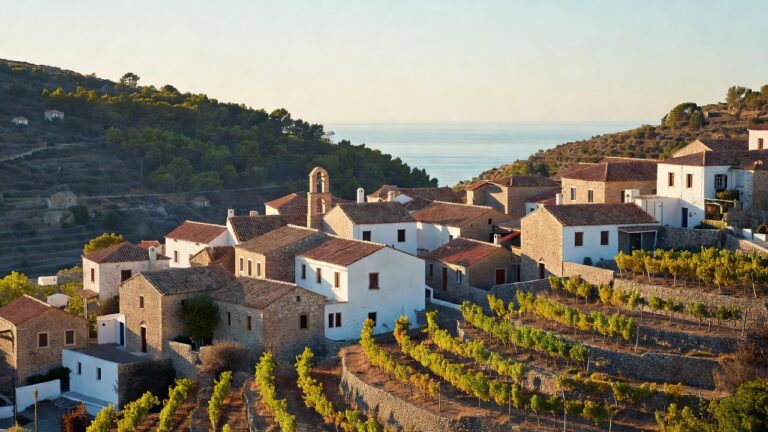
We analysed 217 Erimi, Limassol listings: 105 apartments, 81 houses and 24 plots. Median 2-bed flat EUR295,000. See prices, the repeat-advert trap…
We analysed 48 Kalo Chorio, Limassol listings: 33 plots, 11 houses and 4 rentals. Large plots start near EUR4 per sqm. See…
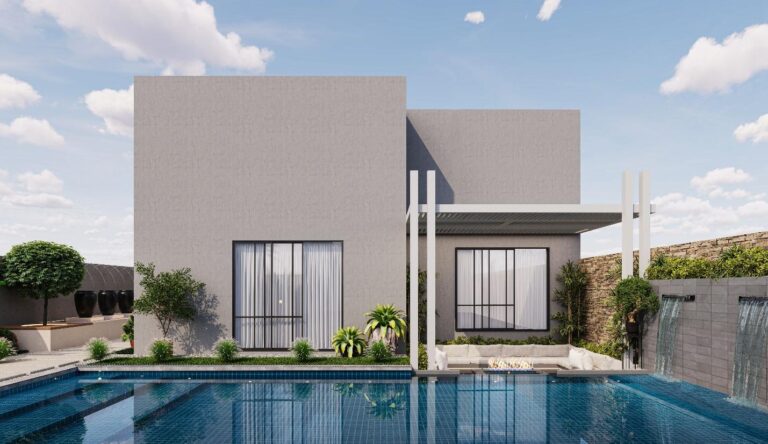
Five companies that design modern villas in Limassol — what each of them covers, and the questions worth settling before you sign…
Keep reading

We analysed 249 Kouklia, Paphos listings: 210 houses, 20 plots and 6 apartments. Median 2-bed house asks EUR397,000. See prices, plots and…
We analysed 217 Erimi, Limassol listings: 105 apartments, 81 houses and 24 plots. Median 2-bed flat EUR295,000. See prices, the repeat-advert trap…
We analysed 319 Aglantzia, Nicosia listings: 155 apartments, 34 houses and 38 plots. Median 2-bed costs EUR257,500. See prices, rents and what…