What this guide covers
- Why Are So Many Expats Living in Cyprus?
- The Real Cost of Living in Cyprus (2026)
- Where Do Expats Actually Live? The 5 Districts Compared
- Limassol — The Business and Russian-Speaking Hub
- Paphos — The Retiree and UK Expat Capital
- Nicosia — The Capital and Young Professional Hub
- Larnaca — The Value Play
- Famagusta — Emerging and Affordable
- Tax Benefits of Living in Cyprus (What’s Actually True)
- Property: Rent First or Buy Your Home?
- Healthcare, Schools, and Day-to-Day Infrastructure
- The Honest Disadvantages of Living in Cyprus
- How to Establish Residency in Cyprus
- Quality of Life: What Daily Life Actually Looks Like
- Is Living in Cyprus Right for You?
Living in Cyprus is no longer a niche choice. Since 2020, the island has quietly become one of Europe’s most active expat destinations — drawing UK retirees, Israeli entrepreneurs, Russian-speaking tech workers, and a steady stream of remote professionals from across Europe. Roughly 20% of Cyprus’ 1.3 million residents now hold a foreign passport, and in property-heavy districts like Paphos that figure climbs past 30%.
But the honest picture is more nuanced than the “350 days of sunshine, low taxes” version you read on most relocation sites. Living in Cyprus delivers a genuinely high quality of life for the right person — it also comes with real tradeoffs around infrastructure, summer heat, and the quirks of a small-island economy. This guide gives you both sides: verified 2026 numbers on costs, districts, taxes, property, and healthcare, plus the drawbacks expats actually complain about.
Whether you’re scouting your first visit or already drafting resignation emails, you’ll leave this guide knowing what life on the island realistically looks like and how to price your move.
Why Are So Many Expats Living in Cyprus?
Cyprus is small — about the size of Connecticut — but its appeal stacks up fast for anyone comparing European relocation options.
The climate does more work than people admit. Cyprus averages 340+ sunny days per year. Winters are mild (12–18°C daytime in coastal districts), summers are hot but dry, and swimmable sea temperatures run from May through November. For expats leaving grey northern Europe, the mood shift is immediate and measurable.
English is everywhere. As a former British colony, English is the default second language for government, banking, legal, and medical services. Most property contracts are issued in English, and Cyprus law permits officially sworn English translations for nearly every process an expat will encounter.
The tax framework favours mobile workers. Cyprus’ non-domicile (non-dom) tax regime exempts foreign dividends, interest, and capital gains from Cypriot tax for 17 years. Combined with one of Europe’s lower corporate tax rates (12.5%) and no inheritance tax, the island has become a genuine destination for remote entrepreneurs, not just retirees.
The community is larger than you expect. Paphos has a visible British community of 20,000+. Limassol has grown into Cyprus’ Russian-speaking and Israeli hub. Nicosia draws a younger professional mix tied to international companies and embassies. Whatever your profile, there’s usually a community already in place.
Safety and healthcare rank well. Cyprus consistently places in the top 10 safest countries in Europe by reported crime. The GESY public healthcare system, launched in 2019 and fully operational since 2020, now covers residents at a flat percentage of income.
The Real Cost of Living in Cyprus (2026)
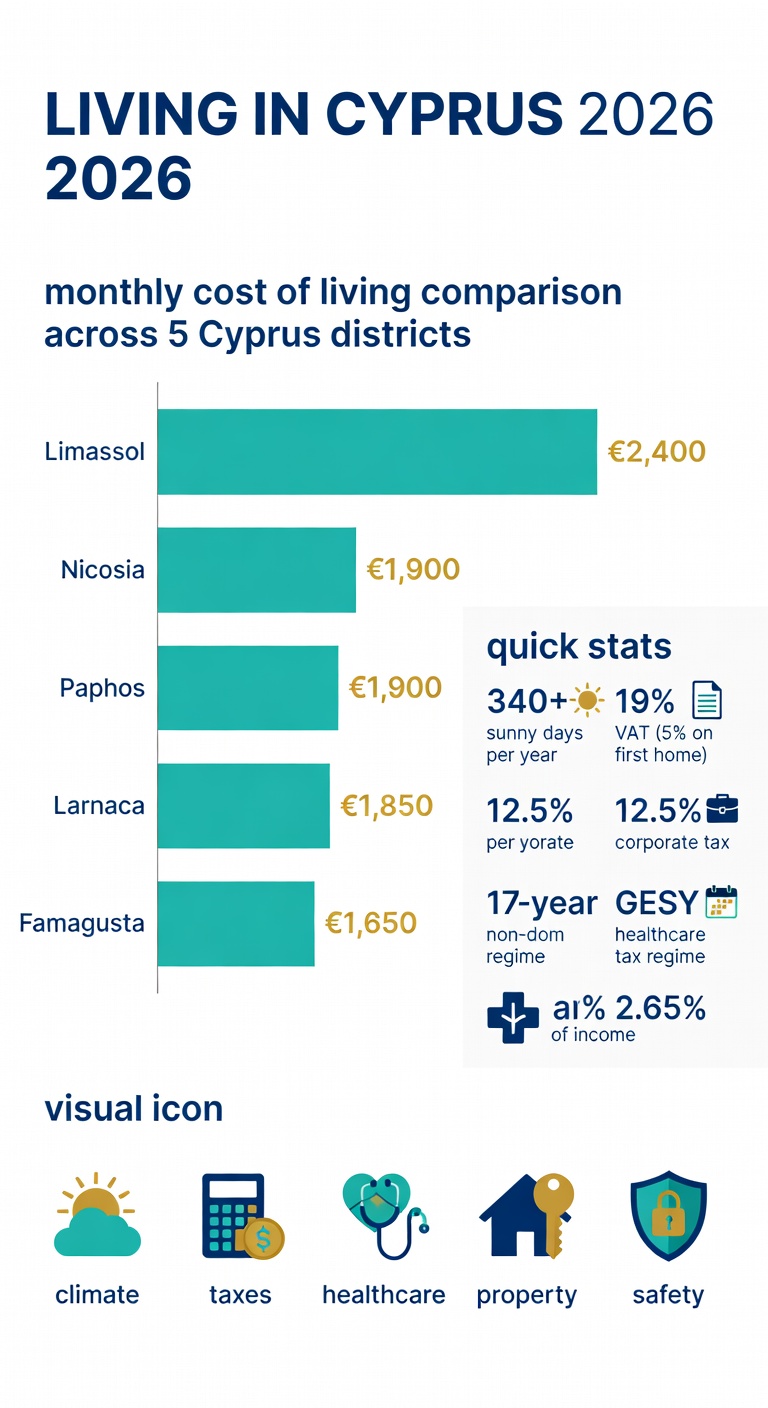
Cost is where most relocation planning goes sideways — either because expats underestimate district differences or they budget from a holiday’s worth of data. Here’s the realistic picture using index.cy listing data and 2026 market rates.
| Expense | Limassol | Nicosia | Paphos | Larnaca | Famagusta |
|---|---|---|---|---|---|
| 1-bed apartment rent (central) | €1,100 | €750 | €800 | €750 | €650 |
| 2-bed apartment rent (central) | €1,650 | €1,050 | €1,150 | €1,050 | €900 |
| Utilities (2-bed, monthly) | €180 | €160 | €150 | €160 | €150 |
| Groceries (couple, monthly) | €650 | €600 | €580 | €580 | €550 |
| Meal out (mid-range, for 2) | €60 | €50 | €45 | €50 | €40 |
| Petrol (per litre) | €1.55 | €1.55 | €1.55 | €1.55 | €1.55 |
| Public transport (monthly) | €40 | €40 | €40 | €40 | €40 |
| GESY healthcare (monthly, employee avg) | €100–€180 | €100–€180 | €100–€180 | €100–€180 | €100–€180 |
A realistic monthly budget for a couple living comfortably in Cyprus — rent, utilities, groceries, eating out 2–3 times a week, a car, and healthcare — sits around €2,200–€2,800 in Limassol and €1,700–€2,200 in Paphos, Larnaca, or Nicosia. Single professionals can do it for €1,400–€1,800 outside Limassol.
For the full breakdown of pre-move budgeting, our cost of living in Cyprus guide walks through each category with additional context on seasonal variation and one-off setup costs.
Where Do Expats Actually Live? The 5 Districts Compared
Cyprus has five administrative districts, each with a distinctly different expat profile. Choosing the right one is the single biggest decision you’ll make after deciding to move.
Limassol — The Business and Russian-Speaking Hub
Limassol is Cyprus’ most international city and its economic engine. Home to the country’s largest port, the financial services industry, and most of the Russian-speaking business community, it also has the newest housing stock — many of the seafront towers along the marina strip have been built in the last decade. Rent premiums of 40–60% over other districts reflect this. Expect to pay €1,500–€2,500 for a modern 2-bedroom apartment near the sea, or €2,500+ for Limassol Marina. If budget allows and you want cosmopolitan energy, this is the fit. Browse properties for sale in Limassol to get a feel for the market.
Paphos — The Retiree and UK Expat Capital
Paphos has the deepest British community on the island and the mildest winters. The city is quieter than Limassol, property is roughly 35% cheaper, and you can live within walking distance of the sea in neighbourhoods like Kato Paphos, Universal, or Coral Bay. Downsides: less professional infrastructure, fewer international schools, and a noticeable slowdown in off-season months. Ideal for retirees, remote workers, and anyone prioritising value. Explore properties for sale in Paphos or read our dedicated Paphos property investment analysis.
Nicosia — The Capital and Young Professional Hub
Nicosia is the only landlocked district — and the only city most expats dismiss too quickly. It has the highest incomes, strongest job market, best international schools, and the most stable year-round rhythm (tourist seasonality barely touches it). Winters are colder (frost is possible) and summers hotter than the coast, but housing is 30–40% cheaper than Limassol. If you’re moving for a job rather than a lifestyle, Nicosia almost always makes the best maths. See Nicosia property for sale.
Larnaca — The Value Play
Larnaca is Cyprus’ second coastal success story after Limassol. It has the island’s main international airport, a long sandy coastline, and rental prices roughly 40% below Limassol. Growing foreign investment in the marina and new developments along the Mackenzie strip is nudging Larnaca into a genuinely attractive mid-budget option. Check Larnaca real estate listings if airport proximity matters for your lifestyle.
Famagusta — Emerging and Affordable
The Famagusta district (the government-controlled part, including Ayia Napa and Protaras) is Cyprus’ cheapest and least developed coastal option. It’s a seasonal tourism area — stunning in summer, quiet in winter — and works best for remote workers who want genuine value and don’t mind off-season dormancy. Browse properties for sale in Famagusta for current inventory.
Tax Benefits of Living in Cyprus (What’s Actually True)
Cyprus’ tax reputation is partly earned, partly oversold. Here’s what an honest 2026 picture looks like for most expats.
Personal income tax is progressive. Nothing below €19,500 is taxed. The next €8,500 is taxed at 20%, then 25%, 30%, and 35% on income above €60,000. For high earners, this is competitive with Spain or Portugal but not obviously better than low-tax Eastern European options.
The non-dom regime is the real draw. Cyprus residents who qualify as non-domiciled are exempt from tax on foreign dividends, interest, and most capital gains for 17 years. For remote entrepreneurs, retirees with investment portfolios, and crypto investors, this is the single most valuable feature of the system.
No inheritance tax and no wealth tax. Unlike most EU member states, Cyprus doesn’t tax estates on death or charge an annual tax on net assets.
Pensions from abroad can be taxed at 5%. Foreign pension income can be taxed at a flat 5% rate after the first €3,420 (which is exempt). For UK retirees with a £30,000 pension, the annual tax bill in Cyprus is often half what it would be at home.
VAT is 19%, reduced to 5% on your first home. New-build residential purchases qualify for a reduced 5% VAT on the first 130 m² for primary residences, which is material on new apartments.
For a complete technical breakdown of every tax and legal fee involved in Cyprus property ownership, our Cyprus property tax guide covers buying taxes, ownership taxes, and rental income tax in depth.
Property: Rent First or Buy Your Home?
The rent-vs-buy question is the most common expat planning mistake. Both make sense — for different timelines.
Rent first if you’re new to Cyprus or under 3-year commitment. Districts feel different once you live in them — Paphos’ winter quietness surprises many, Limassol’s summer heat shocks most. A 6–12 month rental costs less than a bad property purchase and gives you time to learn the micro-markets. Typical 2-bedroom long-term rentals range from €900 (Famagusta, Larnaca outskirts) to €2,500+ (central Limassol).
Buy when you’re committed and know your target neighbourhood. Cyprus property typically pays back over 5+ years through a mix of avoided rent, capital appreciation (historical average ~4–5% per year in growth districts), and — for non-EU buyers — permanent residency eligibility through the investor route.
If you plan to buy, three resources are worth reading before making any offer: our comprehensive due diligence guide covers the legal steps, the Cyprus mortgage guide walks through financing for non-residents, and the permanent residence by property investment route explains the €300,000+ investor pathway.
For active inventory, apartments for sale in Cyprus gives you the broadest picture, and villas for sale covers detached homes.

Healthcare, Schools, and Day-to-Day Infrastructure
Healthcare: GESY is genuinely good. The public General Healthcare System (GESY) launched in 2019 and now covers 95%+ of residents. Costs run about 2.65% of gross income (employee contribution), uncapped. Public hospitals handle most routine and emergency care well. For faster access and English-speaking specialists, many expats also hold private insurance at €600–€1,500 per year. You can read more about the system on the official GESY portal.
International schools exist but cluster geographically. Nicosia has the strongest international school ecosystem (American, British, French, Russian curricula). Limassol and Paphos both have multiple British schools. Fees run €6,000–€12,000 per year per child. Public schooling in Greek is free but rarely used by non-Greek-speaking expats.
Internet is fast and cheap. Fibre-to-home covers most urban areas and most of Paphos and Larnaca districts. 1 Gbps connections are available for €30–€45/month. For remote workers, this is rarely a blocker.
Public transport is limited outside Nicosia. Buses exist but are slow and inconsistent. Most expats buy a car within 3–6 months of arrival. Used cars are roughly 10–20% more expensive than the UK but fuel and insurance are cheap. Driving is on the left.
The Honest Disadvantages of Living in Cyprus
Cyprus is great for many expats and frustrating for others. Here’s what people actually complain about in expat forums and what to weigh before committing.
Summer heat is more extreme than the brochure suggests. July and August coastal temperatures routinely hit 38–42°C. Inland Nicosia can exceed 45°C. Air conditioning runs around the clock; electricity bills in summer months can triple.
Bureaucracy moves slowly. Setting up utilities, obtaining residency cards, registering vehicles, and opening bank accounts take longer than most European countries. Plan for 2–3 months before your setup admin is fully resolved. Hiring a local lawyer or accountant streamlines most of this.
Property purchases carry title risk. Cyprus has a historical issue with delayed title deeds — developers who failed to discharge mortgages before selling units, leaving buyers waiting years for their deeds. This has improved significantly since 2015 reforms, but pre-purchase due diligence is still essential. Our property inspection service and instant property report tool are both built to surface these risks early.
Some services are stuck in the 20th century. Banking, postal services, and certain municipal offices still require in-person visits and paper forms. This frustrates expats used to fully digital infrastructure in northern Europe.
Winter social life is thin in tourist districts. Coral Bay, Protaras, Ayia Napa, and parts of Paphos become noticeably quieter from November to March. Restaurants close, events stop, and the community shrinks. If year-round social activity matters, choose Nicosia or central Limassol.
Brexit complicates things for UK nationals. Since 2021, British passport holders are treated as non-EU. They need a residency permit, can stay for 90 out of 180 days on tourist status, and face more paperwork for property purchases and banking. Our moving to Cyprus from the UK guide covers the post-Brexit process step-by-step.
How to Establish Residency in Cyprus
The residency route depends on your passport.
EU/EEA citizens. Straightforward. Apply for a Registration Certificate (MEU1 form) within 90 days of arrival. Requires proof of address, income or employment, and health insurance. Fee is nominal (€20). Details on the Cyprus Ministry of Interior website.
UK nationals. Since Brexit, UK citizens apply as non-EU. Most route through the Pink Slip (temporary residency) for the first year, then convert to permanent status after 5 years of continuous residency — or via the investor permanent residency route with a €300,000+ property purchase.
Non-EU citizens (US, Russia, Israel, etc.). Three main options: the investor Category F route for retirees with passive income, the digital nomad visa (introduced 2022) for remote workers earning €3,500+/month, or the permanent residency programme through property investment.
Tax residency is separate from immigration residency. You become a Cyprus tax resident either via the 183-day physical presence rule or the 60-day rule (if you don’t spend 183+ days in any other country and meet specific work/domicile criteria). Tax residency is what unlocks the non-dom benefits.
Quality of Life: What Daily Life Actually Looks Like
After the logistics, what’s living in Cyprus actually like?
The rhythm is Mediterranean. Shops close midday in smaller towns. Lunch is the main meal. Evenings are long, especially in summer — restaurants fill up past 9pm, children play in squares past 10. Work culture in international companies is standard European, but the broader pace outside tech hubs is noticeably slower than London or Frankfurt.
Food is excellent and affordable. Local produce is fresh, abundant, and cheap — a supermarket grocery bill for a couple runs €550–€700 per month, and village-level tavernas serve complete meals for €15–€25 per head. Imported products (Marks & Spencer foods, specialty ingredients) carry a 20–40% premium.
Sport and outdoor life is year-round. Sea access, mountain biking trails, running routes along coastal promenades, and an active expat sports community (padel, swimming, triathlon) make it easy to stay fit. The Troodos mountains get enough snow for a short ski season in January–February.
Community forms quickly or slowly depending on where you land. In established expat districts (Paphos, Coral Bay, Limassol Marina), plugging into social networks takes weeks. In smaller villages or Nicosia’s more local neighbourhoods, integration is rewarding but takes 12–24 months.
Is Living in Cyprus Right for You?
Cyprus works best for expats who value outdoor life, want reasonable taxes without giving up European quality of life, are willing to buy a car, and can tolerate summer heat. It works less well for people who need year-round big-city energy, high-speed bureaucracy, or cheap public transport.
The island’s strongest pitch is simple: you get 80% of Mediterranean lifestyle at 60% of Spanish or French coastal costs, with English as a working language and a tax framework that genuinely rewards mobile workers. The weakest point is that it’s a small island — career ceilings exist, specialist services are thin in some districts, and winter slowdowns are real in tourist areas.
If the trade-off sounds right, the next step is a two-week scouting trip split between Limassol, Paphos, and Nicosia. Use that time to walk neighbourhoods, meet a couple of local agents, and open a bank account. You’ll leave with enough context to make your rent-vs-buy decision with confidence.
Ready to explore the market? Start with properties for sale across Cyprus and apartments for sale to see what €250,000 or €500,000 actually gets you in each district — or pull an instant property report on any listing that catches your eye to see valuation, title risk, and comparable sales in seconds.
Data reflects index.cy platform analysis and publicly available Cyprus market data as of Q2 2026. Rental and purchase figures are indicative averages — your specific situation should always be verified with current listings and a qualified local advisor.
Keep reading
We analysed 319 Aglantzia, Nicosia listings: 155 apartments, 34 houses and 38 plots. Median 2-bed costs EUR257,500. See prices, rents and what…
We analysed 387 Egkomi (Engomi), Nicosia listings: 169 apartments, 73 houses and 99 rentals. Median 2-bed costs EUR285,000. See prices, rents and…
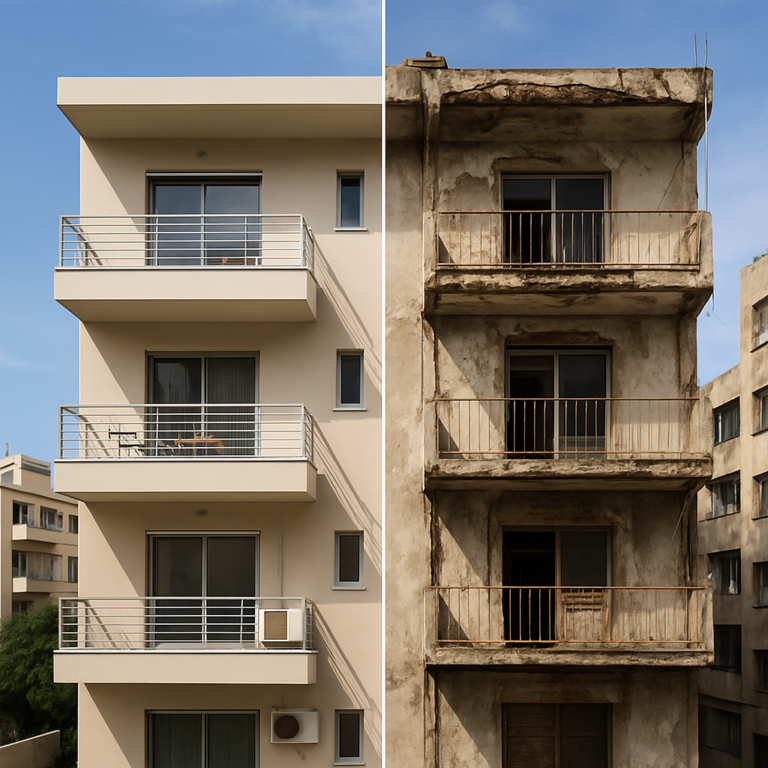
Addressing Dangerous Buildings in Cyprus: The Need for Proactive Management Concerns about the safety of jointly owned buildings in Cyprus have sparked…