What this guide covers
- Why Solar Panels Make Sense in Cyprus
- How Much Do Solar Panels Cost in Cyprus?
- How Much Can You Save With Solar Panels?
- A Worked Example
- Net Metering to Net Billing: The Big 2026 Change
- Grants and Incentives for Solar in Cyprus
- Do Solar Panels Add Value to a Cyprus Property?
- Solar Panels in Cyprus: Frequently Asked Questions
- Are solar panels worth it in Cyprus in 2026?
- How many solar panels does a Cyprus home need?
- What is the difference between net metering and net billing?
- Can I install solar panels on an apartment in Cyprus?
- How long do solar panels last in Cyprus?
- The Bottom Line on Solar Panels in Cyprus
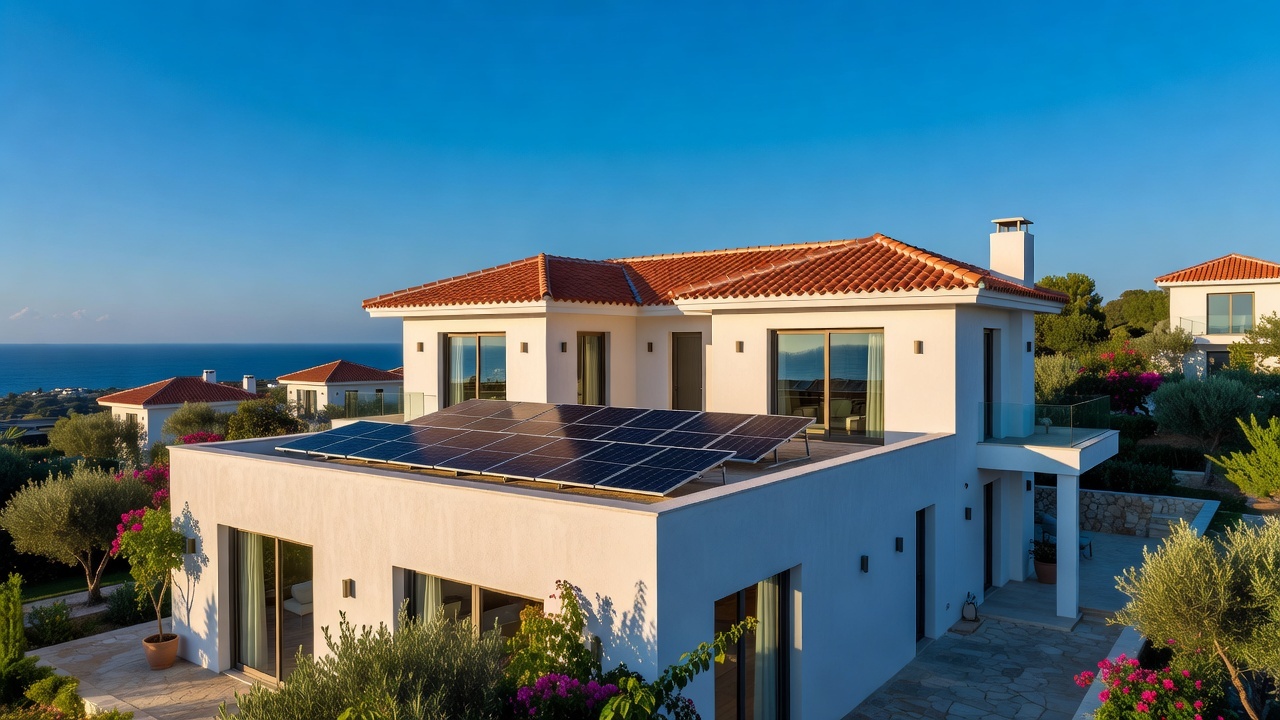
With around 340 sunny days a year, Cyprus is one of the best places in Europe to own solar panels. For property buyers and homeowners, that sunshine is not just a lifestyle perk—it is a way to slash electricity bills, hedge against rising energy costs, and add value to a home. But 2026 brought a major change to how solar is rewarded on the island, and getting the details right matters more than ever.
This guide explains what solar panels in Cyprus actually cost in 2026, how much you can save, the payback period, and the shift from net metering to net billing that reshaped the economics this year. We write as Cyprus’ #1 property marketplace, so our focus is practical: how solar affects the running costs and resale value of a Cyprus home, and what buyers should check before they commit.
Why Solar Panels Make Sense in Cyprus
Cyprus enjoys one of the highest levels of solar irradiance in the European Union. With roughly 340 days of sunshine annually, a rooftop system here generates far more electricity than the same panels would in northern Europe. That single fact underpins the whole case for going solar on the island.
Electricity is also expensive. Cyprus households typically pay between €0.20 and €0.35 per kilowatt-hour, among the higher rates in the EU, and prices have been volatile. When you combine abundant sun with costly grid power, the savings from self-generated solar energy add up quickly.
For property owners, there is a second benefit beyond the monthly bill: value. A home with a well-installed photovoltaic system and a strong energy rating is more attractive to buyers who increasingly factor running costs into their offers. Whether you own a compact apartment or one of the many villas for sale in Cyprus, solar is becoming a feature buyers actively look for.
How Much Do Solar Panels Cost in Cyprus?
The honest answer is that it depends on system size, panel quality, and whether you add battery storage—but the ranges are well established. Most residential solar panel systems in Cyprus cost between €5,000 and €10,000, with smaller or premium installations falling anywhere from €4,000 to €15,000.
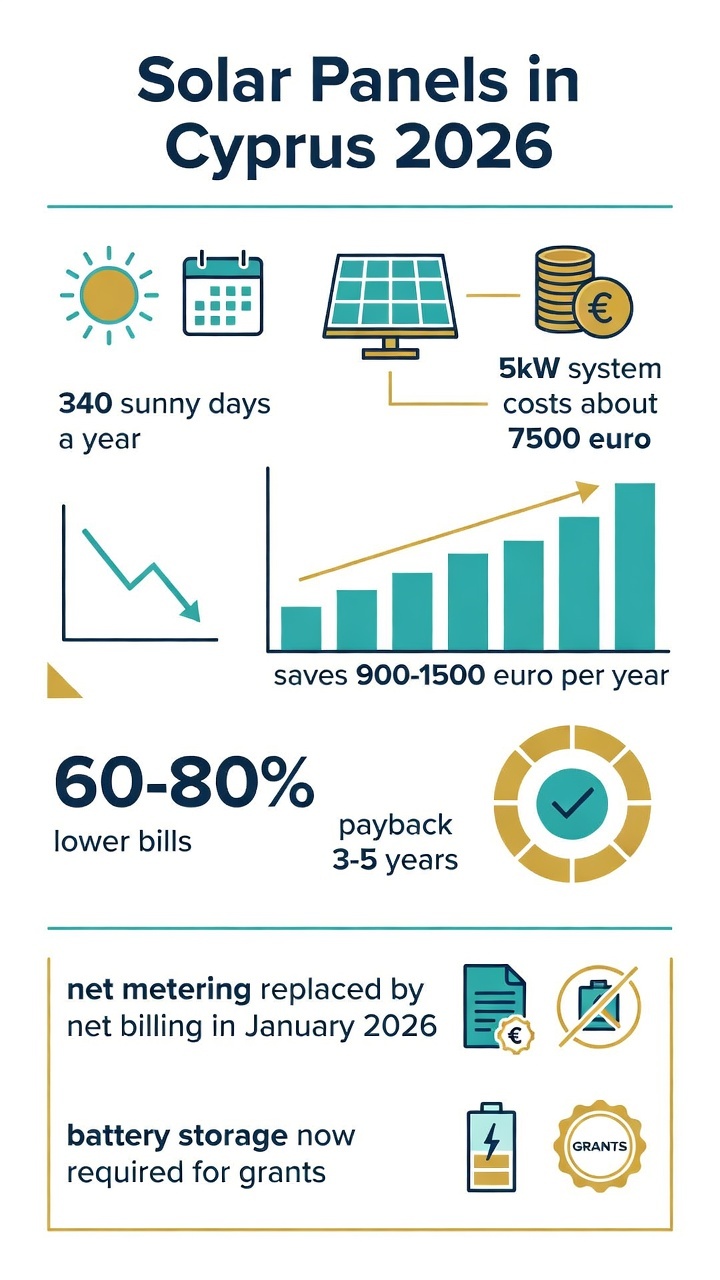
A typical family home installs around a 5 kW system, which costs roughly €7,500 before any incentives. Here is how the numbers generally break down by system size:
| System size | Typical cost | Best suited to |
|---|---|---|
| 3 kW | €4,000 – €6,000 | Apartments, small homes, low usage |
| 5 kW | €6,500 – €9,000 | Average family house |
| 8 kW | €10,000 – €14,000 | Large villas, high consumption, EV charging |
Adding a home battery increases the upfront cost—often by €4,000 to €8,000—but under the 2026 rules it dramatically improves the value you get from every panel, as we explain below. Panel prices have fallen sharply over the past decade, so systems today are both cheaper and more efficient than they were even a few years ago.
How Much Can You Save With Solar Panels?
Savings are where solar in Cyprus becomes compelling. A 5 kW system typically saves a household €900 to €1,500 per year, and many owners see their electricity bills fall by 60% to 80%. Over the 25-year-plus life of a quality system, total savings often run to €25,000–€40,000.
The payback period reflects this. Depending on your consumption, system size, and the incentives available when you install, most Cyprus homeowners recover their investment within three to five years. After that, the electricity your panels generate is essentially free for the remaining two decades of the system’s life.
Your actual savings depend on how much of the solar energy you use yourself versus export to the grid. This self-consumption question sits at the heart of the 2026 rule change—so understanding it is essential before you buy.
A Worked Example
Consider a family in Limassol running a 5 kW system that cost €7,500 installed. If it cuts their annual electricity bill from €2,000 to around €600, they save roughly €1,400 a year. At that rate, the system pays for itself in a little over five years—and with a battery raising self-consumption, the effective payback can be shorter still. For the following twenty years, that €1,400 of annual saving is money that stays in their pocket rather than going to the grid.
Households with higher consumption—air conditioning running through the summer, a pool pump, or an electric vehicle charging at home—tend to see the fastest payback, because they use more of their own solar output directly and avoid buying expensive peak-rate power.
Net Metering to Net Billing: The Big 2026 Change
For years, Cyprus ran a generous net metering scheme. Every surplus kilowatt-hour your panels exported to the grid earned a one-to-one credit against power you drew back later—effectively using the grid as a free virtual battery. It was simple and highly favourable to homeowners.
From January 2026, Cyprus is replacing net metering with a net billing system for new installations, as reported by pv magazine. Under net billing, you are still paid for surplus energy you export—but at the lower wholesale rate, not the retail price you pay to buy electricity. The gap between those two prices changes the maths significantly.
The practical takeaway is straightforward: it now pays to use as much of your own solar energy as possible rather than exporting it. That makes battery storage far more important. A battery stores midday solar output for use in the evening, pushing self-consumption higher and protecting your savings under the new regime.
The government has shifted incentives to reflect this. A separate EU-funded programme supports home battery storage, and new grant schemes are expected to require a battery as a condition of support. If you are installing in 2026, plan around storage from the start rather than treating it as an afterthought. Details of current support schemes are maintained on the Photovoltaics in Cyprus support-schemes portal.
Grants and Incentives for Solar in Cyprus
Cyprus has run several subsidy programmes to accelerate residential solar. The long-running “Photovoltaics for All” scheme offered grants and subsidised loans for home systems, with a headline grant of around €1,000–€1,500 for standard households and larger support for vulnerable ones. That particular grant closed to new applications at the end of 2025 as the system transitioned to net billing.
Looking ahead, state support in 2026 is being redirected toward systems that include battery storage, backed by EU funding. Because the specific grant amounts and eligibility rules are being updated, always confirm the current programme and deadlines with the Cyprus energy authorities or a licensed installer before committing—incentives change, and timing can materially affect your return.
A few practical points apply regardless of the scheme in force:
- Use a licensed installer. Grant eligibility and grid connection both require certified, compliant installation.
- Get multiple quotes. Prices and equipment quality vary; compare at least three installers.
- Check the roof first. Orientation, shading, and structural condition all affect output—south-facing, unshaded roofs perform best.
- Keep the paperwork. Invoices and certificates matter for grants, warranties, and future resale.
Do Solar Panels Add Value to a Cyprus Property?
Yes—and increasingly so. As energy costs climb and buyers grow more cost-conscious, a property that generates its own power carries a clear advantage. Lower running costs are a tangible selling point, and a modern solar system signals that a home has been well maintained and future-proofed.
The effect is strongest when the system is recent, correctly sized, and paired with a good energy performance rating. New-build developments increasingly include solar as standard, which is worth checking when you browse new complexes and projects in Limassol or compare houses for sale across Cyprus. For older properties, adding solar can be a smart pre-sale upgrade.
If you are weighing solar as an investment in your property rather than just an energy decision, it helps to understand how features translate into market value. Our guide on how to evaluate the value of your property in Cyprus covers the fundamentals, and the complete guide to real estate investing on index.cy puts energy upgrades in the context of overall returns.
To see what a real residential installation looks like in practice, this short video walks through a rooftop solar system on a Cyprus home:
Solar Panels in Cyprus: Frequently Asked Questions
Are solar panels worth it in Cyprus in 2026?
For most homeowners, yes. Cyprus’s abundant sunshine and high electricity prices mean a well-sized system still pays for itself in roughly three to five years, even under the new net billing rules—especially if you add a battery to raise self-consumption.
How many solar panels does a Cyprus home need?
An average family home is well served by a 5 kW system, which is roughly 12 to 14 modern panels. Larger villas with air conditioning, a pool pump, or an EV charger may need 8 kW or more. An installer will size the system to your actual annual consumption.
What is the difference between net metering and net billing?
Net metering credited exported solar energy at the full retail electricity price, one-to-one. Net billing, which applies to new systems from 2026, pays the lower wholesale rate for exports. This makes using your own solar power—ideally with battery storage—more valuable than selling it back to the grid.
Can I install solar panels on an apartment in Cyprus?
It is possible but more complex, because the roof is usually shared common property requiring the management committee’s agreement. Owners of houses and villas have far more freedom, which is one reason solar is more common on standalone properties.
How long do solar panels last in Cyprus?
Quality panels are typically warrantied for 25 years and often keep producing usefully well beyond that, though at slightly reduced output over time. Cyprus’s heat can marginally lower efficiency on the hottest days, but good installation with proper ventilation manages this. Inverters usually need replacing once during the system’s life, around the 10-to-15-year mark.
The Bottom Line on Solar Panels in Cyprus
Solar panels remain one of the smartest upgrades a Cyprus property owner can make. The island’s 340 days of sunshine, high grid prices, and three-to-five-year payback keep the case strong—but 2026 changed the playbook. With net billing replacing net metering, the winners are homeowners who size their system to their own usage and pair it with battery storage to maximise self-consumption.
Before you install, get several quotes from licensed installers, confirm the current grant scheme, and factor in a battery. And if you are buying or selling, treat solar as a genuine value factor, not a footnote. When you are ready to explore the market, index.cy lists verified properties from more than 100 companies across all five districts—including energy-efficient homes where the panels are already working for you. You can also commission an instant property report to understand a home’s data-backed value before you commit.
Keep reading
Growing Demand for Cyprus Property as Russian Buyers Shift Focus in 2026 Recent data reveals a notable surge in interest among Russian…

We analysed 136 Agios Dometios, Nicosia listings: 67 apartments, 8 houses, 16 plots and 24 rentals. Median 2-bed costs EUR192,500. See prices…

Cyprus Property Market Braces for Supply Shift Amid Rising Permits and Affordability Challenges The Cyprus real estate market is set to experience…