
Buy-to-let in Cyprus has quietly become one of the Mediterranean’s most reliable income strategies. The island combines steady tenant demand, transparent ownership rules, and gross rental yields that sit comfortably above the eurozone average. In Q3 2025, the average gross rental yield across Cyprus reached 5.09%, and the four main cities have trended upward every year since 2022.
This guide breaks down exactly what a buy-to-let investment in Cyprus looks like in 2026: which districts deliver the strongest returns, how much you need upfront, what you’ll pay in tax, and how to finance the purchase. We lead with data, not hype—because the difference between a 6% yield and a 3% yield usually comes down to choices you make before you buy.
Three structural factors keep Cyprus rental demand firm. First, the population of long-term residents keeps growing: relocating professionals, remote workers on the digital nomad visa, and retirees all need housing they don’t yet want to buy. Second, the tourism economy underpins short-term lets across the coast. Third, supply in the most desirable urban zones remains tight, which protects rents.
For an investor, the appeal is the combination of income and capital growth. You collect monthly rent while the underlying asset typically appreciates—Cyprus residential prices have risen consistently over the past four years. Unlike a pure trading market, buy-to-let rewards patience: hold a well-located unit, and both rent and value tend to climb together.
Cyprus also keeps the rules simple for foreign owners. Non-residents can buy residential property with minimal restrictions, the legal system is English-influenced and English-friendly, and the euro removes currency friction for European investors. If you’re weighing the broader case, our comprehensive guide to real estate investing covers strategy, risk, and portfolio building in depth.
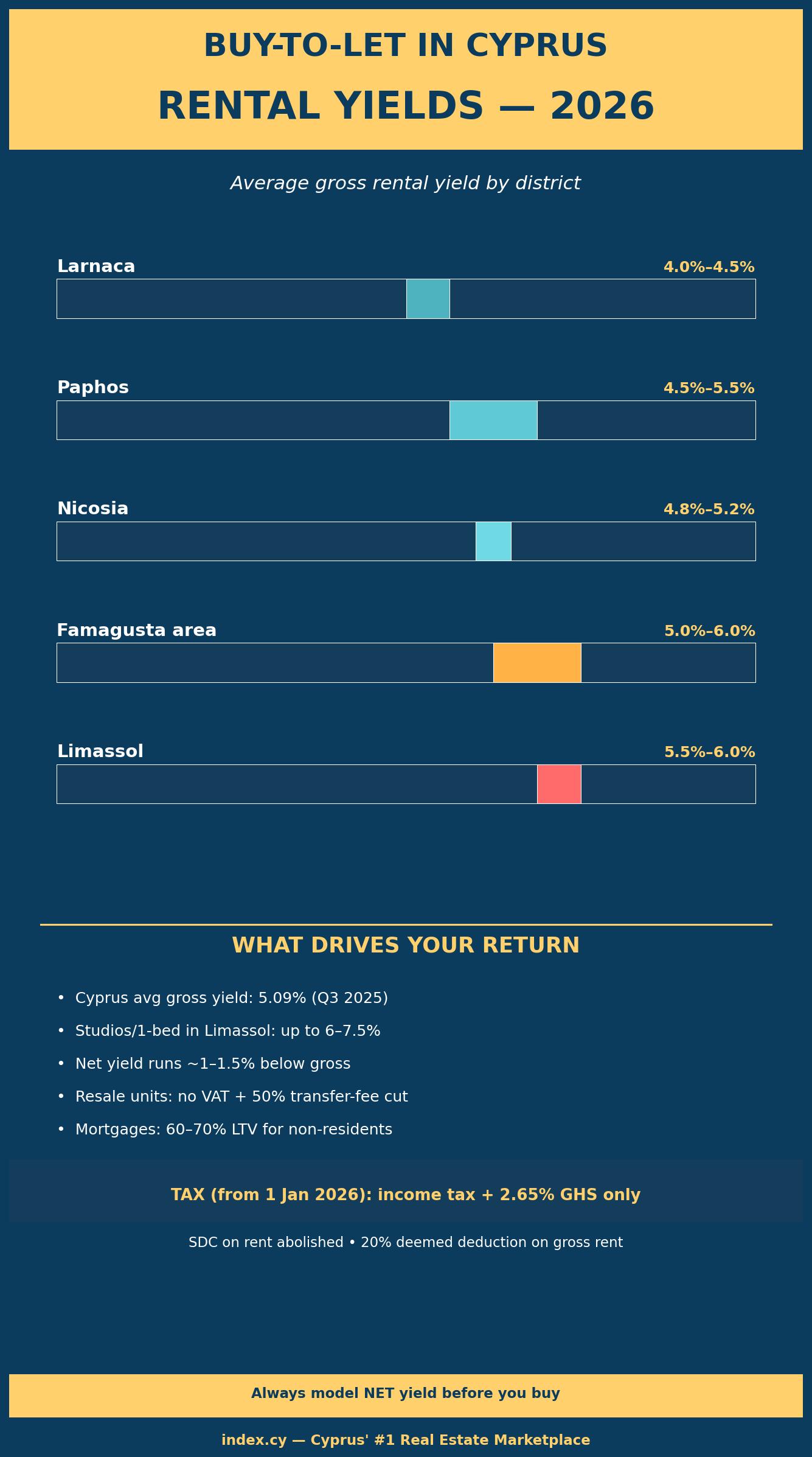
Yield is the number that matters most for a buy-to-let investor. Gross rental yield is annual rent divided by purchase price, expressed as a percentage. Here’s how the main districts compare in 2026.
| District | Typical gross yield | Best-fit strategy |
|---|---|---|
| Limassol | 5.5%–6% | Long-term lets to professionals |
| Nicosia | ~5% | Stable long-term, low vacancy |
| Larnaca | 4%–4.5% | Growth play, mixed lets |
| Paphos | 4.5%–5.5% | Holiday and expat lets |
| Famagusta area | 5%–6% | Seasonal short-term lets |
Limassol delivers the highest residential yields on the island, driven by a deep pool of corporate tenants and premium rents near the marina and city centre. Nicosia, the capital, offers the most predictable occupancy because its tenant base—civil servants, students, and office workers—doesn’t depend on the tourist season.
Property size also shapes yield. Studios and one-bedroom apartments in Limassol often return 6% to 7.5% gross, while larger three-bedroom units and villas tend to land at 4% to 5%. Smaller units cost less per square metre to buy but command proportionally higher rent, which lifts the yield. If you’re optimising purely for income, compact apartments usually win. Browse current apartments for sale in Cyprus to compare entry prices across districts.
A quick caution: gross yield ignores costs. After management fees, maintenance, insurance, and vacancy, net yields typically run 1 to 1.5 percentage points below gross. Always model the net figure before you commit.
Your rental strategy determines your workload, your tax position, and your real return. Cyprus supports two main approaches.
Long-term lets—contracts of a year or more—deliver steady, predictable income with low turnover. This suits Limassol and Nicosia, where professional tenants want stability. You’ll see lower gross rent than a holiday let, but you avoid seasonal voids, cleaning costs, and constant guest turnover.
Short-term holiday lets—the Airbnb model—can produce higher headline income in tourist hotspots like Paphos, Ayia Napa, and Protaras. The trade-off is intensity: you need licensing, active management, higher cleaning and furnishing costs, and you carry the risk of empty weeks in the off-season. Cyprus now requires short-term rentals to register with the Deputy Ministry of Tourism, so factor compliance into your plan. Our Airbnb Cyprus short-term rental guide walks through licensing, pricing, and seasonality.
Many investors blend the two: a coastal apartment let short-term in summer and long-term over winter. Whichever route you choose, professional property management in Cyprus is worth budgeting for if you live abroad—expect 8% to 12% of rent for long-term management and more for holiday lets.
Entry prices vary widely by district and property type. As a realistic 2026 benchmark for a two-bedroom apartment—the workhorse of most buy-to-let portfolios—Limassol runs roughly €350,000–€450,000, Paphos and Larnaca €230,000–€300,000, and Nicosia €200,000–€260,000. For precise, up-to-date figures, see our data on the average price of a 2-bedroom apartment in Cyprus.
Beyond the purchase price, budget for these upfront costs:
A frequently missed point: VAT and reduced-rate relief usually don’t apply to investment lets, so a new build can carry full 19% VAT. Resale apartments avoid VAT entirely and benefit from the 50% transfer-fee discount, which is one reason many buy-to-let investors favour the secondary market.
You don’t need to pay cash. Cypriot banks lend to both residents and non-residents, though terms differ. Residents can often borrow up to 70%–80% of value, while non-residents are typically capped around 60%–70% loan-to-value. Expect variable interest rates broadly in the 4.5%–6% range in 2026, tracking the European Central Bank and Central Bank of Cyprus, and terms up to 25–30 years depending on your age at maturity.
Lenders assess the property’s rental potential alongside your income, so a strong yield can strengthen your application. You’ll need proof of income, bank statements, and a valuation. Mortgage interest on a let property is also a deductible expense against rental income, which improves your after-tax return—more on that below.
Leverage cuts both ways. Borrowing amplifies your return on cash when rents and prices rise, but it also magnifies losses if values dip or a unit sits empty. A common rule of thumb: make sure the rent comfortably covers the mortgage, management, and a maintenance buffer with room to spare. For a full breakdown of rates, deposits, and approval criteria, read our guide to financing your property purchase in Cyprus.
The video below offers a helpful visual overview of how buying property in Cyprus works, from listings to legal steps.
Tax treatment changed meaningfully in 2026, and it now favours landlords. Here’s how rental income is taxed.
Rental profit is added to your other income and taxed under personal income tax, which is progressive: the first €19,500 of total annual income is tax-free, then rates rise in bands up to 35%. Before tax, you can claim a deemed deduction of 20% of gross rent with no receipts required—this covers wear, minor repairs, and maintenance. You can also deduct mortgage interest and capital allowances on the building.
The big change: from 1 January 2026, the Special Defence Contribution (SDC) on rental income was abolished for all Cyprus tax residents. Previously, domiciled residents paid 3% SDC on 75% of gross rent; that charge is gone. What remains is the General Healthcare System (GHS/GeSY) contribution at 2.65% of gross rental income, which applies to Cyprus tax residents including non-doms, subject to an overall annual cap.
For non-domiciled residents—a status many relocating investors hold for up to 17 years—this means rental income now attracts only income tax plus 2.65% GHS. That’s a genuinely competitive position within Europe. Always confirm your specific liability with a tax adviser and our guide to taxes and legalities in Cyprus real estate, because the 2026 tax reform is still rolling out and thresholds may shift.
Turning a single purchase into a performing portfolio follows a clear sequence. Here’s the path most successful Cyprus investors take.
The investors who do best treat buy-to-let as a system, not a one-off purchase. They track yields, refresh rents to market, and keep vacancy low—because in Cyprus, location and management discipline matter more than market timing.
Buy-to-let in Cyprus offers a rare blend in 2026: yields of roughly 4% to 6% gross, steady tenant demand, simple rules for foreign owners, and—after the 2026 tax reform—a lighter tax burden on rental income. The strongest returns come from compact, well-located units in Limassol and Nicosia, while coastal districts add growth and holiday-let upside.
Success isn’t about chasing the highest headline rent. It’s about buying the right property at the right price, financing it sensibly, and modelling the net return before you sign. Start by comparing live listings and price data, run your numbers, and verify any property thoroughly before you commit. Explore current properties for sale in Limassol and Nicosia on index.cy to see where today’s buy-to-let opportunities sit.
For most investors, yes. Buy-to-let in Cyprus offers gross rental yields of roughly 4% to 6%, steady tenant demand from professionals, students, and tourists, and—since the 2026 tax reform—a lighter tax burden on rental income. As with any investment, returns depend on buying the right property at the right price and managing it well.
Gross yields typically range from about 4% in Larnaca to 6% in Limassol. Compact studios and one-bedroom units in Limassol can reach 6% to 7.5%, while larger three-bedroom apartments and villas usually return 4% to 5%. Net yield, after costs, generally runs 1 to 1.5 percentage points lower.
Yes. Non-residents can buy residential property in Cyprus with minimal restrictions, finance up to around 60%–70% of value through local banks, and let it out. The legal process is English-friendly, and the euro removes currency risk for European investors.
Rental profit is taxed under personal income tax (the first €19,500 of total income is tax-free, then up to 35%), after a 20% deemed deduction on gross rent plus mortgage interest. From 1 January 2026, the Special Defence Contribution on rent was abolished; Cyprus tax residents now pay only income tax plus a 2.65% GHS contribution.
Long-term lets suit Limassol and Nicosia, where professional tenants want stability and vacancy is low. Short-term holiday lets can earn more in coastal hotspots like Paphos and Protaras but require licensing, active management, and carry off-season risk. Many investors blend both across the year.
Disclaimer: This guide is for general information and is not financial, legal, or tax advice. Yields, prices, and tax rules change—confirm specifics with a qualified Cyprus adviser before investing.