
What this guide covers
- Is Airbnb a Good Investment in Cyprus in 2026?
- Short-Term Rental Registration Rules for Airbnb in Cyprus
- Airbnb Taxes in Cyprus: Income Tax, VAT, and SDC
- Best Areas for Airbnb in Cyprus
- How Much Can You Earn From an Airbnb in Cyprus?
- How to Set Up a Profitable Airbnb in Cyprus: Step by Step
- Airbnb vs. Long-Term Rental in Cyprus: Which Is Better?
- Frequently Asked Questions About Airbnb in Cyprus
- Is Airbnb legal in Cyprus?
- Do I need a licence to run an Airbnb in Cyprus?
- How much tax do I pay on Airbnb income in Cyprus?
- Which area in Cyprus is best for Airbnb?
- The Bottom Line on Airbnb in Cyprus
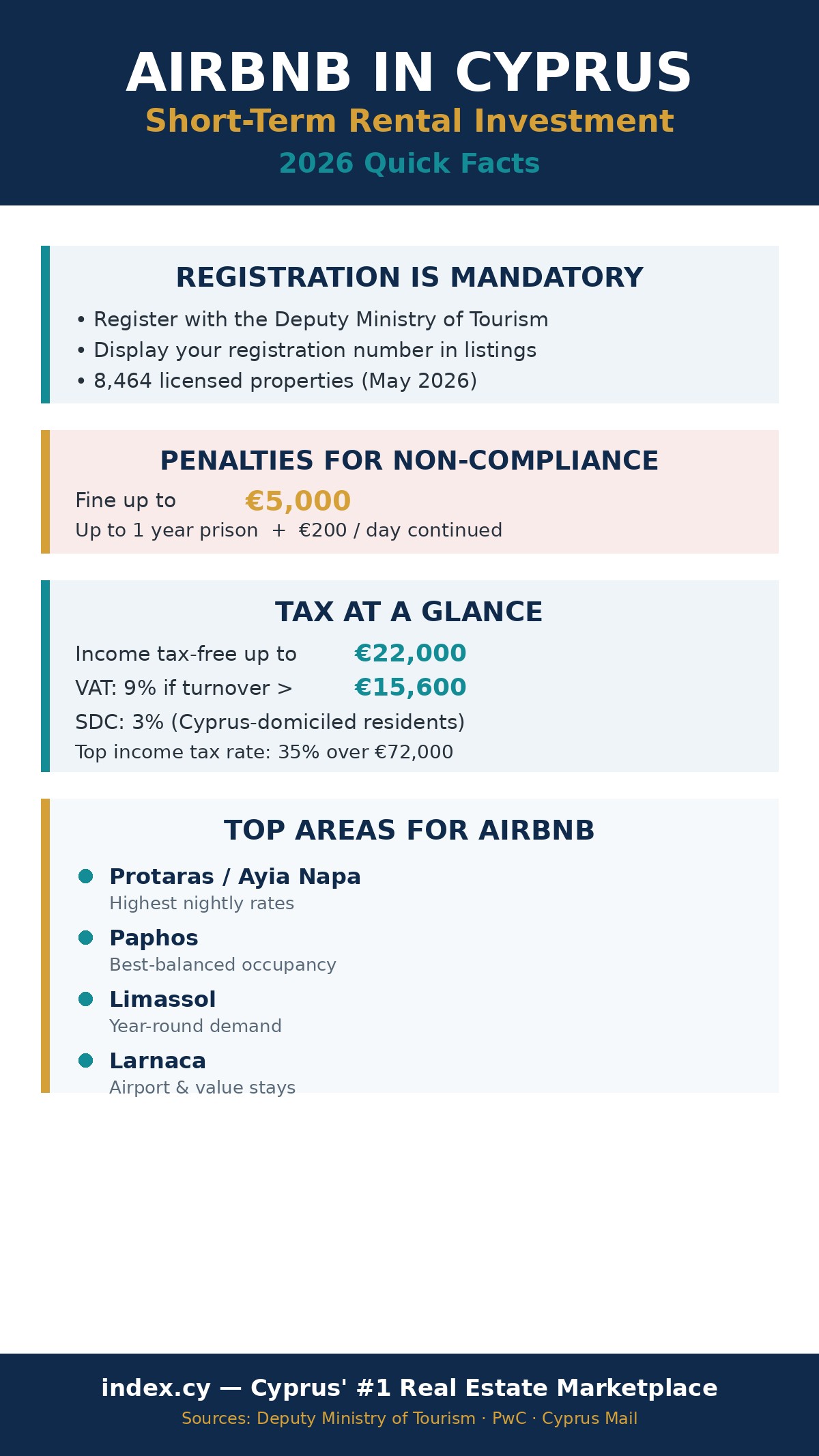
Thinking about running an Airbnb in Cyprus? You’re not alone. Short-term rentals have become one of the island’s fastest-growing property strategies, and the numbers explain why. By May 2026, the Deputy Ministry of Tourism’s register listed 8,464 licensed self-catering properties nationwide — up from roughly 8,375 a year earlier — as more owners turned holiday homes into income. This guide breaks down exactly how Airbnb in Cyprus works in 2026: the registration rules, the taxes, the districts that perform best, and the returns you can realistically expect.
We’ll keep it practical and data-driven. Whether you already own a villa near the coast or you’re weighing a purchase specifically for short-term letting, you’ll leave knowing what’s legal, what’s profitable, and what to watch out for.
Is Airbnb a Good Investment in Cyprus in 2026?
For the right property in the right area, short-term letting in Cyprus can outperform a traditional long-term tenancy — but only after you account for costs, seasonality, and compliance.
The demand is real. Cyprus welcomes millions of visitors each year, concentrated heavily between May and October. That seasonality is the single biggest factor shaping returns: a coastal apartment might be booked solid in August and nearly empty in January. Across ranked Cyprus markets, annual occupancy tends to land between 40% and 65% depending on location and property type, with peak-season nightly rates far higher than shoulder months.
The market is also getting more crowded. In Limassol, short-term rental supply grew more than 100% over the past year, yet nightly rates and revenue still trended upward — a sign that traveller demand is currently outpacing new inventory. That won’t last forever, so location and quality matter more than ever.
Here’s the honest tradeoff. Airbnb income is higher per night but comes with more work: cleaning, guest communication, dynamic pricing, and mandatory registration. Long-term rentals earn less but are simpler and more stable. If you want the numbers on the passive route, compare this guide against our guide to renting property in Cyprus before deciding.
Short-Term Rental Registration Rules for Airbnb in Cyprus
This is the part too many owners get wrong. In Cyprus, you cannot legally advertise or let a short-term rental without registering it first.
Registration is mandatory under the Regulation of the Establishment and Operation of Hotels and Tourist Accommodation Law (Law 34(I)/2019, as amended by Law 9(I)/2020). The law formalised “self-service” or “self-catering” accommodation — exactly the villas, houses, and apartments listed on platforms like Airbnb and Booking.com.
Here’s how it works in practice:
- Register with the Deputy Ministry of Tourism. Owners and managers apply online and receive a registration certificate with a unique number. The permit costs €222, is valid for three years, and is renewed online.
- Display your registration number. That number must appear in every advertisement, listing, and promotion for the property. Airbnb and other platforms increasingly require it.
- Meet the property standards. Units must satisfy basic safety and quality requirements to qualify for the self-catering register.
The penalties for skipping registration are serious. Operating an unregistered short-term rental can bring a fine of up to €5,000, imprisonment of up to one year, and an additional €200 per day if the offence continues after conviction. Authorities have stepped up enforcement, auditing platform listings to identify “ghost” properties advertising without a permit.
There’s an EU dimension too. A new EU short-term rental regulation takes effect across member states on 20 May 2026, mandating the collection and sharing of registration data and requiring hosts to declare their registration numbers and property details. In short: transparency is only increasing, and unregistered letting is a shrinking option.
If you’re buying specifically to let, factor registration into your due diligence. Our instant property report helps you assess a unit before you commit, so you know what you’re working with from day one.
Airbnb Taxes in Cyprus: Income Tax, VAT, and SDC
Short-term rental income is taxable, and Cyprus treats it differently from passive long-term rent. Plan for three separate obligations.
Income tax. Earnings from short-term lets are generally treated as business income rather than passive rental income. Following the 2026 tax reform, the personal income tax-free threshold rose to €22,000. Income above that is taxed progressively: 20% on €22,001–€32,000, 25% on €32,001–€42,000, 30% on €42,001–€72,000, and 35% above €72,000. Each rate applies only to the portion of income within its band.
VAT. Short-term accommodation of less than 30 days is a VATable activity. If your annual turnover from short-term letting exceeds €15,600, you must register for VAT and charge the reduced 9% rate that applies to tourist accommodation. Below the threshold, registration is not required.
Special Defence Contribution (SDC). A 3% SDC applies to rental income for individuals who are both tax resident and domiciled in Cyprus. Non-domiciled residents and non-residents are generally exempt from SDC, though non-residents remain liable for income tax on Cyprus-sourced earnings.
Owners must file an annual tax return declaring rental income. Because the rules interact — and because non-dom status can change your SDC position — this is worth getting professional advice on. For a fuller breakdown of how the tax department treats property earnings, see our Cyprus rental income tax guide. None of this is a substitute for advice from a licensed Cyprus tax adviser on your specific situation.
Best Areas for Airbnb in Cyprus
Location drives everything in short-term letting. The strongest Airbnb markets in Cyprus combine tourist demand, walkable amenities, and proximity to a beach or a marina. Here’s how the main areas compare.
| Area | Best for | Typical occupancy | Nightly rate signal |
|---|---|---|---|
| Protaras & Ayia Napa (Famagusta) | Peak-season beach demand, family villas | ~60% | Highest rates on the island |
| Paphos | Consistent occupancy, expat + tourist mix | 48–65%+ | Moderate, steady |
| Limassol | Year-round demand, marina & business travel | ~43% | Rising, premium units |
| Larnaca | Airport proximity, shorter stays | Moderate | Value-friendly |
| Nicosia | Business travel, low seasonality | Lower | Steady, non-tourist |
A few takeaways. Protaras and Ayia Napa post the highest nightly rates and monthly revenue during summer — a well-positioned pool villa can command exceptional peak-season pricing, though winter demand nearly vanishes. Browse the coastal stock through Famagusta district listings if that’s your target. Paphos offers the most balanced profile: strong occupancy, a large international community, and lower entry prices than Limassol. Explore properties for sale in Paphos to gauge the market.
Limassol carries the highest purchase prices but benefits from year-round demand from business travellers and marina visitors, softening the seasonality that hits pure beach markets. For a property type built for premium short lets, villas for sale in Cyprus with private pools consistently outperform standard apartments on nightly rate.
If you’re considering a new build for letting, off-plan units in tourist zones can be configured for hospitality from the ground up — see the new developments in Paphos for current projects.
How Much Can You Earn From an Airbnb in Cyprus?
Returns vary enormously by area and property type, so treat any single figure with caution. That said, the market data gives useful benchmarks.
- Paphos: short-term rentals average roughly 65% occupancy at around a $111 nightly rate, with monthly revenue reported near $15,000 for well-performing listings.
- Protaras: the top performer for revenue, averaging about 61% occupancy, a $315 nightly rate, and monthly revenue around $26,700 during active months.
- Limassol: roughly $15,900 in annual revenue for a typical listing at a $127 nightly rate and 43% occupancy — with clear room to optimise through better pricing and presentation.
- Premium villas: well-positioned pool villas in Ayia Napa or Paphos can reach €4,500–€6,000 per month at peak, translating to over €40,000 annually when shoulder-season bookings are added.
The lesson is that averages hide huge spread. A generic inland apartment may struggle to clear costs, while a sea-view villa with a pool in a prime area can generate strong annual revenue. Before you buy, model your specific unit’s numbers — nightly rate, realistic occupancy, cleaning and management fees, registration, taxes, and utilities — rather than relying on headline figures.
For a wider view of how short-term letting fits into a property portfolio, our complete guide to real estate investing in Cyprus covers appreciation, financing, and long-term strategy alongside rental yield.
How to Set Up a Profitable Airbnb in Cyprus: Step by Step
Turning a property into a compliant, profitable short-term rental follows a clear sequence.
- Choose the right property. Prioritise location, a pool or sea view where possible, and proximity to beaches, restaurants, and transport. These features drive both occupancy and nightly rate.
- Confirm you can legally let it. Check that the property qualifies for the self-catering register and that no title, planning, or management-company restrictions block short-term letting.
- Register with the Deputy Ministry of Tourism. Apply online, meet the safety and quality standards, and obtain your registration number before listing anywhere.
- Sort out tax. Register with the Tax Department, assess whether you’ll cross the €15,600 VAT threshold, and set up bookkeeping for income tax and any SDC.
- Furnish and photograph professionally. Quality furnishings and strong photography materially lift both bookings and achievable rates.
- List and price dynamically. Publish your registration number, then use seasonal, demand-based pricing to capture peak rates while keeping shoulder-season occupancy up.
- Decide on management. Self-manage for higher margins, or hire a short-term rental manager (typically 15–25% of revenue) to handle guests, cleaning, and turnovers.
Airbnb vs. Long-Term Rental in Cyprus: Which Is Better?
There’s no universal answer — it depends on your property, your appetite for work, and your risk tolerance.
Airbnb wins on gross income in tourist areas, especially for villas and coastal apartments during the long Cyprus summer. It also gives you flexibility to use the property yourself between bookings. The costs: mandatory registration, higher management effort, VAT above the threshold, income treated as a business, and real seasonal swings.
Long-term rental wins on stability and simplicity. You get predictable monthly income, far less admin, lower turnover costs, and gentler tax treatment. The tradeoff is lower headline yield and less flexibility.
A practical rule of thumb: coastal and tourist-zone properties often favour short-term letting, while units in Nicosia and non-tourist areas usually make better long-term rentals. Many investors blend the two — short lets in summer, longer contracts in winter — to smooth income across the year.
Frequently Asked Questions About Airbnb in Cyprus
Is Airbnb legal in Cyprus?
Yes. Airbnb and other short-term rentals are legal in Cyprus, but every property must be registered with the Deputy Ministry of Tourism and display its registration number in all listings. Operating without registration can bring fines up to €5,000, up to a year’s imprisonment, and €200 per day for continued offences.
Do I need a licence to run an Airbnb in Cyprus?
You need to register your property on the self-catering accommodation register and obtain a registration certificate and number (a €222 permit valid for three years). The property must meet basic safety and quality standards to qualify.
How much tax do I pay on Airbnb income in Cyprus?
Short-term rental income is treated as business income and taxed progressively after the €22,000 tax-free threshold (2026 rates). If turnover exceeds €15,600 a year you must also register for and charge 9% VAT, and Cyprus-domiciled residents pay an additional 3% SDC on rental income.
Which area in Cyprus is best for Airbnb?
Protaras and Ayia Napa command the highest peak-season rates, Paphos offers the most balanced occupancy and entry price, and Limassol provides the steadiest year-round demand thanks to business and marina travel.
The Bottom Line on Airbnb in Cyprus
Airbnb in Cyprus can be a strong income strategy in 2026 — but success depends on three things: choosing a property in a high-demand area, registering it properly with the Deputy Ministry of Tourism, and running the numbers honestly after tax and costs. The market rewards well-located, well-presented villas and coastal apartments, while penalising unregistered or poorly positioned units.
Start by getting clear on the property itself. Explore current listings across Cyprus, model your realistic occupancy and nightly rate, and confirm the unit qualifies for short-term letting before you buy. When you’re ready to evaluate a specific property, run an instant property report to check its fundamentals — and let the data, not the hype, guide your decision.
Keep reading

We analysed 24 Kornos, Larnaca listings: 23 are land, most plots ask EUR30 to EUR115 per sqm and there are no rentals.…
Building Permits Soar 29.5% in Cyprus as Apartments Take the Lead In the first half of 2026, Cyprus saw a significant jump…
Understanding the Roots of Cyprus’ Housing Challenge The recent announcements by the Cypriot government aimed at addressing housing challenges are a step…