
Buying a home is rarely just the sticker price. In Cyprus, one of the largest one-off costs you’ll face at completion is the property transfer fee—the charge the Land Registry applies when ownership of a property passes into your name. Understanding property transfer fees in Cyprus before you make an offer can save you thousands of euros and remove one of the most common surprises first-time buyers report.
The good news: the system is more buyer-friendly than it looks. Depending on whether you buy a brand-new property or a resale, and whether you buy alone or jointly, the effective rate you pay can range from 8% all the way down to zero. This guide breaks down the 2026 rates, the exemptions that apply, and the practical steps that legally reduce what you owe.
We’ll walk through every scenario with worked examples so you can estimate your own cost. As Cyprus’ largest property marketplace, index.cy sees these questions from buyers every day, and the answer almost always comes down to a few clear rules.
Property transfer fees are a one-time government charge paid to the Department of Lands and Surveys (the Cyprus Land Registry) when a property’s title is transferred to a new owner. In simple terms, they are the cost of putting the title deed in your name.
The fee is calculated on the market value of the property as assessed by the Land Registry—not necessarily the price you paid. In most standard transactions the agreed sale price and the assessed value align, but the Registry reserves the right to use its own valuation if it believes the declared price is below market.
Crucially, transfer fees are the buyer’s responsibility, not the seller’s. They are paid once, at the point of transfer, and are separate from annual ownership costs like municipal taxes. Because they can add several thousand euros to your total, they belong in your budget from the start—alongside legal fees and any mortgage costs. For a full picture of the taxes and charges involved in a purchase, our complete guide to taxes and legalities in Cyprus real estate puts every cost in context.
Cyprus uses a progressive, banded system. This is the single most important thing to understand, because it means you never pay the top rate on the whole property—only on the portion that falls within each band.
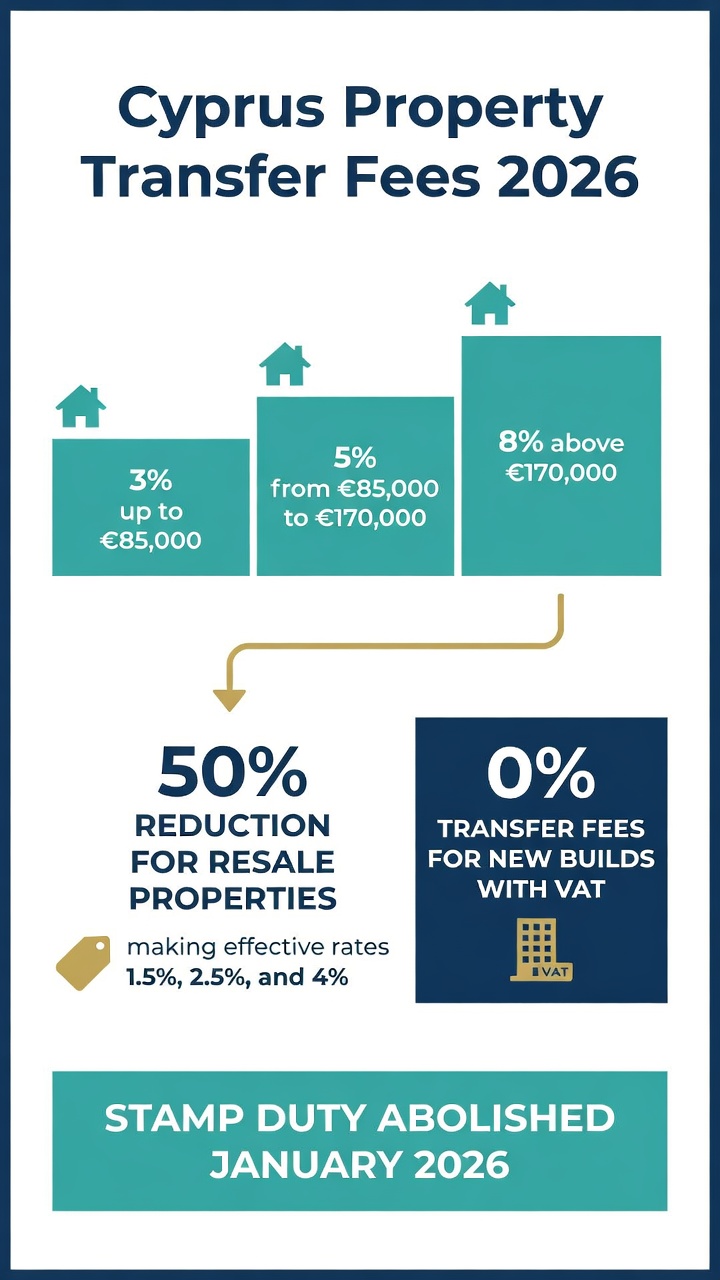
Here are the standard 2026 rates, applied to the assessed market value:
| Property value (€) | Transfer fee rate |
|---|---|
| Up to 85,000 | 3% |
| 85,001 – 170,000 | 5% |
| Above 170,000 | 8% |
Each band applies only to the value inside that range. Consider a resale house assessed at €250,000. You do not pay 8% on the full amount. Instead:
That figure is the starting point. As you’ll see below, most buyers pay far less once discounts and exemptions are applied. To sanity-check any estimate, the Cyprus government publishes an official transfer fee calculation service that mirrors these bands.
The biggest exemption in the Cyprus system applies to new properties. If VAT has been charged on the purchase—as it is on brand-new builds bought directly from a developer—the property is generally exempt from transfer fees entirely.
In practice, this means buyers of new-build apartments and villas typically pay 0% in transfer fees. The trade-off is that they pay VAT instead: the standard rate is 19%, though a reduced rate of 5% applies to a qualifying primary residence.
The 5% reduced VAT rate is significant. Under the 2026 rules, it applies to the first 130 m² of a primary residence, provided the home is valued at up to €350,000, the total transaction value does not exceed €475,000, and the total internal covered area stays within 190 m². The reduced rate also carries a condition: you must use the property as your permanent residence for ten years, or repay the difference proportionally if you sell or rent it out sooner.
One nuance to watch: the transfer-fee exemption applies to the portion of the price that was subject to VAT. If the Land Registry’s assessed market value is higher than your VAT-inclusive purchase price, transfer fees may apply to the difference. This is uncommon in a fair-market sale but worth confirming with your lawyer. Browse new-build apartments across Cyprus to compare VAT-inclusive pricing directly.
If you buy a resale property—one that is not subject to VAT—you won’t get the full new-build exemption, but you do benefit from a substantial statutory discount. A 50% reduction currently applies to the standard transfer fee rates, effectively halving your bill.
With the discount applied, the effective rates become:
| Property value (€) | Effective rate (after 50% reduction) |
|---|---|
| Up to 85,000 | 1.5% |
| 85,001 – 170,000 | 2.5% |
| Above 170,000 | 4% |
Return to our €250,000 resale house. The gross fee was €13,200; with the 50% reduction, the amount you actually pay drops to €6,600. On a €500,000 resale villa, the difference is even more dramatic—the discount saves a buyer well over €13,000.
This reduction is one reason resale properties remain attractive despite the appeal of new builds. When you weigh a resale against a new-build, factor the transfer fee saving into your comparison alongside price, condition, and location. If you’re still mapping out your budget, our guide to financing a property purchase in Cyprus shows how these upfront costs fit into your overall funding plan.
Here is a legitimate, widely used strategy that many buyers overlook: purchasing in joint names. Because transfer fees are progressive, splitting ownership between two buyers—typically a married couple or business partners—divides the property value into two separate sets of bands.
When a property is bought in joint names, the assessed value is effectively split between the owners, and the progressive bands apply separately to each share. This pushes more of the value into the lower 3% and 5% brackets and less into the top 8% band.
Take a €340,000 resale apartment. Bought in a single name, the value runs deep into the 8% band. Bought in two equal names, each buyer is assessed on €170,000—which falls entirely within the first two bands, avoiding the 8% rate altogether. Combined with the 50% resale reduction, the savings compound.
A worked comparison for that €340,000 resale, single vs. joint:
The exact saving depends on the property value and how the split falls across the bands, but for higher-value homes the benefit can reach several thousand euros. It costs nothing to structure the purchase this way from the outset—just make sure your lawyer sets it up correctly before completion. This is exactly the kind of detail our due diligence checklist for buying property in Cyprus is designed to catch.
Cyprus applies special, heavily reduced rates when property changes hands between close family members. These matter for estate planning, gifting, and intra-family sales:
These rates are dramatically lower than an open-market transfer. Passing a family home to a child, for example, carries no transfer fee at all, while a transfer between spouses on a €300,000 property would cost just €300.
If you are considering restructuring family property ownership or planning an inheritance, these provisions are worth reviewing with a qualified advisor. The rules around eligibility and documentation are specific, and getting the paperwork right the first time avoids delays at the Land Registry.
Transfer fees don’t exist in a vacuum. To budget accurately, you need to see them alongside the other transaction costs—and one of those costs has just disappeared.
Stamp duty has been abolished. As of 1 January 2026, stamp duty on property transactions no longer applies in Cyprus. Previously it was charged on the contract value at rates up to 0.2%, capped at €20,000. Its removal lowers total transaction costs for every buyer and simplifies the closing process.
Here’s how the main upfront costs stack up in 2026:
For a data-backed view of what properties actually sell for across the island, our insights on average house prices in Cyprus help you estimate the value your transfer fee will be calculated on. The PwC Cyprus tax summary is a reliable external reference if you want to cross-check the current rates and thresholds.
Timing catches many buyers off guard, so it’s worth being clear. Transfer fees are not due when you sign the contract or pay your deposit. They fall due at the moment the title is transferred into your name at the District Land Registry—which, for a new build, can be years after you move in, once the developer has issued separate title deeds.
The practical sequence looks like this:
The video below walks through the legal steps and costs of buying property in Cyprus, and complements the fee breakdown above:
Because the fee is assessed on the Registry’s valuation at the time of transfer, it’s wise to keep a reserve set aside if there’s a gap between purchase and title issuance. Before any of this, confirming the title status is essential—a property without clean, transferable deeds can leave you unable to complete. An instant property report from index.cy surfaces exactly this kind of information early, so there are no surprises at the Registry counter.
Do buyers or sellers pay transfer fees in Cyprus? The buyer pays. Transfer fees are the purchaser’s responsibility and are settled at the point the title is transferred.
Are property transfer fees in Cyprus tax-deductible? They are not deductible against income, but they are added to the property’s acquisition cost, which can reduce capital gains tax when you eventually sell.
Can I avoid transfer fees legally? Yes—buying a new build subject to VAT means no transfer fees, and buying a resale in joint names combined with the 50% reduction minimises them. These are all legitimate, built-in features of the system.
Property transfer fees in Cyprus can look intimidating at 8% headline rates, but the reality for most buyers is far gentler. New builds bought with VAT pay nothing in transfer fees. Resale buyers enjoy a 50% statutory reduction, cutting effective rates to between 1.5% and 4%. Buying in joint names splits the progressive bands and lowers the bill further, and the abolition of stamp duty from January 2026 removes a cost entirely.
The three takeaways to remember: transfer fees are progressive, so you never pay the top rate on the whole value; the VAT exemption and 50% resale reduction are the biggest levers; and how you structure ownership genuinely changes what you owe. Factor these into your budget from the first viewing, not at the closing table.
Ready to start your search with the numbers on your side? Browse verified listings across all five districts on index.cy, compare new builds against resales, and understand the true, all-in cost of every property before you commit.