
Cyprus tax residency has become one of Europe’s most talked-about relocation strategies, and 2026 made it even more accessible. If you own or plan to buy property on the island, understanding how Cyprus tax residency works is not a side issue—it is central to how much of your income you keep. This guide breaks down the two ways to become a tax resident, the non-dom status that delivers 0% tax on dividends and interest, the 2026 income tax bands, and the practical role your Cyprus home plays in the whole equation.
We write this as a marketplace, not a law firm or accountancy. Our goal is to give you the data and context to make an informed decision, then point you to qualified advisers for your personal situation. Tax rules carry real financial consequences, so treat this as a starting map, not personal advice.
Cyprus tax residency is a status that determines where you pay tax on your worldwide income. An individual becomes a Cyprus tax resident by satisfying one of two tests in a calendar year: the long-standing 183-day rule, or the newer 60-day rule. Meet either test and Cyprus treats you as a tax resident for that year.
The 183-day rule is the simpler of the two. Spend more than 183 days physically in Cyprus during the tax year, and you are automatically a tax resident. No employment, company, or property condition applies—physical presence alone decides it. This suits people who genuinely relocate and spend most of the year on the island.
The 60-day rule was designed for a different profile: internationally mobile people with real economic ties to Cyprus who do not spend six months anywhere. It is the route that makes Cyprus stand out, and it is where most property buyers and entrepreneurs focus their attention.
Under the 60-day rule, you can become a Cyprus tax resident by spending only 60 days on the island in a calendar year—provided you meet every one of the following conditions:
All four conditions must be met together. Fail one—for example, spending 200 days in another country—and you fall outside the rule.
A significant reform took effect on 1 January 2026. Before 2026, a fifth condition applied: you could not be a tax resident of any other country in the same year. That condition has been removed. If a dual-residency situation now arises, it is resolved under the tie-breaker rules of the relevant double tax treaty rather than by an outright bar. This change widened access to the 60-day rule, and it is one reason interest in Cyprus tax residency has climbed through 2026.
The third and fourth conditions are where property and business intersect. You need a genuine home in Cyprus, and you need a substantive tie such as a company directorship or local employment. A rented apartment plus a Cyprus company directorship is a common, legitimate combination.
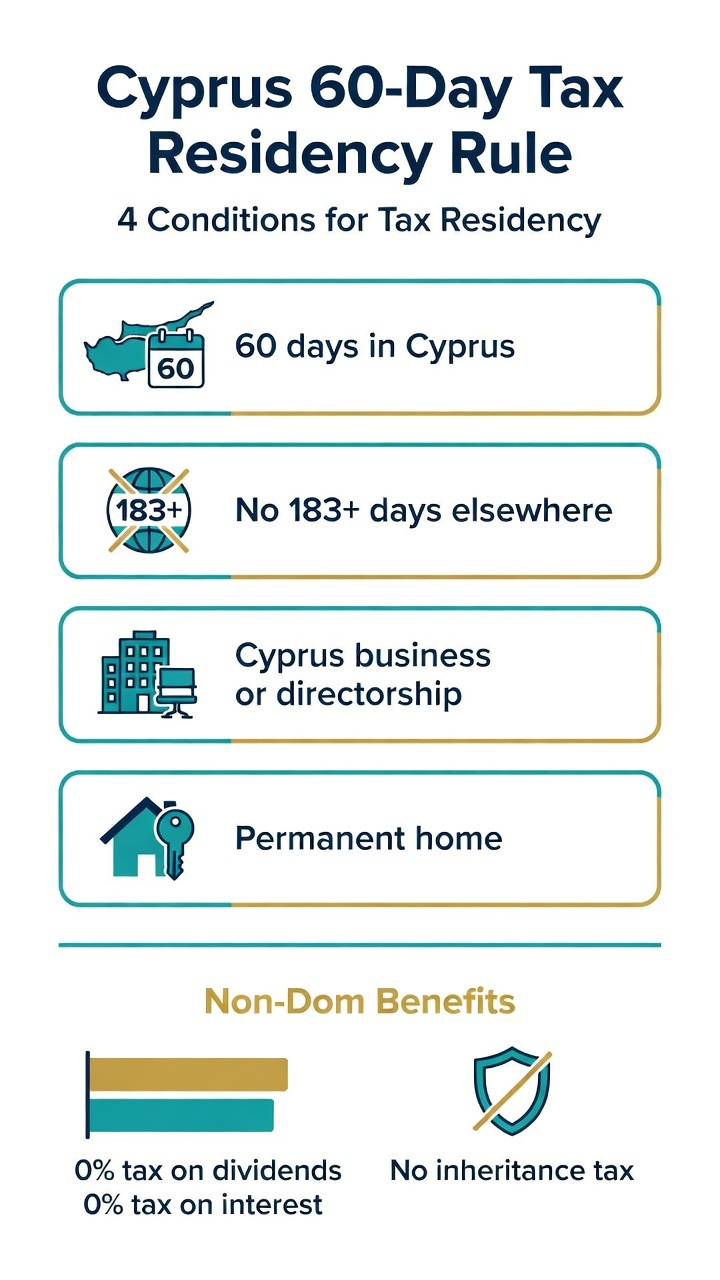
Becoming a tax resident is the entry ticket. Non-dom status is the reward. A Cyprus non-dom is a tax resident who is not considered domiciled in Cyprus for Special Defence Contribution (SDC) purposes—and that distinction unlocks the headline benefits.
A tax resident qualifies as non-domiciled if both of these hold: they do not have a Cyprus domicile of origin (generally inherited at birth, usually following the father’s domicile), and they have not been a Cyprus tax resident for at least 17 of the 20 years immediately before the tax year. In practice, almost every foreign national relocating to Cyprus qualifies as non-dom from day one, and the status can last up to 17 years. You can review the official framework in the PwC summary of Cyprus individual residence rules.
The core benefit is straightforward and substantial. A Cyprus non-dom is exempt from SDC on worldwide dividend income and on most “passive” interest income. That means:
For an entrepreneur who pays themselves through dividends, or an investor living off a portfolio, the difference between a high-tax home country and Cyprus non-dom status can be transformative. Non-doms still contribute to the General Healthcare System (GHS/GESY) at 2.65% on income including dividends, but that contribution is capped, keeping the effective cost modest.
Here is the part many guides skip: your Cyprus home is not just a lifestyle choice—it is often a structural requirement for tax residency. The 60-day rule explicitly demands a permanent residence in Cyprus that you own or rent. Without it, the route is closed.
That makes property the practical anchor of the whole strategy. Whether you buy or rent, you need a real address on the island. Many people relocating under the 60-day rule start by securing a home in one of the coastal districts, then build the business or directorship tie around it. Browsing current apartments for sale across Cyprus is often the first concrete step people take once they decide to pursue residency.

District choice matters for both lifestyle and budget. Limassol is the premium, business-focused hub where many company directors base themselves, which aligns neatly with the 60-day rule’s employment condition. Paphos attracts a large international community at noticeably lower entry prices, making it popular with retirees and remote workers who want the residency benefits without Limassol pricing. Larnaca and Nicosia round out the options for buyers prioritising value.
Buying, rather than renting, also has a tax dimension worth noting. Cyprus levies capital gains tax at 20% on gains from selling Cyprus-situated immovable property—one of the few gains a non-dom does still pay locally. Understanding these mechanics before you commit is exactly the kind of due diligence we encourage. Our guide to navigating taxes and legalities in Cyprus real estate walks through the transaction costs, and the complete guide to real estate investing on index.cy covers how residency-driven demand shapes the market.
Tax residency also determines how your Cyprus-source and employment income is taxed. The 2026 reform reshaped the personal income tax bands and, importantly, raised the tax-free threshold. Here is how the progressive scale looks now:
| Annual income (€) | Tax rate |
|---|---|
| 0 – 22,000 | 0% |
| 22,001 – 32,000 | 20% |
| 32,001 – 42,000 | 25% |
| 42,001 – 72,000 | 30% |
| Over 72,000 | 35% |
The tax-free threshold rose from €19,500 to €22,000 in the 2026 reform, giving every resident more untaxed income at the bottom of the scale. On top of income tax, the GHS/GESY healthcare contribution applies at 2.65% for employees and 4.0% for the self-employed, both capped at €180,000 of annual income. You can cross-check the current contribution rates in the PwC guide to other Cyprus taxes.
It is worth separating two things people often confuse. Income tax applies to employment and business income earned in or from Cyprus. Non-dom status, by contrast, shields passive income—dividends and interest—from SDC. A relocating entrepreneur typically pays modest income tax on any Cyprus salary while receiving dividends tax-free as a non-dom. That combination is the engine behind Cyprus’s appeal.
For a clear walkthrough of how the 60-day rule works in practice, this short explainer is a useful primer:
A tax residency certificate is the official document, issued by the Cyprus Tax Department, confirming that you were a Cyprus tax resident in a specific calendar year. Banks, foreign tax authorities, and treaty claims frequently require it, so securing one is a practical necessity rather than a formality.
The process for 60-day-rule applicants centres on form T.D. 126, submitted to the Tax Department. In broad strokes, the path looks like this:
Documentation is everything. The Tax Department expects evidence, so retain rental or purchase contracts, utility bills, board minutes or employment records, and boarding passes. A qualified Cyprus accountant or tax adviser handles this routinely and is well worth engaging for the first application.
Cyprus tax residency suits some profiles far better than others. It tends to make the most sense for:
It is a weaker fit for people who cannot establish a genuine Cyprus tie, or who remain firmly tax-resident in a country whose treaty tie-breaker would still pull them home. This is why professional advice matters: the rules are clear, but applying them to a real life with foreign income, family, and existing residency takes judgement.
For anyone in the right profile, the property piece is usually the first move. Securing a home is both a lifestyle decision and a residency requirement, and it is where the abstract benefits become concrete. As Cyprus’ #1 real estate marketplace, index.cy lists verified properties across all five districts from more than 100 companies—so you can compare the market transparently before committing.
Cyprus tax residency in 2026 offers a rare combination: a low day-count threshold through the 60-day rule, non-dom status delivering 0% tax on dividends and interest for up to 17 years, no inheritance or wealth tax, a raised €22,000 tax-free income threshold, and a straightforward certificate process built around form T.D. 126. The 2026 removal of the “not tax resident elsewhere” condition only widened the door.
The through-line for property buyers is simple. A permanent Cyprus home is not optional under the 60-day rule—it is a condition—which is why residency and real estate decisions belong in the same conversation. Start by exploring what your budget buys across the districts, read up on the transaction taxes, and speak to a qualified Cyprus tax adviser about your personal circumstances. Do that, and Cyprus tax residency shifts from an appealing headline into a concrete, well-documented plan.