
Getting a driving licence in Cyprus is one of the first practical tasks most people face after they relocate to the island. Whether you have just bought a villa in Paphos, signed a rental in Limassol, or moved for work, your ability to drive shapes daily life here. Public transport is limited outside the main cities, so a car — and a valid licence to drive it — is close to essential.
The rules differ depending on where your current licence was issued. A European licence works differently from a British one, and someone learning to drive from scratch follows a different path again. This guide breaks down every route to a legal Cyprus driving licence in 2026: recognition rules, the exchange process, the learner and test system, current fees, and the local driving conditions you need to know before you get behind the wheel.
Rules and fees can change, so always confirm the latest details with the Do You Need a Cyprus Driving Licence?
Whether you must swap your existing licence depends on where it was issued and how long you plan to stay. Cyprus drives on the left, uses the British-style road system, and belongs to the EU — three facts that decide the answer for most people. EU and EEA licence holders get the easiest treatment. A licence issued by any EU or EEA member state is recognised in Cyprus on equal footing with a local one. You can keep driving on it for as long as it remains valid, with no obligation to exchange. Many residents choose to swap voluntarily anyway, because a Cyprus card is simpler to renew locally and avoids complications if the original is lost or expires. UK licence holders face a firmer rule. Since the UK left the EU, a British licence is treated as a third-country document. You may drive on it for up to six months after you establish residency in Cyprus. After that window, you must exchange it for a Cypriot licence to keep driving legally. The good news: thanks to an exchange agreement between Cyprus and the UK, you can swap without sitting a theory or practical test. Non-EU licence holders from other countries fall into two groups. If your country has a reciprocal agreement with Cyprus, you can usually exchange your licence directly. If it does not, you may need to pass the Cyprus theory and practical tests to obtain a local licence, even if you have decades of driving experience. Visitors and tourists can drive on a valid foreign or international licence for the length of their stay without becoming residents. The six-month residency clock matters. It typically starts when you register as a resident — the same milestone that affects healthcare registration, tax status, and other essentials covered in our complete guide to relocating to Cyprus. For most expats moving from the UK or the EU, exchanging an existing licence is the fastest route. The process is handled at the district offices of the Department of Road Transport (DoRT), and you must apply in person or through an authorised representative. Requirements are broadly consistent across applicants, though the department can ask for extras case by case. Prepare the following: First, gather and, where needed, translate your documents. Second, visit your district DoRT office to submit the TOM 7D form and supporting papers. The department photographs you on site for the new card. Third, pay the fee and receive a temporary paper licence that lets you drive while the plastic card is produced. The physical Cyprus driving licence usually arrives within two to four weeks. The exchange fee is 40 euro for applicants under 65 and free for those aged 65 and over. Because you surrender your original licence during an exchange, keep a photocopy for your records before handing it over. For UK movers in particular, this exchange is a milestone worth handling early. Sorting it alongside your other setup tasks — bank account, healthcare, utilities — keeps your first months smooth. Our expat guide to living in Cyprus walks through how these pieces fit together. If you have never held a licence, or yours cannot be exchanged, you will go through the full learner-to-licence process. Cyprus uses a provisional (learner) permit system similar to the UK’s, and the requirements are clear. You must be at least 17 to apply for a learner’s permit and a resident able to prove you have lived in Cyprus for at least six months. Applications are made in person at a DoRT district office with two recent passport photos (40 x 35 mm), your residence permit, and evidence of six months’ residency such as a utility bill. The learner’s permit is valid for one year from issue. While driving on a learner’s permit, you must display “L” plates and be accompanied by a qualified driver. Many applicants take lessons with a licensed driving school to prepare for both the theory and practical elements. Before you can sit the practical exam, you pass a basic eyesight check and a theory test covering road signs and the Highway Code. The theory exam is a short assessment offered in English or Greek, and the fee is 10 euro, paid when you take it. Practising with official road-sign materials in advance dramatically improves your first-attempt pass rate. You cannot take the practical test until you are 18, and you must hold your learner’s permit for at least 21 days first. The practical exam lasts around 35 minutes and includes normal driving on local roads plus manoeuvres such as parallel parking. Pass it, and you pay the licence fee to receive your full Cyprus driving licence. Once licensed, you are free to explore. Owning a car opens up the island — from the coastal roads around property in Limassol to the quieter hillside villages behind Paphos, where many expat buyers settle precisely because a car makes the location work. Budgeting for a driving licence in Cyprus is straightforward — the fees are modest compared with many European countries. The table below summarises the main official charges. Note that driving-school lessons, document translation, and medical certificates are separate and vary by provider. A first-time applicant taking the full route should budget roughly 100 euro in official fees, plus lessons. Anyone exchanging a valid EU or UK licence pays the single 40 euro fee. These figures are the government charges only — driving schools in Cyprus typically price lessons individually, so request a quote before committing to a package. Keeping these costs in perspective helps with the bigger relocation budget. If you are still calculating what island life adds up to, our breakdown of the cost of living in Cyprus puts transport alongside housing, utilities, and everyday spending. A Cyprus driving licence is only useful if you understand how the roads work here. The system is British in origin but Mediterranean in practice, and a few local habits catch newcomers off guard. The most important rule: you drive on the left, and most cars are right-hand drive. Distances and speed limits are in kilometres, not miles — a common source of confusion for British drivers used to mph. On motorways the standard limit is 100 km/h, dropping to 80 km/h on open roads and 50 km/h in built-up areas unless signs state otherwise. Seat belts are mandatory for all occupants, and using a handheld phone while driving carries fines. Road quality is generally good on the main motorways linking Nicosia, Limassol, Larnaca, and Paphos. Secondary and village roads can be narrow, steep, and poorly lit, so caution pays off away from the highways. Summer brings heavy tourist traffic to coastal areas, while sudden winter rain can make roads slick after months of dry weather. Petrol stations, parking rules, and enforcement cameras all follow local conventions worth learning early. The short video below offers a practical overview of what driving in Cyprus feels like day to day. Fuel and running costs also connect to broader household budgeting. Registering with the health system is another early task; see our guide to healthcare in Cyprus for how residents get covered. Can I use my UK driving licence in Cyprus? Yes, but only temporarily. You may drive on a valid UK licence for up to six months after establishing residency in Cyprus. After that, you must exchange it for a Cyprus driving licence, which you can do without a test thanks to the UK-Cyprus exchange agreement. Do EU citizens need to exchange their licence in Cyprus? No. An EU or EEA licence is fully valid in Cyprus for as long as it stays current. Exchange is optional, though many residents do it for convenience when the original nears expiry. How long does it take to get a Cyprus driving licence? An exchange typically produces your physical card within two to four weeks, and you receive a temporary paper licence immediately. Starting from scratch takes longer because of the learner-permit period, theory test, and the minimum 21-day wait before the practical test. How much does a driving licence cost in Cyprus? Exchanging a foreign licence costs 40 euro (free for those 65 and over). A first-time licence involves separate fees — around 30 euro for the provisional permit, 10 euro for the theory test, 20 euro for the practical test, and 40 euro for the licence — plus driving-school lessons. Where do I apply for a driving licence in Cyprus? Applications are made in person at the district offices of the Department of Road Transport (DoRT), part of the Ministry of Transport, Communications and Works. You can find forms and current requirements on the department’s official website. Sorting out your driving licence in Cyprus is a small task with a big payoff: the freedom to reach every corner of the island on your own schedule. For EU citizens, the choice is simply whether to exchange. For UK movers, it is a six-month deadline worth marking on the calendar. For anyone starting fresh, it is a clear, affordable process of permit, theory, and practical test. Handle it early and it becomes one less thing standing between you and settled island life. A licence, a car, and the right home turn Cyprus from a destination into a place you actually live. When you are ready to find that home, browse verified property listings across all five districts on index.cy — Cyprus’ largest, most transparent property marketplace — and start the next chapter with confidence.How to Exchange a Foreign Driving Licence in Cyprus
Documents you will need
The exchange steps
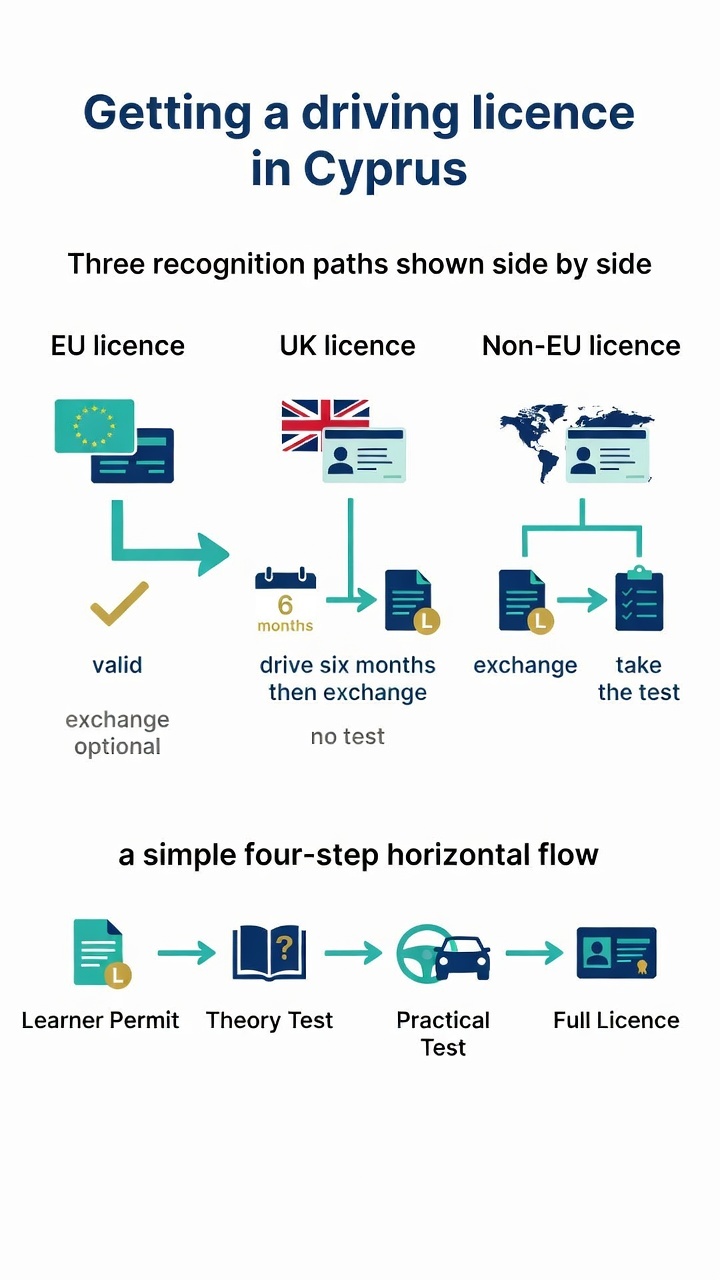
How to Get a Cyprus Driving Licence From Scratch
Eligibility and the learner’s permit
The theory test
The practical driving test
Costs and Fees for a Cyprus Driving Licence in 2026
Item Fee (2026) Learner’s / provisional permit 30 euro Theory test 10 euro Practical driving test 20 euro Full licence issue 40 euro Exchange of foreign licence (under 65) 40 euro Exchange of foreign licence (65 and over) Free Driving Rules and Road Conditions in Cyprus
Frequently Asked Questions About Driving Licences in Cyprus
Getting Road-Ready in Cyprus