
Retiring in Cyprus has become one of the most popular moves for pensioners from the UK, Europe, and beyond — and it is easy to see why. The island offers more than 320 days of sunshine a year, some of the lowest crime rates in Europe, English spoken almost everywhere, and a cost of living that stretches a pension much further than it would back home. Add a genuinely favourable tax system for foreign pensioners and warm, welcoming communities, and you have a retirement destination that keeps drawing people back.
This guide walks you through everything you need to plan a retirement in Cyprus in 2026: how much money you realistically need, the residency routes for both EU and non-EU citizens, the tax advantages, healthcare, the best places to settle, and how to choose and buy the right home. Whether you are just daydreaming or already booking a viewing trip, here is what to know before you make the move.
The appeal starts with the climate. Cyprus enjoys long, hot summers and short, mild winters, so outdoor living is a year-round reality rather than a summer treat. For retirees, that means more walking, swimming, gardening, and socialising — and often noticeably better health and mood.
Beyond the weather, three things stand out. First, safety: Cyprus consistently ranks among the safest countries in Europe, which matters enormously when you are settling somewhere new later in life. Second, language: English is widely spoken thanks to the island’s history and its large international community, so day-to-day life, banking, and medical appointments rarely require fluent Greek. Third, community: established expat hubs in Paphos, Larnaca, and the Limassol area mean you are never far from clubs, churches, coffee mornings, and friends who have already navigated the move.
There is also a practical financial angle. Property, dining out, fresh produce, and local services generally cost less than in the UK or northern Europe, so a fixed pension income simply goes further. For many, that is the difference between a comfortable retirement and a stretched one.
This is the question every prospective retiree asks first, and the honest answer is: less than you might think, but it depends on your lifestyle and location.
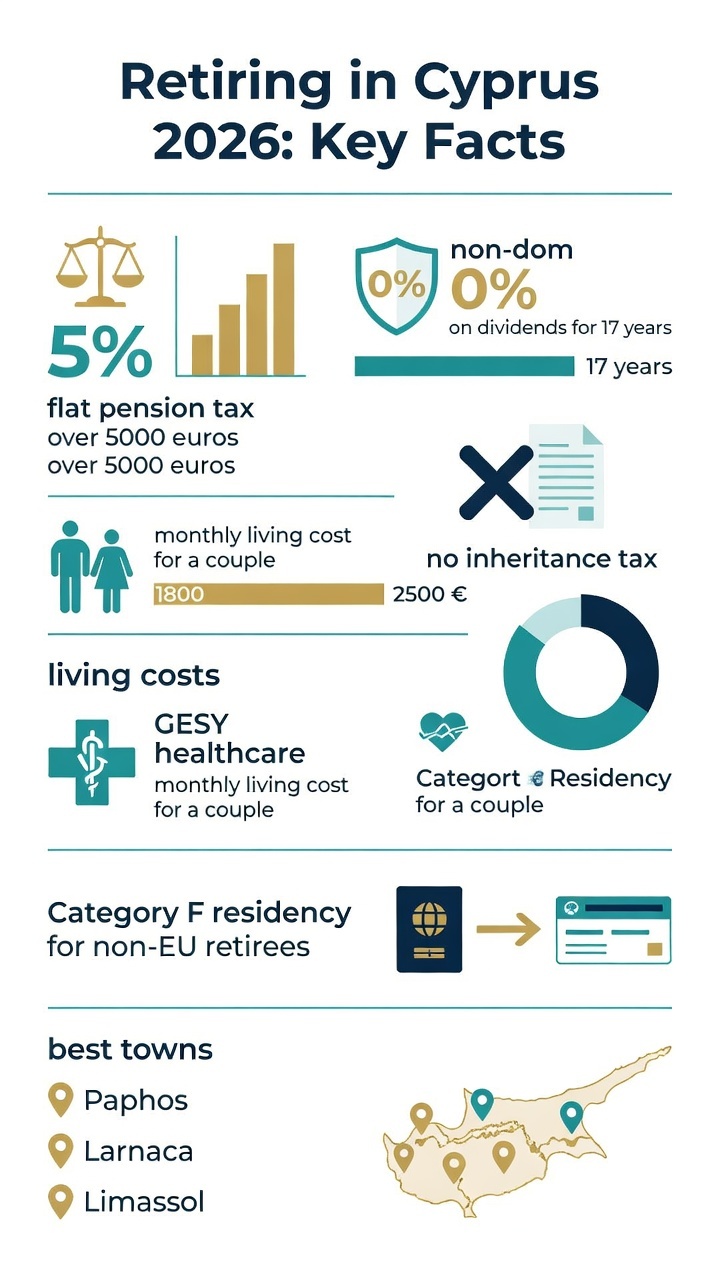
A couple living modestly outside the priciest districts can live comfortably on roughly €1,800–€2,500 per month, covering rent or property running costs, utilities, groceries, healthcare, and leisure. Choose a coastal village near Paphos or Larnaca and you will land at the lower end; choose central Limassol, the island’s most expensive city, and you should budget considerably more.
Independent cost-of-living data, such as Numbeo’s Cyprus figures, broadly confirms that everyday expenses run well below UK and northern-European levels. Typical monthly costs for a retired couple look something like this:
If you are buying rather than renting, your biggest one-off decision is the property itself. Apartment prices vary widely by district — you can check current figures for a two-bedroom apartment across Cyprus to benchmark your budget before you start viewing. Owning outright removes rent from the equation entirely, which is why so many retirees buy.
For residency purposes (more on that below), non-EU applicants must also prove a secured annual income. In 2026 the base threshold sits at roughly €9,600 for the main applicant, with around €4,600 added for each dependant, though many advisers recommend showing a higher, comfortable figure to smooth the process. Always confirm the current numbers with a qualified immigration lawyer, as thresholds are periodically revised.
Your residency path depends on your nationality, and this is where EU and non-EU retirees diverge sharply.
If you hold an EU passport, retiring in Cyprus is straightforward. You have the right to live on the island, and you simply register for a Registration Certificate (MEU1) once you have been resident for more than three months. You will need proof of sufficient income and health cover. There is no property purchase requirement and no income “threshold” in the immigration sense — the process is administrative rather than a hurdle.
Since Brexit, British retirees are treated as third-country nationals, so the most common route is the Category F Permanent Residence Permit. Category F is designed precisely for financially independent people who will not work in Cyprus and can support themselves from a secured overseas income such as a pension. It grants permanent residence, and unlike some fast-track schemes it does not require a large property investment — though buying a home strengthens any application and simplifies life on the ground.
There is also the well-known fast-track permanent residency route tied to a property purchase of at least €300,000 (plus VAT), which appeals to retirees who are buying anyway and want a quicker, more predictable timeline. If you are weighing these options, our guide to relocating to Cyprus breaks down the residency routes and practical steps in detail.
Whichever route applies to you, engage an immigration lawyer early. Application backlogs, document legalisation, and health-insurance requirements all take time, and a small mistake can add months.
Cyprus’s tax treatment of foreign pensioners is one of the strongest reasons people relocate here, and the 2026 rules made it even more attractive.
Foreign pension income is taxed in one of two ways, and you choose annually whichever is cheaper. You can pay a flat 5% on pension income above €5,000 per year (the exempt threshold was raised from €3,420 to €5,000 in the 2026 reform), or you can be taxed under the standard progressive income-tax bands. For most retirees with a meaningful pension, the flat 5% option is dramatically lower than what they would pay at home.
The advantages do not stop there:
To access these benefits you must become a Cyprus tax resident, which you can do under the 183-day rule or the flexible 60-day rule for those who spend limited time in any single other country — the PwC Cyprus tax summary sets out how both tests work. Tax planning is personal and the rules interact, so speak to a Cyprus tax adviser before relocating. index.cy is a property marketplace rather than a tax firm, so treat the above as general information and confirm your position with a licensed professional.
Healthcare is a decisive factor for anyone retiring abroad, and Cyprus scores well. The island runs a modern universal system called GESY (the General Healthcare System), which provides access to GPs, specialists, hospital care, and subsidised prescriptions at very low out-of-pocket cost.
Access depends on your status. EU retirees can often use their home-country entitlements or register through the reciprocal arrangements, while others gain access once they hold a residence permit and register as beneficiaries. Importantly, non-EU retirees generally cannot rely on GESY during the residency application window and must hold private health insurance in the meantime — a requirement for the permit itself. Once your permit is granted and you register, you can use the public system.
Many retirees keep a modest private policy even after joining GESY, using private clinics for faster appointments and English-speaking specialists while relying on GESY for major and ongoing care. Private hospitals in Nicosia, Limassol, and Paphos are well-regarded, and waiting times are typically short.
For a first-hand overview of the move, this walkthrough covers the essentials of retiring on the island:
Where you settle shapes your whole experience. Here are the districts retirees favour most, each with a different character.
Paphos is the undisputed capital of retirement living in Cyprus. Its large, long-established British and northern-European community means clubs, societies, and familiar comforts are everywhere, while the coastline, harbour, and archaeological sites give the town real charm. Prices are gentler than Limassol, and the pace is relaxed. Browse properties for sale in Paphos to see how far a budget goes here.
Larnaca offers coastal living at some of the island’s most reasonable prices, with a walkable seafront, an international airport on the doorstep for visiting family, and an ongoing marina and port redevelopment that is lifting the whole district. It suits retirees who want a real town rather than a resort. Explore Larnaca properties for sale for apartments and townhouses close to the sea.
Limassol is cosmopolitan, lively, and the most expensive option — a fit for retirees who want city energy, fine dining, a marina, and a large international scene, and who have the budget to match. For quieter, greener surroundings within reach of the city’s amenities, many buyers look at the hillside villages just inland. See what is available among villas for sale in Cyprus if you are after space and a pool.
Beyond the main towns, traditional stone villages near Paphos and in the Troodos foothills offer cooler summers, authentic community life, and lower prices — appealing to retirees seeking peace over convenience. The trade-off is that you will want a car and should factor in distance to hospitals and shops.

Once you have a shortlist of areas, the buying process in Cyprus is well-trodden and safe for foreign buyers, but doing it properly matters even more when this is the home you plan to grow old in.
Start with the practicalities of ageing in place. Single-level bungalows and ground-floor or lift-served apartments are worth prioritising; a beautiful hillside villa with dozens of steps can become a burden later. Proximity to a hospital, pharmacy, and public transport should weigh as heavily as the sea view.
On the transaction itself, three steps protect you. First, commission proper due diligence so you know the title is clean and there are no hidden encumbrances — our comprehensive due diligence guide explains exactly what to check. Second, if you are not paying cash, understand your options early; retirees can face different lending criteria, and our guide to financing your property purchase in Cyprus covers the essentials. Third, budget for transfer fees, stamp duty, legal fees, and — on some new-builds — VAT, on top of the purchase price.
A viewing trip is invaluable. Spend time in each shortlisted area at different times of day, talk to residents, and picture your actual daily routine rather than a holiday. Working with a reputable local agent and an independent lawyer — never the seller’s lawyer — keeps your interests protected throughout.
Yes. UK retirees now apply as non-EU citizens, most commonly through the Category F permanent residence permit or the property-linked fast-track route, provided you can show a secured pension income and hold health insurance.
A couple can live comfortably on roughly €1,800–€2,500 per month outside the most expensive areas. For non-EU residency, you must also prove a secured annual income, starting around €9,600 for a single applicant in 2026, plus more for dependants.
Yes. The GESY universal system provides low-cost access to GPs, specialists, and hospitals once you are eligible, and private clinics offer fast, English-speaking care. Non-EU retirees need private cover during the residency process.
Paphos is the most popular for its large expat community and gentle prices; Larnaca offers affordable coastal living near an airport; Limassol suits those wanting city life and can afford it.
Retiring in Cyprus offers a rare combination: a sunny, safe, English-friendly island with a genuinely favourable tax regime for foreign pensioners, solid healthcare, and property that lets a fixed income go further. For UK and European retirees especially, the mix of the flat 5% pension tax, non-dom benefits, and no inheritance tax is hard to beat.
The keys to a smooth move are simple. Plan your budget honestly, choose your district based on daily life rather than a holiday feeling, sort residency and health cover with professional help, and buy your home carefully with proper due diligence. Do those things, and Cyprus can be everything you pictured — and more.
When you are ready to start the search, browse thousands of homes across every district on index.cy, Cyprus’s leading property marketplace, and take the first step toward your retirement in the sun.
This article is general information for people considering retiring in Cyprus and does not constitute tax, legal, or immigration advice. Always confirm current thresholds and your personal position with a licensed Cyprus professional.