
What this guide covers
- Why People Are Relocating to Cyprus in 2026
- Residency and Visa Routes: How to Legally Move to Cyprus
- EU and EEA Citizens
- Non-EU Citizens: The Main Routes
- Pathway to Permanent Residence and Citizenship
- The Cost of Relocating to Cyprus
- Healthcare: How the GESY System Works
- Tax Advantages That Make Cyprus Attractive
- Choosing Where to Live: A District-by-District Snapshot
- A Practical Relocation Checklist
- Frequently Asked Questions
- Can foreigners easily relocate to Cyprus?
- How much money do I need to relocate to Cyprus?
- Is healthcare free in Cyprus for residents?
- Do I pay tax on foreign income if I move to Cyprus?
- Should I rent or buy when I first move to Cyprus?
Relocating to Cyprus has never been more popular. The island combines EU membership, 300-plus days of sunshine, English as a second language, and one of Europe’s friendliest tax regimes — a rare mix that draws retirees, remote workers, entrepreneurs and families in growing numbers each year. But a successful move takes more than a plane ticket. You need the right residency permit, a realistic budget, health cover, and a plan for where to live.
This guide walks you through everything relocating to Cyprus involves in 2026: the visa route that fits your situation, what life actually costs, how the GESY healthcare system works, the tax advantages that make the island so attractive, and how to choose between the five districts. Whether you are moving from the UK, the Gulf, or further afield, here is how to plan the move with confidence.
Why People Are Relocating to Cyprus in 2026
Cyprus sits at the crossroads of Europe, the Middle East and Africa, and that position shapes its appeal. As a full EU member using the euro, it offers legal stability, property rights and freedom of movement across the bloc for those who gain citizenship. Yet the cost of living remains 20–35% below Western European averages, and the Mediterranean climate delivers mild winters and long, warm summers.
The practical advantages add up quickly. English is widely spoken across business, healthcare and daily life, a legacy of the island’s history. Cyprus drives on the left, like the UK, and its legal system is based on English common law — small details that make the transition smoother for British and Commonwealth movers. The island is also one of the safest countries in Europe, with low crime rates and a relaxed, family-oriented culture.
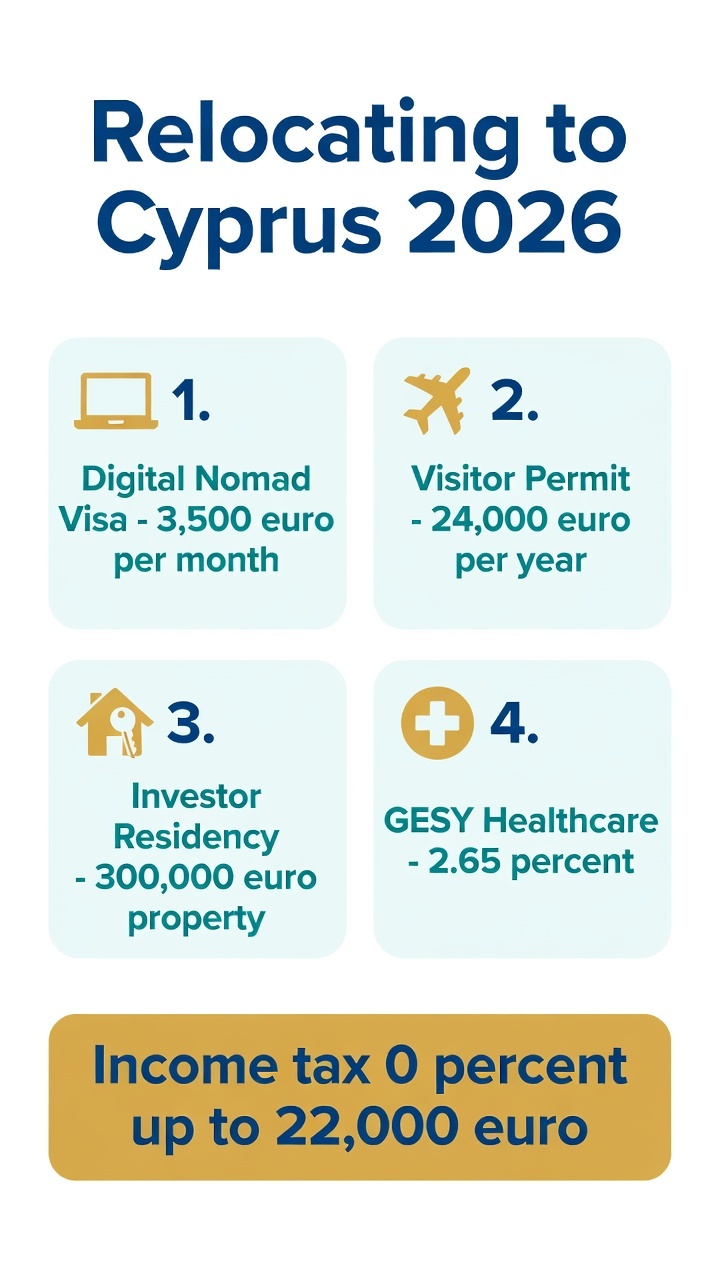
For remote workers and investors, the tax framework is the headline. Non-domiciled residents pay no tax on foreign dividends, interest or rental income, and the personal income tax-free threshold rose to €22,000 in 2026. Combine that with a stable property market and a well-established expat community, and it is easy to see why relocating to Cyprus tops so many shortlists. If you are weighing the day-to-day reality of the move, our complete expat guide to living in Cyprus covers what settling in really feels like.
Residency and Visa Routes: How to Legally Move to Cyprus
Your nationality determines how you gain the right to live in Cyprus. The process is straightforward for EU citizens and well-structured for everyone else.
EU and EEA Citizens
If you hold an EU, EEA or Swiss passport, you have the automatic right to live and work in Cyprus. You simply register with the authorities after arrival, obtaining a registration certificate (the “yellow slip”, form MEU1) once you have been in the country for more than three months. You will need proof of income or employment, accommodation and health cover. There is no visa, quota or investment requirement.
Non-EU Citizens: The Main Routes
Third-country nationals have several well-defined pathways, each suited to a different profile:
- Visitor Permit / “pink slip” (temporary residence): For retirees and those with passive income. You must show roughly €24,000 a year in secure foreign income, hold health insurance and have accommodation. Valid for one year and renewable, but does not permit local employment.
- Digital Nomad Visa: For remote workers employed by or running a business abroad. You need around €3,500 a month in net foreign income and can stay up to three years. See our dedicated Cyprus digital nomad visa guide for the full application process.
- Category F (independent means): A long-standing permanent route for people with a secured annual income of at least €10,000 from abroad, plus a Cyprus bank deposit. It suits pensioners and those living on investment income.
- Investor Permanent Residence (Regulation 6.2): The fast-track route, granted on the purchase of €300,000 (plus VAT) in new property, supported by €50,000 of annual income. Our permanent residence through property investment guide explains the requirements in detail.
- Employment routes: The Business Facilitation Unit work visa (tech sector, minimum salary around €2,500 a month) and the EU Blue Card for highly skilled professionals both allow non-EU nationals to work and, eventually, apply for citizenship.
Pathway to Permanent Residence and Citizenship
Temporary permits can lead to permanent residency, and continuous legal residence can eventually support a citizenship application (generally after several years, faster for certain skilled workers). If your goal is a residency-by-investment route tied to property, our Cyprus Golden Visa guide breaks down how the investor programme works and what it delivers.
The Cost of Relocating to Cyprus
Relocation costs fall into two buckets: the one-off expenses of moving, and your ongoing monthly budget once you arrive.
Upfront, budget for international shipping or a fresh set of furnishings, permit application fees, the first month’s rent plus a deposit (usually one to two months), private health insurance, and — if you drive — vehicle import or purchase. Many movers rent for the first six to twelve months before committing to a purchase, which spreads the cost and lets you get to know the districts first.
For everyday living, a single person can live comfortably on roughly €1,200–1,800 a month including rent, while a couple or small family should plan for €2,500–4,000 depending on the city and lifestyle. Limassol, the business capital, is the most expensive at €1,800–2,500 a month for one person; Larnaca, Paphos and Nicosia are noticeably cheaper. Groceries, dining out and utilities all sit below Western European norms, though imported goods and electricity can be pricier than newcomers expect.
The table below gives a realistic monthly snapshot for a single person by district.
| District | Rent (1-bed) | Total monthly budget | Best for |
|---|---|---|---|
| Limassol | €1,200–1,800 | €1,800–2,500 | Professionals, business, luxury lifestyle |
| Paphos | €600–900 | €1,200–1,700 | Retirees, UK expats, coastal value |
| Larnaca | €700–1,000 | €1,300–1,800 | Affordable coastal living, airport access |
| Nicosia | €700–1,000 | €1,300–1,800 | Working professionals, students, capital life |
| Famagusta (free area) | €600–900 | €1,200–1,600 | Beach lovers, holiday-home owners |
For a deeper breakdown of prices, our full cost of living in Cyprus guide compares groceries, utilities, transport and schooling across the island.
Healthcare: How the GESY System Works
Cyprus operates a universal healthcare system called GESY (the General Healthcare System, or GHS), introduced in 2019. Once you are a registered resident and contributing, GESY gives you access to GPs, specialists, hospital care, prescriptions and more through a mix of public and participating private providers.
Funding comes from income-based contributions — around 2.65% for employees and a higher rate for the self-employed, with contributions capped at a set income ceiling. For most residents this works out far cheaper than comprehensive private insurance elsewhere in Europe.
There is one important gap to plan for: before your GESY registration is complete, and as a requirement for most residence permit applications, you will need private health insurance. Basic cover from a Cyprus insurer typically costs €40–80 a month. Many expats keep a private policy even after joining GESY, using it for faster access to certain specialists or private hospitals. Factor health cover into your budget from day one — it is both a legal requirement for your permit and essential peace of mind while you settle in.
Tax Advantages That Make Cyprus Attractive
Cyprus is one of the reasons the island competes with Portugal, Malta and Dubai for internationally mobile residents. Two features stand out.
Non-domiciled (non-dom) status. If you become a Cyprus tax resident but your domicile of origin is outside Cyprus, you can claim non-dom status for up to 17 years. Non-doms pay no Special Defence Contribution on dividends, interest or rental income — including foreign-sourced income. In practice, foreign dividends carry only the modest GESY health levy (2.65%, capped), giving an effective rate of roughly 5% on that passive income. For investors and business owners living off dividends, this is a major draw.
A generous income tax scale. Following the 2026 reform, the personal income tax bands are:
| Annual income | Tax rate |
|---|---|
| Up to €22,000 | 0% |
| €22,001 – €32,000 | 20% |
| €32,001 – €42,000 | 25% |
| €42,001 – €72,000 | 30% |
| Over €72,000 | 35% |
The tax-free threshold rose from €19,500 to €22,000 in 2026, and the middle bands were widened, lowering the effective burden across the income scale. Cyprus also has no wealth tax, no inheritance tax and no annual immovable property tax.
To be treated as a tax resident, you generally spend 183 days a year in Cyprus, or qualify under the 60-day rule — spending at least 60 days on the island, not being tax resident elsewhere, and maintaining a home plus a business or employment tie in Cyprus. A 2026 change simplified the 60-day rule by removing the previous need to prove non-residency in another specific country. Tax planning is personal, so confirm your position with a qualified Cyprus tax adviser before you move — this guide is general information, not tax advice.
Choosing Where to Live: A District-by-District Snapshot
Cyprus has five districts (four in the government-controlled area plus the free part of Famagusta), and each attracts a different kind of mover.
Limassol is the cosmopolitan business hub — home to international companies, marinas, the largest expat professional community and the highest prices. It suits executives, entrepreneurs and anyone who wants city energy with a seafront. Paphos, on the west coast, is the traditional UK-expat and retiree favourite: quieter, greener, more affordable, with a large English-speaking community. Browse properties for sale in Paphos to gauge the market.

Larnaca offers the best value on the coast, with the island’s main international airport on its doorstep — convenient for frequent travellers. Nicosia, the inland capital, is where much of the year-round working population lives; it is the most affordable big city and the least tourist-driven. The free area of Famagusta, including Ayia Napa and Protaras, appeals to beach lovers and holiday-home buyers.
Most successful movers rent before they buy. Renting first lets you test a district through all four seasons before committing capital — you can start by exploring rental listings in Limassol and comparing neighbourhoods. When you are ready to buy, running an instant property report on any listing gives you a data-backed valuation before you make an offer.
A Practical Relocation Checklist
Pulling it together, here is the order most smooth relocations follow:
- Choose your visa route based on nationality, income source and long-term goals.
- Gather documentation — passport, proof of income, criminal record check, marriage/birth certificates (apostilled and translated where required).
- Secure health insurance before you apply for your permit.
- Open a Cyprus bank account and, where needed, place the required deposit.
- Rent accommodation for your first 6–12 months in your chosen district.
- Register with the authorities and apply for your residence permit.
- Register for GESY once eligible, and confirm your tax residency position with an adviser.
- Enrol children in school — Cyprus has strong public schools and many private and international options in Limassol, Nicosia and Paphos.
If you are moving specifically from Britain, our dedicated guide to moving to Cyprus from the UK covers the extra steps — from shipping and pets to pensions and NHS-to-GESY transitions. Retirees will also find our retire to Cyprus guide useful for pension and lifestyle planning.
Frequently Asked Questions
Can foreigners easily relocate to Cyprus?
Yes. EU citizens simply register after arrival, while non-EU nationals choose from several structured routes — a visitor permit for retirees, a digital nomad visa for remote workers, Category F for those with independent income, or investor permanent residence tied to a €300,000 property purchase. Each has clear income and documentation requirements.
How much money do I need to relocate to Cyprus?
Budget for upfront costs (permit fees, shipping, deposit, first month’s rent, health insurance) plus ongoing living expenses. A single person needs roughly €1,200–1,800 a month including rent; a family should plan €2,500–4,000. Investor and passive-income routes require proof of €10,000–50,000+ in annual income depending on the permit.
Is healthcare free in Cyprus for residents?
Cyprus’s GESY system provides comprehensive care funded by income-based contributions of around 2.65% for employees. It is not entirely free but is very affordable. You will need private health insurance (€40–80 a month) before your GESY registration is complete and for most permit applications.
Do I pay tax on foreign income if I move to Cyprus?
With non-domiciled status — available for up to 17 years — you pay no Special Defence Contribution on foreign dividends, interest or rental income, giving an effective rate of about 5% on foreign passive income. Employment income is taxed on the progressive scale, which starts at 0% up to €22,000. Always confirm your situation with a Cyprus tax adviser.
Should I rent or buy when I first move to Cyprus?
Most relocation experts recommend renting for the first 6–12 months. This lets you experience a district through every season, understand local prices, and avoid a rushed purchase. Once you know where you want to settle, you can buy with confidence — and an instant property report helps you value any listing before you commit.
Relocating to Cyprus in 2026 is a well-trodden path with clear rules, real tax advantages and a lifestyle that keeps drawing people back. Get the visa route right, budget realistically, secure your health cover, and rent before you buy — and the island rewards you with sunshine, safety and a genuinely lower cost of living. When you are ready to find your Cyprus home, index.cy — the country’s #1 property marketplace — brings every listing and the data to value it into one place.
More about Limassol

We analysed 217 Erimi, Limassol listings: 105 apartments, 81 houses and 24 plots. Median 2-bed flat EUR295,000. See prices, the repeat-advert trap…
We analysed 48 Kalo Chorio, Limassol listings: 33 plots, 11 houses and 4 rentals. Large plots start near EUR4 per sqm. See…

Five companies that design modern villas in Limassol — what each of them covers, and the questions worth settling before you sign…
Keep reading
We analysed 217 Erimi, Limassol listings: 105 apartments, 81 houses and 24 plots. Median 2-bed flat EUR295,000. See prices, the repeat-advert trap…

We analysed 319 Aglantzia, Nicosia listings: 155 apartments, 34 houses and 38 plots. Median 2-bed costs EUR257,500. See prices, rents and what…

We analysed 387 Egkomi (Engomi), Nicosia listings: 169 apartments, 73 houses and 99 rentals. Median 2-bed costs EUR285,000. See prices, rents and…