
What this guide covers
- The Cyprus Job Market in 2026: An Honest Snapshot
- Salaries in Cyprus: What You Can Actually Expect
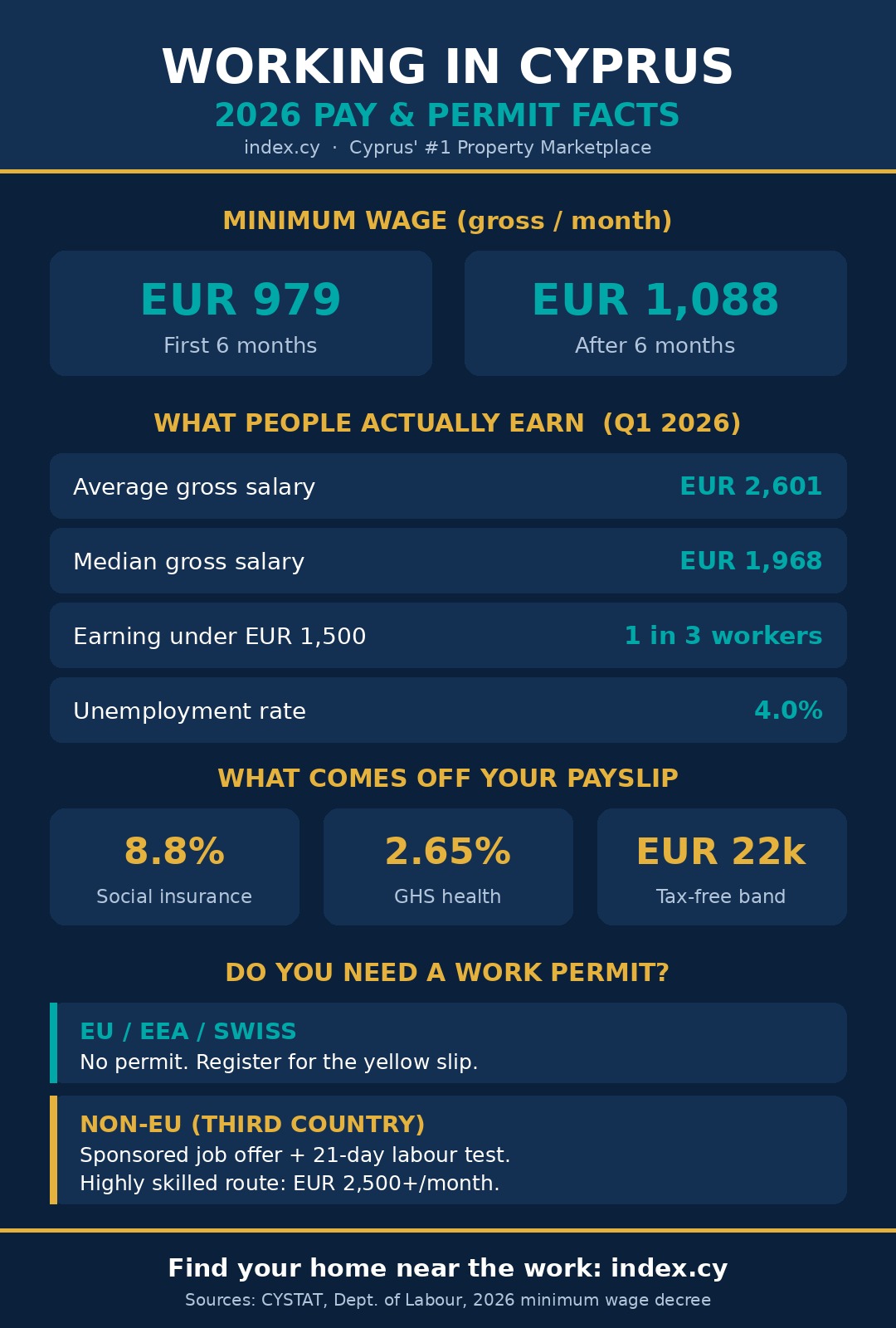
- Minimum Wage in Cyprus 2026: €979 and €1,088
- Do You Need a Work Permit to Work in Cyprus?
- EU, EEA and Swiss citizens
- Non-EU (third-country) nationals
- The highly skilled route
- Remote workers
- Which Sectors Are Actually Hiring
- What Comes Out of Your Cyprus Payslip
- How to Find a Job in Cyprus
- Where to Live When You’re Working in Cyprus
- Frequently Asked Questions About Working in Cyprus
- Can a foreigner work in Cyprus?
- What is a good salary in Cyprus in 2026?
- Do I need to speak Greek to work in Cyprus?
- Is it easy to find a job in Cyprus?
- How many hours is a standard Cyprus working week?
- The Bottom Line on Working in Cyprus
Working in Cyprus has rarely looked more attractive than it does in 2026. Unemployment has fallen to 4.0%, average gross earnings have climbed to €2,601 a month, and the island’s technology, shipping and professional-services sectors are hiring at a pace the old tourism-dominated economy never matched. For anyone weighing up a move — whether you are an EU citizen who can start tomorrow or a third-country national who needs a sponsored permit — the practical questions are the same: what will you earn, what comes out of your payslip, what paperwork do you need, and where should you live?
This guide answers all four with current 2026 figures. We have no stake in where you end up working; as Cyprus’ largest property marketplace, our interest is simply that you understand the market before you commit to a lease or a purchase.
The Cyprus Job Market in 2026: An Honest Snapshot
The headline numbers are genuinely good. Unemployment fell to 4.0% in the first quarter of 2026, down from 5.0% a year earlier, and the employment rate now sits close to 77%. That is a tight labour market by European standards, and it gives candidates real bargaining power in the sectors that are short of staff.
The structure of the economy explains where those jobs are:
- Services: 81.8% of total employment — tourism, finance, shipping, ICT, professional services, healthcare, education
- Industry: 16.3% — construction, manufacturing, energy
- Agriculture: 1.9% — small, seasonal, and shrinking
One caveat worth stating plainly: youth unemployment (ages 15–24) rose to 13.1% in Q1 2026 from 11.2% a year earlier. The market is strong for experienced professionals and specialists; it is noticeably tougher for graduates without a niche skill or a network.
Cyprus is also a small market. The entire island has roughly the working population of a mid-sized European city, which means job openings are fewer in absolute terms and personal referrals carry more weight than they would in London or Berlin. Plan for a longer search and a more relationship-driven process.
Salaries in Cyprus: What You Can Actually Expect
Average gross monthly earnings reached €2,601 in Q1 2026, up 3.7% year on year, according to the Cyprus Statistical Service. But the average is the wrong number to plan your life around.
The median salary is €1,968 — and roughly one in three employees earns less than €1,500 a month, as Cyprus Mail reported from the latest CYSTAT release. The gap between the two figures tells you everything about how Cypriot pay is distributed: a concentrated group of high earners in finance, shipping and tech pulls the average up, while large parts of retail, hospitality and administrative work sit far below it.
| Measure (Q1 2026, gross monthly) | Amount |
|---|---|
| Average earnings — all employees | €2,601 |
| Median earnings | €1,968 |
| Average — male employees | €2,776 |
| Average — female employees | €2,378 |
| Minimum wage (after 6 months) | €1,088 |
| Minimum wage (first 6 months) | €979 |
These are gross figures and include the 13th salary, bonuses, overtime and cost-of-living allowance where they apply — so a headline “€2,600 average” does not mean €2,600 landing in your account each month. Deductions are covered further down.
Indicative ranges by sector, drawn from current market listings, look roughly like this: hospitality and retail typically €1,000–€1,800; administrative and customer-service roles €1,300–€2,200; qualified accountants, lawyers and engineers €2,500–€4,500; and experienced software, fintech and shipping professionals frequently €4,000–€7,000 or more. Treat these as orientation, not a promise — Cyprus salaries vary widely between a Limassol multinational and a family business in a village.
Minimum Wage in Cyprus 2026: €979 and €1,088
Cyprus introduced a national minimum wage in 2023 and has raised it every year since. From 1 January 2026 the statutory rates are:
- €979 gross per month for the first six months with the same employer
- €1,088 gross per month once six months of continuous employment are completed
That is an increase of roughly 8.8% on the 2025 rate of €1,000, and it applies to full-time employees across almost all sectors. A handful of categories — including domestic workers, agricultural and livestock workers, and seafarers — sit outside the general decree and are governed separately.
Two practical notes. First, the minimum wage is a floor, not a market rate: in Limassol or Nicosia, €1,088 gross is difficult to live on once rent is accounted for, which is why the cost of living in Cyprus deserves a careful look before you accept an offer. Second, the six-month threshold resets with a new employer, so job-hopping early on can keep you on the lower rate.
Do You Need a Work Permit to Work in Cyprus?
This is where EU and non-EU citizens diverge sharply.
EU, EEA and Swiss citizens
You have the right to live and work in Cyprus without a work permit. What you do need is registration: after three months you must apply for a registration certificate — the “yellow slip” (MEU1) — at the Civil Registry and Migration Department. Our Cyprus yellow slip guide walks through the documents and appointments. Employment itself is unrestricted, and you access the health system and social insurance on the same terms as Cypriots.
Non-EU (third-country) nationals
You need a sponsored job offer before you arrive. The process is employer-led and overseen by the Department of Labour’s Public Employment Service:
- Labour market test. The employer advertises the vacancy through the Public Employment Service for 21 days to demonstrate no suitable Cypriot or EU candidate is available.
- Application to the Department of Labour, followed by an application to the Civil Registry and Migration Department for entry and residence.
- Entry visa collected from the Cyprus consulate in your home country.
- Registration on arrival with the District Aliens and Immigration Unit, and issue of your residence card — the pink slip.
Processing has improved considerably with digital filing, with recent cases averaging around four weeks rather than the several months applicants once faced.
The highly skilled route
Companies registered as foreign-interest businesses can hire third-country professionals on a faster track, bypassing the standard labour market test. The core criteria are a minimum gross salary of €2,500 per month, a relevant university degree or at least two years of relevant experience, and an employment contract of at least two years. Permits are typically granted for three years and renewable. Support staff earning under €2,500 can also be employed, but are capped at 30% of the company’s support workforce.
This route is the reason Limassol’s fintech, forex and software sector is so international — and why demand for quality rental and purchase stock in the city has been so persistent.
Remote workers
If your employer and income are outside Cyprus, you are not entering the local labour market at all. The digital nomad visa is the appropriate route, with its own income threshold and residence conditions.
Which Sectors Are Actually Hiring

Technology, fintech and forex. Concentrated in Limassol, with a growing Nicosia cluster. Software engineers, DevOps, data analysts, compliance and risk officers, and multilingual customer-support specialists are in consistent demand. This is the sector where salaries most often exceed €4,000 and where English is the working language.
Shipping and maritime. Cyprus is one of the largest ship-management centres in the world, and Limassol is its home. Technical superintendents, crewing, chartering, marine insurance and maritime law all recruit internationally.
Professional and financial services. Audit, tax, corporate administration and legal services employ heavily in Nicosia and Limassol. Qualified accountants (ACA/ACCA) are perennially sought after.
Tourism and hospitality. Still a major employer, particularly in Paphos, Ayia Napa and Protaras, and still highly seasonal. Contracts often run March to November, and pay sits at the lower end unless you are in management.
Healthcare. Expanding since the rollout of the national health system, with recruitment of doctors, nurses and allied health professionals — though registration and, in most public-facing roles, Greek language ability are prerequisites.
Construction and real estate. Sustained development activity keeps demand up for civil engineers, quantity surveyors, project managers and licensed agents.
What Comes Out of Your Cyprus Payslip
Cyprus is a low-tax country by European standards, and that is a genuine part of the compensation package. Two deductions come off gross pay before income tax:
- Social insurance: 8.8% of gross earnings (matched by your employer), applied up to a cap on insurable earnings of €68,904 per year from 1 January 2026
- GHS/GESY health contribution: 2.65% of gross earnings
Income tax is then charged progressively on your remaining taxable income, with the 2026 tax-free threshold raised to €22,000:
| Annual taxable income | Rate |
|---|---|
| Up to €22,000 | 0% |
| €22,001 – €32,000 | 20% |
| €32,001 – €42,000 | 25% |
| €42,001 – €72,000 | 30% |
| Over €72,000 | 35% |
The practical consequence is striking: a worker on the minimum wage pays no income tax at all, and someone on the €2,601 average pays tax on only a modest slice of their earnings. If you are relocating with foreign investment income as well as a salary, the interaction with residency rules matters — our Cyprus tax residency guide covers the 183-day and 60-day tests and the non-dom regime.
This section is general information, not tax advice. Confirm your position with a licensed Cyprus tax adviser before making decisions.
How to Find a Job in Cyprus
- The Public Employment Service portal (ergodotisi.com) is the government portal where all permit-related vacancies must be advertised — useful both for openings and for gauging what employers are legally required to offer.
- EURES, the European employment network, lists Cyprus vacancies and provides free relocation support for EU jobseekers.
- LinkedIn and local boards such as Kariera.com.cy carry most private-sector professional roles.
- Specialist recruiters dominate the fintech, shipping and legal markets — several Limassol agencies fill senior roles almost exclusively.
- Referrals. In a market this small, a large share of mid and senior positions are filled before they are ever advertised. Attending industry meetups in Limassol and Nicosia is not optional networking fluff; it is the most efficient channel available.
Applications are usually in English for international companies and in Greek for public-sector and locally focused employers. Interview processes are typically shorter than in northern Europe, and verbal offers move quickly.
Where to Live When You’re Working in Cyprus
Cyprus is small, but it is not commuter-friendly in the way that a metro system would make it. There is no rail network, and while intercity buses connect the main towns, most working residents drive. Living within 20–30 minutes of your office genuinely matters.
Limassol is the centre of gravity for tech, forex, shipping and professional services — and the most expensive place to live. Salaries are highest here and so are rents. If your job is in Limassol, look at the eastern suburbs and Germasogeia for a balance of commute and cost, or explore property for sale in Limassol if you are settling long term. Our guide to living in Limassol covers neighbourhoods in detail.
Nicosia is the capital and the administrative, legal and banking hub. It is inland, hotter in summer, and meaningfully cheaper — property in Nicosia typically costs less per square metre than comparable coastal stock, which makes it the strongest value proposition for a salaried buyer.
Larnaca offers the shortest airport commute and moderate prices, and increasingly attracts remote workers and staff who commute to Limassol or Nicosia.
Paphos suits tourism, healthcare and remote roles, with the lowest housing costs of the four but the thinnest professional job market.
If you are arriving on a first contract, renting before buying is almost always the right call — a year in the country tells you more about traffic, neighbourhoods and schools than any amount of research. Start with our renting guide and, when you are ready to buy, run an instant property report before making an offer so you know what the asking price is actually built on. For a broader comparison of districts, see the best places to live in Cyprus, and for the full move checklist, our relocating to Cyprus guide.
Frequently Asked Questions About Working in Cyprus
Can a foreigner work in Cyprus?
Yes. EU, EEA and Swiss citizens can work without a permit and simply register for a yellow slip. Non-EU nationals need a sponsored job offer and an employment permit arranged by the employer through the Department of Labour and the Civil Registry and Migration Department.
What is a good salary in Cyprus in 2026?
Anything above the €1,968 median puts you ahead of half the workforce. A household income of €3,000–€3,500 gross supports a comfortable standard of living outside central Limassol; in Limassol itself, budget closer to €4,000 for the same comfort once rent is included.
Do I need to speak Greek to work in Cyprus?
Not in the international sectors. Tech, fintech, forex, shipping and much of professional services operate in English. Greek becomes important in public-sector roles, healthcare, education, retail and any customer-facing local business — and it helps everywhere socially.
Is it easy to find a job in Cyprus?
It depends entirely on your field. Specialists in software, compliance, accounting, shipping and healthcare are actively recruited. Generalists, recent graduates and those without EU work rights face a much longer search, and youth unemployment at 13.1% reflects that.
How many hours is a standard Cyprus working week?
Typically 38–40 hours, usually Monday to Friday. Many local businesses still observe an extended afternoon break in summer, and public-sector hours differ from the private sector.
The Bottom Line on Working in Cyprus
Working in Cyprus in 2026 means entering a tight labour market with 4.0% unemployment, a €1,088 minimum wage, a €2,601 average salary against a more realistic €1,968 median, and one of the lightest tax burdens in the EU. The opportunity is concentrated: Limassol’s tech, forex and shipping cluster and Nicosia’s professional-services base offer genuinely competitive pay, while tourism and retail roles sit much closer to the minimum.
Get the sequence right and the move is straightforward — confirm your permit route, negotiate against real salary data rather than the headline average, and rent before you buy. When you are ready to put down roots, index.cy lists more than 60,000 verified properties across all five districts, so you can match your housing decision to where the work actually is — including apartments across Cyprus.
More about Limassol

We analysed 48 Kalo Chorio, Limassol listings: 33 plots, 11 houses and 4 rentals. Large plots start near EUR4 per sqm. See…

Five companies that design modern villas in Limassol — what each of them covers, and the questions worth settling before you sign…

Mesa Geitonia property prices from 1,009 live listings: flats ask €440,500, two-beds €450,000 on a 5.3% gross yield. See rents, bedroom mix…
Keep reading

Larnaca Property Market Surges: Which Areas Are Leading the Price Rise? Larnaca’s property market has experienced a notable surge in prices recently,…

We analysed 66 Tseri, Nicosia listings: 18 apartments, 8 houses and 34 plots. Median 2-bed price is EUR174,000. See prices and what…

We analysed 246 Lakatamia, Nicosia listings: 129 apartments, 52 houses and 46 plots. Median 2-bed price is EUR195,000. See prices and what…