What this guide covers
- Why Cyprus? A Quick Overview for Prospective Residents
- Limassol: Best for Professionals, Entrepreneurs, and Cosmopolitan Living
- Lifestyle and Amenities in Limassol
- Property Prices in Limassol
- Paphos: Best for Retirees, UK Expats, and Relaxed Coastal Living
- Lifestyle and Amenities in Paphos
- Property Prices in Paphos
- Larnaca: Best for Budget-Conscious Buyers, Families, and Airport Proximity
- Lifestyle and Amenities in Larnaca
- Property Prices in Larnaca
- Nicosia: Best for Careers, Culture, and Authentic Cypriot Life
- Lifestyle and Amenities in Nicosia
- Property Prices in Nicosia
- Famagusta District: Best for Affordable Beach Living and Emerging Opportunities
- Lifestyle and Amenities in Famagusta District
- Property Prices in Famagusta
- Comparing Districts: Which Location Fits Your Lifestyle?
- Practical Tips for Choosing Where to Live in Cyprus
- Making Your Move: Next Steps
Cyprus consistently ranks among Europe’s most desirable places to relocate. With over 300 days of sunshine per year, an affordable Mediterranean lifestyle, and a thriving expat community, the island attracts thousands of new residents annually from the UK, Europe, the Middle East, and beyond.
But choosing the best place to live in Cyprus depends entirely on what you’re looking for. A young professional relocating for work will have different priorities than a retired couple seeking a quiet coastal village, or a family needing international schools and safe neighborhoods.
This guide breaks down every major district and area in Cyprus — comparing lifestyle, cost of living, property prices, amenities, safety, and community — so you can find the location that matches your priorities. Whether you’re an expat planning your move, a family weighing your options, or a retiree searching for your forever home, this district-by-district comparison gives you the data and local insight you need to decide with confidence.
Why Cyprus? A Quick Overview for Prospective Residents
Before diving into individual locations, it’s worth understanding what makes Cyprus such an attractive place to live overall.
Cyprus offers a unique combination of European Union membership, English as a widely spoken second language, a favorable tax regime, and a remarkably low crime rate. The island’s healthcare system includes both public and private options, with private health insurance costing significantly less than in the UK or Western Europe.
The cost of living in Cyprus runs approximately 25-35% lower than most Western European capitals, depending on your lifestyle. Groceries, dining out, and utilities are particularly affordable, while imported goods and certain luxury items may cost more.
For property buyers, Cyprus offers transparent ownership laws, a straightforward purchasing process for EU citizens, and accessible residency pathways through property investment. If you’re considering buying, our comprehensive guide to living in Cyprus covers the broader picture of daily life, visas, and practical considerations.
Now, let’s explore where exactly you should settle.
Limassol: Best for Professionals, Entrepreneurs, and Cosmopolitan Living
Limassol is the undisputed business and lifestyle capital of Cyprus. With the island’s largest port, a booming tech sector, and a skyline that’s been transformed by modern high-rises over the past decade, Limassol attracts young professionals, entrepreneurs, and international families who want urban energy with a Mediterranean twist.
Who it’s best for: Working professionals, tech workers, entrepreneurs, families seeking international schools, and anyone who values a vibrant social scene, diverse dining options, and a cosmopolitan atmosphere.
Lifestyle and Amenities in Limassol
Limassol’s seafront promenade — Molos — stretches for over a kilometer and serves as the social heart of the city. The marina area features upscale restaurants, boutique shopping, and nightlife that rivals any European coastal city. Beyond the waterfront, the old town offers authentic Cypriot culture, craft markets, and traditional tavernas.
International schools in Limassol include several British-curriculum and IB programs, making it the top choice for families with school-age children. Healthcare facilities are excellent, with multiple private hospitals and specialist clinics.
Property Prices in Limassol
Limassol commands the highest property prices on the island. Apartments in central locations and near the seafront typically start from €200,000 for a one-bedroom and can exceed €500,000 for premium two- and three-bedroom units. Villas in surrounding areas like Germasogeia, Agios Tychonas, and Mouttagiaka range from €400,000 to well over €1 million. You can browse the full range of properties for sale in Limassol to compare current market pricing.
Safety: Limassol is considered very safe by European standards. The city has a visible police presence, well-lit public areas, and low crime rates. Petty crime exists, as in any Mediterranean city, but violent crime is extremely rare.
Considerations: Traffic congestion during peak hours can be significant, particularly along the coastal road. Limassol is also the most expensive district for both property and daily expenses. Summer humidity along the coast can be intense — residents in the hillside areas around Pissouri and the wine villages enjoy cooler temperatures.
Paphos: Best for Retirees, UK Expats, and Relaxed Coastal Living
Paphos is the spiritual home of the British expat community in Cyprus. Located on the island’s western coast, it offers a gentler pace of life, stunning natural landscapes, and a well-established English-speaking community that makes the transition from abroad remarkably smooth.
Who it’s best for: Retirees, UK and European expats, couples seeking a quieter lifestyle, nature lovers, and anyone who prioritizes community, affordability, and access to beautiful coastline.
Lifestyle and Amenities in Paphos
Paphos divides into two main areas: Kato Paphos (the lower, coastal area with the harbor, archaeological sites, and tourist infrastructure) and Pano Paphos (the upper town, where most locals and long-term residents live). The surrounding villages — Peyia, Tala, Chloraka, and Coral Bay — are where the majority of expats settle.
The expat community in Paphos is exceptionally well-organized, with social clubs, volunteer groups, English-language church services, and regular community events. For retirees, this ready-made social network is one of Paphos’s strongest advantages. If you’re considering retirement specifically, our guide to retiring in Cyprus covers pensions, healthcare, and tax planning in detail.
Healthcare in Paphos includes Paphos General Hospital and several private clinics. The private healthcare system is affordable and high-quality, with many doctors trained in the UK and speaking fluent English.
Property Prices in Paphos
Paphos offers some of the best value on the island. A two-bedroom apartment typically costs between €120,000 and €200,000, while villas with pools in the Peyia and Coral Bay areas range from €250,000 to €500,000. The price-per-square-meter in Paphos runs roughly 30-40% lower than equivalent properties in Limassol. Explore current listings of properties for sale in Paphos.
Safety: Paphos is widely considered one of the safest areas in Cyprus. The district’s smaller population, close-knit communities, and lower density create a secure environment that’s especially appealing for retirees and families.
Considerations: Job opportunities in Paphos are more limited compared to Limassol and Nicosia. The area is more tourism-dependent, which means some businesses operate seasonally. Public transport is limited — a car is essentially a necessity. Paphos also has fewer international school options than Limassol.
Larnaca: Best for Budget-Conscious Buyers, Families, and Airport Proximity
Larnaca occupies a strategic sweet spot on Cyprus’s southeastern coast. It offers genuine coastal living at more accessible price points than Limassol, with the added advantage of being home to the island’s main international airport.
Who it’s best for: Budget-conscious expats, families looking for affordable property near the sea, frequent travelers who want airport proximity, and professionals who commute between cities.
Lifestyle and Amenities in Larnaca
Larnaca’s Finikoudes promenade — lined with palm trees, cafes, and restaurants — gives the city a relaxed, walkable feel. The Mackenzie Beach area has emerged as a popular residential neighborhood, combining beach access with restaurants and an increasingly vibrant social scene.
The city center is compact and easy to navigate, with a traditional market, churches, and the medieval Larnaca Fort. Larnaca Salt Lake, just south of the city, provides a stunning natural backdrop and attracts flamingos during winter months.
International schools in Larnaca include several English-curriculum options, and the city’s healthcare infrastructure features both public and private facilities. Being just 10 minutes from Larnaca International Airport makes the city ideal for those who travel frequently or maintain business connections abroad.
Property Prices in Larnaca
Larnaca is among the most affordable coastal districts in Cyprus. Two-bedroom apartments near the beach start around €130,000-€180,000, and houses in surrounding areas like Pervolia, Oroklini, and Livadia range from €200,000 to €350,000. See current Larnaca properties for sale for up-to-date pricing.
Safety: Larnaca is very safe, with crime rates comparable to other Cyprus districts. The city has a strong community feel, particularly in residential neighborhoods away from the tourist center.
Considerations: Larnaca’s social and dining scene is less developed than Limassol’s, though it has improved considerably in recent years. Development projects, including a new marina and mixed-use waterfront, are expected to transform parts of the city over the coming years. The surrounding area lacks the dramatic mountain scenery of Limassol or Paphos.
Nicosia: Best for Careers, Culture, and Authentic Cypriot Life
Nicosia, the island’s capital and only landlocked city, is where Cyprus’s government, business, and cultural institutions are concentrated. It offers an entirely different experience from the coastal cities — more urban, more traditionally Cypriot, and less influenced by tourism.
Who it’s best for: Professionals and civil servants, culture enthusiasts, families who prefer a city environment with lower property costs, and anyone wanting to experience authentic Cypriot daily life away from the beach-resort atmosphere.
Lifestyle and Amenities in Nicosia
Nicosia’s old city, enclosed by Venetian walls, is a fascinating blend of historical architecture, trendy cafes, art galleries, and boutique shops. The city has a growing food scene, vibrant nightlife centered around the Phaneromeni area, and cultural institutions including the Cyprus Museum, the Leventis Gallery, and multiple theaters.
As the capital, Nicosia offers the best employment opportunities outside of Limassol, particularly in government, banking, professional services, and education. The University of Cyprus and several private universities bring a young, energetic population to the city.
Healthcare in Nicosia is the most comprehensive on the island, with Nicosia General Hospital being the largest in Cyprus and numerous specialist private clinics and hospitals.
Property Prices in Nicosia
Nicosia offers the most affordable property prices of any major Cyprus city. Two-bedroom apartments in desirable areas like Strovolos, Engomi, and Aglantzia range from €120,000 to €180,000 — significantly less than equivalent properties in Limassol. Houses in suburban neighborhoods start around €200,000. Browse Nicosia properties for sale for current options.
Safety: Nicosia is safe, with certain areas around the Buffer Zone feeling quieter after dark but posing no real danger. Suburban residential areas are extremely secure and family-friendly.
Considerations: The biggest trade-off is the absence of beaches — the nearest coastline is about 45 minutes by car. Nicosia also experiences hotter summers and cooler winters than the coastal cities, with temperatures occasionally exceeding 40°C in July and August. Traffic can be challenging, though less so than Limassol.
Famagusta District: Best for Affordable Beach Living and Emerging Opportunities
The Famagusta district — encompassing popular resort towns like Ayia Napa, Protaras, and Paralimni — offers a unique combination of some of Cyprus’s best beaches and surprisingly affordable property outside the resort centers.
Who it’s best for: Budget-conscious beach lovers, investors looking for emerging markets, remote workers seeking affordable coastal living, and those who enjoy a quieter winter lifestyle with vibrant summers.
Lifestyle and Amenities in Famagusta District
Ayia Napa and Protaras are renowned for their crystal-clear waters and sandy beaches — Nissi Beach and Fig Tree Bay consistently rank among Europe’s best. Outside the peak summer season, these towns transform into quiet, peaceful communities with a genuine local character.
Paralimni, the district’s administrative center, offers a more year-round residential feel with local shops, markets, and services. The area is developing rapidly, with new residential projects and improving infrastructure.
Property Prices in Famagusta
The Famagusta district offers excellent value, particularly in Paralimni and surrounding villages. Apartments start from €100,000, and houses from €180,000. Beachfront properties in Protaras command premium prices but still undercut Limassol equivalents. Check current Famagusta properties for sale for available listings.
Safety: The district is very safe, with the small-town character of Paralimni and off-season quiet of the resort towns creating a secure environment.
Considerations: The Famagusta district is the most seasonal area of Cyprus. Many restaurants, shops, and services operate reduced hours or close entirely from November to March. Employment opportunities are heavily tourism-dependent. The area has fewer international schools and specialist healthcare providers than Limassol or Nicosia, though Larnaca’s facilities are within a 40-minute drive.
Comparing Districts: Which Location Fits Your Lifestyle?
Choosing between Cyprus’s districts ultimately comes down to your priorities. Here’s a practical comparison across the factors that matter most to prospective residents.
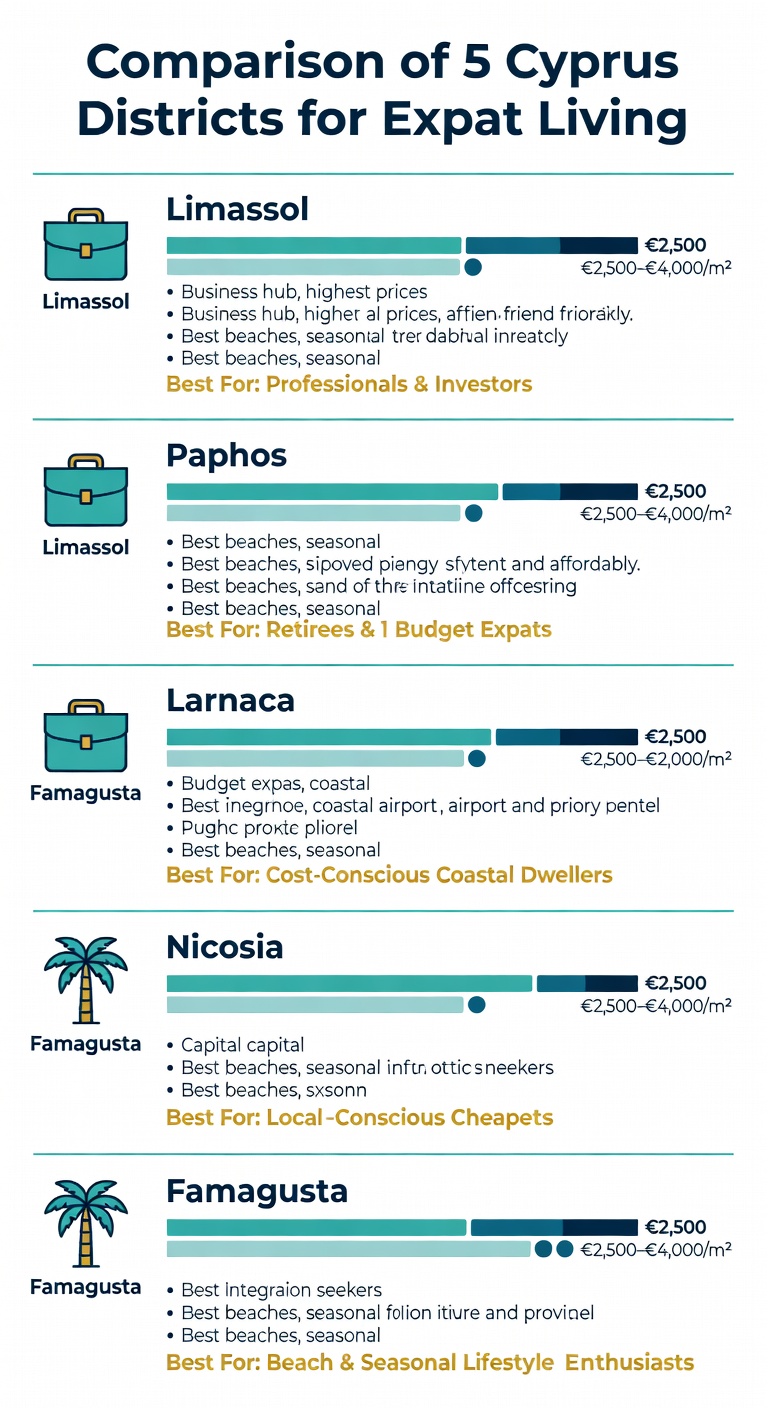
| Factor | Limassol | Paphos | Larnaca | Nicosia | Famagusta |
|---|---|---|---|---|---|
| Best For | Professionals, families | Retirees, UK expats | Budget buyers, travelers | Careers, culture | Beach lovers, investors |
| 2-Bed Apartment | €200,000–€350,000 | €120,000–€200,000 | €130,000–€180,000 | €120,000–€180,000 | €100,000–€200,000 |
| Job Market | Strong (tech, finance) | Limited (tourism) | Growing | Strong (government) | Seasonal (tourism) |
| International Schools | Many options | Few options | Some options | Good options | Limited |
| Beach Access | Good | Excellent | Good | None (45 min drive) | Best on island |
| Expat Community | Large, diverse | Large, mostly UK | Growing | Smaller | Small, seasonal |
| Safety | Very safe | Very safe | Very safe | Safe | Very safe |
For career opportunities, Limassol and Nicosia lead, with the strongest job markets in tech, finance, professional services, and government. Larnaca is developing but currently offers fewer options.
For affordability, Nicosia and Famagusta offer the lowest property prices and cost of living. Larnaca provides a strong middle ground — coastal living without Limassol prices.
For families with children, Limassol offers the widest choice of international schools and extracurricular activities. Nicosia is a close second.
For retirees, Paphos remains the top choice, thanks to its established expat community, affordable healthcare, moderate climate, and strong social infrastructure.
For remote workers and digital nomads, Larnaca’s airport proximity, affordable living costs, and improving cafe and coworking scene make it a practical base.
Practical Tips for Choosing Where to Live in Cyprus
Before committing to a location, consider spending an extended period — ideally two to four weeks — in your top two districts during different seasons. Cyprus transforms between summer and winter, and what feels perfect in June may feel isolated in January.
Rent before you buy. The rental market across Cyprus is accessible and affordable. Spending six months to a year renting gives you time to explore neighborhoods, understand commuting patterns, and identify the area that truly suits your daily life before making a property purchase.
Visit in winter. This is critical. Most newcomers visit during the glorious Mediterranean summer and fall in love with the island. Winter reveals a different reality — shorter days, reduced services in tourist areas, and a slower pace. If you enjoy the winter version of your chosen area, you’ll love it year-round.
Consider your transport needs. Public transport in Cyprus is limited outside Nicosia and Limassol. Most residents own a car, and proximity to motorways, airports, and daily amenities should factor into your decision. Larnaca’s airport proximity is a genuine advantage for frequent travelers.
Connect with existing communities. Every district has expat groups, social clubs, and online forums. Reaching out before your move can provide invaluable firsthand insights about daily life, practical challenges, and local recommendations that no guide can capture.
Making Your Move: Next Steps
Cyprus offers something rare — a European island with genuine diversity of lifestyle across a compact geography. Whether you want Limassol’s urban energy, Paphos’s expat-friendly warmth, Larnaca’s affordable balance, Nicosia’s cultural authenticity, or Famagusta’s beach paradise, the right fit is waiting.
Start by exploring properties in your preferred districts. Browse apartments and houses across all five districts on index.cy, where 60,000+ verified listings from over 100 real estate agencies give you the most comprehensive view of the Cyprus property market. Use our instant property report tool to analyze any listing before you commit — because the best place to live in Cyprus is the one that matches your priorities, your budget, and your vision for the future.
Keep reading

We analysed 249 Kouklia, Paphos listings: 210 houses, 20 plots and 6 apartments. Median 2-bed house asks EUR397,000. See prices, plots and…
We analysed 217 Erimi, Limassol listings: 105 apartments, 81 houses and 24 plots. Median 2-bed flat EUR295,000. See prices, the repeat-advert trap…
We analysed 319 Aglantzia, Nicosia listings: 155 apartments, 34 houses and 38 plots. Median 2-bed costs EUR257,500. See prices, rents and what…