What this guide covers
- What Is the Cyprus Digital Nomad Visa?
- Eligibility Requirements for the Digital Nomad Visa
- How to Apply: Step-by-Step Process
- Tax Benefits: Why Cyprus Stands Out for Remote Workers
- Where to Live: Best Cities for Digital Nomads in Cyprus
- Limassol: The International Business Hub
- Paphos: Mediterranean Lifestyle at Lower Cost
- Nicosia: Affordable Capital City Energy
- Larnaca: The Balanced Choice
- Finding Property: Renting and Buying as a Digital Nomad
- Short-Term Rentals (First 1–3 Months)
- Long-Term Rentals (3 Months to 3 Years)
- Buying Property as a Digital Nomad
- Practical Considerations: Internet, Healthcare and Daily Life
- Internet and Connectivity
- Healthcare
- Cost of Living Overview
- Family Provisions: Bringing Your Partner and Children
- Digital Nomad Visa vs. Other Cyprus Residency Options
- Common Mistakes to Avoid
- Is the Cyprus Digital Nomad Visa Right for You?
Cyprus has emerged as one of Europe’s most compelling destinations for remote workers, combining over 320 days of sunshine, a favorable tax regime, and a growing digital infrastructure that rivals more established nomad hubs. The Cyprus digital nomad visa — officially a temporary residence permit for remote workers — allows non-EU nationals to live and work from the island for up to three years while serving foreign employers or clients.
Whether you’re a software developer considering a Mediterranean base, a freelance consultant exploring tax-efficient residency, or a remote team lead scouting locations for your next chapter, this guide covers everything you need to know about the digital nomad visa in Cyprus in 2026: eligibility requirements, the application process, tax implications, where to live, and how to find the right property.
What Is the Cyprus Digital Nomad Visa?
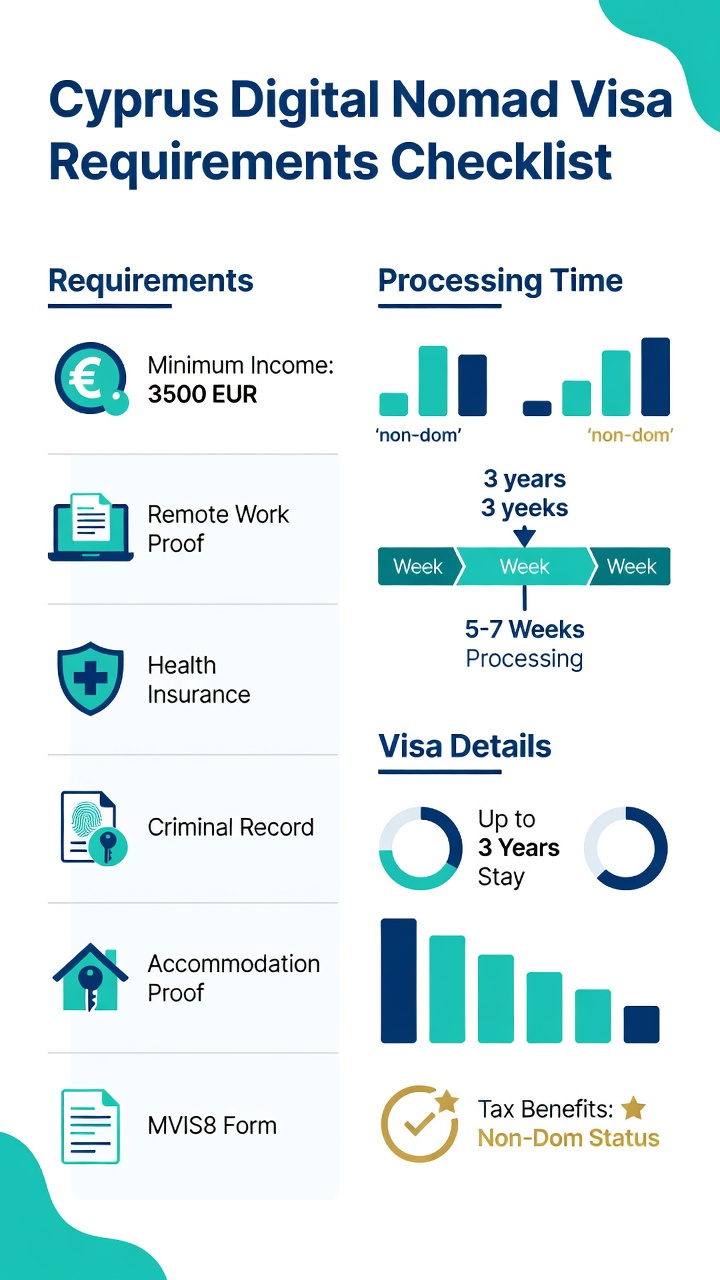
The Cyprus digital nomad visa is a residence permit introduced in 2022 that allows non-EU/EEA nationals to live in Cyprus while working remotely for employers or clients based outside the country. It grants an initial one-year stay, renewable for up to two additional years — a total of three years under the scheme.
The fundamental condition is straightforward: you must use telecommunications technology to perform your work remotely, and your employer or clients must be based abroad. You cannot work for Cypriot companies, provide services to Cypriot residents, or engage with the local labor market in any way.
In March 2025, the government expanded the program by adding 500 permits to the original cap of 500, bringing the total available slots to 1,000. This expansion reflects growing demand from remote professionals worldwide and Cyprus’s strategic push to position itself as a Mediterranean tech and business hub.
The visa is distinct from other residency pathways. Unlike the permanent residence permit through property investment, the digital nomad visa doesn’t require purchasing property — though many holders eventually do. And unlike the Cyprus golden visa, it’s designed specifically for working professionals rather than investors.
Eligibility Requirements for the Digital Nomad Visa
To qualify for the Cyprus digital nomad visa in 2026, you must meet several key criteria.
Nationality: You must be a non-EU/EEA citizen. EU and EEA nationals already have the right to live and work in Cyprus under freedom of movement rules and don’t need this visa.
Remote work status: You must work remotely using telecommunications technology for an employer or clients registered outside Cyprus. This includes salaried employees of foreign companies, freelancers with international clients, and self-employed professionals with foreign-registered businesses.
Minimum income: You need to demonstrate a net monthly income of at least €3,500. This threshold increases by 20% (€700) for a spouse or partner and 15% (€525) for each dependent child. For a family of four, the minimum monthly income requirement would be approximately €5,250.
Health insurance: You must hold comprehensive health insurance valid in Cyprus, covering both inpatient and outpatient care as well as repatriation of remains.
Clean criminal record: You need a criminal record clearance certificate from your country of origin, issued within the last six months.
No local economic activity: This is non-negotiable — you cannot work for Cypriot companies or provide services to Cypriot residents while on this visa.
How to Apply: Step-by-Step Process
Unlike many digital nomad visa programs globally, you cannot apply for the Cyprus digital nomad visa from abroad. The application is submitted after you arrive in Cyprus, which means you’ll enter on a tourist visa or visa-free arrangement first, then apply within three months of arrival.
Step 1: Enter Cyprus. Arrive using your tourist visa or visa-free entry (many nationalities get 90 days). Use this initial period to find accommodation, explore districts, and prepare your application documents.
Step 2: Gather required documents. You’ll need to prepare a complete package including your valid passport (with at least 3 months validity beyond your intended stay), the completed MVIS8 application form, proof of employment or freelance status (employment contract, client agreements, or business registration), bank statements from the last 6 months showing regular income payments, proof of accommodation in Cyprus (a registered rental agreement or title deed), health insurance documentation, criminal record clearance (translated into Greek or English), a current CV or resume, and a letter of intent explaining why you want to work from Cyprus.
Step 3: Submit at the Civil Registry and Migration Department. Applications must be submitted in person at the Migration Department in Nicosia. You’ll pay a €70 application fee plus €70 for the Alien Registration Certificate. Fingerprints and a photo are taken at this stage.
Step 4: Wait for processing. Processing typically takes 5–7 weeks in 2026. During this period, you can remain in Cyprus legally. Once approved, you receive your temporary residence permit.
Step 5: Renew if needed. Before your initial year expires, you can apply for renewal for up to two additional years, subject to the same eligibility conditions.
Tax Benefits: Why Cyprus Stands Out for Remote Workers
The tax framework is arguably the single biggest reason remote workers choose Cyprus over other Mediterranean destinations. Here’s how it works.
Tax residency rules: Obtaining the digital nomad visa does not automatically make you a tax resident. Tax residency is determined separately through two pathways. The 183-day rule is the traditional approach — spend more than 183 days in Cyprus during a calendar year, and you become a tax resident. The 60-day rule is the alternative — if you spend at least 60 days in Cyprus, don’t spend more than 183 days in any other single country, and maintain a permanent home in Cyprus, you can qualify as a tax resident. From January 2026, this applies even if you’re simultaneously tax resident elsewhere.
Non-domiciled (Non-Dom) status: If you’re a new tax resident who hasn’t been domiciled in Cyprus before, you automatically qualify for non-dom status. Non-dom residents are exempt from the Special Defence Contribution (SDC) on dividends (0% vs. 17% for domiciled residents), interest income (0% vs. 30%), and rental income (0% vs. 3%).
The 50% income tax exemption: If your employment income exceeds €55,000 per year, you may qualify for a 50% income tax exemption that applies for 17 years. This is a significant incentive for high-earning remote professionals.
Standard income tax rates: Cyprus uses a progressive tax system. The first €19,500 of annual income is tax-free. Income between €19,501 and €28,000 is taxed at 20%, between €28,001 and €36,300 at 25%, between €36,301 and €60,000 at 30%, and income above €60,000 is taxed at 35%.
It’s important to consult a qualified tax advisor for your specific situation. Tax planning for digital nomads involves multiple jurisdictions, and the rules around domicile, residency, and treaty benefits can be complex.
Where to Live: Best Cities for Digital Nomads in Cyprus
Each Cyprus district offers a different lifestyle and price point. Here’s how the main cities compare for remote workers.
Limassol: The International Business Hub
Limassol is the most cosmopolitan city in Cyprus and the natural choice for digital nomads who want a vibrant social scene, diverse dining options, and a large international community. The city hosts major tech companies, shipping firms, and forex brokers, creating a business-oriented atmosphere that feels energizing for remote professionals.
Coworking spaces like The Hub and Regus locations offer high-speed fiber connections (300–500 Mbps), meeting rooms, and networking events. Monthly coworking passes typically cost €150–250.
The trade-off is cost. Limassol is the most expensive city in Cyprus for housing. A modern one-bedroom apartment near the seafront runs €1,000–1,300 per month, though older flats in non-central areas can be found for less. Total monthly living costs range from €1,500 to €2,630 depending on lifestyle.
Browse apartments for rent in Limassol or explore properties for sale in Limassol if you’re considering a longer-term commitment.
Paphos: Mediterranean Lifestyle at Lower Cost
Paphos attracts remote workers who prioritize quality of life over nightlife. The city offers a more relaxed pace, stunning coastal scenery, and a well-established expat community — particularly from the UK. Monthly living costs range from €1,140 to €1,950, making it significantly more affordable than Limassol.
The coworking scene is smaller but growing, and many nomads work from the numerous cafés along the harbor and coastal promenade. Internet speeds are reliable in central areas, with fiber broadly available.
Check out apartments for rent in Paphos for current options, or see our guide to long-term rental in Paphos for practical tips on finding accommodation.
Nicosia: Affordable Capital City Energy
As the only divided capital in Europe, Nicosia offers a unique cultural experience alongside practical advantages for remote workers. It’s the most affordable major city in Cyprus, with monthly costs ranging from €1,040 to €1,850. Rent for a modern one-bedroom apartment typically runs €500–800 per month.
Nicosia’s walkability, business infrastructure, and access to government services (including the Migration Department where you’ll submit your visa application) make it a practical base. The downside: no beach access, and summers can feel more intense without coastal breezes.
Explore apartments for rent in Nicosia for current availability.
Larnaca: The Balanced Choice
Larnaca sits between Limassol’s premium pricing and Nicosia’s inland location, offering beach access, a functioning marina, airport proximity, and monthly costs between €1,090 and €1,900. It’s increasingly popular with nomads who want coastal living without Limassol’s price tag.
The city’s Mackenzie Beach area has become a de facto nomad neighborhood, with cafés and restaurants that welcome laptop workers. See apartments for rent in Larnaca for current listings.
Finding Property: Renting and Buying as a Digital Nomad
Your accommodation needs will evolve as your stay in Cyprus extends. Here’s what to consider at each stage.
Short-Term Rentals (First 1–3 Months)
When you first arrive, flexibility matters most. Many digital nomads start with furnished short-term rentals or Airbnb-style accommodation while they explore different neighborhoods and districts. This period is also when you’ll prepare your visa application, so staying in or near Nicosia can be practical for the initial weeks.
Our guide to Airbnb and short-term rentals in Cyprus covers what to expect from pricing and availability.
Long-Term Rentals (3 Months to 3 Years)
Once you’ve decided on a district, a long-term rental agreement (typically 12 months) will significantly reduce your monthly housing costs compared to short-term options. You’ll also need a registered rental agreement for your visa application.
Key considerations when renting long-term include verifying that the apartment has reliable fiber internet (not just ADSL), checking for air conditioning (essential from May through October), understanding utility costs (electricity can be expensive during summer cooling months), and ensuring the landlord will register the rental agreement with the tax department — which you need for your visa documentation.
Browse houses for rent across Cyprus or explore villas for rent in Limassol if you need more space.
Buying Property as a Digital Nomad
Some digital nomads who extend their stay to the full three years — or who plan to transition to a different residency pathway — choose to purchase property. Cyprus has no restrictions on property ownership by foreign nationals, and purchasing can make financial sense if you’re staying long-term, especially given that rental yields in popular areas are strong.
A property purchase can also serve as your pathway to permanent residence if you invest €300,000 or more in new property. This is worth considering if you see Cyprus as your long-term base beyond the three-year digital nomad visa period.
For buying guidance, our comprehensive guide to buying property in Cyprus as a foreigner covers the entire process. You can also explore current listings for apartments for sale or villas for sale across all five districts.
Practical Considerations: Internet, Healthcare and Daily Life
Internet and Connectivity
Reliable internet is non-negotiable for remote work, and Cyprus delivers well in urban areas. Fixed broadband speeds of 100–200 Mbps are widely available through providers like Cyta, Epic, and PrimeTel. Fiber connections reaching 500 Mbps to 1 Gbps are increasingly available in Limassol and Nicosia. Home internet costs approximately €25–40 per month. Mobile data is affordable and 4G/5G coverage is solid across all major cities.
When choosing accommodation, always verify the available internet speed at the specific address before signing a lease.
Healthcare
Your visa requires comprehensive health insurance, but it’s worth understanding the broader healthcare landscape. Cyprus has both a public healthcare system (GESY/GHS, the General Healthcare System) and a robust private sector. Most expats and digital nomads opt for a combination: registering with GESY for basic coverage while maintaining private insurance for faster access and specialist care.
Cost of Living Overview
Beyond rent, monthly expenses for a single digital nomad typically include utilities (electricity, water, garbage) at €80–150, groceries at €250–400, dining out at €150–300, transportation at €50–150 (many areas require a car), coworking or home office setup at €0–250, and health insurance at €50–150.
Total monthly costs (excluding rent) range from €580 to €1,400 depending on lifestyle. For a detailed breakdown, see our cost of living in Cyprus guide.
Family Provisions: Bringing Your Partner and Children
The Cyprus digital nomad visa allows your spouse or partner and minor children to accompany you under separate residence permits. However, family members cannot engage in any economic activity in Cyprus — including remote work, freelancing, or starting a business.
Your income threshold increases with family: €3,500 base + €700 for a spouse + €525 per child. For a couple with two children, you’d need to demonstrate at least €5,250 in net monthly income.
Cyprus is an excellent family destination. International schools are available in all major cities, the crime rate is among the lowest in Europe, and the outdoor lifestyle — beaches, hiking in the Troodos mountains, year-round warm weather — makes for a high quality of life for children. For families considering property, our best places to live in Cyprus guide compares districts from a family perspective.
Digital Nomad Visa vs. Other Cyprus Residency Options
Understanding how the digital nomad visa compares to other residency pathways helps you plan your long-term strategy.
| Feature | Digital Nomad Visa | Permanent Residence (Cat. F) | Golden Visa |
|---|---|---|---|
| Minimum income/investment | €3,500/month net income | €300,000+ property purchase | Significant investment required |
| Duration | Up to 3 years | Indefinite | Varies by category |
| Property required? | No | Yes (new property) | Yes |
| Local employment allowed? | No | No | No |
| Path to citizenship? | No (but can transition) | Yes (after 7 years) | Yes (after 7 years) |
Many digital nomads use the 3-year visa as a trial period. If they decide Cyprus is their long-term home, they transition to permanent residency through property investment — a pathway that also opens the door to eventual EU citizenship.
Common Mistakes to Avoid
Based on the experiences of digital nomads who’ve gone through the process, here are the most common pitfalls.
Applying too late: You must submit within 3 months of arrival. Start gathering documents before you fly to Cyprus — especially the criminal record clearance, which can take weeks from your home country.
Underestimating the income requirement: The €3,500 minimum is net income, not gross. Bank statements must clearly show regular deposits at or above this threshold for the preceding 6 months.
Ignoring tax implications: The visa doesn’t automatically trigger tax residency, but spending 183+ days in Cyprus does. Plan your tax strategy before arrival, not after.
Choosing accommodation without checking internet: Not all areas have fiber coverage. Verify speeds at the specific address before committing to a lease.
Skipping health insurance: Generic travel insurance usually doesn’t meet the visa requirements. You need comprehensive coverage including inpatient, outpatient, and repatriation.
Is the Cyprus Digital Nomad Visa Right for You?
The Cyprus digital nomad visa is best suited for mid- to high-income remote professionals earning above €3,500 per month who want a Mediterranean lifestyle combined with favorable tax treatment. The island delivers on climate, safety, connectivity, and quality of life — and the 60-day tax residency rule plus non-dom status make it one of the most tax-efficient nomad destinations in Europe.
The 3-year maximum stay is generous compared to most digital nomad visas globally, giving you genuine time to build a life rather than just pass through. And if you decide to stay longer, the transition pathways to permanent residency through property investment are well-established.
Start your property search on index.cy — Cyprus’ #1 real estate marketplace with 60,000+ verified listings from over 100 agencies across all five districts. Whether you’re looking for a rental apartment to start your digital nomad journey or considering purchasing property as your next investment, our instant property report helps you make data-driven decisions from day one.
Keep reading

We analysed 217 Erimi, Limassol listings: 105 apartments, 81 houses and 24 plots. Median 2-bed flat EUR295,000. See prices, the repeat-advert trap…
We analysed 319 Aglantzia, Nicosia listings: 155 apartments, 34 houses and 38 plots. Median 2-bed costs EUR257,500. See prices, rents and what…

We analysed 387 Egkomi (Engomi), Nicosia listings: 169 apartments, 73 houses and 99 rentals. Median 2-bed costs EUR285,000. See prices, rents and…