
What this guide covers
- What Is Cyprus Non-Dom Status?
- How Cyprus Non-Dom Status Cuts Your Tax to Almost Zero
- Who Qualifies as Non-Dom in Cyprus?
- Becoming a Cyprus Tax Resident: The 60-Day Rule and Your Property
- The 17-Year Clock and the 2026 Extension Option
- Where Property Fits Into a Non-Dom Move to Cyprus
- Frequently Asked Questions
- How long does Cyprus non-dom status last?
- What tax does a Cyprus non-dom actually pay on dividends?
- Do I have to live in Cyprus full-time to be a non-dom?
- Can I be a non-dom if I buy property in Cyprus?
- Conclusion: Plan the Move, Earn the Non-Dom Benefit
Cyprus non-dom status is one of the main reasons investors, entrepreneurs, and retirees move to the island — and it sits much closer to a property decision than most people realise. If you become a Cyprus tax resident but keep a foreign domicile, you can legally pay 0% tax on dividends and interest for up to 17 years. For anyone weighing a relocation and a property purchase together, understanding the Cyprus non-dom regime is not optional; it shapes how much of your income you keep.
We write this as a marketplace, not a law firm or tax adviser. Our aim is to give you the data and context to decide for yourself, then point you toward qualified professionals for your personal situation. Tax rules carry real financial consequences, so treat this guide as a clear starting map, updated for the 2026 reforms, rather than personal advice.
What Is Cyprus Non-Dom Status?
Cyprus non-dom status is a tax classification — not a type of residence permit — that lets you be a Cyprus tax resident while remaining non-domiciled for the purposes of the Special Defence Contribution (SDC). In plain terms, you live in Cyprus and pay tax here, but a specific tax on passive income does not apply to you.
Cyprus introduced the non-domicile regime in July 2015 to attract international talent and capital, and the 2026 tax reform kept its core benefits intact — a package the Cyprus government actively promotes to relocating investors. It works because Cyprus separates two ideas: where you are tax resident (based on days and ties) and where you are domiciled (broadly, your long-term “home” country under the Wills and Succession Law). You can be tax resident in Cyprus yet keep a domicile of origin elsewhere.
That gap is where the benefit lives. Domiciled Cyprus residents pay SDC on dividends, interest, and — historically — rental income. Non-doms are exempt from SDC on all three. Combined with Cyprus rules that already tax dividends and interest at 0% income tax, the result for a non-dom is close to zero tax on passive income.
How Cyprus Non-Dom Status Cuts Your Tax to Almost Zero
The headline benefit of non-dom Cyprus status is the Special Defence Contribution exemption. SDC is the tax that normally applies to passive income for domiciled residents. Remove it, and dividends and interest become almost tax-free.
Here is how the main income types are treated for a Cyprus non-dom in 2026:
| Income type | Domiciled resident | Non-dom resident |
|---|---|---|
| Dividends | 5% SDC (on 2026+ profits) + 2.65% GHS | 0% SDC, only 2.65% GHS |
| Interest | 17% SDC + GHS | 0% SDC, only 2.65% GHS |
| Rental income | No SDC from 2026 + income tax | No SDC, income tax on bands |
| Employment income | Progressive income tax | Progressive income tax |
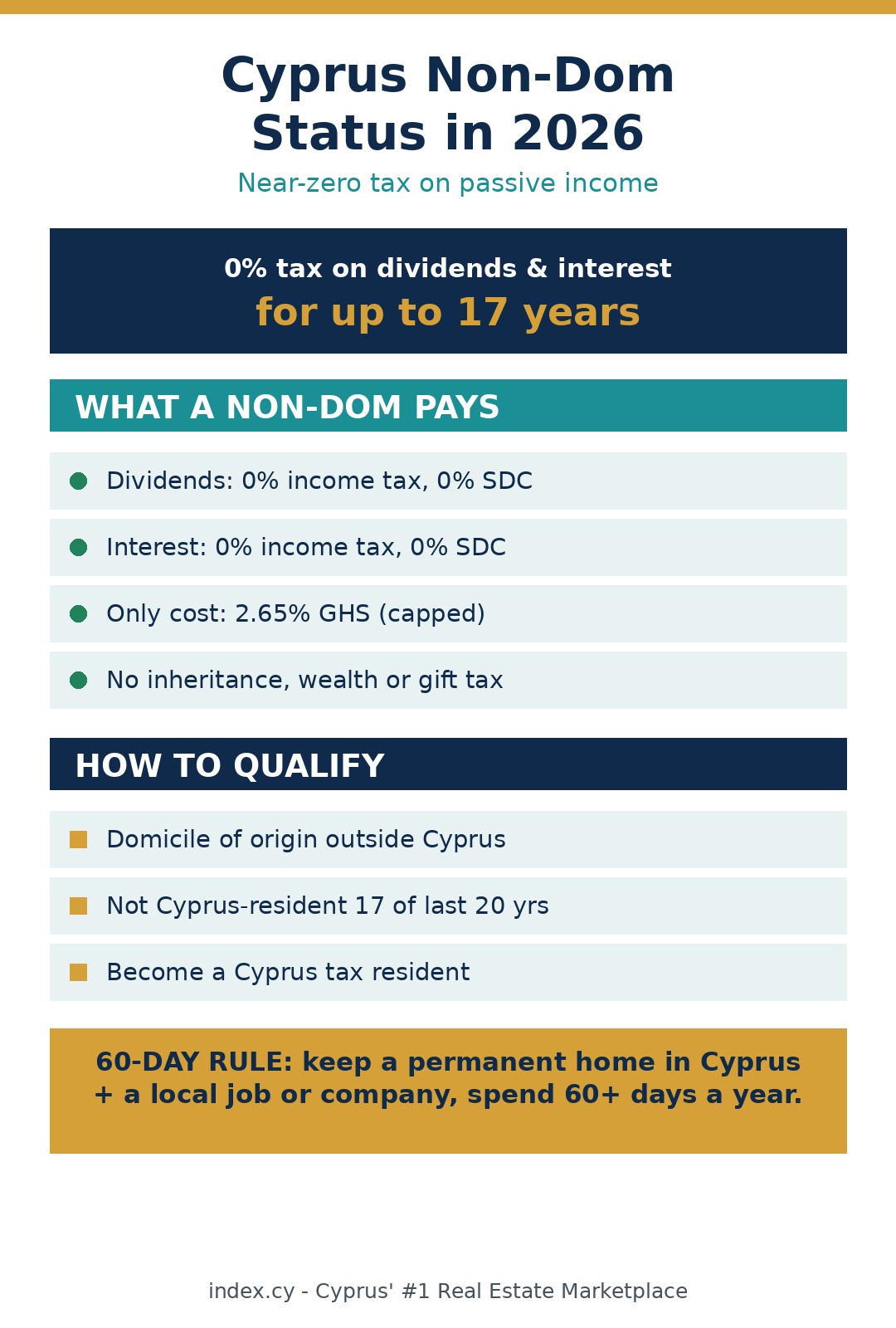
The practical effect is striking. A non-dom drawing dividends from a company — Cypriot or foreign — pays no income tax and no SDC on that dividend. The only cost is the General Healthcare System (GHS/GESY) contribution of 2.65%, and even that is capped, currently at €4,770 per year once income reaches €180,000. That is why advisers often describe the effective tax on non-dom dividends as roughly 2.65%, not zero, but far below almost anywhere in Europe.
Interest income works the same way: fully exempt from SDC, subject only to GHS. From 1 January 2026, a further reform removed SDC on rental income for all Cyprus tax residents, which narrows the gap on rent but leaves the dividend and interest advantage fully intact for non-doms.
Two Cyprus features sweeten the package. There is no inheritance tax, no wealth tax, and no gift tax. And capital gains tax applies only to gains on Cyprus-situated immovable property, not to gains on foreign assets or shares. For an internationally mobile investor, that combination is the real draw.
Who Qualifies as Non-Dom in Cyprus?
Qualifying for Cyprus non-dom status comes down to your domicile, not your nationality. Under Cyprus law you generally have a “domicile of origin” — the domicile you inherit at birth, usually your father’s — unless you have acquired a “domicile of choice” by permanently settling somewhere else.
You are treated as non-domiciled in Cyprus if your domicile of origin is outside Cyprus and you have not become deemed domiciled here. This is the rule that matters most: you are “deemed domiciled” only once you have been a Cyprus tax resident for at least 17 of the last 20 years. Until then, a person whose roots are abroad keeps non-dom status.
So the typical qualifying profile is straightforward. You are a foreign national or a Cypriot who was born and raised abroad, you were not a Cyprus tax resident for 17 of the 20 years before you apply, and your domicile of origin is another country. Meet those conditions and you can claim non-dom treatment for the SDC exemptions from your first year of Cyprus tax residency.
The status is not automatic in practice — you confirm it when you register with the Cyprus Tax Department and complete the relevant declaration. Because domicile can be a nuanced legal question, especially if you have spent long periods in Cyprus before, this is exactly the point where a licensed tax adviser earns their fee.
Becoming a Cyprus Tax Resident: The 60-Day Rule and Your Property
Non-dom status only helps once you are actually a Cyprus tax resident — and this is where a property purchase enters the picture. Cyprus offers two routes to tax residency, and the faster one is built around having a home on the island.
The long-standing 183-day rule is simple: spend more than 183 days physically in Cyprus in a calendar year and you are automatically tax resident. No home, job, or company condition applies.
The newer 60-day rule is what makes Cyprus unusually accessible. You qualify as a Cyprus tax resident by spending at least 60 days on the island in the year, provided you also:
- Maintain a permanent home in Cyprus — owned or rented — available to you throughout the year.
- Carry on business, work, or hold a directorship in a Cyprus tax-resident company during the year.
- Do not become tax resident in any single other country under its own day-count rules.
A 2026 reform relaxed the regime further: you no longer have to prove you are not tax resident elsewhere in the same rigid way, which helps people with cross-border ties. The permanent-home condition, however, remains central — and it is the clearest reason a non-dom move and a property decision belong in the same conversation.

That permanent home can be rented, but buying gives you a fixed base, a long-term asset, and clean evidence of your Cyprus tie. Whether you are drawn to the coast or the capital, you can browse verified listings for apartments across Cyprus or focus on a specific market such as property for sale in Limassol or Paphos. Before you commit, run an instant property report to check the numbers behind any listing.
For the full mechanics of both residency tests, the tax-free threshold, and the 2026 income tax bands, see our companion Cyprus tax residency guide, which sits alongside this piece as the broader picture.
The 17-Year Clock and the 2026 Extension Option
Cyprus non-dom status is generous but time-limited. The exemption from SDC on dividends and interest runs for up to 17 years from the date you first become a Cyprus tax resident — under either the 183-day or the 60-day rule. The clock starts the moment you qualify, so the year you move matters.
After 17 years of Cyprus tax residency, you become “deemed domiciled” and SDC applies as it would to any long-term resident. Historically that was the hard stop. The 2026 reform, however, introduced a paid extension: non-doms whose domicile of origin is outside Cyprus can extend the exemption for two further five-year periods, at a lump-sum payment of €250,000 for each five-year block.
For most people that extension is a distant, optional consideration. What matters at the outset is that 17 tax-free years is a long runway — long enough to build and draw down an investment portfolio, run a business, or enjoy a comfortable retirement while your effective tax on passive income stays near 2.65%.
It also reframes the relocation decision. A move that secures nearly two decades of favourable treatment is worth structuring carefully from day one, including how and where you hold your Cyprus property.
Where Property Fits Into a Non-Dom Move to Cyprus
For a marketplace like index.cy, the honest point is this: non-dom status is a tax matter, but the move that unlocks it is a property and lifestyle decision. The two are inseparable in practice.
A Cyprus home does three things for a non-dom relocation at once. It satisfies the permanent-home condition of the 60-day rule. It gives you a genuine base for the 60-plus days you spend on the island. And it puts your capital into an asset in a market with no annual national property tax since 2017 and capital gains tax charged only on the eventual sale of Cyprus property.
Where you buy shapes both lifestyle and budget. Limassol suits investors and executives who want a business hub and marina living. Paphos and the west draw retirees and remote workers with lower prices and a large international community. Larnaca and Nicosia offer value and everyday practicality. Retirees in particular pair non-dom status with the island’s climate and healthcare — our guide to retiring in Cyprus covers that combination in detail.
Non-dom status also connects to your residency paperwork. Many non-doms hold or pursue Cyprus residency alongside the tax status; our Cyprus permanent residency guide explains the property-investment route. And because tax, legal, and closing costs all interlock, it is worth reading our overview of taxes and legalities in Cyprus real estate before you sign anything.
The sequence that works best is deliberate: confirm your domicile and residency plan with a licensed adviser, choose a district and property that fit both your life and the permanent-home rule, verify the listing with data, and only then complete. Get that order right and non-dom status becomes the reward for a well-planned move, not an afterthought.
Frequently Asked Questions
How long does Cyprus non-dom status last?
Cyprus non-dom status lasts up to 17 years from the date you first become a Cyprus tax resident. During that period you are exempt from Special Defence Contribution on dividends, interest, and rental income. From 2026, non-doms with a foreign domicile of origin can extend the benefit by two further five-year periods for €250,000 each.
What tax does a Cyprus non-dom actually pay on dividends?
A Cyprus non-dom pays 0% income tax and 0% SDC on dividends. The only charge is the General Healthcare System (GHS/GESY) contribution of 2.65%, which is capped at €4,770 per year. That gives an effective rate of roughly 2.65% on dividend income, whether the dividend comes from a Cypriot or a foreign company.
Do I have to live in Cyprus full-time to be a non-dom?
No. Thanks to the 60-day rule, you can become a Cyprus tax resident — and claim non-dom status — by spending as little as 60 days a year on the island, provided you keep a permanent home in Cyprus and have a business, job, or directorship here. Full-time residence is not required.
Can I be a non-dom if I buy property in Cyprus?
Yes. Buying property does not affect your domicile, so it does not jeopardise non-dom status. In fact, owning a home is one way to satisfy the permanent-home condition of the 60-day residency route, which is a common path to claiming non-dom treatment.
Conclusion: Plan the Move, Earn the Non-Dom Benefit
Cyprus non-dom status offers something rare: up to 17 years of near-zero tax on dividends and interest, in an EU member state with no inheritance or wealth tax and a genuinely pleasant place to live. For investors and retirees, the numbers are compelling, and the 2026 reforms kept the core advantage firmly in place.
Three things decide whether you capture it. Confirm that your domicile of origin is outside Cyprus and that you meet the residency test — usually the 60-day rule. Secure a permanent home on the island, which anchors both your residency claim and your daily life. And structure the move with a licensed tax adviser so the 17-year clock starts cleanly.
The property step is the one you control most directly. When you are ready to move from planning to real listings, browse verified homes across every district on index.cy and run an instant property report before you commit — so your non-dom move rests on solid numbers, not guesswork.
This guide is general information, not legal or tax advice. Non-dom and tax-residency rules turn on personal circumstances; always work with a licensed Cyprus tax adviser for your specific situation.
Keep reading

Larnaca Property Market Surges: Which Areas Are Leading the Price Rise? Larnaca’s property market has experienced a notable surge in prices recently,…

We analysed 66 Tseri, Nicosia listings: 18 apartments, 8 houses and 34 plots. Median 2-bed price is EUR174,000. See prices and what…

We analysed 246 Lakatamia, Nicosia listings: 129 apartments, 52 houses and 46 plots. Median 2-bed price is EUR195,000. See prices and what…