
What this guide covers
- What Is the Pink Slip in Cyprus?
- Who Needs a Pink Slip—and Who Doesn’t
- Pink Slip Requirements: Income, Housing, and Insurance
- Documents You Need to Apply
- How to Apply for the Pink Slip: Step by Step
- Pink Slip Cost, Processing Time, and Renewal
- What the Pink Slip Lets You Do (and What It Doesn’t)
- Pink Slip vs Yellow Slip vs Permanent Residence
- Frequently Asked Questions
- What is a pink slip in Cyprus?
- How much does the pink slip cost in Cyprus?
- Can I work in Cyprus with a pink slip?
- How long does a pink slip take to process?
- Does a pink slip let me travel in Europe?
- Putting Down Roots in Cyprus
If you are moving to Cyprus from outside the EU, the pink slip is the document that turns a holiday-length visit into legal residence. Officially called the Temporary Residence Permit, the pink slip Cyprus issues to non-EU nationals is what lets Americans, Britons, Israelis, South Africans, and other third-country citizens stay on the island for more than 90 days. Get it right and you unlock a year of settled life, with the option to renew each year and, in time, work toward permanent residence.
This guide explains exactly how the pink slip works in 2026: who needs one, the income and housing you must show, the documents to prepare, what it costs, how long it takes, and the important limits on working and travel. Whether you are retiring to the coast, working remotely, or buying property, here is what you need to know before you apply.
What Is the Pink Slip in Cyprus?
The pink slip is a temporary residence permit for non-EU nationals who want to live in Cyprus for longer than 90 days. It is valid for up to one year, renews annually as long as you keep meeting the conditions, and does not grant the right to take a local job. The name is informal—it comes from the pink-coloured document historically issued by the Civil Registry and Migration Department.
Today the permit is issued as a physical biometric card, sometimes called the Alien Registration Card (ARC), but the “pink slip” nickname has stuck. It is the standard route for third-country citizens who plan to settle in Cyprus without local employment—retirees, remote workers, and property owners who spend a large part of the year on the island.
One point often causes confusion. The pink slip is a national Cyprus permit, not a Schengen visa. Cyprus is an EU member but is not part of the Schengen Area, so the permit lets you reside in Cyprus—not travel freely around mainland Europe.
Who Needs a Pink Slip—and Who Doesn’t
The pink slip requirement applies to all non-EU, non-EEA, and non-Swiss nationals who intend to stay in Cyprus beyond 90 days within any 180-day period. Below that threshold, most third-country tourists can visit visa-free or on a short-stay visa; above it, a residence permit becomes mandatory.
If you hold an EU, EEA, or Swiss passport, you do not need a pink slip at all. Your equivalent is the yellow slip—the MEU1 registration certificate for EU citizens. If you are unsure which applies to you, our Cyprus yellow slip guide explains the EU citizen’s route in full, and the contrast makes the two systems easy to tell apart.
The visitor category of the pink slip is the most common. It suits people with income from abroad—pensions, remote salaries, investments, or business profits—who are financially self-sufficient and are not seeking a Cypriot employer. Different permit categories exist for those coming to work or study, each with its own rules, as set out by the Cyprus Migration Department.
Pink Slip Requirements: Income, Housing, and Insurance
To qualify for the visitor’s pink slip, you must prove three things: a stable foreign income, a place to live, and private health cover. These conditions show the authorities you can support yourself without relying on the local labour market or state funds.
Secured annual income. The main applicant must demonstrate a stable income from abroad of at least €24,000 per year (around €2,000 per month). This figure increases for dependants—typically by roughly 20% for a spouse and around 15% for each child—so confirm the current threshold for your family size before applying. The income must come from outside Cyprus and be transferred into a Cyprus bank account.
A Cyprus bank deposit. Applicants are generally asked to hold a balance in a local account—commonly around €10,000 for the main applicant, plus roughly €5,000 for each additional family member. Opening the account is a step in its own right; our guide to opening a bank account in Cyprus walks through the documents and timeline involved.
Housing. You must show a registered rental agreement (usually for a minimum of one year) or the title/sale contract for a property you own. If you are buying rather than renting, browsing verified listings in a district like Paphos or Limassol is the natural first step toward securing that address.
Private health insurance. Because non-EU visitors are not automatically covered by the national health system (GESY), you need a private medical insurance policy from a Cyprus-licensed insurer. Our healthcare in Cyprus guide explains how the public and private systems work side by side.

Documents You Need to Apply
Cyprus immigration applications are document-heavy, and an incomplete file is the single most common reason for delay. Gather everything before you book your appointment. You will typically need:
- The completed temporary residence permit application form (the MVIS-series form for the visitor category), one per family member
- Your original passport plus copies of the photo page and your most recent entry stamp
- Passport-size photographs to the specified size and background
- Proof of secured annual income and recent bank statements showing foreign transfers
- Evidence of your Cyprus bank deposit
- A registered one-year rental agreement or property sale/title contract
- A private health insurance policy valid in Cyprus
- A criminal record / police clearance certificate issued within the last three months
- Marriage certificate and children’s birth certificates, where family members are included
- Results of the required medical tests (commonly HIV, hepatitis B and C, and a chest X-ray for tuberculosis)
Documents issued abroad often need to be officially translated and, in some cases, apostilled or certified. Because requirements can change and vary by category, always confirm the current checklist with the Migration Department before you submit.
How to Apply for the Pink Slip: Step by Step
The process runs through the Civil Registry and Migration Department, and you must apply in person in the district where you live. Here is the sequence most applicants follow:
- Enter Cyprus legally on a visa-free entry or short-stay visa, and keep evidence of your arrival date.
- Secure your housing and bank account, then gather the full document set above.
- Book an appointment at your district’s Immigration Unit as soon as possible after arrival—slots are commonly set two to three weeks ahead.
- Attend in person to submit your application, pay the fees, and provide biometrics (fingerprints, photo, and signature).
- Receive a stamped receipt confirming your submission, which legally bridges the wait while your file is examined.
- Collect your pink slip card once the permit is approved, and diarise the renewal date a year ahead.
This short walkthrough from a non-EU couple who went through the process covers the practical side of applying and what to expect at the immigration office:
Pink Slip Cost, Processing Time, and Renewal
The government fee for the pink slip is modest. Budget €90 in total—€70 for the application and €20 for registration—per applicant. The larger costs sit around the permit rather than in it: the mandatory bank deposit, private health insurance premiums, translations, and any professional help you engage.
Processing time is where patience helps. The physical card commonly takes several weeks to a few months to issue, depending on the district and its caseload—Limassol and Nicosia tend to run longer than Paphos or Larnaca. Your stamped submission receipt keeps you legal throughout, so you are not left in limbo while you wait.
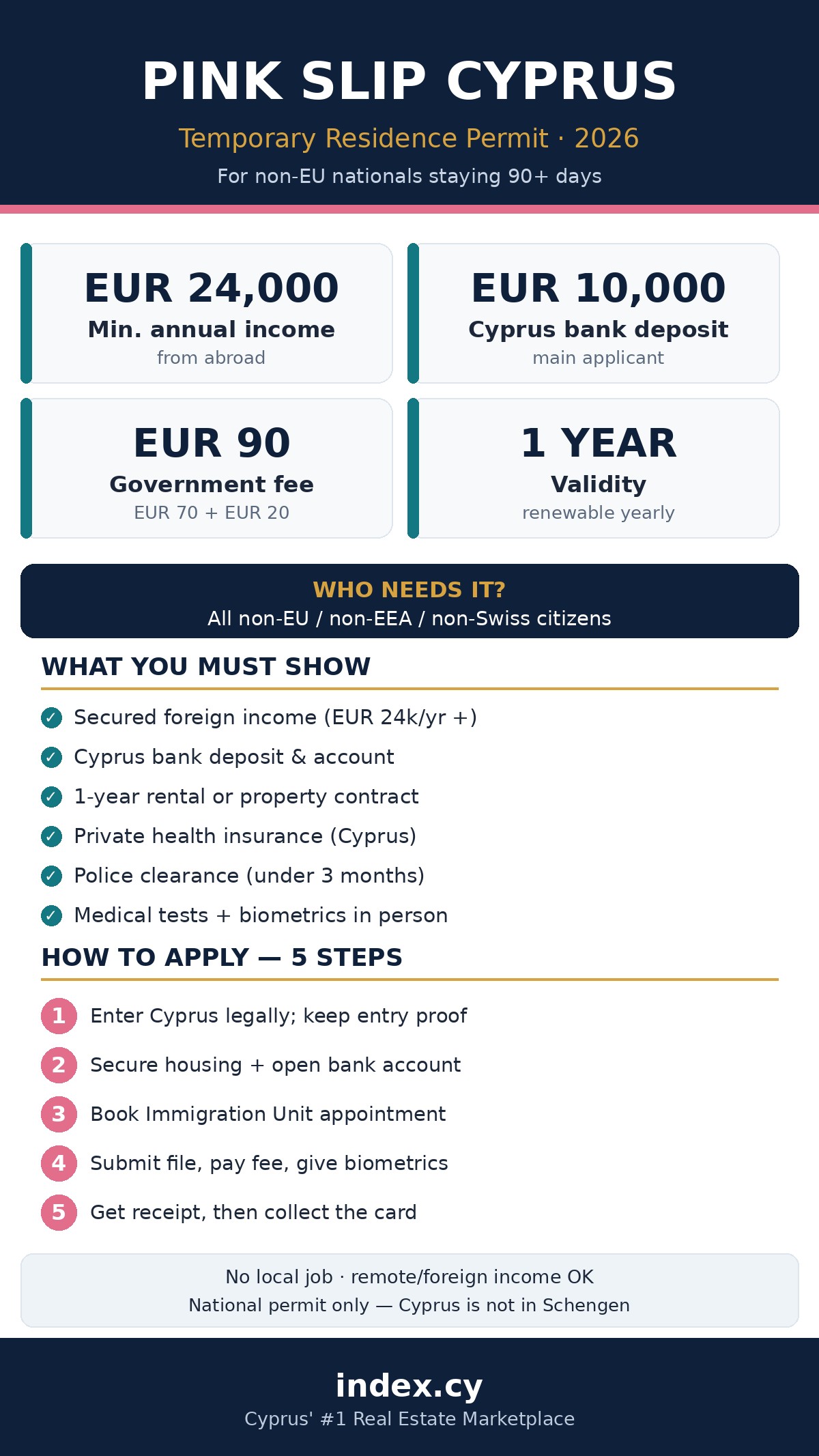
Renewal is annual. Provided you still meet the income, housing, and insurance conditions, you submit an updated file each year before the permit expires. One residence rule matters: pink slip holders are generally expected to spend a substantial part of the year in Cyprus and should not be absent for more than three continuous months, or the permit can lapse.
What the Pink Slip Lets You Do (and What It Doesn’t)
Understanding the limits of the pink slip is as important as meeting the requirements—several restrictions surprise newcomers.
Work. The visitor’s pink slip does not allow you to take up local employment in Cyprus. It does, however, permit you to live on the island while earning from abroad. Working remotely for a foreign employer or running your own overseas business is compatible with the permit, and directors of their own Cyprus company may act through that directorship. If your goal is to work locally, a different permit category or route applies.
Travel. Because Cyprus is outside the Schengen Area, the pink slip does not grant visa-free movement around mainland Europe. It authorises your residence in Cyprus only; travel to Schengen countries follows the normal EU residence and travel rules for your nationality.
Family. A spouse and children under 18 can usually be included in the same application, so families can settle together rather than filing entirely separate cases.
A path to permanence. Years of continuous, compliant temporary residence can support a later application for long-term or permanent status. If that is your aim, our guide to permanent residence in Cyprus sets out the investment-based and long-stay routes.
Pink Slip vs Yellow Slip vs Permanent Residence
Cyprus runs parallel systems for different residents, and the terms are easy to mix up. Here is how the three most common statuses compare:
| Status | Who it’s for | Duration | Work rights |
|---|---|---|---|
| Pink slip (temporary residence permit) | Non-EU nationals staying 90+ days | 1 year, renewable | No local job (remote/foreign income OK) |
| Yellow slip (MEU1 certificate) | EU/EEA/Swiss citizens staying 90+ days | Indefinite | Full work rights |
| Permanent residence | Mainly non-EU investors / long-stay residents | Permanent | Depends on category |
For most third-country citizens the journey starts with the pink slip and, over time, may progress toward permanent residence. Planning your budget around the move is easier with our cost of living in Cyprus breakdown alongside this permit guide.
Frequently Asked Questions
What is a pink slip in Cyprus?
The pink slip is the informal name for the Cyprus temporary residence permit issued to non-EU nationals who want to stay longer than 90 days. It is valid for one year, renewable annually, and lets you live in Cyprus without granting the right to take a local job.
How much does the pink slip cost in Cyprus?
The government fee is €90 in total—€70 for the application and €20 for registration—per applicant. Separate costs include the required Cyprus bank deposit, private health insurance, and any document translations.
Can I work in Cyprus with a pink slip?
No, the visitor’s pink slip does not allow local employment. You can live in Cyprus while working remotely for a foreign employer or earning income from abroad, and directors of their own Cyprus company may work through that directorship.
How long does a pink slip take to process?
The physical card commonly takes several weeks to a few months, depending on your district and its caseload. A stamped submission receipt keeps you legally resident while your application is examined.
Does a pink slip let me travel in Europe?
No. Cyprus is not in the Schengen Area, so the pink slip authorises residence in Cyprus only. Travel to Schengen countries follows the standard visa rules for your nationality.
Putting Down Roots in Cyprus
The pink slip Cyprus grants to non-EU nationals is the practical foundation of a life on the island: prove a steady foreign income, secure a home and health cover, submit a complete file, and you gain a renewable year of legal residence. It rewards preparation—an organised document set and an early appointment are what keep the process smooth.
Take the time to line up your bank account, housing, and insurance before you apply, mark your renewal date each year, and keep records of your residence. If you are still planning the wider move, our guides to relocating to Cyprus and living in Cyprus as an expat cover the practicalities that surround the permit. And when you are ready to secure that all-important Cyprus address, browse verified listings across the island’s five districts on Cyprus’ number-one property marketplace.
This guide is general information, not legal or immigration advice. Requirements and thresholds change—confirm the current rules with the Civil Registry and Migration Department or a qualified adviser before applying.
Keep reading

Larnaca Property Market Surges: Which Areas Are Leading the Price Rise? Larnaca’s property market has experienced a notable surge in prices recently,…

We analysed 66 Tseri, Nicosia listings: 18 apartments, 8 houses and 34 plots. Median 2-bed price is EUR174,000. See prices and what…

We analysed 246 Lakatamia, Nicosia listings: 129 apartments, 52 houses and 46 plots. Median 2-bed price is EUR195,000. See prices and what…