
What this guide covers
- Why You Need a Bank Account in Cyprus
- Can Foreigners Open a Bank Account in Cyprus?
- Documents You Need to Open a Bank Account in Cyprus
- How to Open a Bank Account in Cyprus: Step by Step
- Cyprus Banks Compared: Which Account Is Right for You?
- Costs, Fees, and Timeframes
- Opening a Cyprus Bank Account for Buying Property
- Frequently Asked Questions
- Can I open a Cyprus bank account without residency?
- How long does it take to open a bank account in Cyprus?
- Do I need a Cyprus tax number to open a bank account?
- Is Revolut enough for living and buying property in Cyprus?
- Final Thoughts
Opening a bank account in Cyprus is one of the first practical steps for anyone relocating, investing, or buying property on the island. A local account lets you pay a property deposit, receive mortgage funds, set up utility direct debits, and collect rental income without expensive international transfer fees. Yet many newcomers hit avoidable delays because they arrive without the right paperwork.
This guide walks you through exactly how to open a bank account in Cyprus in 2026: who can apply, which documents you need, how long it takes, what it costs, and how banking fits into the property-buying process. Whether you are an EU citizen, a UK expat, or a non-EU investor, you will finish this article knowing precisely what to prepare.
Cyprus banks apply strict anti-money-laundering (AML) and know-your-customer (KYC) checks. That sounds intimidating, but the process is straightforward when you understand it. Incomplete documentation—not nationality—is the single most common reason applications stall.
Why You Need a Bank Account in Cyprus
A Cyprus bank account is more than a convenience; for property buyers and residents, it is close to essential. Most banks require borrowers to hold a local account before approving a mortgage, and lenders release funds directly into it. If you are purchasing a home, the account is where your deposit, completion payment, and transfer fees flow through.
For everyday life, a local account simplifies almost everything. You can arrange direct debits for electricity, water, and internet, receive a Cyprus-issued debit card, and avoid the 2–4% currency-conversion costs that foreign cards often carry. Landlords also use local accounts to collect rent and demonstrate a clean, traceable income trail to the tax authorities.
There is a compliance dimension too. When you buy property, you must show the source of your funds. Routing money through a regulated Cyprus account creates the paper trail that lawyers, banks, and the Land Registry expect. If you plan to browse properties for sale in Limassol or elsewhere, sorting your banking early removes friction later.
Finally, a local account supports your tax and residency position. Cyprus tax residents and non-domiciled individuals benefit from favourable rules, and a domestic account makes filing, receiving pensions, and managing rental income far cleaner. Our guide to tax residency in Cyprus explains how the 60-day and 183-day rules work alongside your banking setup.

Can Foreigners Open a Bank Account in Cyprus?
Yes. Foreigners can open a bank account in Cyprus, and both residents and non-residents are eligible. The exact requirements, however, depend on your nationality, residence status, and whether you already live on the island.
EU and UK citizens generally face the fewest hurdles. If you hold an EU passport or a registration certificate, banks treat your application as relatively low-risk and processing is faster. Non-EU nationals undergo more extensive KYC and AML verification, and banks typically ask for a detailed explanation of the source of your funds.
You do not always need to be physically present. Several Cyprus banks now allow non-residents to open accounts remotely through online verification programs, so a branch visit is not always required. That said, in-person verification is still common for non-resident accounts, and requirements vary from bank to bank.
Your residence status shapes which documents you provide. EU citizens living in Cyprus usually present their Yellow Slip (MEU1)—the official EU registration certificate—while non-EU residents present their Alien Registration Certificate (ARC). Non-residents applying from abroad rely more heavily on passport verification and source-of-funds evidence. If you are still planning your move, our relocating to Cyprus guide covers residency permits in detail.
Documents You Need to Open a Bank Account in Cyprus
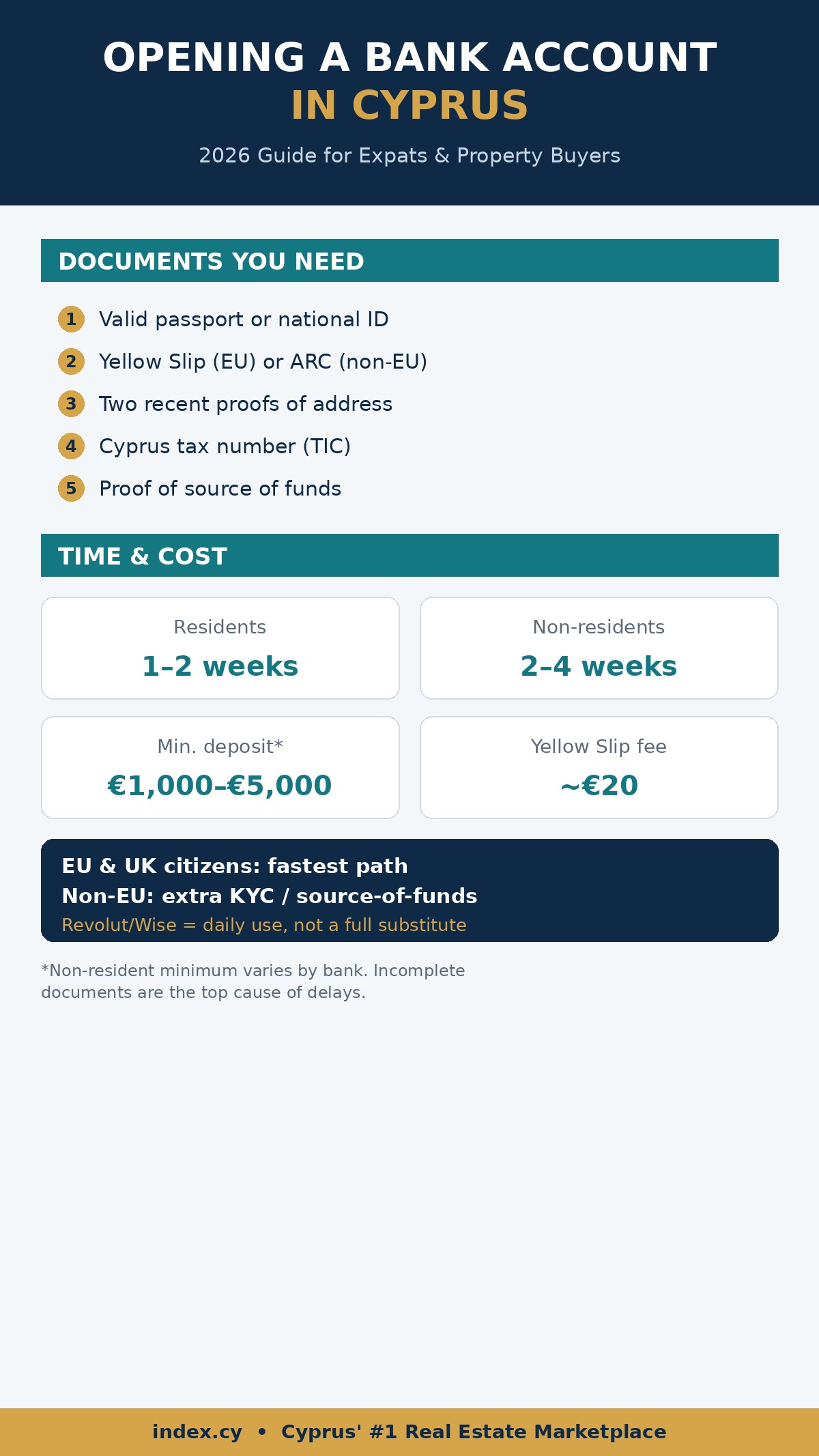
Preparing the right documents is where most applications succeed or fail. Banks reject incomplete files far more often than they reject applicants, so gather everything before you apply. Here is what Cyprus banks typically require in 2026.
- Valid identification: a passport or national ID card. Non-EU applicants may need certified copies.
- Proof of address: often two separate documents, such as a recent utility bill (within three months) or a signed and stamped lease agreement. Hotel invoices and serviced-apartment confirmations are usually rejected.
- Cyprus Tax Identification Code (TIC): a 9-character code (8 digits plus a letter) issued by the Tax Department. All non-resident property owners must obtain one.
- Foreign tax identification number: plus a FATCA/CRS self-certification form for international reporting.
- Proof of source of funds: typically three months of payslips, an employment contract, audited business accounts, or documentation of specific funds such as property-sale proceeds, a pension lump sum, or an inheritance.
- Reason for opening the account: for example, salary, property purchase, savings, or investment.
Proof of address is the item that “ages out” most often—banks routinely refuse paperwork older than three months, so request fresh documents shortly before you apply. Keep both digital scans and originals; branches frequently want to sight the originals.
For EU citizens, obtaining the Yellow Slip first makes everything smoother. You apply at any District Administration Office with your passport, a rental contract, and proof of financial resources (broadly, at least €12,000 in savings or a stable income). The fee is around €20 and processing takes one to four weeks.
How to Open a Bank Account in Cyprus: Step by Step
The mechanics of opening a bank account in Cyprus follow a predictable sequence. Working through it in order prevents the back-and-forth that causes delays.
- Get your Cyprus tax number (TIC). Apply through the Tax Department. Property owners and most residents need this before the bank will finalise an account.
- Sort your residency paperwork. EU citizens should secure the Yellow Slip; non-EU residents should hold their ARC. Non-residents applying from abroad can skip this but need stronger source-of-funds evidence.
- Choose your bank. Compare the major institutions on branch access, English-language service, digital banking, and fees.
- Assemble your documents. Confirm the bank’s exact checklist—requirements differ slightly—and make sure every proof of address is recent.
- Submit your application. Do this in branch or through the bank’s online onboarding platform if remote opening is offered.
- Complete verification. The bank runs its KYC and AML checks and may request clarification on your funds. Respond quickly to keep things moving.
- Activate the account. Once approved, make any required minimum deposit, collect your debit card, and set up online and mobile banking.
Throughout, responsiveness matters. Banks pause applications while waiting for missing information, and each round trip can add days. A well-organised applicant with complete paperwork moves through the process markedly faster.
Cyprus Banks Compared: Which Account Is Right for You?
Cyprus has a compact but competitive banking sector. The main retail banks offer multi-currency accounts, English-language online banking, and debit cards suitable for both residents and international clients. Digital alternatives complement, but rarely replace, a local account.
| Bank / Service | Type | Best for | Notes |
|---|---|---|---|
| Bank of Cyprus | Traditional retail | Broadest branch and ATM network | Largest bank; full mortgage and multi-currency services |
| Hellenic Bank | Traditional retail | Everyday and business banking | Strong branch network and digital app |
| Eurobank Cyprus | Traditional retail | Affluent and corporate clients | Well regarded for wealth and business accounts |
| AstroBank | Traditional retail | International and non-resident clients | Focus on private and international banking |
| Alpha Bank Cyprus | Traditional retail | General retail banking | Part of the wider Alpha Bank group |
| Revolut / Wise | Digital / e-money | Daily spending and SEPA transfers | Fast setup, EU IBAN; not a full local-bank substitute |
Traditional banks are the right choice when you need a mortgage, a locally recognised account for property completion, or a document trail for official processes. Digital services such as Revolut open in minutes and provide a full EU IBAN (Revolut’s are Lithuanian, starting “LT”) that works for SEPA transfers and utility payments. However, Revolut and Wise statements are generally not accepted as proof of address for official Cyprus government and Land Registry processes, so treat them as a supplement rather than your primary account.
For buyers focused on the coast, pairing a Bank of Cyprus or Hellenic account with a browse through properties for sale in Paphos is a common starting point for UK and EU expats.
Costs, Fees, and Timeframes
Understanding the costs upfront helps you budget and avoid surprises. Fees in Cyprus are moderate by European standards, but they vary by bank and account type.
For non-residents, minimum opening deposits typically range from €1,000 to €5,000, depending on the bank and the account package. Resident accounts often carry little or no minimum. Most banks charge a monthly or quarterly maintenance fee, usually a few euros, and additional charges apply for international wire transfers, cheque books, and card replacement. Always request the bank’s official schedule of commissions and charges before signing.
On timing, straightforward resident applications with complete documents can be finalised in about one to two weeks. Non-resident accounts generally take two to four weeks from the submission of complete documentation, because the compliance review is deeper. Corporate accounts take longer still.
The clearest way to speed things up is to submit a complete, current file. As noted, incomplete or stale documents are the leading cause of delays and rejections. Everything you pay in fees is modest against the cost of a stalled property purchase, and banking or management costs tied to rental income are typically deductible against that income—worth discussing with a local accountant.
Opening a Cyprus Bank Account for Buying Property
If your goal is a home or investment on the island, banking and buying are tightly linked. Most lenders require you to hold a local Cypriot account before approving a mortgage, and they release loan funds into that account. Non-residents can still obtain financing, though conditions—income verification, down payment, and eligible property types—vary with your legal and tax status.
The account also carries your transaction. Your deposit, completion payment, and ongoing costs run through it, giving your lawyer and the Land Registry a clean, verifiable record. If you are weighing a mortgage, our guide to financing your property purchase in Cyprus explains how lenders assess non-resident borrowers. Because Cyprus requires proof of the source of your purchase funds, moving money through a regulated local account is the simplest way to satisfy AML checks.
Timing matters here. Open your account—or at least start the process—before you are ready to make an offer, since approval can take several weeks. Buyers who leave banking to the last minute risk missing completion deadlines. Our guide to buying a house in Cyprus sets out how the account, mortgage, and legal steps fit together.
Once you own property, the same account underpins your income and running costs. Landlords collect rent into it and pay for maintenance, insurance, and management from it. Investors weighing permanent residence through property investment will also find that a well-documented banking history strengthens their application. Before committing to any property, it is wise to run an instant property report to confirm you are paying a fair price.
Frequently Asked Questions
Can I open a Cyprus bank account without residency?
Yes. Non-residents can open accounts in Cyprus, and several banks offer remote onboarding through online verification. Expect deeper KYC and AML checks, a possible minimum deposit of €1,000–€5,000, and detailed source-of-funds documentation. EU and UK applicants generally clear these checks faster than non-EU nationals.
How long does it take to open a bank account in Cyprus?
Resident applications with complete documents usually take one to two weeks. Non-resident accounts typically take two to four weeks from the submission of a complete file. The main variable is documentation—missing or outdated paperwork is the leading cause of delay.
Do I need a Cyprus tax number to open a bank account?
In most cases, yes. Banks generally require a Cyprus Tax Identification Code (TIC), and all non-resident property owners must obtain one. Apply through the Tax Department before finalising your account. You will also provide your home-country tax number and a FATCA/CRS self-certification.
Is Revolut enough for living and buying property in Cyprus?
Revolut and Wise are excellent for daily spending and SEPA transfers, and they open quickly with no minimum deposit. But their statements are not accepted as proof of address for official Cyprus processes, and lenders expect a local account for mortgages and property completion. Use them alongside, not instead of, a Cyprus bank account.
Final Thoughts
Opening a bank account in Cyprus is a manageable process once you know the rules. Prepare your passport, residency paperwork, Cyprus tax number, recent proof of address, and clear source-of-funds evidence, and most applications move smoothly within a few weeks. EU and UK citizens have the easiest path, but non-EU investors are well catered for too, including remote options.
For property buyers, the message is simple: bank first. A local account unlocks mortgage financing, carries your deposit and completion funds, and satisfies the source-of-funds checks that every Cyprus purchase requires. Start early, keep your documents current, and choose a bank that matches how you will actually use the account.
Ready to take the next step? Once your banking is in place, explore verified listings across all five districts on Cyprus’ #1 property marketplace, and read our guide to living in Cyprus to plan the rest of your move with confidence.
This article is for general information only and is not financial, tax, or legal advice. Banking requirements change and vary by institution—confirm current details directly with your chosen bank and a qualified local adviser.
Keep reading

September Sees Cyprus Property Sales Soar to Record Highs September 2026 marked a new peak for property transactions across Cyprus, with a…

We analysed 57 Deryneia, Famagusta listings: 39 apartments, most 2-beds near EUR205,000, plus 8 plots and no rentals. See prices and what…

We analysed 24 Kornos, Larnaca listings: 23 are land, most plots ask EUR30 to EUR115 per sqm and there are no rentals.…