What this guide covers
- Why Buy a House in Cyprus in 2026?
- Can Foreigners Buy a House in Cyprus?
- How Much Does a House Cost in Cyprus?
- The Step-by-Step Process of Buying a House in Cyprus
- Step 1: Set your budget and arrange financing
- Step 2: Find the right house
- Step 3: Appoint an independent lawyer
- Step 4: Make an offer and pay a reservation deposit
- Step 5: Due diligence and contract
- Step 6: Sign the contract and pay the deposit
- Step 7: Complete payment and transfer title
- Taxes, Fees and Costs When Buying a House
- Financing Your House Purchase
- Common Mistakes and How to Avoid Them
- Frequently Asked Questions
- How long does it take to buy a house in Cyprus?
- Can I get residency by buying a house in Cyprus?
- Do I need to be in Cyprus to buy a house?
- Is buying a house in Cyprus a good investment in 2026?
- Final Thoughts
Buying a house in Cyprus is one of the most rewarding decisions a buyer can make in the Mediterranean — but it is also one that rewards preparation. Whether you are a Cypriot family upgrading to a larger home, a British buyer relocating after Brexit, or an investor chasing rental yields and year-round sunshine, the process follows a clear, well-regulated path. This 2026 guide walks you through every step of buying a house in Cyprus: what houses cost across the island, who is allowed to buy, the taxes and fees you will pay, how to finance the purchase, and the due-diligence steps that protect your money.
Cyprus combines an English-based legal system, low taxes, EU membership, and roughly 320 days of sunshine a year. As the island’s #1 real estate marketplace, index.cy lists tens of thousands of verified properties from over 100 agencies — and operates on a pay-per-listing model, so the guidance here is neutral, not commission-driven.
Why Buy a House in Cyprus in 2026?
Cyprus property has been on a sustained upward trajectory. According to the Central Bank of Cyprus Residential Property Price Index, house and apartment prices have risen for several consecutive years, with nominal growth of roughly 2–3% year-on-year heading into 2026 and stronger gains in coastal districts. Transaction volumes remain healthy: property sale contracts have continued to climb in early 2026, driven by both domestic demand and international buyers.
The fundamentals behind the demand are straightforward:
- Lifestyle. Mediterranean climate, low crime, beaches, and a relaxed pace of life attract retirees, families, and remote workers.
- EU membership and a familiar legal system. Cyprus law is based on English common law, and contracts and title deeds are handled in a transparent, court-backed framework.
- Tax efficiency. No inheritance tax, no annual immovable property tax (abolished in 2017), and — as of 1 January 2026 — no stamp duty on purchase contracts.
- Residency options. Buying property worth €300,000 or more can qualify non-EU nationals for permanent residency.
A house, specifically, gives you something an apartment cannot: land, privacy, outdoor space, and — in most cases — stronger long-term appreciation. Browse current listings of houses for sale in Cyprus to get a feel for what your budget buys before you commit.
Can Foreigners Buy a House in Cyprus?
Yes. Foreigners can and do buy houses in Cyprus, but the rules differ depending on nationality.
EU citizens have the same property rights as Cypriots. They can buy any number of houses, of any size, with no special permit.
Non-EU nationals (including UK citizens since Brexit) can buy property too, but with two practical limits. First, they generally need approval from the Council of Ministers to register the title — a formality that is almost always granted and does not stop you from completing the purchase or moving in. Second, non-EU buyers are typically limited to one property up to a plot size of around 4,014 m² for personal use, though this is rarely a constraint for a family home.
In practice, the process for a foreign buyer is nearly identical to that for a local buyer. The most important difference is that you must engage an independent lawyer early. For a deeper look at the rules for international buyers, see our dedicated guide to buying property in Cyprus as a foreigner.
How Much Does a House Cost in Cyprus?
House prices in Cyprus vary widely by district, location relative to the coast, plot size, and whether the property is new or resale. The table below gives realistic 2026 ranges for a typical 3-bedroom house; luxury seafront villas and large country estates sit well above these figures.
| District | Typical 3-bed house | Notes |
|---|---|---|
| Limassol | €450,000 – €900,000+ | Most expensive; premium coastal and marina demand |
| Paphos | €280,000 – €550,000 | Popular with expats; strong value |
| Larnaca | €260,000 – €480,000 | Growing fast; new airport-area demand |
| Nicosia | €280,000 – €500,000 | Capital; inland, year-round resident market |
| Famagusta | €270,000 – €520,000 | Resort and holiday-home market |
For verified, regularly updated figures, see index.cy’s data on the average price of a house in Cyprus and the average price per square metre. If you are working to a tighter budget, the cheap houses and villas for sale section is a good starting point.
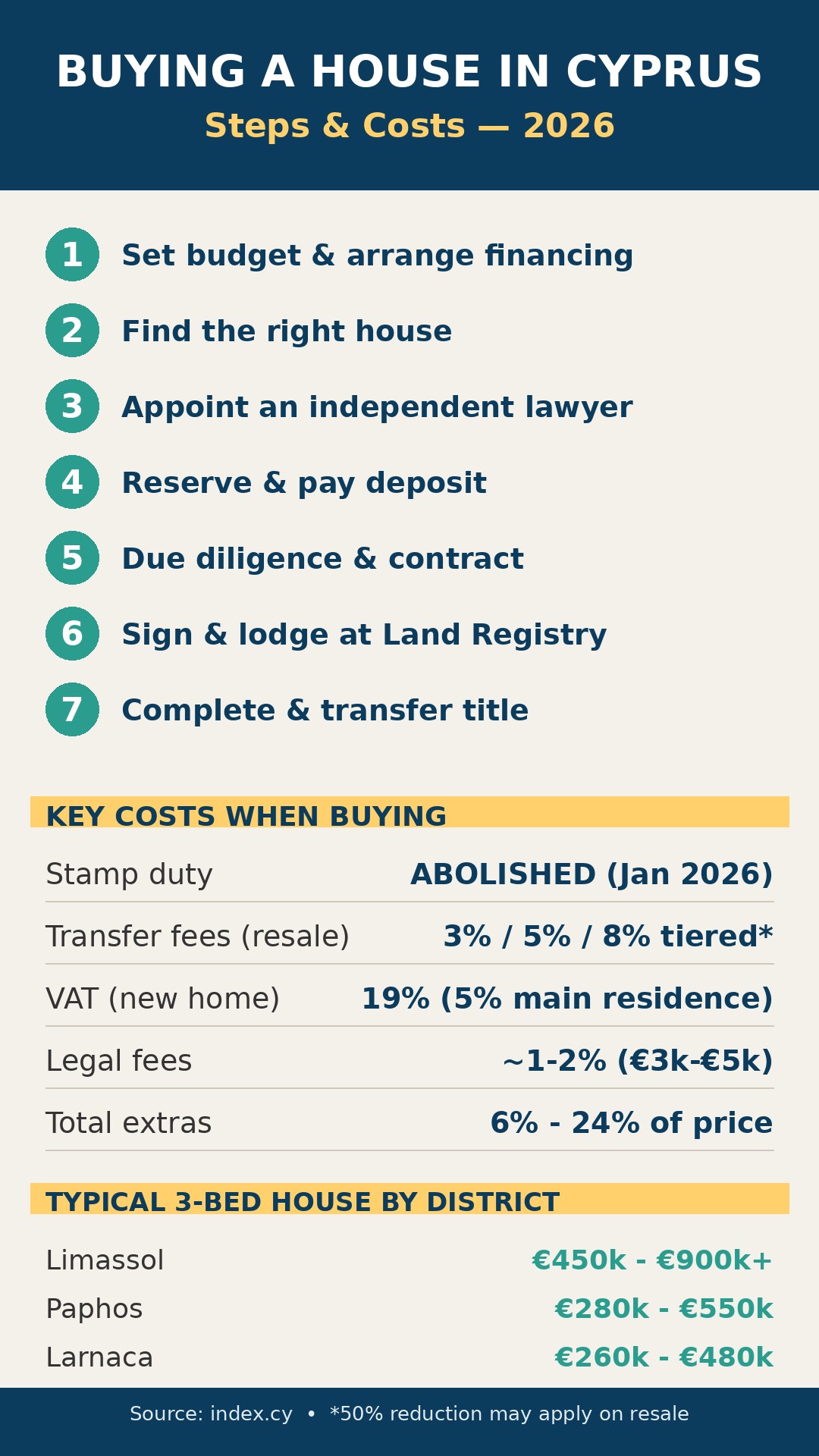
Remember that the headline price is not your total cost. Budget an additional 6–24% on top of the purchase price for taxes, fees, and legal costs — the wide range depends heavily on whether you buy new (where VAT dominates) or resale (where transfer fees and legal fees apply). We break these down below.
The Step-by-Step Process of Buying a House in Cyprus
Buying a house in Cyprus is methodical and protective of the buyer when done correctly. Here is the path from search to keys.
Step 1: Set your budget and arrange financing
Decide your maximum total cost, including taxes and fees. If you need a mortgage, get a pre-approval in principle from a Cypriot bank before you start viewing. See our Cyprus mortgage guide for current rates and requirements.
Step 2: Find the right house
Search by district, property type, and budget. Shortlist properties, then view in person or via video tour. A marketplace like index.cy lets you compare verified listings side by side without agency bias.
Step 3: Appoint an independent lawyer
This is the single most important step. Your lawyer — independent of the seller, agent, and developer — verifies ownership, checks for mortgages or charges on the property, confirms planning permits, and protects your deposit. Expect legal fees of roughly €3,000–€5,000, or about 1–2% of the price plus VAT.
Step 4: Make an offer and pay a reservation deposit
Once your offer is accepted, you pay a reservation deposit (typically €5,000–€10,000) to take the property off the market while contracts are prepared. Make sure the reservation agreement states the deposit is refundable if legal checks fail.
Step 5: Due diligence and contract
Your lawyer conducts a full title search and reviews the contract of sale. For older or rural houses, a survey or professional inspection is strongly recommended to catch structural issues, boundary problems, or unpermitted extensions. You can also pull an instant property report for a fast, data-driven valuation and risk check.
Step 6: Sign the contract and pay the deposit
On signing, you typically pay 20–30% of the price. Critically, your lawyer lodges the signed contract at the Land Registry within the statutory window. This “specific performance” protection means the seller cannot sell or mortgage the property to anyone else.
Step 7: Complete payment and transfer title
On completion you pay the balance and receive the keys. Title transfer at the Land Registry may follow immediately (for properties with separate title deeds) or later for newer developments awaiting deed issuance. Read our guide to title deeds in Cyprus so you understand exactly what you are signing for.
For a visual walkthrough of how the Cyprus buying process works in practice, this overview is a helpful primer:
Taxes, Fees and Costs When Buying a House
Understanding the true cost of buying a house in Cyprus prevents nasty surprises at completion. Here is what you will pay in 2026.
Stamp duty — abolished. As of 1 January 2026, stamp duty on purchase contracts has been fully abolished under Law N. 239(I)/2025. Previously buyers paid up to 0.2% of the contract value; this cost is now gone.
Property transfer fees (resale homes). Paid to the Land Registry when title transfers to your name, on a tiered scale: 3% on the first €85,000 of value, 5% on €85,001–€170,000, and 8% above €170,000. For resale properties (no VAT), a 50% reduction often applies. If VAT was paid on the property, transfer fees are not charged at all.
VAT (new-build homes). New properties carry 19% VAT. However, a reduced 5% rate applies to a main residence on the first 130 m² of buildable area, subject to value and eligibility conditions — a significant saving for owner-occupiers.
Legal fees. Roughly €3,000–€5,000, or about 1–2% of the purchase price, plus VAT.
Other costs. Land Registry and survey fees, mortgage registration (if applicable), and annual municipal/communal charges (typically a few hundred euros a year).
For a complete, figure-by-figure breakdown, see index.cy’s Cyprus property tax guide and the practical advice in our financing your property purchase article.
Financing Your House Purchase
Most buyers fund a Cyprus house purchase through a mix of savings and a mortgage. Cypriot banks lend to both residents and non-residents, typically offering:
- Loan-to-value up to 70–80% for residents and 60–70% for non-residents.
- Terms of up to 30–40 years, usually subject to an age cap (often 65–70 at the end of the term).
- Variable rates linked to the Euribor plus a margin, though fixed-rate products exist.
Lenders will assess your income, existing debts, and the property valuation. Non-residents should expect to provide more documentation, including proof of income from abroad. Arrange financing before you make an offer so you can move quickly and negotiate from a position of strength. Our Cyprus mortgage guide covers eligibility, paperwork, and how to get approved.
Common Mistakes and How to Avoid Them
Even in a buyer-friendly system, avoidable errors cost money and stress. Watch for these:
- Skipping independent legal advice. Never rely on the seller’s or developer’s lawyer. Appoint your own.
- Not checking the title deed. Confirm the property has — or will have — a clean, separate title deed free of mortgages or charges. Always read our due diligence guide before signing anything.
- Forgetting the total cost. Budget for the full 6–24% of extras, not just the asking price.
- Ignoring the survey. For resale and older houses, a professional inspection can reveal damp, structural cracks, or illegal extensions that derail a sale later.
- Rushing the reservation agreement. Ensure your deposit is refundable if legal checks fail.
For high-value or rural homes — for example, larger villas for sale in Cyprus or properties in fast-growing districts like Larnaca and Paphos — these protections matter even more.
Frequently Asked Questions
How long does it take to buy a house in Cyprus?
From accepted offer to completion typically takes 6–12 weeks for a resale property with a clean title. Mortgage approval or pending title deeds can extend this.
Can I get residency by buying a house in Cyprus?
Yes. Buying property worth €300,000 or more (plus VAT) can qualify non-EU nationals for permanent residency, subject to income and other conditions.
Do I need to be in Cyprus to buy a house?
Not necessarily. You can grant your lawyer power of attorney to sign documents and complete the purchase on your behalf, which is common for overseas buyers.
Is buying a house in Cyprus a good investment in 2026?
Cyprus has seen steady price growth, strong rental demand, and favourable taxes. As with any market, returns depend on location, property condition, and how long you hold. Use independent data and professional advice rather than agent estimates.
Final Thoughts
Buying a house in Cyprus in 2026 is a clear, well-protected process — provided you prepare your budget, appoint an independent lawyer, complete proper due diligence, and account for the full cost beyond the asking price. The abolition of stamp duty, low ongoing taxes, and a transparent legal system make this an attractive moment for both lifestyle buyers and investors.
Start by exploring verified houses for sale across Cyprus on index.cy, then use our instant property report and inspection service to buy with confidence. With the right preparation, your Mediterranean home is closer than you think.
Keep reading
September Sees Cyprus Property Sales Soar to Record Highs September 2026 marked a new peak for property transactions across Cyprus, with a…
We analysed 57 Deryneia, Famagusta listings: 39 apartments, most 2-beds near EUR205,000, plus 8 plots and no rentals. See prices and what…

We analysed 24 Kornos, Larnaca listings: 23 are land, most plots ask EUR30 to EUR115 per sqm and there are no rentals.…