
What this guide covers
- What Is Social Insurance in Cyprus and Who Must Pay?
- Cyprus Social Insurance Rates in 2026
- The 2026 Insurable Earnings Ceiling
- What Employers Actually Pay
- How to Register for a Social Insurance Number in Cyprus
- If You Are an Employee
- If You Are Self-Employed
- What Your Cyprus Social Insurance Contributions Buy You
- The Old-Age Pension
- Short-Term and Family Benefits
- How Social Insurance Affects Buying Property in Cyprus
- Social Insurance for Landlords, Investors and Non-Residents
- Practical Tips for Managing Your Contributions
- Frequently Asked Questions
- How much is social insurance in Cyprus in 2026?
- How do I get a social insurance number in Cyprus?
- Do self-employed people in Cyprus get unemployment benefit?
- What is the pension age in Cyprus?
- Do I pay social insurance on rental income in Cyprus?
- Can I combine social insurance contributions from another EU country?
- The Bottom Line on Social Insurance in Cyprus
Social insurance in Cyprus is the contribution every employee, employer and self-employed person pays into the state Social Insurance Fund — and it quietly shapes far more of your financial life than most newcomers expect. It determines your state pension, your sick pay, your maternity leave, and whether a Cyprus bank treats you as a credible mortgage applicant.
If you have moved here to work, started a business, or you are weighing up a property purchase, this is the system you will meet in your first month and live with for the rest of your career. Yet it is one of the least clearly explained parts of relocating to Cyprus.
This guide breaks down what you actually pay in 2026, how to register, what your contributions buy you, and — because we are a property marketplace — how your contribution record affects your ability to borrow and buy.
A note on scope: this is general information, not tax, legal or financial advice. Rates and thresholds change annually, and self-employed contributions in particular depend on your occupational classification. Confirm your own position with the Social Insurance Services or a licensed accountant before acting.
What Is Social Insurance in Cyprus and Who Must Pay?
Social insurance in Cyprus is a compulsory contributory scheme run by the Social Insurance Services, part of the Ministry of Labour and Social Insurance. Everyone who works in Cyprus — employed or self-employed, Cypriot or foreign — contributes a percentage of their earnings, and those contributions build entitlement to pensions and benefits.
Three groups pay in:
- Employees. Contributions are deducted at source from your payslip. Your employer deducts your share and pays it, alongside their own, to the Social Insurance Services.
- Employers. They match your social insurance contribution and pay several additional employer-only levies on top.
- Self-employed persons. You pay the whole contribution yourself, at a higher combined rate, on a quarterly basis.
Two points catch newcomers out. First, this is separate from income tax — social insurance is deducted in addition to tax, not instead of it. Second, it is separate from the General Healthcare System (GESY), which is its own contribution with its own rates and its own ceiling. Your payslip will show both.
Nationality does not change the obligation. EU and non-EU workers alike contribute from their first day of insurable employment. What nationality does affect is the paperwork route in — EU citizens register through the yellow slip process, while non-EU nationals arrive via the employment permit and pink slip route before their employer registers them.
Cyprus Social Insurance Rates in 2026
The headline rates for 2026 are unchanged from the previous year. What has changed is the ceiling they apply to.
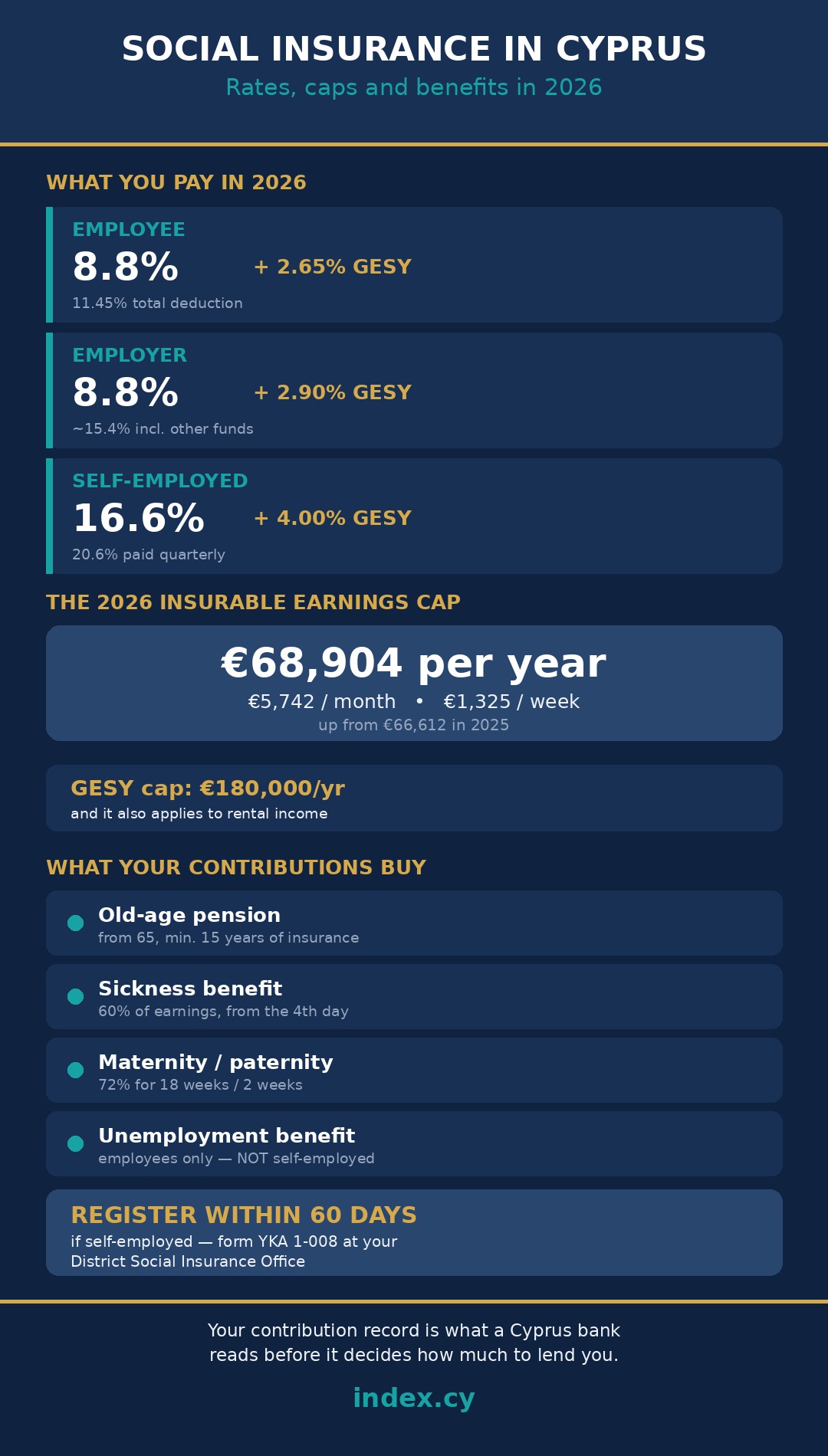
| Contributor | Social Insurance Fund | GESY (healthcare) | Combined |
|---|---|---|---|
| Employee | 8.8% | 2.65% | 11.45% |
| Employer (per employee) | 8.8% | 2.90% | 11.70% + other funds |
| Self-employed | 16.6% | 4.00% | 20.6% |
The 8.8% employee and employer rate has applied since 1 January 2024 and is fixed for a five-year cycle. Under the current legislated schedule, the rate steps up every five years, reaching somewhere between 10.3% and 10.7% by 2039 depending on the actuarial reviews carried out along the way. That is a long runway, but it is worth factoring into long-term planning if you are self-employed.
One detail that is often missed: the self-employed 16.6% is not the whole contribution made on your behalf. The state adds a further 5.2%, bringing the total credited to the fund to 21.8%. You only pay the 16.6%.
The 2026 Insurable Earnings Ceiling
Social insurance is not charged on unlimited income. From 1 January 2026, the maximum insurable earnings are:
- €1,325 per week
- €5,742 per month
- €68,904 per year
That is up from €66,612 per year in 2025 — an annual recalibration tied to wage growth. Earnings above the ceiling attract no further social insurance contributions, which means high earners pay a progressively smaller percentage of their total income into the fund.
GESY has a separate and much higher ceiling: contributions apply on income up to €180,000 per year. Note that GESY also catches income the Social Insurance Fund does not — rental income, dividends and interest are within its scope, which matters if you own investment property in Cyprus.
What Employers Actually Pay
Employers frequently underestimate the true cost of a hire, because social insurance is only part of it. On top of the 8.8% social insurance and 2.90% GESY, employers contribute to three additional funds:
- Redundancy Fund — 1.2%, funding statutory severance payments
- Human Resource Development Authority (HRDA) Fund — 0.5%, funding training programmes
- Social Cohesion Fund — 2.0%, funding social welfare programmes
The redundancy and HRDA contributions are subject to the same insurable earnings ceiling. The Social Cohesion Fund is the exception: it is calculated on actual gross earnings with no cap at all. Add it up and total mandatory employer contributions come to roughly 15.4% of gross salary.
For anyone budgeting a business relocation, or a developer costing a Cyprus team, that 15.4% is the number that belongs in the model — not 8.8%.
How to Register for a Social Insurance Number in Cyprus
Your social insurance number is a lifelong identifier. You will be asked for it by employers, banks, GESY, the Tax Department and the Land Registry. Get it early.
If You Are an Employee
Your employer handles most of it, but you need a number first. The process is straightforward:
- Complete form YKA 1-008, the application for registration as an insured person.
- Attach identification — a copy of your ID card, passport, or alien registration certificate (ARC).
- Submit at your District Social Insurance Office, by hand or by post. Offices operate in each district, generally Monday to Friday, 08:00 to 13:00.
- Wait one to two weeks. The number is typically issued within that window.
As of 2026 there is still no online appointment booking system for social insurance registration. Call your district office to ask about wait times, or simply attend during opening hours. Employers separately register themselves using form YKA 01-001. The government’s Business in Cyprus portal sets out the employer-side requirements in detail.

If You Are Self-Employed
The obligation is on you, and there is a deadline: register within 60 days of starting your business activity. Late registration can trigger penalties, and it delays the contribution record you may later need for a mortgage or a pension claim.
Self-employed contributions work differently from employed ones. You pay 16.6% not simply on what you earned, but on the higher of your actual earnings or a notional minimum set for your occupational class. The Social Insurance Services publish an annual table of minimum weekly insurable earnings covering around 60 occupational categories — a shopkeeper, a builder, a doctor and a consultant each sit in a different band.
For many categories the minimum notional income lands around €20,318 per year, and directors of Cyprus limited companies have a minimum insurable base of €22,000 per year as of 2026. The practical consequence is important: in a lean year, you still owe contributions on the notional minimum even if you actually earned less. Budget for it.
Self-employed contributions are paid quarterly, following the schedule published by the Social Insurance Services. Check the exact due dates when you register — this is the single most common source of unexpected penalties among new freelancers in Cyprus.
What Your Cyprus Social Insurance Contributions Buy You
This is where the system stops being a deduction and starts being an asset. Contributions to the Social Insurance Fund build entitlement to a range of benefits.
The Old-Age Pension
The Cyprus state pension is earnings-related, calculated from your accumulated insurance units across your working life rather than a flat rate. The core conditions:
- Standard pension age is 65.
- You need at least 15 years of insurance — 780 weeks of paid contributions on earnings of at least 780 times the weekly basic insurable earnings.
- You must also have paid or credited contributions across a minimum proportion of your reference period.
Early retirement is possible from age 63 if you meet the 780-week condition, but the pension is permanently reduced by roughly 0.5% for each month claimed before 65. Over two years that is a lasting cut of around 12% — a meaningful trade-off if you are planning to fund retirement partly from property income.
If you do not qualify for the full pension, two fallbacks exist. An old-age settlement — a lump sum rather than a pension — is available at 68 to those with at least six years of contributions meeting a lower earnings threshold. A social pension, which is income-tested and non-contributory, is available at 65 to long-term residents (broadly, 20 years of residence after age 40 or 35 years after age 18).
Short-Term and Family Benefits
| Benefit | What it pays | Key condition |
|---|---|---|
| Sickness benefit | 60% of weekly insurable earnings, rising to 75% after day 156 | Payable from the 4th day of incapacity |
| Unemployment benefit | Earnings-related, capped (roughly €450/week maximum in 2026) | Employees only — self-employed do not qualify |
| Maternity benefit | 72% of weekly insurable earnings for 18 weeks | 26 weeks of contributions in the two preceding years |
| Paternity benefit | 72% of weekly insurable earnings for 2 weeks | Claimed within 16 weeks of the birth |
The unemployment exclusion deserves emphasis. Self-employed people in Cyprus pay a higher contribution rate but receive no unemployment benefit. If you are freelancing here, that gap has to be covered by your own savings buffer — a factor worth weighing before you commit to a mortgage payment at the top of your affordability range.
If you are moving from another EU country, periods of insurance completed elsewhere can generally be aggregated with your Cyprus record under EU social security coordination rules, which matters for meeting minimum contribution conditions. PwC’s Cyprus tax summary is a useful cross-check on the current rates and ceilings.
A short walkthrough of how Cyprus social security contributions are structured. Note that the percentages quoted predate the 2026 update — use the table earlier in this guide for current figures.
How Social Insurance Affects Buying Property in Cyprus
Here is the connection most guides miss. Your social insurance record is one of the documents that decides whether a Cyprus bank will lend to you.
Lenders verify income through the contribution record. When you apply for a mortgage, banks want payslips and a social insurance contribution statement that corroborates them. A clean, continuous record demonstrates stable declared income. Gaps, or a record showing contributions on the notional minimum while you claim a much higher income, create friction — and can reduce the loan you are offered.
The self-employed face a higher bar. If you are self-employed, your declared insurable earnings effectively cap the income a lender will recognise. Declaring the occupational minimum to keep quarterly contributions low is legal, but it may quietly shrink your borrowing capacity years later. Anyone planning to buy in Cyprus within a few years should think about that trade-off before it becomes a problem. Our Cyprus mortgage guide covers what lenders look for in more depth.
Contributions shape genuine affordability. An 11.45% deduction on top of income tax changes what you can comfortably service. A €3,000 gross monthly salary is not a €3,000 budget. Model the net figure against real prices before you shortlist — our Cyprus property prices guide and cost of living breakdown give you the other half of that calculation.
Retirement planning runs through the pension. If your long-term plan is a home in Cyprus funded partly by the state pension, your contribution years are the mechanism. Fifteen years is the entry threshold, and the pension is earnings-related, so both duration and declared level matter. Our retiring in Cyprus guide sets out the wider picture.
Whichever route you take, run the numbers on a specific property before you commit. An instant property report shows you how a given listing compares to similar homes nearby, so your affordability calculation is grounded in what the property is actually worth.
Social Insurance for Landlords, Investors and Non-Residents
Owning Cyprus property does not by itself create a social insurance obligation. The Social Insurance Fund is a contribution on employment and self-employment income — passive rental income is outside it.
GESY is the important exception. Healthcare contributions extend to rental income, dividends and interest for Cyprus tax residents, at 2.65% for income earners up to the €180,000 ceiling. If you own apartments in Cyprus let out to tenants, budget for GESY on that rental income even though social insurance does not apply.
The picture changes if letting is your business rather than a passive holding. Someone actively running a portfolio of short-term rentals may be treated as self-employed, bringing the 16.6% social insurance contribution into scope. Where the line sits depends on scale and how the activity is structured — this is exactly the point at which a licensed Cyprus accountant earns their fee.
Non-residents who own Cyprus property but neither live nor work here generally fall outside both systems, though rental income remains subject to Cyprus income tax. If you are relocating and your residency status is about to change, the Cyprus tax residency guide and the non-dom regime guide explain how the thresholds interact.
Practical Tips for Managing Your Contributions
A handful of habits prevent most of the problems we see people run into.
- Request your contribution statement annually. The Social Insurance Services can issue a statement of your record. Check it — employer reporting errors happen, and they are far easier to correct in the same year than a decade later when you are claiming a pension.
- Keep the number and the paperwork together. Your social insurance number will be requested when opening a bank account, registering for GESY, applying for a mortgage, and dealing with the Tax Department.
- Do not treat the notional minimum as free money. Self-employed people naturally gravitate to the lowest permitted classification. It reduces quarterly outgoings today at the cost of pension entitlement and mortgage capacity later.
- Diarise the quarterly deadlines. Penalties for late self-employed contributions are avoidable and irritating.
- Understand the healthcare link. Contributions and GESY registration together give you access to the public healthcare system — see our healthcare in Cyprus guide for what GESY actually covers.
Salary alone is a poor guide to whether a move works financially. Our working in Cyprus guide covers wages, permits and sectors, and the relocating to Cyprus guide sequences the admin in the order you will actually face it.
Frequently Asked Questions
How much is social insurance in Cyprus in 2026?
Employees pay 8.8% of insurable earnings to the Social Insurance Fund plus 2.65% to GESY — 11.45% in total. Employers pay 8.8% plus 2.90% GESY and three further levies, totalling around 15.4%. Self-employed persons pay 16.6% plus 4.00% GESY. Social insurance applies to earnings up to €68,904 per year in 2026.
How do I get a social insurance number in Cyprus?
Submit form YKA 1-008 with a copy of your ID card, passport or alien registration certificate to your District Social Insurance Office, in person or by post. Offices generally open Monday to Friday, 08:00 to 13:00. The number is usually issued within one to two weeks. There is no online booking system as of 2026.
Do self-employed people in Cyprus get unemployment benefit?
No. Unemployment benefit is available only to employees whose employment ended involuntarily. Self-employed persons pay a higher social insurance rate (16.6% versus 8.8%) but are excluded from unemployment cover, so an independent savings buffer is essential.
What is the pension age in Cyprus?
The standard old-age pension age is 65, requiring at least 15 years of insurance (780 weeks of paid contributions) plus a minimum contribution density across your reference period. Early retirement is possible from 63 with a permanent reduction of about 0.5% for each month claimed before 65.
Do I pay social insurance on rental income in Cyprus?
Not to the Social Insurance Fund — that applies to employment and self-employment income only. GESY, however, does apply to rental income for Cyprus tax residents at 2.65%, up to the €180,000 annual ceiling. If letting property is run as an active business rather than a passive investment, self-employed social insurance may come into scope.
Can I combine social insurance contributions from another EU country?
Generally yes. Under EU social security coordination rules, insurance periods completed in other member states can be aggregated with your Cyprus record to help meet minimum contribution conditions for pensions and benefits. Confirm your specific position with the Social Insurance Services.
The Bottom Line on Social Insurance in Cyprus
Social insurance in Cyprus costs an employee 8.8% and a self-employed person 16.6% of insurable earnings, on income up to €68,904 in 2026, with GESY layered on top. In exchange you build entitlement to an earnings-related state pension from 65, sickness and maternity cover, and — for employees — unemployment protection.
Three things are worth carrying away. Register early: within 60 days if you are self-employed, and before your first payslip if you are employed. Check your record annually, because errors compound. And recognise that your contribution history is financial infrastructure — it is what a Cyprus bank reads when it decides how much to lend you, and what the state reads when it calculates your pension.
For anyone planning to put down roots here, that last point is the one that connects a payroll deduction to a front door. Ready to see what your numbers actually buy? Browse properties for sale in Limassol and Nicosia, or explore houses for sale across Cyprus on Cyprus’ largest verified property database.
This guide is general information about social insurance in Cyprus and is not tax, legal or financial advice. Rates, ceilings and occupational classifications are reviewed annually. Verify your own position with the Social Insurance Services or a licensed Cyprus accountant.
Keep reading

Larnaca Property Market Surges: Which Areas Are Leading the Price Rise? Larnaca’s property market has experienced a notable surge in prices recently,…

We analysed 66 Tseri, Nicosia listings: 18 apartments, 8 houses and 34 plots. Median 2-bed price is EUR174,000. See prices and what…

We analysed 246 Lakatamia, Nicosia listings: 129 apartments, 52 houses and 46 plots. Median 2-bed price is EUR195,000. See prices and what…