
What this guide covers
- What Is the Cyprus Yellow Slip?
- Who Needs a Yellow Slip in Cyprus?
- Documents Required for the Yellow Slip
- How to Apply for the Cyprus Yellow Slip: Step by Step
- Yellow Slip Costs and Processing Time
- Yellow Slip vs Pink Slip: What’s the Difference?
- How the Yellow Slip Connects to Buying Property in Cyprus
- 2026 Update: The Move to Biometric Cards
- Frequently Asked Questions
- Does the Cyprus yellow slip expire?
- Can I work in Cyprus with a yellow slip?
- How long does it take to get a yellow slip?
- Do I need a yellow slip to buy property in Cyprus?
- What is the difference between the yellow slip and the pink slip?
- Conclusion
If you are an EU citizen planning to live, work, or buy property in Cyprus for more than three months, the Cyprus yellow slip is the document that makes it official. Known formally as the MEU1 Registration Certificate, this simple paper certificate confirms your legal right to reside on the island under EU free movement rules.
Yet the process trips up plenty of newcomers. Which documents do you need? Where do you apply? Does it expire? And how does it connect to renting or buying a home here? This guide breaks down exactly what the yellow slip is, who needs one, and how to get yours in 2026 — with the specific figures, forms, and steps verified for this year.
What Is the Cyprus Yellow Slip?
The Cyprus yellow slip is the Registration Certificate issued to EU, EEA, and Swiss nationals who stay in Cyprus for longer than 90 days. It takes its nickname from the yellow paper it has traditionally been printed on, and it is applied for using the MEU1 form.
Think of it as your registration with the state rather than a permit you have to earn. As an EU citizen, you already hold the right to free movement across the Union. The yellow slip simply documents that you have exercised that right and settled in Cyprus. Once issued, it gives you a registered address, an Alien Registration Certificate (ARC) number, and the paper trail you need for almost every other administrative task on the island.
That includes opening a bank account, registering for the General Healthcare System (GESY), getting a tax identification number, signing utility contracts, and — importantly for many readers — completing a property purchase or a long-term rental. The yellow slip is often the first domino that has to fall before the rest of your relocation can proceed.
Who Needs a Yellow Slip in Cyprus?
The yellow slip applies specifically to citizens of the EU, the European Economic Area (Iceland, Liechtenstein, Norway), and Switzerland. If you hold one of these passports and intend to stay beyond three months, you are legally required to register.
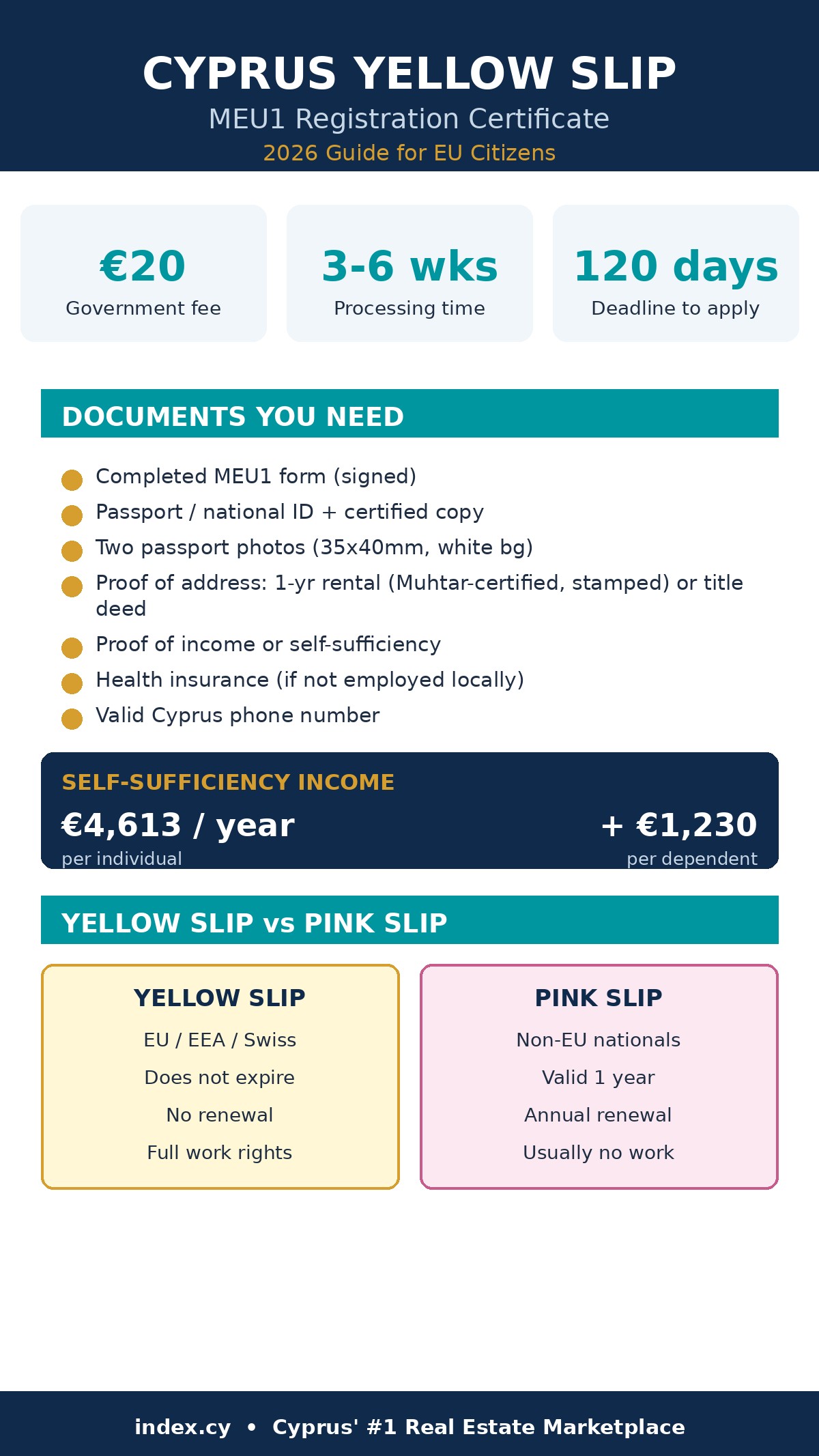
You must submit your application within four months (120 days) of arriving in Cyprus. Staying past 90 days without registering leaves you technically undocumented, which can complicate everything from banking to healthcare access.
Non-EU nationals follow a completely different route. Instead of a yellow slip, they apply for a pink slip — a temporary residence permit that we compare in detail below. British citizens, following the UK’s departure from the EU, now fall into the non-EU category and generally need the pink slip rather than the yellow one, unless they secured protected status earlier. If you are relocating from Britain, our guide to moving to Cyprus from the UK walks through the current requirements.
Family members also have their own forms. EU family members register with the MEU2 form, while non-EU family members of an EU citizen apply for a residence card using the MEU3 form.

Documents Required for the Yellow Slip
Getting your paperwork right the first time is the single biggest factor in a smooth application. Incomplete documents are the most common reason for delays. Here is what the Civil Registry and Migration Department expects for a standard MEU1 application in 2026.
- Completed MEU1 form — the official registration application, signed and dated.
- Valid passport or national ID card — original plus a certified copy.
- Two passport photographs — 35x40mm, white background.
- Proof of Cyprus address — a rental agreement, title deed, or recent utility bill. As of 2026, rental agreements must run for at least one year, be certified by a Muhtar (community certifying officer), and be stamped at the Tax Department.
- Proof of income or self-sufficiency — see the thresholds below.
- Health insurance — required for applicants who are not employed in Cyprus.
- A valid Cyprus phone number.
The income requirement depends on your status. Employed applicants provide an employment contract or a confirmation letter from their employer. Self-employed applicants show business registration and tax documents. Financially independent applicants — retirees, remote workers, and investors — must demonstrate stable income of at least €4,613 per year for an individual, plus roughly €1,230 for each dependent.
Financially independent applicants typically submit three months of bank statements showing at least five transactions made within Cyprus. Pension statements and investment portfolios are also accepted. If you are not employed locally, you will usually need comprehensive sickness insurance with medical coverage of at least €30,000, since employed residents are covered automatically through GESY.
How to Apply for the Cyprus Yellow Slip: Step by Step
The application is done in person, and the process follows a predictable sequence.
- Secure your address first. You cannot register without proof of where you live. Sign a compliant rental agreement or complete your property purchase before you begin. Browsing verified listings on Cyprus’ largest property marketplace is the practical starting point if you have not yet chosen a home.
- Gather and certify your documents. Get your rental agreement certified and stamped, arrange your health insurance if needed, and prepare your bank statements and photographs.
- Book an appointment. Apply at the Immigration Unit of the district where you live, under the Civil Registry and Migration Department. Nicosia residents apply at the central office; those in other districts use their local District Immigration Unit.
- Attend in person and submit. Bring originals and copies of everything. You will complete biometric details and hand over your file.
- Collect your temporary receipt. This receipt confirms your registered status while your certificate is processed, so you are covered in the interim.
- Receive your yellow slip. The certificate follows once your application is approved.
Where you settle can shape the experience. The busier district offices in Limassol and Paphos — both popular with expat buyers — can carry longer queues than quieter districts, so book early.
Yellow Slip Costs and Processing Time
The good news for budgeting: the yellow slip itself is inexpensive. The government fee is €20.
Processing typically takes three to six weeks from your appointment, though it can be faster in less busy districts. Your temporary receipt bridges the gap, so you are not left in limbo while you wait.
The real cost lies in the preparation, not the fee. Certifying a rental agreement, buying qualifying health insurance, and — for financially independent applicants — maintaining the required funds in a local account are the elements worth planning ahead for. Factoring the yellow slip into your wider relocation budget alongside deposits, taxes, and moving costs is smart; our cost of living in Cyprus guide puts these numbers in context.
Yellow Slip vs Pink Slip: What’s the Difference?
This is the distinction that confuses newcomers most. The two documents serve entirely different populations and carry very different rights.
| Feature | Yellow Slip (MEU1) | Pink Slip |
|---|---|---|
| Who it’s for | EU / EEA / Swiss citizens | Non-EU nationals |
| Legal basis | EU free movement rights | National immigration law |
| Validity | Does not expire | 1 year |
| Renewal | Not required | Annual renewal |
| Right to work | Full employment rights | Generally no work rights |
| Typical fee | €20 | Higher, varies by category |
In short, the yellow slip is a lighter-touch registration that reflects your existing EU rights, while the pink slip is a conditional permit that must be renewed and does not include the right to work. Non-EU buyers who want a more permanent footing often pursue residency through property investment instead; our permanent residence through property guide covers that route in full.
How the Yellow Slip Connects to Buying Property in Cyprus
For property buyers and renters, the yellow slip is woven into almost every step of settling in — which is why it matters to anyone using the island as a base rather than a holiday spot.
First, proof of address is central to the application, and that proof usually comes from a property. A certified one-year rental agreement or a title deed from a completed purchase is what unlocks the registration. Choosing a home, in other words, is often the trigger for the whole process.
Second, the yellow slip smooths the transactions that surround a property deal. Opening a Cyprus bank account to transfer purchase funds is far easier once you are registered, and registration feeds directly into your Cyprus tax residency position, which affects how rental income and capital gains are treated.
Third, being registered makes you a resident buyer rather than an overseas one, which can simplify mortgage applications and utility connections. If you are still weighing districts and property types, running an instant property report before you commit helps you understand exactly what you are buying and whether the price is fair. For the wider picture of settling in, our relocating to Cyprus guide ties the residency, tax, and housing pieces together.
2026 Update: The Move to Biometric Cards
The most significant change this year is administrative. Cyprus is transitioning the registration certificate from the traditional yellow paper format toward a biometric card. New applications submitted from mid-2026 onward may be issued in the newer card format rather than the classic yellow slip.
The rights the document confers do not change — it still proves your EU registration and residence. But it is worth knowing that the “yellow slip” you receive may increasingly be a card. If you already hold a paper certificate, it remains valid; the yellow slip does not expire, so there is no need to rush a replacement unless you are told otherwise.
Frequently Asked Questions
Does the Cyprus yellow slip expire?
No. The MEU1 yellow slip does not expire and does not need to be renewed. It reflects your ongoing EU right of residence. You should, however, keep your registered details current if your address or circumstances change.
Can I work in Cyprus with a yellow slip?
Yes. The yellow slip grants full employment rights. As an EU citizen you can work, be self-employed, or run a business in Cyprus without any additional work permit.
How long does it take to get a yellow slip?
Most applications are processed within three to six weeks of your appointment. You receive a temporary receipt at submission that confirms your status while you wait.
Do I need a yellow slip to buy property in Cyprus?
You do not need a yellow slip to purchase property — EU citizens can buy freely. But if you intend to live in the property for more than three months, you must register for the yellow slip, and your property or rental agreement typically provides the proof of address the application requires.
What is the difference between the yellow slip and the pink slip?
The yellow slip is for EU, EEA, and Swiss citizens, does not expire, and includes the right to work. The pink slip is for non-EU nationals, is valid for one year, must be renewed annually, and generally does not grant work rights.
Conclusion
The Cyprus yellow slip is one of the first and most important steps for any EU citizen putting down roots on the island. For a €20 fee and a manageable stack of documents, you gain a registered residence that unlocks banking, healthcare, tax registration, and a smoother property journey.
The keys to a fast application are simple: sort your proof of address early, certify and stamp your rental agreement correctly, meet the income thresholds if you are financially independent, and apply within four months of arrival. Get those right and the yellow slip becomes a formality rather than a hurdle.
Because a property so often provides the address that starts the whole process, choosing the right home is the natural first move. Explore verified listings across all five districts on index.cy, Cyprus’ #1 real estate marketplace, and register with confidence once you have found your place.
This guide is for general information and reflects requirements as understood in 2026. Immigration rules can change, and individual circumstances vary — confirm the current process with the Civil Registry and Migration Department or a qualified professional before applying.
Keep reading

Larnaca Property Market Surges: Which Areas Are Leading the Price Rise? Larnaca’s property market has experienced a notable surge in prices recently,…

We analysed 66 Tseri, Nicosia listings: 18 apartments, 8 houses and 34 plots. Median 2-bed price is EUR174,000. See prices and what…

We analysed 246 Lakatamia, Nicosia listings: 129 apartments, 52 houses and 46 plots. Median 2-bed price is EUR195,000. See prices and what…