
What this guide covers
- What Are Title Deeds in Cyprus?
- Why Title Deeds Matter When Buying Property in Cyprus
- The Title Deeds Transfer Process — Step by Step
- Title Deed Fees, Taxes, and Costs in Cyprus
- Title Deed Problems — The Trapped Buyers Issue Explained
- How to Check If a Property Has Title Deeds (Due Diligence)
- New Legislation: The 2024–2026 Title Deed Reforms
- Frequently Asked Questions About Cyprus Title Deeds
- Can I buy a property in Cyprus without title deeds?
- How long does it take to get a title deed in Cyprus?
- What’s the difference between contract deposit and title transfer?
- Do I need a Cyprus title deed to get permanent residence?
- Can foreign buyers hold title deeds in Cyprus?
- Where do I find verified properties with title deeds?
- The Bottom Line on Title Deeds in Cyprus
Buying property in Cyprus is one of the safest moves you can make in the Mediterranean — if you understand title deeds. Cyprus has historically had one of the largest title deed backlogs in the EU, with tens of thousands of buyers left without registered ownership for years. That problem is finally shrinking thanks to reforms passed in 2015 and expanded through 2024, but it has not disappeared. Any buyer purchasing a property in Limassol, Paphos, Nicosia, Larnaca, or Famagusta in 2026 still needs to know exactly how title deeds in Cyprus work, what they cost, and what to check before signing anything.
This guide walks you through the entire system — how deeds are issued, how they transfer, what the fees are, why so many properties were historically sold without them, and how to verify whether the property you’re looking at has a clean, separate title before you commit. We’ll cite the Cyprus Department of Lands and Surveys process at every step and link to the verified property listings and buyer guides on index.cy that let you move from research to purchase with full confidence.
What Are Title Deeds in Cyprus?
A title deed in Cyprus — known locally as Tίτλος Ιδιοκτησίας — is the official government document issued by the Department of Lands and Surveys (DLS) that proves legal ownership of a specific piece of immovable property. It is the Cypriot equivalent of a registered land title in the UK or a recorded deed in the United States, and it is the only document that gives a buyer absolute legal ownership rights over a property.
A valid title deed in Cyprus contains:
- A unique registration number (sometimes called the “MEM” or parcel number)
- The exact plot location, block, sheet, and survey reference
- Boundaries, coverage ratio, and building permissions
- The registered owner’s full details
- Any encumbrances — mortgages, liens, memos, or rights of way attached to the property
Once issued and transferred, the deed is recorded at the competent District Land Office (Limassol, Nicosia, Paphos, Larnaca, or Famagusta/Paralimni). The registration is the moment when full ownership passes to the buyer. Until that moment, the buyer has only contractual rights — not ownership.
This is the single most important thing to understand about the Cyprus property market: a sale contract, even one deposited at the Land Registry, is not the same as ownership. Only a transferred and registered title deed makes you the owner.
Why Title Deeds Matter When Buying Property in Cyprus
Title deeds matter because they determine whether you can legally sell, mortgage, gift, or inherit a property without obstacles. Without a separate registered title in your name, you can still occupy the property you bought, but your options shrink sharply.
Three practical reasons buyers should insist on clean title deeds:
- Resale liquidity. Properties with issued title deeds typically sell 15–25% faster and at better prices than comparable units without them. Buyers — especially foreign buyers and banks — treat the absence of a deed as a red flag.
- Mortgage access. Cypriot banks rarely grant mortgages to a buyer on a property that does not yet have a separate title deed in the seller’s name. This matters if you plan to use financing or if your future buyer will need a loan to purchase from you. Our Cyprus mortgage guide covers bank requirements in detail.
- Protection from developer debt. If the developer who built your property holds a mortgage over the entire parcel and defaults, buyers without separate title deeds can — in the worst cases — find their homes legally attached to the developer’s unpaid debts. This is exactly what created Cyprus’ “trapped buyers” crisis, which we cover in detail below.
For investors, the calculus is simple. Units with deeds are cleaner assets, easier to exit, and easier to finance. If you’re comparing apartments for sale in Cyprus or browsing villas for sale in Cyprus, the presence of a title deed should be one of your first filters.
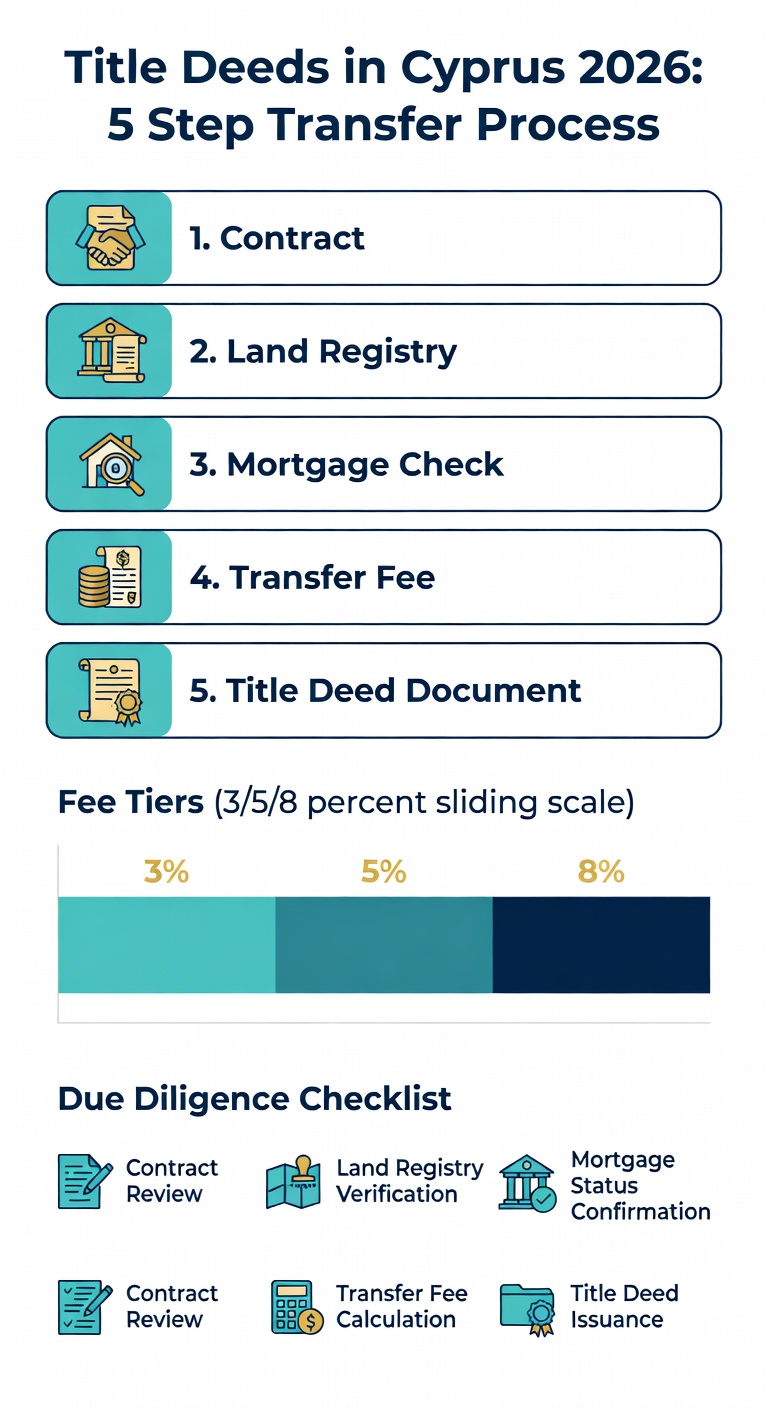
The Title Deeds Transfer Process — Step by Step
The transfer process itself is administrative and straightforward once the title deed has been issued. The complications in Cyprus arise almost exclusively when the deed has not yet been issued at the time of purchase. Here’s how a typical clean transfer works.
Step 1 — Sign the sale contract. The buyer and seller sign a contract of sale. Foreign buyers from non-EU countries also need approval from the Council of Ministers, which is routine for residential property.
Step 2 — Deposit the contract at the Land Registry. Within six months of signing, the contract should be deposited at the competent District Land Office. This “specific performance” deposit (under Cap. 232 as amended) gives the buyer priority over later claims and is the minimum protection every buyer should demand before paying any substantial amount.
Step 3 — Pay the purchase price in full. The balance of the purchase price is paid, usually at or just before transfer day. Mortgage funds, if any, are released at this point.
Step 4 — Obtain tax clearance certificates. Before the DLS will transfer the deed, both parties must produce clearance certificates: Immovable Property Tax (abolished in 2017 but historical liabilities may still apply), Capital Gains Tax, Sewerage Board, Municipality, and Community Board certificates. Your lawyer coordinates these.
Step 5 — Attend the Land Registry for transfer. Both parties (or their lawyers holding Power of Attorney) attend the District Land Office. The buyer pays the transfer fee, and the deed is re-registered in the buyer’s name on the spot. The buyer walks out with the title deed — or can collect it a few working days later.
For a full treatment of the paperwork, see our comprehensive due diligence guide for buying property in Cyprus.
Title Deed Fees, Taxes, and Costs in Cyprus
Title deed costs in Cyprus are predictable, and in many cases heavily discounted. Here’s how the fees stack up in 2026.
Title deed transfer fees are calculated on the property’s market value at transfer, on a sliding scale:
| Property value (€) | Transfer fee rate |
|---|---|
| Up to 85,000 | 3% |
| 85,001 – 170,000 | 5% |
| Above 170,000 | 8% |
Importantly, since the 2011 reform and subsequent extensions still in force in 2026, transfer fees are reduced by 50% for all resale properties, and VAT-eligible new properties pay no transfer fee at all (5% reduced VAT applies instead on a primary residence up to specific square-meter thresholds). In practice, most buyers pay half of the figures above.
Other costs to budget for:
- Stamp duty on the sale contract: 0% up to €5,000; 0.15% on €5,001–€170,000; 0.20% above €170,000 (capped at €20,000 per contract).
- Legal fees: typically €1,000–€2,500 for a standard residential purchase, or 1% of price for larger transactions.
- Land Registry search and deposit fees: under €100 for a contract deposit and a pre-purchase title search.
For a full breakdown of these costs — including VAT, Capital Gains Tax on resale, and annual taxes — review our Cyprus property tax guide and the broader taxes and legalities guide.
Title Deed Problems — The Trapped Buyers Issue Explained
Cyprus’ title deed crisis is one of the most misunderstood aspects of the local property market. It dates back to the construction boom of 2000–2008, when developers routinely sold units in a complex before the final separate title deeds had been issued. In many cases, the developer had taken out a blanket mortgage over the entire land parcel to finance construction. When the 2013 financial crisis hit, some of those developers defaulted. The banks then held enforcement rights over properties that buyers had already paid for in full.
This left tens of thousands of buyers — many of them foreigners from the UK, Russia, and the Middle East — “trapped”: they had paid, they lived in their homes, but they had no separate title deeds in their name and their properties were mortgaged to banks that were owed money by the developer.
Three reforms have materially improved the picture:
- The 2015 “Trapped Buyers Law” gave the Director of the DLS the power to transfer title deeds directly to buyers who had paid in full, even when the developer’s mortgage was still in place. Thousands of deeds were issued under this mechanism.
- 2020 constitutional court rulings restored balance between buyer protection and lender rights, and new procedural rules were passed to keep the transfer process moving.
- 2024 reforms accelerated transfers further, modernised parts of the Land Registry system digitally, and narrowed the remaining legal grey zones.
What this means for a 2026 buyer: the risk still exists, but it is concentrated in older resale units built before 2013 where the title deed has never been issued. New-build properties in modern complexes in Limassol, Nicosia complexes, Paphos complexes, Larnaca complexes, and Famagusta complexes are delivered by developers who are contractually and practically obligated to produce clean separate titles — often within 12–24 months of delivery.
The rule of thumb: if a property is advertised as having title deeds available, verify the deed. If it is advertised as “pending title deeds,” budget more time, negotiate harder on price, and engage a specialist lawyer from day one.
How to Check If a Property Has Title Deeds (Due Diligence)
You can verify title status yourself before spending a euro on legal fees. Here is the practical checklist.
- Ask for the property’s MEM number and Land Registry search. A licensed lawyer or even the owner can request an official search at the District Land Office. The search will list the current registered owner, the property’s boundaries, and — crucially — any mortgages, memos, injunctions, or liens.
- Confirm the owner on the search matches the seller. If the name on the deed is a developer rather than the person selling to you, the unit does not yet have a separate title in the seller’s name.
- Check for encumbrances. Any registered mortgage, memo, or injunction must be understood and cleared by the closing date.
- Inspect the building permit and final approval certificate. Title deeds for new builds are issued only after the building has received a final Certificate of Approval. No certificate = no deed.
- Commission a technical inspection. A legal search tells you about the paper status of the property; a technical inspection tells you about the physical one. We recommend using a professional property inspection service for any property over €150,000.
- Run an instant valuation. Cross-check the asking price against recent comparables with an instant property report before you submit an offer.
Foreign buyers — particularly those unfamiliar with Cyprus conveyancing — should always engage an independent Cyprus property lawyer who does not represent the seller or the developer. The extra €1,500–€2,500 in legal fees is the single best insurance policy you will buy in the entire transaction.
New Legislation: The 2024–2026 Title Deed Reforms
Cyprus is in the middle of a multi-year modernisation of its Land Registry. The direction of travel is clear: faster transfers, more digital services, and fewer legacy disputes.
Key recent developments buyers should know about in 2026:
- Digital title deed searches are now available through the DLS online portal, reducing the time to complete a pre-purchase search from days to hours.
- Accelerated issuance for new builds — developers face tighter deadlines to apply for separate title deeds once the final approval certificate is issued, cutting typical post-completion wait times.
- Clearer rules on developer-bank disputes — the law now provides more predictable outcomes for buyers who paid in full but face a developer default, narrowing the worst-case scenarios that created the original trapped buyers crisis.
- Capital Gains Tax and transfer-fee concessions have been extended through 2026, preserving the effective 50% discount on transfer fees for resale properties and the VAT-only regime for new primary residences.
The European Central Bank and IMF have both cited the Cyprus Land Registry modernisation as a positive signal for the country’s property market. For foreign buyers weighing Cyprus against other Mediterranean destinations, the title deed system is now meaningfully better than it was five years ago — not worse. For broader context on EU property registration reform, see the ongoing monitoring by the European Commission’s Copernicus Land Monitoring Service and the IMF’s Cyprus country page, which regularly covers the legal and property-market reforms that underpin title deed policy.
Frequently Asked Questions About Cyprus Title Deeds
Can I buy a property in Cyprus without title deeds?
Yes, but you shouldn’t unless you fully understand the trade-offs. Deposit your sale contract at the Land Registry immediately, ensure any developer mortgage is released before payment, and use a specialist lawyer. For a typical foreign buyer, the safer option is to buy resale or new-build properties that already have — or will have within a defined, contractually enforceable timeline — separate title deeds.
How long does it take to get a title deed in Cyprus?
For a property that already has a registered title in the seller’s name, the transfer is completed on the day of attendance at the Land Registry. For a new-build where the developer still needs to apply for the separate title, the typical wait is 6–24 months after handover, depending on the municipality and whether the building has its final Certificate of Approval.
What’s the difference between contract deposit and title transfer?
A contract deposit protects your contractual right to buy. A title transfer gives you legal ownership. Only the transfer makes you the owner; only the deed is your proof.
Do I need a Cyprus title deed to get permanent residence?
To qualify under the Cyprus permanent residence by property investment route, you generally need a purchase of new-build property of at least €300,000 (plus VAT) with a fully executed contract deposited at the Land Registry. The separate title deed transfer follows as soon as the developer is able to produce it.
Can foreign buyers hold title deeds in Cyprus?
Yes. EU citizens can acquire property with the same rights as Cypriot citizens. Non-EU buyers need Council of Ministers approval for most residential purchases, which is routinely granted — typically within 3–6 months. See our complete guide to buying property in Cyprus as a foreigner for the step-by-step.
Where do I find verified properties with title deeds?
Filter listings on index.cy by district — Limassol, Paphos, Larnaca, Nicosia, or Famagusta — and ask the listing agent for the title status of any property you shortlist. Licensed agents on our marketplace are required to confirm title status on request.
The Bottom Line on Title Deeds in Cyprus
Cyprus title deeds are no longer the cautionary tale they were a decade ago. The legal framework has been rebuilt, the digital infrastructure has caught up, and the transfer process is genuinely predictable. What has not changed is the buyer’s responsibility to verify title status before any money changes hands.
If you do three things on every Cyprus property purchase, you will avoid virtually every serious title deed problem:
- Run an official Land Registry search before signing.
- Deposit your contract at the Land Registry within six months.
- Engage your own independent Cypriot lawyer.
Everything else — the transfer fee calculations, the VAT thresholds, the developer-bank risk — flows from those three disciplines. Cyprus remains one of the most attractive Mediterranean property markets, and title deeds, done properly, are the asset that makes that attractiveness real for the next buyer in the chain.
Ready to start your search with clean-title properties in mind? Browse verified listings across all five districts on index.cy, the #1 real estate marketplace in Cyprus, where every listing is published by a verified agent or developer on our neutral pay-per-listing platform. For institutional partners, see information for agencies and information for developers.
More about Limassol

Five companies that design modern villas in Limassol — what each of them covers, and the questions worth settling before you sign…

Mesa Geitonia property prices from 1,009 live listings: flats ask €440,500, two-beds €450,000 on a 5.3% gross yield. See rents, bedroom mix…

Agios Athanasios Limassol property prices from 1,072 live listings: apartments €487,800, houses €1.35M, plus rents, yields and area comparisons.
Keep reading
September Sees Cyprus Property Sales Soar to Record Highs September 2026 marked a new peak for property transactions across Cyprus, with a…

We analysed 57 Deryneia, Famagusta listings: 39 apartments, most 2-beds near EUR205,000, plus 8 plots and no rentals. See prices and what…

We analysed 24 Kornos, Larnaca listings: 23 are land, most plots ask EUR30 to EUR115 per sqm and there are no rentals.…