What this guide covers
- Why Choose Limassol? Cyprus’s Coastal Business Capital
- The Cost of Living in Limassol
- Best Neighbourhoods for Living in Limassol
- Germasogeia and the Tourist Area
- Agios Tychonas and the Marina
- Mesa Geitonia and Panthea (Best for Families)
- Agios Athanasios and Neapolis
- How Limassol Compares to Other Cyprus Cities
- Renting vs Buying Property in Limassol
- Getting Around Limassol
- Daily Life, Food, and Things to Do
- The Pros and Cons of Living in Limassol
- Working, Schools, and Healthcare
- How to Make Your Move to Limassol
- Frequently Asked Questions About Living in Limassol
- Is Limassol expensive to live in?
- Is Limassol a good place for expats?
- Do you need a car to live in Limassol?
- Is Limassol safe?
- Conclusion
Thinking about living in Limassol? You are looking at the most cosmopolitan city in Cyprus—a seafront business hub where fintech offices sit beside sandy beaches, and roughly one in five residents holds a foreign passport. It is energetic, international, and unmistakably Mediterranean.
It is also the most expensive place to live on the island. That trade-off is the whole story of Limassol: you pay a premium for the lifestyle, the jobs, and the sea views. This guide breaks down the real numbers—rent, utilities, groceries, schools—plus the best neighbourhoods and how the property market actually works, so you can decide with data rather than guesswork.
Why Choose Limassol? Cyprus’s Coastal Business Capital
Limassol is Cyprus’s second-largest city and its commercial engine. It is home to the island’s busiest port, the headquarters of most international shipping companies, and a fast-growing cluster of fintech, forex, and tech firms. Around 20% of residents are non-nationals, one of the highest shares in the country.
That concentration of business shapes daily life. English is spoken almost everywhere. International schools, private clinics, and global restaurant brands are easy to find. The 14-kilometre seafront promenade, the marina, and a dense calendar of festivals give the city a holiday feel year-round.
For many newcomers, Limassol hits a rare balance: a genuine career market and a beach lifestyle in the same place. If you want to understand how the wider island compares, our complete guide to living in Cyprus sets the national context.
The Cost of Living in Limassol
Here is the honest headline: Limassol is pricey by Cypriot standards, though still cheaper than London, Dublin, or most Western European capitals. Housing is the single biggest line in any budget.
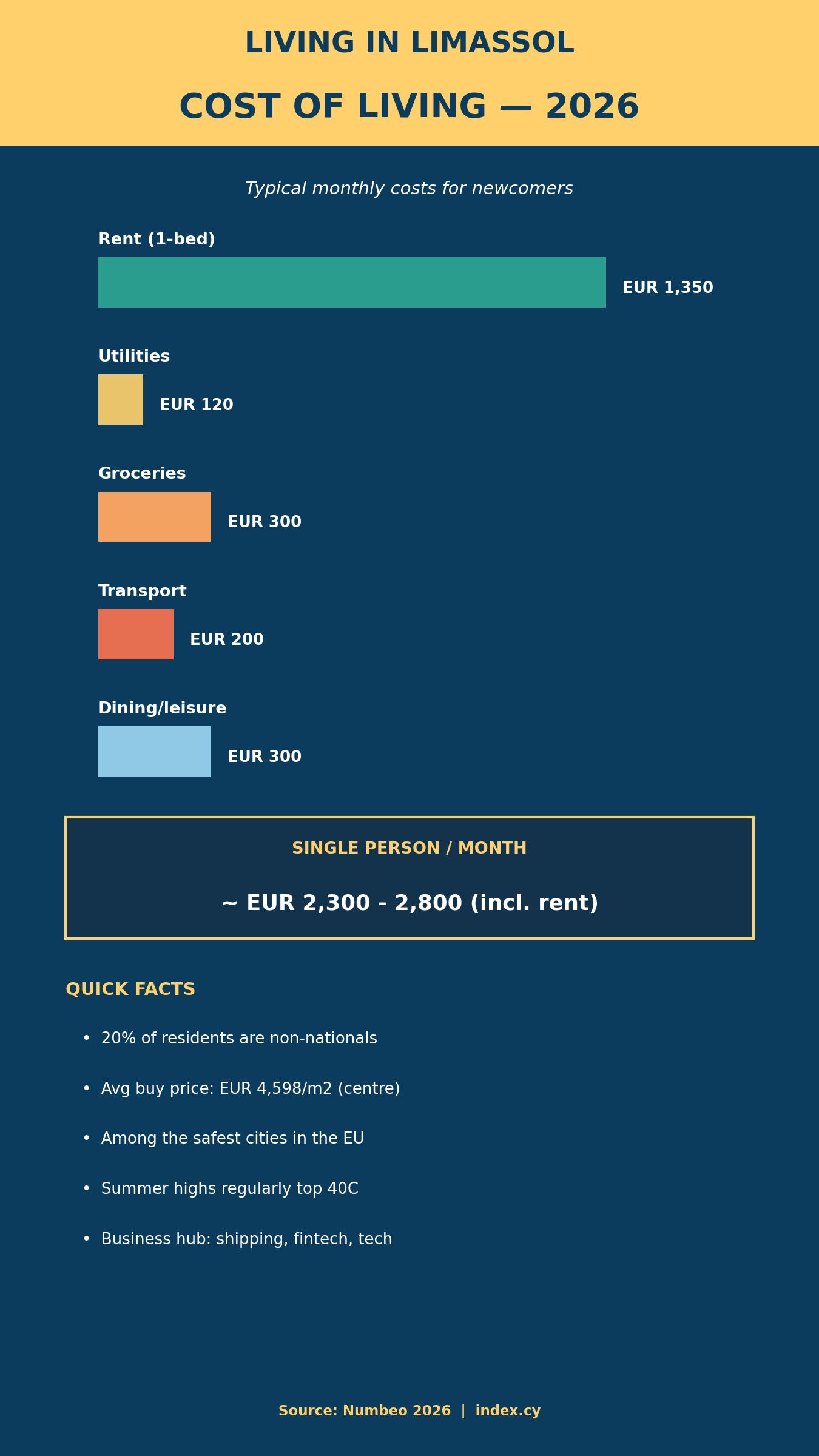
According to Numbeo (April 2026), a one-bedroom apartment in the city centre rents for around €1,350 per month, dropping to roughly €1,157 outside the centre. A single person should budget approximately €2,370 per month including rent for a comfortable lifestyle.
The table below summarises typical monthly costs for newcomers living in Limassol.
| Expense | Single person | Couple / small family |
|---|---|---|
| Rent (1–2 bed) | €1,150–€1,500 | €1,500–€2,200 |
| Utilities (power, water) | €80–€150 | €150–€250 |
| Groceries | €250–€350 | €450–€650 |
| Transport (mostly car) | €150–€250 | €250–€400 |
| Dining & leisure | €200–€400 | €350–€600 |
| Rough monthly total | €2,300–€2,800 | €3,400–€4,200 |
A few things inflate these figures in summer. Temperatures regularly top 40°C from June to September, so air conditioning runs almost constantly and can push electricity bills to €200–€350 a month. Public transport is limited, which means most households run at least one car. For a district-by-district comparison across the island, see our cost of living in Cyprus guide.
Best Neighbourhoods for Living in Limassol
Where you live in Limassol changes your budget and your lifestyle dramatically. The city stretches along the coast, with quieter residential pockets sitting just inland. Here are the areas expats and locals favour most.
Germasogeia and the Tourist Area
The eastern coastal strip around Germasogeia is the classic expat choice. You get beaches, restaurants, international schools nearby, and a mix of modern apartments and villas. Rents are high, but so is convenience.
Agios Tychonas and the Marina
Agios Tychonas, stretching east toward the luxury resorts, and the area around Limassol Marina represent the premium end. Think seafront towers, yacht berths, and concierge living—at a price to match.
Mesa Geitonia and Panthea (Best for Families)
Slightly inland, Mesa Geitonia and Panthea suit families best. They offer quieter streets, proximity to international schools, and noticeably lower rents than the coast, while staying a short drive from the sea.
Agios Athanasios and Neapolis
Agios Athanasios is a large, safe residential district popular with both Cypriots and newcomers, balancing value with access to amenities. Neapolis, closer to the centre, appeals to younger professionals who want to be near the action.
Across the board, Limassol ranks among the safest cities in the EU—violent crime is rare, and most residents feel comfortable walking alone at night. To see live listings by area, browse properties for sale in Limassol or current Limassol rental listings.
How Limassol Compares to Other Cyprus Cities
Limassol is not the only option, and it pays to weigh it against the alternatives before you commit. Each Cypriot city has a distinct character, price point, and buyer profile. The table below gives a quick side-by-side using approximate one-bedroom city-centre rents.
| City | 1-bed centre rent (approx.) | Character | Best for |
|---|---|---|---|
| Limassol | €1,350/month | Cosmopolitan business & beach hub | Professionals, investors |
| Paphos | €800/month | Relaxed, expat-heavy, coastal | Retirees, holiday-home buyers |
| Nicosia | €750/month | Inland capital, local & corporate | Students, first-time buyers |
| Larnaca | €800/month | Affordable coastal, airport city | Value seekers, commuters |
Limassol commands the highest rents because it concentrates the jobs and the lifestyle. If your priority is value or a slower pace, Paphos, Larnaca, or Nicosia stretch your budget further. If you want the deepest career market and the most international scene, Limassol is hard to beat. Our guide to the best places to live in Cyprus compares all five districts in detail.
Renting vs Buying Property in Limassol
Most people start by renting, then decide whether to buy once they know which neighbourhood fits. Both paths have a clear logic.
Renting gives you flexibility and a lower upfront cost. Expect to provide one to two months’ deposit plus the first month’s rent. Leases typically run for a year. Demand is high and supply is tight, so good apartments move fast—line up viewings before you arrive if you can.
Buying makes sense if you are settling long-term or investing. Numbeo puts average purchase prices at roughly €4,598 per square metre in the city centre and €3,602 outside it (April 2026). Limassol consistently delivers Cyprus’s strongest capital appreciation, driven by limited coastal land and steady foreign demand.
If you are weighing a purchase, two resources help. Our Limassol property market report covers prices, trends, and yields, and an instant property report gives you a data-backed valuation before you make an offer.
The video below tours a modern two-bedroom apartment on the Limassol seafront—a useful look at what the city’s newer developments actually offer.
Getting Around Limassol
Limassol stretches roughly 15 kilometres along the coast, so daily life is shaped by how you move around it. The bus network exists but runs infrequently and thins out at night, which is why most residents rely on a car. Budget for fuel, insurance, and the occasional summer-traffic crawl along the seafront road.
The upside is that the city is flat and increasingly walkable in its central and coastal zones. The promenade links beaches, cafés, and parks in one continuous strip, and cycling along it is popular year-round. Taxis and ride-hailing fill the gaps, while Larnaca and Paphos airports both sit within a 45–70 minute drive, keeping international travel easy.
Daily Life, Food, and Things to Do
Beyond the spreadsheets, Limassol is simply an enjoyable place to live. The food scene spans traditional Cypriot tavernas, Lebanese and Asian kitchens, and a growing wave of specialty-coffee spots that reflect the city’s international crowd. Weekly farmers’ markets keep fresh produce cheap and seasonal.
Leisure options are genuinely varied. You can swim from May to November, hike or ski in the nearby Troodos Mountains in winter, tour the medieval castle and the Kourion archaeological site, or join the crowds at the wine festival and the spring carnival. For families, the marina, public beaches, and several green parks make weekends easy and low-cost.
The Pros and Cons of Living in Limassol
No city is perfect. Here is the balanced view before you commit.
The upsides:
- Strong job market in finance, tech, and shipping
- Beach lifestyle with a 14km promenade and a vibrant social scene
- Very safe, consistently ranked among Europe’s safest cities
- Excellent private healthcare and international schools
- Large, welcoming international community
The trade-offs:
- Highest housing costs in Cyprus, with tight supply
- A car is essentially required; public transport is minimal
- Summer heat regularly exceeds 40°C, raising cooling bills
- Coastal areas can be noisy and congested in peak season
For many, the upsides win comfortably—but going in with clear eyes on the cost of housing and transport is the key to a smooth move. Cyprus’s pro-business climate, profiled by Invest Cyprus, is a big part of why so many professionals relocate here.
Working, Schools, and Healthcare
Limassol’s job market is the deepest in Cyprus outside the public sector. Shipping, fintech, forex, software, tourism, and professional services all hire here, and several firms recruit English-speaking staff specifically. Coworking spaces and a visible remote-work community make the city friendly to freelancers and digital nomads.
For families, the city has a strong roster of private and international schools teaching in English, following British, American, or IB curricula. Places fill quickly, so apply early.
Healthcare is among the best on the island. Limassol has numerous private clinics, specialists, diagnostic centres, and hospitals, and English is widely spoken in medical settings. Many residents combine the national GESY system with private insurance for faster access. Local outlets such as the Cyprus Mail are a good way to keep up with city news and policy changes.
How to Make Your Move to Limassol
Once you have chosen Limassol, a simple sequence keeps the move manageable. First, decide on a neighbourhood that matches your budget and stage of life. Second, sort your residency route—EU citizens register easily, while non-EU movers typically use work, digital nomad, or residency-by-investment permits. Third, secure housing, starting with a rental while you learn the city.
If buying is on your horizon, do your due diligence early: verify title deeds, check the developer, and get an independent valuation. A neutral marketplace helps here, because you can compare every verified listing in one place rather than relying on a single agent.
Frequently Asked Questions About Living in Limassol
Is Limassol expensive to live in?
Yes—Limassol is the most expensive city in Cyprus, mainly because of housing. A single person typically needs around €2,300–€2,800 per month including rent, while a couple or small family should budget €3,400–€4,200. It still works out cheaper than most major Western European cities.
Is Limassol a good place for expats?
It is one of the best in Cyprus. With roughly 20% of residents being non-nationals, an English-speaking business culture, international schools, and strong private healthcare, expats integrate quickly. The international community is large and well-established.
Do you need a car to live in Limassol?
For most people, yes. Buses run infrequently and the city sprawls along the coast, so a car makes daily life far easier—especially if you live inland or commute. Central and seafront areas are walkable, but a vehicle remains the practical default.
Is Limassol safe?
Very. Limassol consistently ranks among the safest cities in the EU. Violent crime is rare, petty crime sits below the European average, and most residents feel comfortable walking alone at night.
Conclusion
Living in Limassol means choosing Cyprus’s most international, opportunity-rich city—and accepting that you pay a premium for it. Budget realistically (a single person needs roughly €2,300–€2,800 a month, a family more), pick a neighbourhood that fits your life, and treat housing as the decision that shapes everything else.
The payoff is a safe, sun-soaked city with a real career market, world-class beaches, and a community that already speaks your language. Start by exploring properties for sale in Limassol and rental listings on index.cy, and use the data to move with confidence.
More about Limassol

We analysed 208 Trachoni, Limassol listings: 170 apartments, 19 houses and 12 plots. Median apartment asks EUR260,000. See prices by size and…

We analysed 576 Pareklisia, Limassol listings: 188 houses, 175 apartments and 122 plots. Median house asks EUR965,000. See prices by size and…

We analysed 217 Erimi, Limassol listings: 105 apartments, 81 houses and 24 plots. Median 2-bed flat EUR295,000. See prices, the repeat-advert trap…
Keep reading
Cyprus Affordable Housing Scheme: Current Progress and Financial Insights The Cyprus Interior Ministry recently reported that just over €2.2 million has been…
We analysed 208 Trachoni, Limassol listings: 170 apartments, 19 houses and 12 plots. Median apartment asks EUR260,000. See prices by size and…
We analysed 576 Pareklisia, Limassol listings: 188 houses, 175 apartments and 122 plots. Median house asks EUR965,000. See prices by size and…