
What this guide covers
- Why Limassol Leads the Cyprus Property Market
- Limassol Property Prices in 2026
- What’s Driving Limassol Property Market Trends in 2026
- Best Areas to Buy in the Limassol Property Market
- Limassol Rental Market and Investment Returns
- How to Buy in the Limassol Property Market
- Limassol Property Market Outlook for 2026 and Beyond
- The Bottom Line on the Limassol Property Market
The Limassol property market is the most expensive and most active in Cyprus, and 2026 finds it still climbing. Limassol commands the island’s highest residential prices, the deepest pool of international buyers, and the strongest rental demand—driven by a corporate base of shipping, tech, and financial firms that keeps relocating professionals to the coast. If you’re weighing where to buy, rent, or invest on the island, understanding the Limassol property market is the natural starting point.
This guide leads with data, not hype. We break down what property actually costs in Limassol in 2026, which forces are pushing prices, where the best value sits across the city’s districts, and what kind of returns investors can realistically expect. The goal is simple: give you the numbers and context to decide for yourself.
Why Limassol Leads the Cyprus Property Market
Limassol’s dominance isn’t an accident of geography—it’s the product of a concentrated economy. The city hosts the headquarters of much of Cyprus’s shipping industry, a fast-growing technology cluster, and a large professional-services sector. Each of these brings high-earning, relocating staff who need quality housing, often before they’re ready to commit to buying.
That demand sits on top of a tight supply of prime stock. Sea-view apartments in the city centre and near the marina remain scarce, and new premium developments sell quickly—frequently off-plan. The result is a structural imbalance: more qualified buyers and tenants than there are desirable units, which underpins both prices and rents.
Limassol also leads on lifestyle. The seafront promenade, the Limassol Marina with its yacht berths and luxury residences, international schools, and a year-round social scene make the city the default choice for affluent expats. For a broader view of how the city fits into the national picture, our analysis of the Cyprus property market sets out the island-wide trends shaping 2026.
Limassol Property Prices in 2026
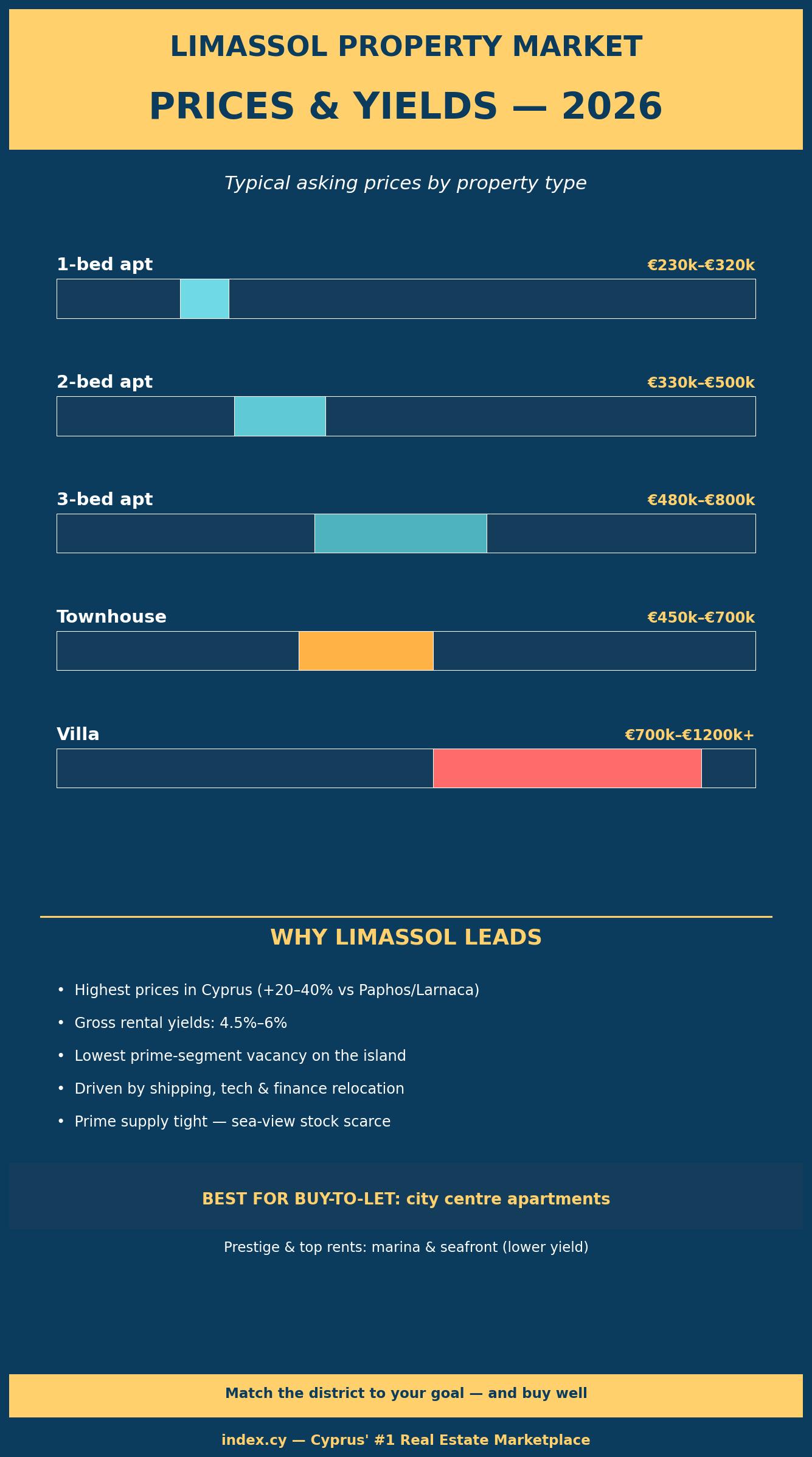
Prices in Limassol carry a clear premium over the rest of Cyprus—typically 20% to 40% above comparable property in Paphos or Larnaca, and well above the national average. Here’s a realistic snapshot of asking prices across the main property types in 2026.
| Property type | Typical 2026 price range | Notes |
|---|---|---|
| 1-bed apartment | €230,000–€320,000 | Higher near marina/seafront |
| 2-bed apartment | €330,000–€500,000 | Workhorse of the rental market |
| 3-bed apartment | €480,000–€800,000+ | Premium for sea views |
| Townhouse / semi | €450,000–€700,000 | Suburban districts |
| Villa | €700,000–€3M+ | Hillside and coastal zones |
These figures are indicative; actual values swing sharply with location, floor, view, and build quality. A sea-view penthouse near the marina can trade at several times the price of a comparable unit a few kilometres inland. For precise, regularly updated data, see our insights on the average price of a 2-bedroom apartment in Limassol.
The premium end of the market is in a category of its own. Limassol holds many of the most expensive villas for sale in Cyprus, with branded residences and beachfront towers reaching prices unseen elsewhere on the island. This top tier is largely insulated from local affordability constraints because it’s bought by international, cash-rich purchasers.
What’s Driving Limassol Property Market Trends in 2026
Several forces are shaping the Limassol property market this year, and they pull in broadly the same direction—upward, but at a slower, steadier pace than the surges of recent years.
First, the economy keeps expanding. The relocation of international companies—accelerated since 2022—continues to add high-income residents. These are people who rent first and buy later, feeding both halves of the market.
Second, construction costs and financing have reset the supply side. Building is more expensive than it was three years ago, and developers price new stock accordingly, which keeps a floor under values. At the same time, interest rates broadly track the European Central Bank and Central Bank of Cyprus, so mortgage affordability shapes how fast the mid-market can move.
Third, price growth is normalising. After double-digit annual jumps in some segments, the official Cyprus statistical data and the Central Bank’s Residential Property Price Index point to more moderate, sustainable appreciation. For buyers, that’s healthy: it lowers the risk of overpaying at a peak. For sellers, it means pricing realistically against live comparables matters more than ever.
Best Areas to Buy in the Limassol Property Market
Limassol is not one market but several. Where you buy should follow what you want—income, lifestyle, capital growth, or value.
| Area | Profile | Best for |
|---|---|---|
| Marina & seafront | Premium, branded residences | Luxury buyers, prestige rentals |
| City centre | Walkable, high rental demand | Buy-to-let, professionals |
| Germasogeia / Tourist Area | Established expat zone | Holiday lets, lifestyle |
| Agios Athanasios | Mid-range, residential | Families, steady growth |
| Mouttagiaka / Potamos | Coastal, newer builds | Mixed lets, value-with-view |
| Hillside suburbs | Spacious villas, quieter | Long-term family homes |
The marina and central seafront deliver prestige and the highest rents, but at the lowest yields—you pay for the address. The city centre offers the best balance for buy-to-let investors: walkable, in constant demand from professional tenants, and priced below the seafront. Suburban and hillside districts give families more space and garden for the money, with steadier rather than spectacular growth.
For new-build and off-plan options, browse current new developments in Limassol, where developers often offer staged payment plans during construction. To compare live listings across every district and price band, explore properties for sale in Limassol on index.cy.
Limassol Rental Market and Investment Returns
For investors, the Limassol property market is fundamentally a rental story. The same corporate demand that lifts prices keeps occupancy high and rents firm—Limassol records the lowest residential vacancy of any Cypriot city in the prime segments.
Gross rental yields in Limassol typically run 4.5% to 6%, with compact city-centre apartments at the top of that range and large seafront units at the bottom. Studios and one-bedroom flats let to professionals can reach 6% or more gross, because rent scales up faster than purchase price for smaller units. Larger villas and premium apartments deliver lower yields but stronger capital appreciation and prestige-tenant appeal.
Two rental strategies work here. Long-term lets to corporate professionals offer stable, low-turnover income and suit the city centre and inland districts. Short-term holiday lets perform in the Tourist Area and near the marina, but carry licensing, management, and seasonality costs. Many investors blend the two across the year. The video below offers a useful visual overview of buying and investing in Cyprus property.
Before committing, model the net yield—after management fees (8%–12% of rent), maintenance, insurance, and vacancy—rather than the headline gross. And verify any property thoroughly: an instant property report and an independent inspection protect you from costly surprises. For the bigger strategic picture, our comprehensive guide to real estate investing covers risk, financing, and portfolio building in depth.
How to Buy in the Limassol Property Market
Buying in Limassol follows the standard Cyprus process, with a few local nuances given the competitive, fast-moving prime stock. Here’s the path most buyers take.
- Set your budget and goal. Decide whether you’re optimising for lifestyle, rental income, or capital growth—each points to a different district and property type.
- Get financing in order. Cypriot banks lend to residents and non-residents alike, though non-residents face lower loan-to-value caps. Pre-approval lets you move fast on the right unit.
- Choose the right district. Match the area to your goal using the guide above, then shortlist live listings.
- Engage an independent lawyer. A lawyer unconnected to the seller checks the title deed, planning permits, and any encumbrances before you commit.
- Verify and value the property. Confirm condition, comparable prices, and—critically in Limassol’s premium market—that you’re not overpaying for the view or the brand.
- Negotiate and reserve. In hot segments, well-priced units move quickly; in slower ones, there’s room to negotiate.
- Complete and register. Pay transfer fees, register the title, and arrange property management if you live abroad.
The discipline that protects buyers everywhere matters more in Limassol because the stakes—and the prices—are higher. Treat due diligence as non-negotiable.
Limassol Property Market Outlook for 2026 and Beyond
The medium-term outlook for the Limassol property market is one of steady, demand-led strength rather than runaway growth. The economic fundamentals—corporate relocation, a deepening tech sector, and limited prime supply—remain firmly in place, which supports both values and rents.
Expect appreciation to continue at a more moderate, sustainable pace, with the premium seafront and marina segments leading and mid-market suburban stock following. The biggest risks are external: shifts in interest rates, global economic conditions, or changes to Cyprus’s residency and tax framework could cool international demand. None of these is on the immediate horizon, but they’re worth watching.
For buyers and investors, the takeaway is that Limassol remains the island’s benchmark market—the most liquid, the most international, and the most resilient. The opportunities sit in choosing the right district for your goal and buying well, not in timing a market that rarely offers bargains.
The Bottom Line on the Limassol Property Market
The Limassol property market in 2026 offers a clear proposition: Cyprus’s highest prices, but also its strongest demand, lowest vacancy, and most resilient values. Two-bedroom apartments—the market’s workhorse—run roughly €330,000 to €500,000, gross rental yields sit between 4.5% and 6%, and the premium seafront tier operates in a league of its own.
Success here comes down to matching the right district to your goal, modelling net returns honestly, and verifying any property before you sign. Start by comparing live properties for sale in Limassol and current Limassol price data on index.cy, then run your numbers with discipline.
Disclaimer: This guide is for general information and is not financial, legal, or tax advice. Prices, yields, and regulations change—confirm specifics with a qualified Cyprus adviser before buying or investing.
More about Limassol

We analysed 208 Trachoni, Limassol listings: 170 apartments, 19 houses and 12 plots. Median apartment asks EUR260,000. See prices by size and…

We analysed 576 Pareklisia, Limassol listings: 188 houses, 175 apartments and 122 plots. Median house asks EUR965,000. See prices by size and…

We analysed 217 Erimi, Limassol listings: 105 apartments, 81 houses and 24 plots. Median 2-bed flat EUR295,000. See prices, the repeat-advert trap…
Keep reading
Cyprus Affordable Housing Scheme: Current Progress and Financial Insights The Cyprus Interior Ministry recently reported that just over €2.2 million has been…
We analysed 208 Trachoni, Limassol listings: 170 apartments, 19 houses and 12 plots. Median apartment asks EUR260,000. See prices by size and…
We analysed 576 Pareklisia, Limassol listings: 188 houses, 175 apartments and 122 plots. Median house asks EUR965,000. See prices by size and…