
What this guide covers
- The Cyprus Property Market in 2026: A Snapshot
- What’s Driving Cyprus Property Prices in 2026
- Cyprus Property Market Trends by District
- Limassol
- Paphos
- Larnaca
- Nicosia
- Famagusta
- District Snapshot at a Glance
- Cyprus Property Prices: What You’ll Pay in 2026
- Rental Yields and the Investment Case
- Cyprus Property Market Forecast: What to Expect
- How to Navigate the Cyprus Property Market
- Is 2026 a Good Time to Buy Property in Cyprus?
- Frequently Asked Questions
- Are property prices in Cyprus rising or falling in 2026?
- Which district has the strongest Cyprus property market?
- What rental yield can I expect in Cyprus?
- Will the Cyprus property market crash?
- The Bottom Line
The Cyprus property market enters 2026 from a position of strength. In 2025, transaction volumes hit a 17-year high, the total value of property transfers crossed €4.7 billion, and every district posted double-digit growth. If you are buying, selling, or investing this year, the question is not whether the market is active—it clearly is. The real question is where prices are heading, which districts are outperforming, and what the data says about value.
This guide breaks down the Cyprus property market in 2026 using the latest figures from the Central Bank of Cyprus, the RICS Cyprus Property Price Index, and the Department of Lands and Surveys. We cover sales activity, district-by-district trends, current price levels, rental yields, and a grounded forecast for the months ahead. No hype—just the numbers and what they mean for your decision.
The Cyprus Property Market in 2026: A Snapshot
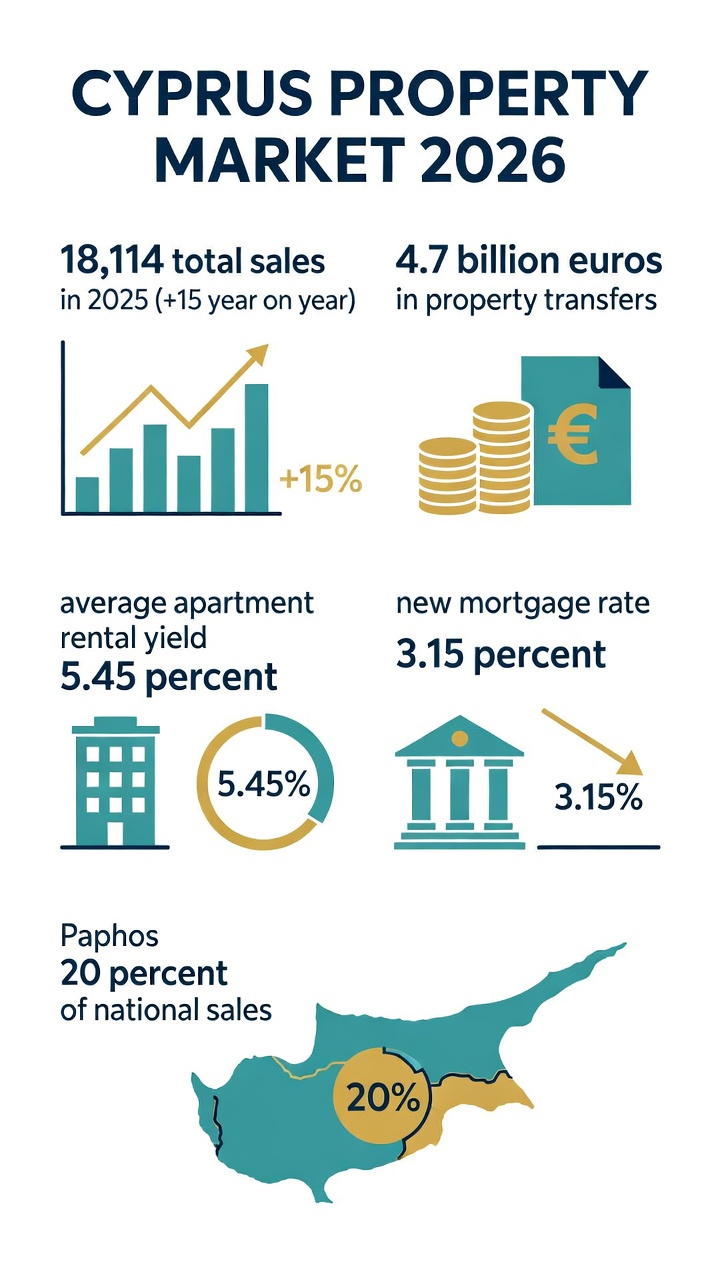
The headline story is sustained, broad-based demand. During 2025, total property sales rose 15% to 18,114 contracts, up from 15,797 in 2024. That is the strongest annual result since 2007, and notably every one of Cyprus’ five districts recorded double-digit gains rather than growth concentrated in one or two hotspots.
Momentum has carried into 2026. In February 2026, sales reached 1,537 transactions, a 12% year-on-year increase. The value of activity is rising too: property transfers in 2025 topped €4.7 billion, signalling strong appetite for higher-value real estate alongside steady volume in the mainstream market.
Crucially, the Central Bank of Cyprus has stated there are no signs of widespread overvaluation. Prices are firm, but the market is not flashing the warning signs that preceded the 2008–2013 correction. That said, the CBC notes the market remains sensitive to external risks given its reliance on foreign demand—a point worth keeping in mind for anyone making a long-term commitment.
What’s Driving Cyprus Property Prices in 2026
Several forces are working together to keep the Cyprus property market buoyant. Understanding them helps you judge whether current price levels are sustainable.
First, foreign demand remains the engine. International buyers—from the UK, Europe, the Middle East, and beyond—continue to target Cyprus for lifestyle, investment, and residency. This demand concentrates in coastal districts and premium developments, which is why Limassol and Paphos consistently lead on transaction value.
Second, financing has become more accessible. As of March 2026, average interest rates on new housing loans stood at 3.15%, down year-on-year, while outstanding loan rates averaged 3.48%. Lower borrowing costs have reignited the mortgage market: new housing loans granted between January and March 2026 jumped 24.5% compared with the same period a year earlier.
Third, supply is tight in the most desirable segments. New build apartments in prime coastal locations sell quickly, and limited inventory supports prices. For buyers, this means moving decisively when the right unit appears—particularly for apartments in Cyprus, the asset class showing the most consistent price strength.
Finally, domestic demand has strengthened. Cypriot buyers, supported by improving wages and the lower-rate environment, are active across all price bands—not just locals priced out of the foreign-driven coastal markets.
Cyprus Property Market Trends by District
One of the defining features of the 2026 market is how differently each district behaves. Averaging across the island hides important variation, so here is how the five districts compare.
Limassol
Limassol remains the value leader. The district recorded roughly €1.7 billion in property transfers in 2025, up from €1.5 billion the year before—comfortably the highest in Cyprus. It is the hub for luxury developments, marina living, and corporate relocation, which keeps both prices and transaction values elevated. Price growth in early 2026 was modest, reflecting an already-high base, but demand for quality stock stays robust. Browse current Limassol properties for sale to gauge live pricing.
Paphos
Paphos is the standout performer for volume growth. In 2025, the district registered 3,567 sale contracts—about 20% of the entire national market—on a 15% annual increase. December 2025 alone saw a 29% year-on-year jump. Paphos draws a heavily expat buyer base attracted by lower prices than Limassol and a strong holiday-rental economy. The RICS index showed apartments in Paphos among the highest price gainers in Q1 2026. See what’s available across Paphos real estate.
Larnaca
Larnaca continues its steady ascent, supported by a major port-and-marina redevelopment and improving connectivity. Prices remain well below Limassol levels, which keeps the district attractive to value-focused buyers and investors seeking rental yield. Growth here is consistent rather than explosive—exactly what many long-term investors prefer.
Nicosia
As the capital and the only landlocked district, Nicosia is driven by domestic demand rather than holiday or expat buyers. That makes it the most stable, least seasonal market on the island. Price movements in early 2026 were modest, and the district offers some of the most affordable entry points for first-time buyers and a reliable long-term rental market.
Famagusta
Famagusta (the government-controlled areas around Ayia Napa, Protaras, and Paralimni) is the emerging story. The RICS index recorded some of the strongest price uplifts here in Q1 2026 across both apartments and houses. A tourism-led economy and relatively low base prices make Famagusta one to watch for investors comfortable with a more seasonal market. Explore Famagusta properties for sale.
District Snapshot at a Glance
The table below summarises how the five districts compare on the metrics that matter most to buyers and investors in 2026.
| District | Buyer profile | Price level | 2026 trend | Best for |
|---|---|---|---|---|
| Limassol | Premium, corporate, luxury | Highest | Firm, modest growth | Capital value, prestige |
| Paphos | Expat, holiday-rental | Mid | Strong growth | Lifestyle + rental income |
| Larnaca | Value, investor | Lower-mid | Steady growth | Entry-level investment |
| Nicosia | Domestic, first-time | Affordable | Stable | Stability, long-term rentals |
| Famagusta | Tourism, investor | Lower-mid | Strongest uplift | Growth potential |
Cyprus Property Prices: What You’ll Pay in 2026
Price levels vary widely by district and property type, so it pays to look at specifics rather than island-wide averages. As a rough guide, Nicosia and the coastal value districts (Larnaca, parts of Famagusta) offer the most affordable per-square-metre pricing, while Limassol commands a clear premium. Paphos sits in the middle, blending expat appeal with prices below Limassol.
Apartments have been the most consistent price performers, supported by both owner-occupier and investor demand. The RICS Cyprus Property Price Index recorded marginal increases across all property categories in Q1 2026, with apartments leading—especially in Paphos and Famagusta—while houses showed selective growth, mainly in Famagusta and Limassol.
Because pricing shifts quarter to quarter, the most reliable approach is to check current data before you make an offer. Our house price insights for Cyprus track average values by district and property type, and our house prices guide explains what drives the variation. For a property-specific view, an instant property report shows whether an individual listing is priced in line with comparable sales.
Rental Yields and the Investment Case
For investors, the Cyprus property market in 2026 offers a clear income story alongside capital growth. According to the RICS Property Price Index for Q4 2025, average gross rental yields stood at 5.45% for apartments, 2.96% for houses, and 5.58% for offices.
Rents are rising too. The RICS-KPMG Rental Index posted a 5.79% year-on-year increase in apartment rental values and a 2.34% increase for houses nationwide in Q4 2025. The combination of rising rents and yields above 5% for apartments and offices explains why income-focused investors continue to favour these segments over standalone houses.
The investment logic is straightforward. Apartments in high-demand coastal districts deliver the best blend of yield, liquidity, and price stability. Offices, often overlooked by individual buyers, quietly offer the highest headline yields. Houses tend to suit lifestyle buyers and longer-horizon capital-growth plays rather than pure cash-flow investors. For a deeper framework, see our guide to real estate investing in Cyprus.
Cyprus Property Market Forecast: What to Expect
So where does the Cyprus property market go from here? The evidence points to continued, measured growth rather than a boom or a bust.
On the supportive side: borrowing costs are easing, mortgage lending is expanding rapidly, foreign demand shows no sign of fading, and the Central Bank sees no widespread overvaluation. These conditions typically sustain a market rather than overheat it.
On the cautionary side: the market’s reliance on foreign demand makes it sensitive to external shocks—global interest-rate shifts, geopolitical events, or changes in investor sentiment toward Europe. A slowdown in international buying would be felt most in the premium coastal segments that have led recent gains.
The most likely scenario for the rest of 2026 is steady single-digit price growth, led by apartments and concentrated in Paphos, Famagusta, and Limassol, with Nicosia and Larnaca providing stability. Transaction volumes should stay near current highs as long as financing remains accessible. For buyers, that means little reason to rush out of fear of a crash—but also limited prospect of bargains in the strongest districts.
How to Navigate the Cyprus Property Market
A strong market rewards preparation. Whether you are buying a first home, an investment apartment, or relocating to Cyprus, a few principles apply.
Start with district fit, not just price. Match the district to your goal—Limassol for premium and corporate, Paphos for expat lifestyle and rental income, Nicosia for stability and value, Larnaca and Famagusta for growth potential at lower entry points.
Verify pricing with data before you offer. Use district-level price insights and a property-specific report so you negotiate from evidence, not emotion. In a confident market, sellers can overprice—data keeps you grounded.
Factor in total costs. Transfer fees, legal fees, and taxes add to the headline price. Build them into your budget from the start so there are no surprises at completion.
Move decisively on quality stock. In the strongest segments, well-priced apartments and prime developments sell fast. Have your financing and legal team ready so you can act when the right property appears.
Is 2026 a Good Time to Buy Property in Cyprus?
For most buyers, the answer is yes—provided you buy on the right terms. The fundamentals are healthy: lending is cheaper than a year ago, the Central Bank sees no overvaluation, and demand is broad rather than speculative. That backdrop reduces the risk of buying near a peak.
The flip side of a strong market is that bargains are scarce in the best districts, and motivated sellers are fewer. So the value play in 2026 is not waiting for prices to fall—it is buying well: choosing the right district for your goal, verifying the price against comparable sales, and negotiating from data.
First-time buyers should focus on Nicosia and Larnaca, where entry prices are most accessible and the market is less seasonal. Investors chasing yield should look at apartments in Paphos, Limassol, and Famagusta, where rental demand and gross yields are strongest. Lifestyle buyers and retirees gravitate to Paphos and coastal Famagusta for the blend of climate, community, and value.
Frequently Asked Questions
Are property prices in Cyprus rising or falling in 2026?
Prices are rising modestly. The RICS Cyprus Property Price Index recorded marginal increases across all categories in Q1 2026, led by apartments in Paphos and Famagusta. There are no signs of a downturn, but growth is steady rather than rapid.
Which district has the strongest Cyprus property market?
By value, Limassol leads with around €1.7 billion in transfers in 2025. By growth, Paphos and Famagusta are the standouts, with Paphos alone accounting for roughly 20% of all national sales contracts.
What rental yield can I expect in Cyprus?
According to the RICS index for Q4 2025, gross yields average 5.45% for apartments, 5.58% for offices, and 2.96% for houses. Apartments in high-demand coastal districts typically deliver the best blend of yield and liquidity.
Will the Cyprus property market crash?
The Central Bank of Cyprus reports no signs of widespread overvaluation, which makes a sharp correction unlikely in the near term. The main risk is external—global rate shifts or a drop in foreign demand—rather than domestic overheating.
The Bottom Line
The Cyprus property market in 2026 is active, broad-based, and—by the Central Bank’s assessment—fundamentally sound rather than overheated. Record 2025 sales, a €4.7 billion transfer market, easing mortgage rates, and rental yields above 5% for apartments all point to a market that rewards informed, decisive buyers.
The smart approach is not to time the market but to understand it. Know your district, verify prices with current data, budget for full costs, and act when the right property fits your goals. Explore live listings across Limassol, Paphos, and the rest of Cyprus on index.cy, and use our data tools to buy with confidence.
Keep reading

We analysed 217 Erimi, Limassol listings: 105 apartments, 81 houses and 24 plots. Median 2-bed flat EUR295,000. See prices, the repeat-advert trap…

We analysed 319 Aglantzia, Nicosia listings: 155 apartments, 34 houses and 38 plots. Median 2-bed costs EUR257,500. See prices, rents and what…
We analysed 387 Egkomi (Engomi), Nicosia listings: 169 apartments, 73 houses and 99 rentals. Median 2-bed costs EUR285,000. See prices, rents and…