
The advertised price is never the whole story. The real cost of buying property in Cyprus includes a stack of one-off taxes and fees that can add anywhere from a few thousand euros to more than 10% on top of the purchase price. Knowing those numbers before you make an offer is the difference between a confident purchase and a nasty surprise at completion.
The good news for 2026: the picture is simpler and cheaper than it used to be. Stamp duty on property contracts has been abolished, transfer fees still carry a 50% discount on resales, and new-build buyers usually pay no transfer fees at all. This guide breaks down every line item in the total cost of buying property in Cyprus, with worked examples so you can estimate your own bill.
We’ll keep it practical. Whether you’re a first-time buyer, an overseas investor, or an expat relocating to the island, you’ll leave knowing exactly what to budget, where the big costs sit, and which ones you can legally avoid. To pressure-test any specific property before you commit, an instant property report gives you the fundamentals in minutes.
Beyond the purchase price, the cost of buying property in Cyprus falls into a handful of predictable categories. Most buyers should budget for the following.
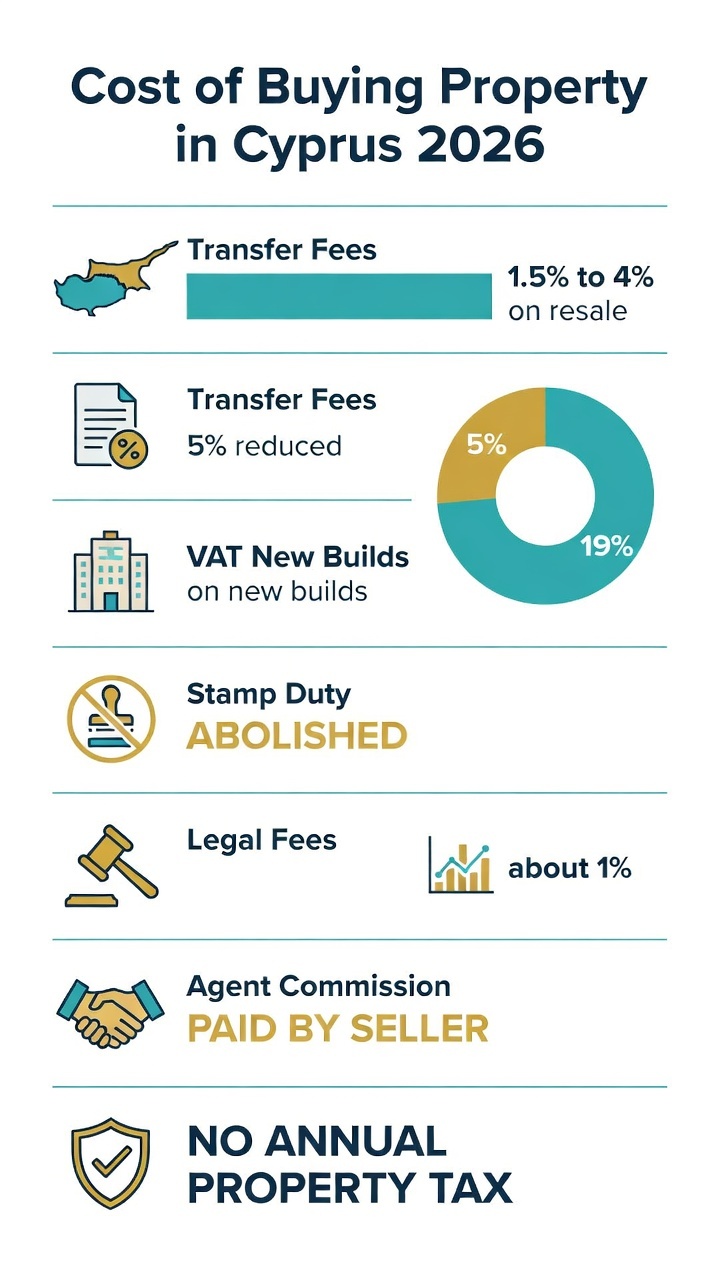
| Cost | Who pays | Typical amount (2026) |
|---|---|---|
| Transfer fees (resale) | Buyer | 1.5%–4% after 50% reduction |
| VAT (new builds) | Buyer | 5% reduced or 19% standard |
| Stamp duty | — | Abolished from 1 Jan 2026 |
| Legal fees | Buyer | ~1% + VAT (or €1,500–€3,000+) |
| Estate agent commission | Seller | 3%–5% + VAT (buyer usually pays nothing) |
| Land Registry / registration | Buyer | Modest administrative fees |
| Mortgage costs (if financing) | Buyer | Arrangement + valuation fees |
The single biggest variable is whether you buy a new build or a resale. That one choice determines whether your largest cost is VAT or transfer fees, and it can swing your total outlay by thousands of euros. We’ll unpack that next.
As a rule of thumb, budget roughly 8%–12% of the purchase price for a resale property once fees and taxes are added, and slightly less for a new build where the reduced VAT rate applies. Financing, professional advice, and your residency status all move the final figure.

This is where most of your money goes, and the rule is simple: you pay one or the other, not both. New properties bought from a developer attract VAT and are exempt from transfer fees. Resale properties attract transfer fees and no VAT.
Transfer fees are a one-off charge paid to the Department of Lands and Surveys when the title deed passes into your name. Cyprus uses a progressive, banded scale, so you never pay the top rate on the whole value.
| Property value (€) | Standard rate | Effective rate (after 50% reduction) |
|---|---|---|
| Up to 85,000 | 3% | 1.5% |
| 85,001 – 170,000 | 5% | 2.5% |
| Above 170,000 | 8% | 4% |
The 50% reduction on resale (non-VAT) transactions has been in continuous effect and still applies in 2026. Take a €250,000 resale house: the gross fee works out to €13,200, but the discount halves your actual bill to €6,600. You can sanity-check any figure with the government’s official transfer fee calculator, which mirrors these bands. For the full mechanics, see our dedicated property transfer fees guide.
Buy a brand-new home directly from a developer and you pay VAT instead of transfer fees. The standard rate is 19%, but a reduced 5% rate applies to a qualifying primary residence. Under the 2026 rules, the 5% rate covers the first 130 m² of a home valued up to €350,000, provided the total transaction value stays under €475,000 and the covered area under 190 m². You must live in the property as your main home for ten years, or repay the difference if you sell or rent it out sooner.
Because VAT-paid properties are exempt from transfer fees, new-build buyers effectively pay 0% in transfer fees. Our VAT on property in Cyprus guide explains who qualifies for the reduced rate and how to claim it. To compare VAT-inclusive pricing directly, browse new-build apartments across Cyprus.
Here’s a cost you can cross off your budget entirely. Under Law 239(I)/2025, Cyprus repealed its Stamp Duty Laws with effect from 1 January 2026. Property sale contracts signed from that date carry no stamp duty at all.
Previously, stamp duty was a documentary tax on the sale contract, charged at 0.15% up to €170,000 and 0.20% above, capped at €20,000. On a €300,000 purchase it added roughly €507. Modest, but a genuine saving now removed from the equation.
One timing detail matters. The abolition turns on the contract’s execution date, not the completion date. If you signed a contract in December 2025 but complete in 2026, the old stamp duty rules may still apply to that document. Our stamp duty in Cyprus guide covers the transition in full. For everyone signing fresh contracts this year, it’s simply one less line item.
You will need a lawyer, and it’s money well spent. An independent Cyprus property lawyer verifies the title, checks for mortgages or encumbrances on the property, drafts and reviews the sale contract, and lodges it with the Land Registry to protect your rights before completion.
Legal fees typically run at around 1% of the purchase price plus VAT, though many firms charge a flat fee for straightforward residential purchases, often in the region of €1,500 to €3,000 or more depending on complexity. For that fee you should expect:
Never skip independent legal representation, and never rely on a lawyer recommended solely by the seller or developer. Thorough due diligence is what protects your investment, far more than any single tax line. Our guide to buying property in Cyprus as a foreigner walks through the checks every buyer should insist on before signing.
Good news for buyers: in Cyprus, the estate agent’s commission is almost always paid by the seller, not you. Under standard practice, the vendor engages the agent and covers the fee, which typically ranges from 3% to 5% of the sale price plus 19% VAT.
As a buyer, you generally pay nothing directly for the agent’s services. That said, the commission is usually baked into the asking price, so it indirectly shapes what you pay. If you’re buying through a registered agency on a formal listing, confirm in writing who bears the commission to avoid any ambiguity, especially on private or dual-agency deals.
This is one reason buyers benefit from browsing a transparent marketplace. On a platform like index.cy, listings come from verified agencies and developers, so you can compare properties on price and features without hidden buyer-side fees clouding the picture.
If you’re borrowing to buy, factor in the cost of the loan itself. Cypriot banks lend to residents and, in many cases, to non-residents and expats, though terms and deposit requirements vary.
Typical mortgage-related costs include a bank arrangement or facility fee, a property valuation fee the bank charges to assess the security, and potential mortgage registration costs at the Land Registry. Most lenders require a deposit of 20%–40% of the property value depending on your residency and income profile, so the cash you need upfront extends well beyond fees alone. Our Cyprus mortgage guide breaks down rates, eligibility, and how to get approved as a foreign buyer.
The cost of buying property in Cyprus doesn’t end at completion. Owning a home carries modest recurring charges you should build into your longer-term budget.
None of these are large individually, but together they belong in your annual running-cost forecast. And if you later sell at a profit, capital gains tax may apply, so keep it in mind when planning your exit.
Let’s put it all together with a realistic scenario: a €300,000 property bought as a primary residence, with a lawyer and no mortgage.
As a resale (transfer fees apply):
As a new build (reduced 5% VAT applies):
The comparison shows why the new-build-versus-resale decision matters so much. On this property, the resale carries lower upfront tax, while the new build trades a higher VAT bill for a modern home, a developer warranty, and no renovation costs. If the standard 19% VAT applied instead of the reduced rate, the new-build figure would rise sharply, so confirming your eligibility for the 5% rate is essential.
Every purchase is different, so always model your own numbers with your lawyer before committing. Here’s a short overview of how buyers typically navigate the process in Cyprus.
Beyond the purchase price, budget roughly 8%–12% for a resale property and slightly less for a new build. The main costs are transfer fees (resale) or VAT (new build), plus legal fees of around 1% + VAT. Stamp duty was abolished in 2026, and estate agent commission is paid by the seller.
No. In Cyprus, the estate agent’s commission (typically 3%–5% plus VAT) is paid by the seller under standard practice. Buyers generally pay nothing directly, though the fee is usually reflected in the asking price.
No. Cyprus abolished stamp duty on property contracts from 1 January 2026 under Law 239(I)/2025. Contracts signed from that date carry no stamp duty. Only contracts executed in 2025 may still fall under the old rules.
It depends on the property and value. Resale buyers pay transfer fees at effective rates of 1.5%–4% after the 50% reduction. New-build buyers pay VAT (5% reduced or 19% standard) and no transfer fees. For a qualifying primary residence at the reduced VAT rate, a resale often has lower upfront tax.
The total cost of buying property in Cyprus in 2026 is more transparent and buyer-friendly than in most European markets. Stamp duty is gone, agent commission falls on the seller, there’s no annual national property tax, and the biggest cost — transfer fees or VAT — comes with meaningful discounts for primary residences and resales.
The smartest move is to model your specific purchase early: decide between new build and resale, confirm your VAT or transfer-fee position, and add legal and financing costs to get a true all-in figure. Run an instant property report on any listing you’re serious about, take independent legal advice, and let the real numbers — not the sticker price — guide your decision.
This guide is general information, not legal or tax advice. Confirm your specific costs with a licensed Cyprus lawyer and tax adviser before buying.