
What this guide covers
- When Does VAT on Property in Cyprus Apply?
- The Standard 19% VAT Rate Explained
- The Reduced 5% VAT Rate: Who Qualifies?
- How Much VAT Will You Actually Pay? The 2026 Thresholds
- How to Apply for the 5% VAT Rate
- The 10-Year Rule and VAT Clawback
- VAT vs Transfer Fees: Which Applies to Your Purchase?
- Key Takeaways for Cyprus Property Buyers
Buying a new-build home in Cyprus? Then VAT is probably the single largest tax you’ll pay at purchase — and the one most buyers misunderstand. Get it right and you could pay just 5% on your first €350,000. Get it wrong and you’ll hand over the full 19% on the entire price.
VAT on property in Cyprus works differently from almost every other purchase cost. It only applies to new-build properties, it comes with a generous reduced rate for people buying a main home, and the rules were tightened significantly in the reforms that finished phasing in during June 2026. This guide breaks down exactly when VAT applies, who qualifies for the reduced 5% rate, how much you’ll actually pay, and the mistakes that trigger a costly clawback years later.
We’ll keep this practical and specific to the Cyprus market. By the end, you’ll know whether your purchase is taxed at 19%, 5%, or nothing at all — and how to plan around it.

When Does VAT on Property in Cyprus Apply?
The first thing to understand is that VAT is a new-build tax. It applies to the first sale of a property by a developer or taxable person — not to resale homes.
Here’s the split that catches most first-time buyers off guard:
- New-build properties (bought from a developer, first transfer): subject to VAT at 19%, or 5% if you qualify for the reduced rate on a main residence.
- Resale properties (previously owned, secondary market): no VAT at all. Instead, you pay property transfer fees when the title deed changes hands.
This is one of the most important trade-offs in the Cyprus property market. A resale home skips VAT entirely but incurs transfer fees. A brand-new home carries VAT but is exempt from transfer fees on the portion where VAT was charged. You almost never pay both on the same property.
So before you calculate anything, answer one question: is this property a first sale from a developer, or a resale? If you’re browsing new apartments and complexes in Limassol or elsewhere, you’re in VAT territory. If you’re looking at an established home changing hands between private owners, you’re in transfer-fee territory — and our guide to property transfer fees in Cyprus covers that side in full.
Building land sold by a person acting in a business capacity is also subject to 19% VAT, following changes introduced in 2018. Purely private land sales between individuals generally fall outside the VAT net.
The Standard 19% VAT Rate Explained
Cyprus applies a standard VAT rate of 19% to new property. This is the default. Unless you actively apply for and qualify for the reduced rate, 19% is what you’ll pay on a new-build purchase.
On a €300,000 new apartment, that’s €57,000 in VAT. On a €500,000 villa, it’s €95,000. These are not small numbers, which is exactly why the reduced 5% scheme matters so much — and why it pays to understand it before you sign anything.
The 19% rate applies in full to:
- Second homes and holiday properties
- Buy-to-let and investment purchases where you won’t live in the property
- Purchases made through a company or legal entity rather than an individual
- The portion of any home that exceeds the reduced-rate thresholds (more on that below)
If you’re buying a new-build purely as an investment — say a rental unit near Limassol Marina or a holiday flat on the coast — assume the full 19% applies. The reduced rate is reserved strictly for genuine primary residences.
Because VAT is such a large line item, it should be factored into your budget from day one, not treated as an afterthought at closing. Running an instant property report before you commit helps you see the full cost picture, VAT included, rather than being surprised at the notary’s office.
The Reduced 5% VAT Rate: Who Qualifies?
The reduced 5% VAT rate is one of the most valuable incentives in Cyprus real estate. It’s designed to help people buying a home to actually live in — and it applies to both Cypriots and foreign buyers, including EU and non-EU nationals.
To qualify for the reduced rate on your primary residence, you must meet all of the following conditions:
- You’re a natural person, not a company. Legal entities cannot claim the reduced rate. The applicant must be an individual aged 18 or over.
- The property is new. It must be a first sale — a resale doesn’t attract VAT anyway, so the reduced rate only ever applies to new-builds.
- It’s your main and permanent residence. You must genuinely intend to live in the property as your primary home in Cyprus.
- You commit to using it as your residence for at least 10 years. This is the condition that trips people up most often, and it comes with real financial consequences if broken.
- You apply before you take delivery. The declaration must be submitted to the Cyprus Tax Department before the property is delivered or occupied, not afterward.
Importantly, foreign buyers are explicitly eligible. You do not need to be a Cypriot citizen or even an EU citizen — a UK buyer relocating to Paphos or a non-EU investor making Cyprus their main home can both claim the reduced rate, provided the property becomes their genuine primary residence.
One property per person or married couple can benefit at a time. If you’ve held a reduced-rate VAT certificate in the previous 10 years, you generally cannot claim it again on a new purchase within that window.
How Much VAT Will You Actually Pay? The 2026 Thresholds
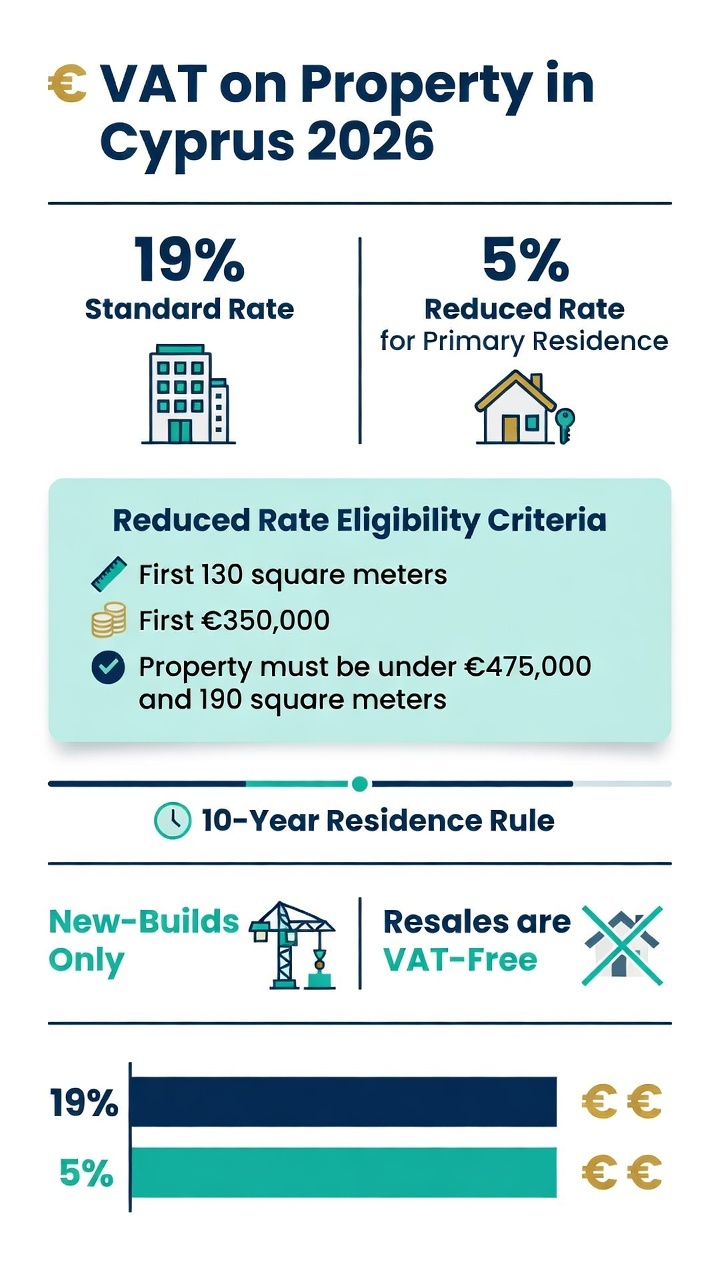
Here’s where the 2026 rules matter. The reduced 5% rate is no longer a blanket discount on the whole property — it’s capped by both size and value. Following the EU-driven reforms that fully took effect after the transitional period ended on 15 June 2026, the current framework works like this:
- 5% applies to the first 130 m² of the home’s covered internal area, up to a value of €350,000.
- The property qualifies only if its total transaction value does not exceed €475,000.
- The property qualifies only if its total internal covered area does not exceed 190 m².
- Any excess is taxed at the standard 19%.
Let’s make that concrete with a few worked examples.
Example 1 — Small apartment, fully covered. You buy a new 100 m² apartment for €280,000. Both the size (under 130 m²) and the value (under €350,000) sit inside the reduced-rate band. You pay 5% on the whole amount: €14,000 in VAT. Compared with the 19% rate (€53,200), you save €39,200.
Example 2 — Larger home, partial reduced rate. You buy a new 160 m² house for €430,000. The property qualifies because it’s under both the €475,000 value cap and the 190 m² size cap. But the reduced rate only covers the first 130 m² and the first €350,000. Roughly speaking, the first €350,000 is taxed at 5% (€17,500) and the remaining €80,000 at 19% (€15,200), for around €32,700 total.
Example 3 — Above the caps, no reduced rate. You buy a new 210 m² villa for €520,000. Because the total area exceeds 190 m² and the value exceeds €475,000, the property doesn’t qualify for the reduced rate at all. The full 19% applies: €98,800.
These thresholds mean the reduced rate now favours modest, genuine family homes over large luxury properties. If you’re weighing options, it’s worth checking current average prices for brand-new apartments in Cyprus against these bands to see where your target property falls. Browsing verified apartments for sale with the €350,000 and 130 m² lines in mind can make a five-figure difference to your tax bill.
How to Apply for the 5% VAT Rate
The reduced rate isn’t automatic. You have to apply for it, and timing is everything.
The application is submitted to the Cyprus Tax Department, typically through your lawyer or the developer’s team, before the property is delivered or occupied. You’ll complete a declaration confirming that the home will be your primary and permanent residence and that you meet the eligibility criteria.
Supporting documents usually include:
- Proof of identity (passport or ID card)
- The sale and purchase contract, stamped and lodged
- Architectural plans confirming the covered area
- Evidence of your intention to reside — which, for foreign buyers, may involve residency documentation
Once approved, the developer charges 5% VAT on the qualifying portion instead of 19%. The key discipline here is sequencing: apply before delivery. Submitting the declaration after you’ve taken possession can jeopardise the reduced rate.
Because the paperwork intersects with contracts, title, and residency, this is a step where professional guidance pays for itself. Our broader guide to navigating taxes and legalities in Cyprus real estate walks through how VAT fits alongside stamp duty, transfer fees, and the conveyancing process.
The 10-Year Rule and VAT Clawback
The reduced rate comes with a commitment, and breaking it is expensive.
To keep the 5% rate, you must use the property as your main residence for at least 10 years. If you sell it, rent it out, or stop using it as your primary home before that decade is up, the Tax Department will reclaim the difference between the 5% you paid and the 19% you would otherwise have owed — calculated in proportion to the years remaining.
Here’s how the clawback works in practice. Say you claimed the reduced rate and saved €40,000 versus the standard rate. If you move out or sell after 6 years, you’ve used 6 of the 10 committed years. You’d typically repay the VAT difference for the remaining 4 years — roughly 40% of the benefit, or about €16,000 in this example.
There are limited exceptions for genuine changes in circumstances, but the general principle is strict: the reduced rate is a reward for genuinely living in the home, not a discount to be flipped for profit. Investors planning to let a property should budget for the full 19% from the outset rather than relying on the reduced rate and hoping to exit early.
This clawback risk is another reason to think carefully about whether a property is truly a primary residence or an investment. If your plan involves renting the home within a few years, the rental-yield math needs to assume 19% VAT, not 5%.
VAT vs Transfer Fees: Which Applies to Your Purchase?
Buyers often ask whether they’ll pay VAT and transfer fees. In almost all cases, the answer is no — you pay one or the other.
- New-build with VAT charged: You pay VAT (5% or 19%). Transfer fees are waived on the portion where VAT applied. This is the norm for first-sale properties from developers.
- Resale property, no VAT: You pay transfer fees instead, calculated on tiered bands of the property value, with a 50% reduction that has applied to standard transfers. No VAT is due.
This distinction shapes the real cost of new versus resale homes. A new apartment might carry 5% VAT but no transfer fees, while a comparable resale carries transfer fees but no VAT. Depending on the price band and whether you qualify for the reduced rate, either can work out cheaper — which is exactly why running the numbers on both matters.
Whichever route you take, VAT is only one piece of the total acquisition cost. Stamp duty on the contract, legal fees, and — for resales — transfer fees all add up. Planning for the complete picture, ideally with a property inspection and an instant valuation report in hand, keeps you from being blindsided at completion.
Here’s a short video overview of how the current Cyprus VAT rules affect real estate buyers:
Key Takeaways for Cyprus Property Buyers
VAT on property in Cyprus rewards the buyers it was designed for — people buying a genuine main home — and taxes everyone else at the full 19%. To recap the essentials:
- VAT only applies to new-builds. Resale properties are VAT-free and pay transfer fees instead.
- The standard rate is 19%, applying to second homes, investments, company purchases, and any value above the reduced-rate caps.
- The reduced 5% rate covers the first 130 m² and first €350,000 of a primary residence, provided the property stays under €475,000 in value and 190 m² in area.
- Foreign buyers qualify for the reduced rate, EU and non-EU alike, as long as the home is a genuine primary residence.
- Apply before delivery, and commit to living in the home for 10 years — or face a proportional clawback of the VAT saved.
The difference between the two rates can exceed €40,000 on a single purchase, so VAT deserves to sit at the centre of your budgeting, not the margins. Before you commit to any new-build, confirm your eligibility for the reduced rate, model the tax on your specific price and size, and factor it in alongside every other cost of buying.
Ready to see what your budget buys? Explore verified new-build listings and complexes across all five districts on index.cy, Cyprus’ largest property marketplace, and start your search with the full cost picture in view.
This guide is for general information and reflects the VAT framework applicable in 2026. It is not tax or legal advice. VAT thresholds, eligibility, and clawback rules can change, and individual circumstances vary — always confirm the current position with the Cyprus Tax Department or a qualified professional before you buy.
Keep reading

Larnaca Property Market Surges: Which Areas Are Leading the Price Rise? Larnaca’s property market has experienced a notable surge in prices recently,…

We analysed 66 Tseri, Nicosia listings: 18 apartments, 8 houses and 34 plots. Median 2-bed price is EUR174,000. See prices and what…

We analysed 246 Lakatamia, Nicosia listings: 129 apartments, 52 houses and 46 plots. Median 2-bed price is EUR195,000. See prices and what…