
Thinking about buying a villa in Cyprus? You’re far from alone. Demand for villas across all five districts has climbed steadily over the past three years, with international buyers and relocating professionals driving competition in Paphos and Limassol in particular. But navigating the villa market requires more than browsing listings — it requires understanding which districts offer the best value, what prices actually look like right now, and what the buying process entails.
This guide breaks down everything you need to know about buying a villa in Cyprus in 2026: where to look, how much to budget, what to prioritise in a property, and how to avoid the most common pitfalls. Whether you’re buying a holiday retreat, a permanent home, or a rental investment, the data points clearly to which decisions pay off.
Cyprus offers a combination of benefits that’s difficult to match in the Mediterranean. EU membership means legal protections and property rights aligned with European standards. A 320-day average annual sunshine count attracts buyers year-round. And compared to comparable villa markets in Spain, Portugal, or Italy, Cyprus still offers notably lower prices per square metre in most districts.
The practical advantages are equally compelling. Villa ownership in Cyprus qualifies non-EU nationals for the Cyprus Permanent Residency Programme if the purchase exceeds €300,000 in value — a significant draw for buyers outside the EU looking for a stable European base. Additionally, Cyprus has no inheritance tax and relatively low capital gains tax on property sales, making it attractive for estate and wealth planning.
From a rental income perspective, Cyprus villas — particularly those in coastal areas of Paphos and Larnaca — generate strong short-term rental yields during the tourist season (April through October), with occupancy rates regularly exceeding 75% for well-positioned properties. Long-term rental demand from the growing expat and remote-worker community provides a stable year-round alternative.
Villas are available across all five districts of Cyprus, but the market characteristics vary significantly. Each district attracts a different buyer profile and offers a different investment thesis.
Paphos leads for expat buyers and holiday home purchasers. The district accounts for roughly 30% of all villa transactions involving international buyers, driven by its established expat communities (particularly from the UK and Russia), lower price points than Limassol, and mature holiday rental infrastructure. Areas like Coral Bay, Peyia, and Aphrodite Hills are among the most searched villa locations on the island.
Limassol attracts premium buyers and investors seeking capital appreciation. The city’s business hub status — it hosts major tech companies, financial services firms, and a large expat professional community — drives demand for high-end villas in areas like Moni, Agios Tychonas, and Pyrgos. Prices are the highest on the island, but so is the resale market depth.
Larnaca represents emerging value. Following major infrastructure investment, including the €1.2 billion Larnaca marina and port development project, the district is attracting increasing buyer interest. Villa prices remain 25–35% lower than comparable Limassol properties, making it a compelling entry point for budget-conscious buyers or those seeking higher rental yield ratios.
Famagusta (specifically the free areas around Ayia Napa and Protaras) is Cyprus’ holiday hub. Villa demand peaks here for short-term rental investors, with the area generating some of the highest summer occupancy rates on the island. However, the market is more volatile and seasonal compared to Paphos or Limassol.
You can browse villas for sale in Cyprus across all districts on index.cy to compare current listings and pricing.
Paphos is consistently the top choice for expat villa buyers, and the data explains why. According to Cyprus Department of Lands and Surveys transaction records, international buyers account for approximately 45–50% of all property purchases in Paphos — significantly higher than any other district.
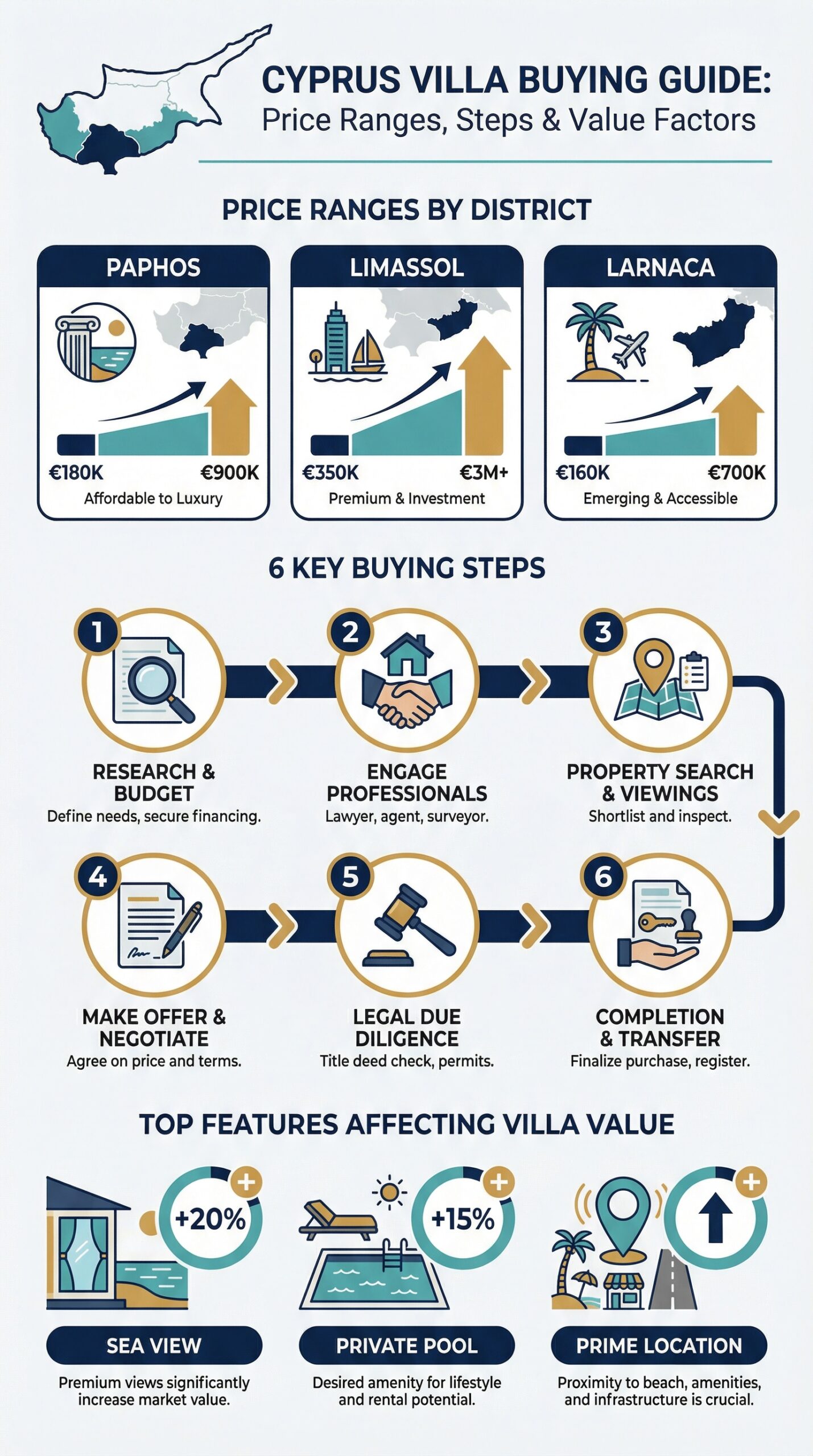
Prices for villas for sale in Paphos range from approximately €180,000 for a compact two-bedroom villa in rural areas to €800,000+ for sea-view properties in premium locations like Coral Bay or the Aphrodite Hills resort. The sweet spot for most buyers — a three-bedroom villa with private pool and garden — typically falls in the €250,000–€450,000 range, depending on location, condition, and sea views.
What drives Paphos villa values most:
Paphos also benefits from Paphos International Airport, which receives direct flights from major European cities — a critical factor for holiday rental success and for buyers who intend to visit periodically. Explore current properties for sale in Paphos to see active listings across all price points.
Limassol is Cyprus’ economic engine and its most liquid property market. Villas for sale in Limassol attract a different buyer profile than Paphos — typically higher-income individuals, executives relocating for work, and investors seeking premium assets with strong capital growth potential.
Prices reflect the premium. Entry-level villas in suburban Limassol areas start around €350,000–€400,000. Mid-range properties with pools in areas like Agios Tychonas, Moni, or Souni typically sell for €500,000–€900,000. Luxury villas with sea views in the Limassol foothills or beachfront locations can exceed €1.5 million–€3 million for branded residences in mixed-use developments.
What distinguishes the Limassol villa market is its buyer depth. Unlike more seasonal markets, Limassol has year-round demand from the island’s largest expat professional community (including significant Israeli, Russian, and Eastern European buyer segments). This depth provides more liquidity and better price stability than other districts.
The Limassol coastline is also undergoing significant development. Several large-scale luxury residential projects have transformed the east and west beaches over the last five years, creating a new tier of branded villa and apartment products that didn’t exist a decade ago. Browse Limassol properties for sale to get a current picture of the market.
Villa prices in Cyprus span a wide range depending on district, size, condition, and location. Here’s a practical breakdown based on current market data:
| District | Entry-Level Villa | Mid-Range (3-bed, pool) | Premium / Sea View |
|---|---|---|---|
| Paphos | €180,000–€250,000 | €280,000–€450,000 | €500,000–€900,000+ |
| Limassol | €350,000–€500,000 | €500,000–€900,000 | €1,000,000–€3,000,000+ |
| Larnaca | €160,000–€220,000 | €250,000–€380,000 | €400,000–€700,000 |
| Famagusta | €150,000–€200,000 | €220,000–€350,000 | €380,000–€600,000 |
| Nicosia | €200,000–€300,000 | €300,000–€450,000 | €500,000–€750,000 |
Beyond the purchase price, buyers should budget for the following acquisition costs:
For detailed information on all applicable taxes, read our comprehensive guide to Cyprus property taxes and legalities, which covers transfer tax rates, capital gains, and VAT implications in full. You can also check average property prices in Cyprus by district for regularly updated market benchmarks.
Not all villas are equal — and several factors specific to Cyprus can significantly affect both your enjoyment of the property and its long-term value.
Title deed status: This is the single most important legal check when buying a villa in Cyprus. Historically, some properties were sold before title deeds were issued, leaving buyers in legal uncertainty. Always verify that a clean, unencumbered title deed exists before proceeding. Your solicitor should confirm this via the District Land Registry.
Planning permits and building compliance: Check that all structures on the property — including pools, extensions, storage buildings, and covered terraces — have the appropriate planning permits. Unauthorised structures can create complications at resale or when applying for financing.
Water and electricity infrastructure: In rural areas, some villas rely on water trucks (particularly during dry summer months) rather than mains water connections. Verify the property’s water supply situation. Similarly, check internet infrastructure — this matters significantly for remote workers and rental guests.
Rental licensing requirements: If you intend to operate short-term holiday rentals, ensure the villa qualifies for a Cyprus Tourism Organisation (CTO) rental licence. Not all properties in all zones are eligible. This check should happen before purchase if rental income is part of your investment thesis.
Before finalising any purchase, we strongly recommend reading our due diligence guide for buying property in Cyprus, which covers every legal and practical check in detail.
Buying a villa in Cyprus follows a well-defined legal process. Here’s what to expect from initial interest to title deed transfer.
The full process typically takes 2–4 months from offer to completion for resale properties; new builds can take longer depending on construction stage. For a detailed overview of financing options, see our guide to financing your property purchase in Cyprus.
The fundamentals remain strong. Cyprus recorded its seventh consecutive year of property market growth in 2025, with transaction volumes reaching levels not seen since before the 2012–2013 financial crisis. Villa demand — particularly from EU relocation buyers and tech-sector professionals — shows no signs of softening.
Key factors supporting continued villa market strength:
Buyers considering the villa market as an investment should use index.cy’s instant property report tool to benchmark asking prices against market comparables before making offers — it provides real-time analysis of whether a property is priced at, above, or below comparable recent transactions.
Cyprus offers one of the most accessible villa markets in the Mediterranean — particularly in Paphos and Larnaca, where prices remain competitive against comparable Southern European markets. Limassol commands a premium, but delivers a deeper market and stronger capital appreciation history.
The key to a successful villa purchase is preparation: understand the title deed status, verify planning compliance, budget accurately for acquisition costs, and engage an independent solicitor before committing. Done right, buying a villa in Cyprus in 2026 represents both a strong lifestyle decision and a sound long-term asset.
Start your search by browsing verified listings across all districts on index.cy’s villa marketplace — with 60,000+ listings from 100+ verified agents, it’s Cyprus’ most comprehensive source for villas and all property types.