
Getting a Cyprus mortgage is a realistic option for buyers — both residents and international investors. As of January 2026, the average mortgage interest rate in Cyprus sits at 3.70%, down from its post-pandemic highs and trending in favour of buyers. Whether you’re purchasing a primary residence, a buy-to-let apartment, or a holiday home, understanding how the Cyprus mortgage market works can save you thousands and prevent costly mistakes.
This guide covers everything you need to know: which banks offer mortgages in Cyprus, current rates, how much you can borrow, what documents you’ll need, and what the process looks like for both residents and foreign buyers.
A Cyprus mortgage is a loan secured against a property in Cyprus. Like other European markets, Cypriot banks lend you a percentage of the property’s appraised value — known as the loan-to-value ratio (LTV) — and you repay the balance over a fixed term with interest.
Cyprus banks issue mortgage loans for terms between 5 and 40 years. However, the loan must be fully repaid by the time the borrower turns 65. This age cap is a key planning consideration, particularly for expat buyers and retirees who start their purchase process later in life.
There are two main rate structures available:
One important nuance: many fixed-rate products in Cyprus revert to a variable rate after the fixed period ends, so read the full loan agreement before committing.
Three major banks dominate the Cyprus mortgage market in 2026:
The island’s largest bank, Bank of Cyprus offers a full range of residential mortgage products for residents and, in some cases, for non-residents. Variable rates are linked to the ECB base rate, with indicative total rates of 4.15%–4.50%. Uniquely, Bank of Cyprus is one of the few lenders that allows borrowers to fix their rate for up to 25 years — a valuable option for buyers seeking long-term stability.
On 1 September 2025, Hellenic Bank merged with Eurobank Cyprus, becoming Eurobank Limited. This is currently the primary bank offering mortgage financing to non-residents — covering both holiday home purchases and buy-to-let investments. Fixed rate products start from 2.95% for a 3-year term, rising to 3.10% for a 5-year fix. After the fixed period, the rate converts to a variable product. For international buyers purchasing without local income, Eurobank Cyprus is typically your best starting point.
Alpha Bank also offers residential mortgages through its Alpha Residence product line, with competitive rates for both primary residences and investment properties. Rates vary based on individual circumstances and LTV.
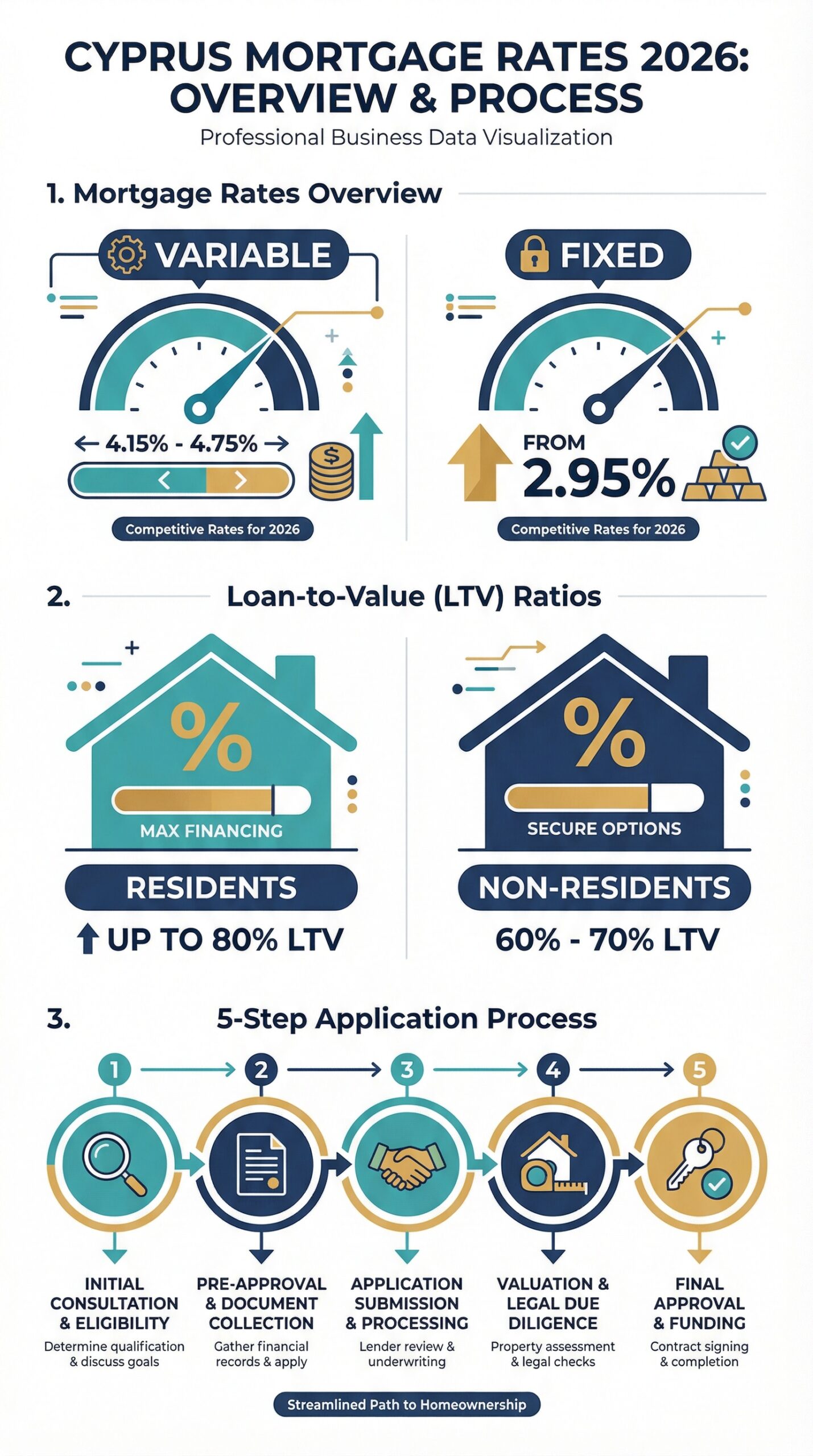
Rates have come down meaningfully from their 2023–2024 highs following ECB rate cuts. Here is where things stand as of Q1 2026:
| Product Type | Indicative Rate |
|---|---|
| Variable rate (resident) | 4.15% – 4.50% |
| Variable rate (non-resident) | 4.50% – 4.75% |
| Fixed rate – 3 years | From 2.95% |
| Fixed rate – 5 years | From 3.10% |
| Fixed rate – 10+ years | 3.50% – 4.00% (indicative) |
| Average market rate (Jan 2026) | 3.70% |
It is worth noting that Cyprus mortgage rates remain above the Eurozone average of approximately 2.43% — a gap that persists due to the concentrated nature of the island’s banking sector. The Central Bank of Cyprus monitors rates closely, and continued ECB easing is expected to put further downward pressure on variable products through 2026.
Green home discounts: Purchasing a property with an Energy Performance Certificate (EPC) rating of A or B can unlock an interest rate discount of 0.10%–0.25% with most lenders — a small but meaningful saving over a 20+ year term.
Eligibility for a Cyprus mortgage depends on several factors: your residency status, income, creditworthiness, and the property itself.
Banks assess your debt-to-income ratio (DTI). As a general rule, your total monthly debt repayments — including the new mortgage — should not exceed 35–40% of your verified gross income. Self-employed applicants and company directors often face more detailed income verification requirements.
The loan-to-value ratio is one of the most important variables in any Cyprus mortgage. Here is how it breaks down:
| Buyer Type | Maximum LTV | Minimum Deposit |
|---|---|---|
| Primary residence (residents) | Up to 80% | 20% |
| Buy-to-let / investment | 60–70% | 30–40% |
| Holiday home (non-resident) | 60–70% | 30–40% |
| New development (off-plan) | Varies by developer scheme | 10–30% |
To understand what your budget looks like in practice, check average apartment prices in Cyprus before approaching a bank. For example, a 2-bedroom apartment in Limassol costs significantly more than comparable units in Larnaca or Nicosia — knowing benchmark prices helps you assess how much you need to borrow.
Our instant property report tool can also help you verify whether a specific property is priced fairly before you commit to financing it.
Yes — but the process and options differ significantly based on where you live and where you are from.
EU citizens resident in Cyprus have full access to all bank products on the same terms as Cypriot nationals. This is the most straightforward scenario.
EU citizens living abroad can access mortgages in Cyprus, though they typically face lower maximum LTV ratios and may need to provide more extensive documentation — particularly proof that the property will be used regularly.
Non-EU nationals (UK passport holders post-Brexit, US citizens, and others) face the most restrictive conditions. Eurobank Cyprus is currently the primary institution serving this group for buy-to-let and holiday home purchases, with deposit requirements of 30–40%.
For a complete overview of foreign buyer rules and the purchasing process, our guide to buying property in Cyprus as a foreigner covers the legal framework in detail.
Here is what the mortgage application process typically looks like in Cyprus:
The full process typically takes 1–3 months. Factor in additional time for non-resident applications, particularly if documents need to be translated or apostilled.
The mortgage repayment is not your only financial obligation when buying property in Cyprus. Budget for these costs on top of your deposit:
For a full breakdown of every cost involved in a Cyprus property transaction, our taxes and legalities guide explains transfer taxes, VAT implications, and legal fees in full detail.
Before approaching a bank, use a mortgage calculator to understand the relationship between loan amount, term, rate, and monthly repayment. Both Bank of Cyprus and Eurobank Cyprus offer online calculators on their websites. As a quick reference point:
| Loan Amount | Rate | Term | Est. Monthly Repayment |
|---|---|---|---|
| €100,000 | 4.00% | 20 years | ~€606 |
| €150,000 | 4.00% | 20 years | ~€909 |
| €200,000 | 4.00% | 25 years | ~€1,055 |
| €250,000 | 3.70% | 25 years | ~€1,286 |
These are indicative only — actual repayments depend on your specific rate, fees, and whether your product is fixed or variable. If you are still building a picture of what you can afford, browse apartments for sale in Cyprus or properties for sale in Limassol to understand current asking prices before committing to a loan size.
For most buyers, yes — particularly if you are planning to hold the property long-term. With variable rates now averaging 3.70% and fixed rates starting from 2.95%, financing a Cyprus property purchase is considerably more affordable than it was in 2023.
Key takeaways:
For a deeper look at all your financing options — including developer payment plans and private financing — read our complete guide to financing your property purchase in Cyprus.
Ready to find a property worth financing? Browse 60,000+ verified listings across all five districts on index.cy — Cyprus’ #1 real estate marketplace.