
Paphos is the villa capital of Cyprus. Drive any stretch of the western coast from Pissouri to Latchi and you will pass more private villas with pools, sea views, and mature Mediterranean gardens than in the rest of the island combined. For buyers comparing villas for sale in Paphos against equivalent properties in Limassol or Larnaca, the numbers are clear: Paphos typically delivers 30–45% more square meters of villa per euro, with a deeper inventory of resale stock and a steady pipeline of new-build projects aimed at international buyers.
This guide walks through the Paphos villa market as it stands in 2026 — what villas actually cost in each area, how the buying process works, what fees and taxes to budget, how financing works for foreign buyers, and what kind of rental yield a Paphos villa realistically generates. Every number is grounded in current listings on index.cy, Cyprus’ #1 property marketplace, and in the latest data from the Cyprus Statistical Service and the Central Bank of Cyprus. Where relevant, we link straight to live villas for sale in Cyprus filters and Paphos-specific search pages so you can move from reading to shortlisting in a single click.
“Paphos” on a listing site is a district, not a single town. The Paphos district stretches along the western coast of Cyprus from the edge of Pissouri in the east to the Akamas peninsula in the north, and inland to the Troodos foothills. When you filter for properties for sale in Paphos you are looking at villas across at least ten distinct micro-markets, each with its own buyer profile and price point.
The main villa zones most buyers care about in 2026:
Most 2026 listings on the marketplace describe a “Paphos villa” as a detached house of 150–400 sqm with a private plot of 300–1,000 sqm, 3–5 bedrooms, a private pool, and a title deed (or a credible path to one). Anything smaller tends to be marketed as a detached house rather than a villa; anything larger typically sits in the €1.5M+ luxury segment, which we cover in a dedicated section below.
Prices in Paphos have risen every year since 2020, but at a slower pace than Limassol. According to the Central Bank of Cyprus Residential Property Price Index and our own analysis of live listings, the Paphos district delivered a compound annual growth rate of roughly 6–8% for detached houses between 2020 and 2025, and the first quarter of 2026 has continued that trend. The table below summarises typical asking prices for 3–4 bedroom villas with private pools, grouped by area.
| Paphos area | Typical villa price (EUR, 3–4 bed, pool) | Price per sqm (EUR) | Buyer profile |
|---|---|---|---|
| Coral Bay | €550,000 – €1,400,000 | €3,200 – €5,500 | Holiday-rental investors, coastal lifestyle |
| Peyia (hillside) | €450,000 – €1,200,000 | €2,800 – €4,800 | UK/EU expats, sea-view hunters |
| Tala | €380,000 – €850,000 | €2,400 – €3,800 | Retirees, long-term residents |
| Kissonerga | €320,000 – €700,000 | €2,100 – €3,300 | Value buyers, new-build hunters |
| Chloraka | €320,000 – €750,000 | €2,200 – €3,500 | Walk-to-beach expats |
| Kato Paphos / Geroskipou | €280,000 – €650,000 | €2,000 – €3,200 | Budget villa buyers |
| Latchi / Polis | €450,000 – €2,000,000+ | €2,900 – €6,000+ | Luxury, boutique rentals |
These ranges reflect asking prices, not transaction prices. Based on recent comparables, final sale prices on Paphos villas tend to settle 4–7% below the asking price for resale stock and 0–2% below for new builds. For a live view of what is actually on the market today, filter the villas for sale page by Paphos and set your target budget.
If you want a deeper market context — including comparisons against Limassol, Nicosia, and Larnaca — our Paphos real estate buyer’s guide covers the full district across all property types.
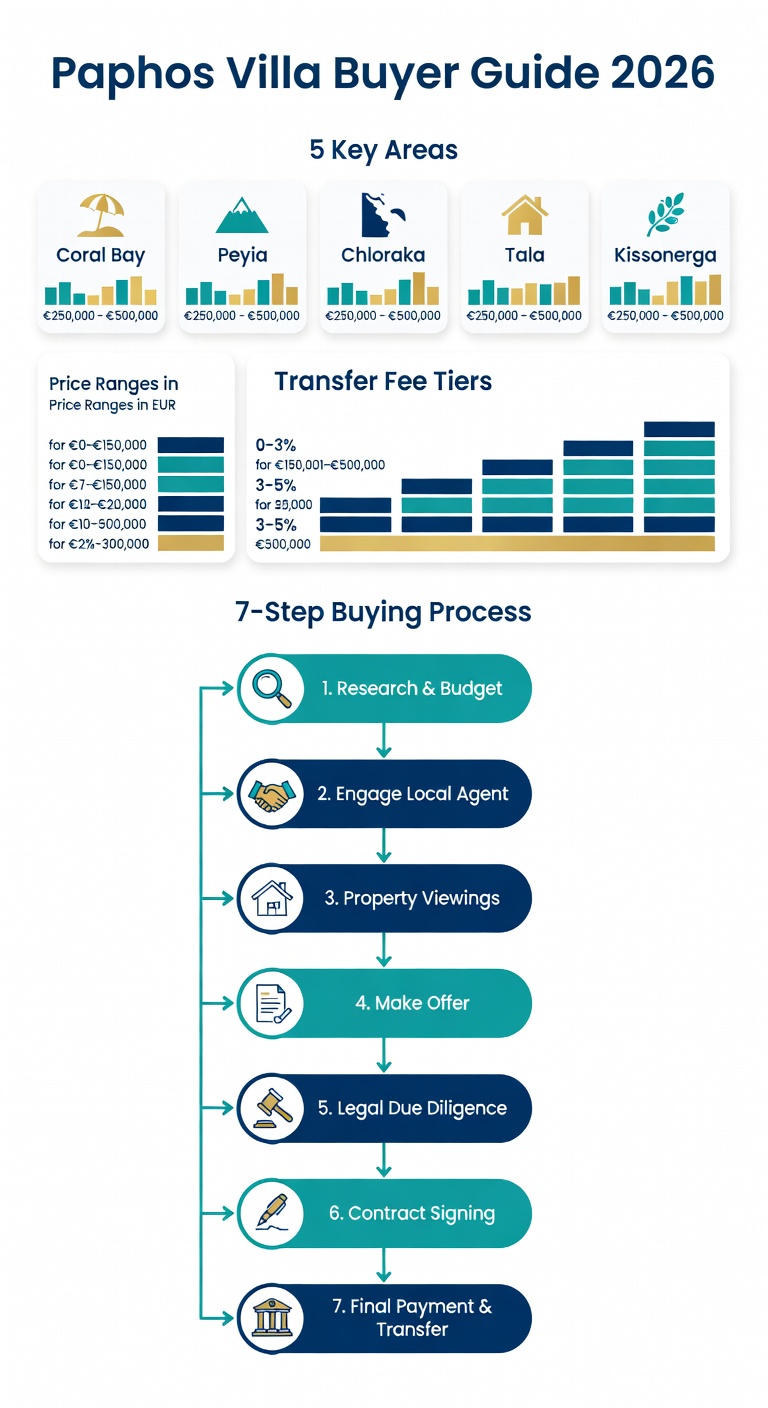
The “best” neighborhood depends entirely on whether you want a holiday home, a year-round residence, or a rental investment. Below are the five Paphos areas that receive the largest share of villa enquiries on the marketplace in 2026, with what each is actually good at.
Coral Bay is Paphos’ most concentrated short-term rental zone. Walk-to-beach villas here achieve the highest gross holiday-rental yields in the district, typically 5–7% on purchase price in peak years, because tourist demand is deep from April through October. The tradeoff is density: Coral Bay is lively, seasonal, and not the place for buyers seeking quiet year-round living. Our Coral Bay property guide covers the micro-market in detail.
Peyia sits on the hillside above Coral Bay and delivers the best sea-view-per-euro ratio in the district. A 3-bedroom villa with a clear Mediterranean view typically costs 20–30% less here than an equivalent view in Limassol’s hillside neighborhoods. Peyia has an established UK and Scandinavian expat community, a handful of good tavernas, and easy access to both Coral Bay beach and Paphos town.
Tala is the Paphos village most associated with long-term expat residence. Villas here sit at 200–350m elevation, which means cooler summers and more rain in winter than the coast, but also mature trees, quiet streets, and a real village square. Buyers who plan to live in Cyprus full-time — especially retirees moving from the UK — consistently rate Tala in their top three Paphos areas.
Kissonerga is where Paphos’ villa pipeline has expanded fastest since 2022. The area sits between Paphos town and Coral Bay, which means reasonable walking or short-drive access to both coasts. New-build villas here commonly offer 10–15% more sqm for the same budget as equivalent Peyia or Tala stock, at the cost of slightly longer drives to restaurants and beaches. Check the Paphos complexes and projects page for the current new-build pipeline.
Above Peyia village, the area around the Sea Caves (Akamas-adjacent) has become the district’s luxury villa corridor. Prices here start around €1M for a 4-bedroom villa with a clean sea view and rise past €3M for the most architect-designed properties. For buyers comparing this corridor against equivalents in Limassol’s Pyrgos or Parekklisia, the Sea Caves area typically delivers more privacy and larger plots at a similar or lower price point.
Buying a villa in Paphos follows the standard Cyprus property-purchase process, which is predictable once you know the sequence. The seven steps below apply equally to EU buyers, UK buyers, and non-EU foreign buyers (with one extra approval step for the latter).
Non-EU buyers (including UK citizens post-Brexit) require Council of Ministers approval for residential purchases — routine for villas under €500,000 and almost always granted within 3–6 months. For the full paperwork checklist, see our comprehensive due diligence guide for buying property in Cyprus and the title deeds in Cyprus guide, which explains how to verify a clean title before you commit.
The all-in transaction cost of buying a villa in Paphos typically sits between 6% and 11% of the purchase price, excluding the deposit for the villa itself. The table below summarises the main line items a buyer should budget for in 2026.
| Cost item | Rate (resale villa) | Rate (new-build villa) |
|---|---|---|
| Transfer fee (on DLS value) | 3% / 5% / 8% sliding — 50% discount in force | €0 (VAT regime applies instead) |
| VAT | 0% | 19% standard (5% reduced on primary residence up to 130 sqm, subject to conditions) |
| Stamp duty on contract | 0.15% up to €170,000, 0.20% above (capped at €20,000) | Same as resale |
| Legal fees | 1% of price (min €1,500) | 1% of price (min €1,500) |
| Inspection & survey | €600 – €1,500 | €600 – €1,500 |
| Land Registry search & deposit | under €100 | under €100 |
The 50% transfer-fee discount for resale properties and the VAT-only regime for new-build primary residences have been extended through 2026. Capital gains tax (20% on gains, with various exemptions) only applies on resale, not on purchase. For the full breakdown of Cyprus property taxation — including the Immovable Property Tax status and municipal taxes — see our Cyprus property tax guide and the broader taxes and legalities guide.
Before you fly to Cyprus, spend ten minutes watching a current walk-through of the Paphos villa segment. The video below covers a recent modern-villa development in the district, which gives a fair read on the finishes, layouts, and outdoor spaces that have become standard in the 2026 market.
Most foreign villa buyers in Paphos complete the purchase in cash or with financing arranged in their home country. Cypriot bank mortgages are available to non-residents, but the terms are tighter than most UK, German, or Scandinavian buyers will be used to.
Typical 2026 terms for a Cyprus villa mortgage extended to a non-resident:
In practice, most UK buyers we see on the marketplace either pay cash or refinance equity in their UK property. Our Cyprus mortgage guide covers the full application process, the documentation package, and the banks most active in the expat segment. For buyers coming specifically from the UK, the moving to Cyprus from the UK guide also covers currency, tax residency, and timing.
Paphos villas are one of the most transparent rental-yield plays in the Mediterranean. The tourist season runs roughly April to late October, peaks in July and August, and in 2025 delivered the strongest arrivals figures in Paphos since before the pandemic — the Cyprus Tourism Organisation reported record summer occupancy across the western coast.
What that translates into for a villa owner:
For a more detailed model of the short-term rental economics — including platform fees, seasonality, and compliance with the Cyprus Deputy Ministry of Tourism registration rules — see our Airbnb Cyprus short-term rental guide. For a broader comparison across districts and property types, the property investment Cyprus guide sets Paphos villas alongside Limassol apartments and Larnaca new builds.
One important caveat: since 2023, the Paphos municipality has tightened short-term rental enforcement. Any villa rented on Airbnb, Booking.com, or equivalent must be registered with the Cyprus Deputy Ministry of Tourism and display a valid licence number. The fines for non-registration are material (€5,000+), and platforms have begun removing unregistered listings. Budget the registration process — or a property manager who handles it — into your acquisition plan.
Yes. EU citizens buy on the same terms as Cypriot citizens. Non-EU buyers — including UK citizens since Brexit — need Council of Ministers approval, which is routine for residential villas and typically granted within 3–6 months. See the full process in our buying property in Cyprus as a foreigner guide.
Kissonerga and the outskirts of Geroskipou consistently deliver the lowest price-per-square-meter for a modern villa with a private pool. Entry-level 3-bedroom villas with a pool and a small garden start around €280,000–€320,000 in these areas in 2026, roughly 25–35% less than the equivalent in Coral Bay.
Most established resale villas in Tala, Peyia, Coral Bay, and Chloraka have issued title deeds. New-build villas often transfer the deed 12–24 months after handover, once the final Certificate of Approval is issued. Always verify title status with a Land Registry search before paying; our title deeds in Cyprus guide explains how to check.
Yes — a new-build villa purchase of at least €300,000 (plus VAT) qualifies for the Cyprus Permanent Residence route, subject to income, clean criminal record, and a deposited sale contract. Most Paphos villas in Coral Bay, Peyia, and Kissonerga sit comfortably above the threshold. See our permanent residence in Cyprus through property guide for the qualifying rules.
Paphos is meaningfully cheaper. A comparable 4-bedroom villa with a pool, sea view, and 500–700 sqm plot typically lists at €450,000–€900,000 in Paphos versus €900,000–€1,800,000 in Limassol’s coastal or hillside neighborhoods. The tradeoff is distance to the premium dining, business, and private-schooling infrastructure that Limassol offers.
From offer to title transfer, the typical resale villa transaction closes in 8–14 weeks. New-build villas with pending title deeds can take longer — the sale contract closes in a similar window, but the final separate title may arrive 12–24 months after handover.
The full verified inventory of villas for sale in Paphos is live on index.cy, where every listing is published by a verified agent or developer on our pay-per-listing marketplace. You can cross-reference against new-build projects via the Paphos complexes and projects page.
Paphos remains the most accessible villa market in Cyprus in 2026. Prices have risen, but not as fast as Limassol. Inventory is deep across resale and new-build. Foreign buyers are well served by an established legal, tax, and banking infrastructure. The risks are the same as anywhere else in Cyprus — title status, developer reliability, realistic rental expectations — and they are all manageable with the right due diligence.
If you only do three things before buying a Paphos villa, do these:
Ready to shortlist? Browse the current villas for sale in Paphos inventory, filter by area and price, and use the instant property report on any villa you are seriously considering. For institutional partners, see information for agencies and information for developers.
For broader market context, the Central Bank of Cyprus Residential Property Price Index and the Cyprus Statistical Service (CyStat) both publish quarterly data on Paphos residential pricing. Both confirm what the listings show: Paphos is a healthy, liquid, moderately growing villa market heading into mid-2026.