
What this guide covers
- What Is Capital Gains Tax in Cyprus?
- Who Pays Capital Gains Tax in Cyprus?
- Cyprus Capital Gains Tax Rate: The 20% Flat Rate
- Understanding Property Transaction Costs in Cyprus
- 2026 CGT Exemptions: What Changed and How Much You Can Save
- Primary Residence Exemption: Up to €150,000 Tax-Free
- How to Calculate Your Capital Gains Tax in Cyprus
- Practical Calculation Example
- Capital Gains Tax for Non-Residents Selling Cyprus Property
- Allowable Deductions That Reduce Your CGT Bill
- CGT on Property Transfers Between Family Members
- The 0.4% Equal Distribution of Burdens Levy
- Filing and Payment: Deadlines and Penalties
- How to Minimize Capital Gains Tax Legally
- Key Takeaways for Property Sellers in Cyprus
What Is Capital Gains Tax in Cyprus?
Selling a property in Cyprus? Capital gains tax (CGT) is one of the most important costs you need to understand before completing any transaction. Whether you’re an investor offloading a rental apartment in Limassol or a homeowner selling your family villa in Paphos, CGT directly affects how much you walk away with.
Capital gains tax in Cyprus is levied at a flat rate of 20% on the profit you make when disposing of immovable property situated in the Republic of Cyprus. The tax applies to the net gain — the difference between your sale price and your adjusted acquisition cost — not the full sale price itself. This distinction matters: many sellers overestimate their CGT liability because they confuse gross proceeds with taxable profit.
Importantly, the 2026 tax reform introduced significantly higher lifetime exemptions, which means many property sellers now pay less — or nothing at all — in capital gains tax. This guide walks you through everything: current rates, exemptions, calculation methodology, and practical strategies to minimize your tax burden legally.
Who Pays Capital Gains Tax in Cyprus?
CGT applies to anyone who disposes of immovable property in Cyprus, regardless of their tax residency status. This is a key point for international investors: even if you live in the UK, Germany, or Russia, you’re subject to Cyprus CGT when selling a Cyprus property. The tax follows the property’s location, not the seller’s nationality.
A “disposal” for CGT purposes includes several types of transactions:
- Direct sale of property (apartments, villas, houses, land, commercial space)
- Exchange of one property for another
- Gifting property to someone other than a spouse or child (family transfers have separate rules)
- Share disposals in companies that own Cyprus immovable property — from 2026, this applies when just 20% of the company’s market value derives from Cyprus property (previously 50%)
- Expropriation of property by government authorities
One important distinction: CGT applies when property is held as a capital asset (investment). If you’re actively trading property as a business — buying, renovating, and reselling frequently — your profits may instead fall under income tax rules. The tax authorities look at the nature and frequency of your transactions to determine which regime applies.
Cyprus Capital Gains Tax Rate: The 20% Flat Rate
The CGT rate in Cyprus is a straightforward 20% flat rate on your net taxable gain. There are no progressive bands, no different rates for short-term versus long-term holdings, and no distinction between residential and commercial property.
This simplicity is actually one of Cyprus’s advantages compared to many European countries, where capital gains tax rates can reach 30-45% depending on the holding period and property type. The 20% rate has remained unchanged through the 2026 tax reform — what changed significantly are the exemptions that reduce how much of your gain is actually taxable.
Understanding Property Transaction Costs in Cyprus
Capital gains tax is just one component of the costs involved in a Cyprus property transaction. For a broader understanding of legal fees, transfer costs, and the buying/selling process, this video from Connor Legal provides a helpful overview of what property sellers and buyers should expect.
2026 CGT Exemptions: What Changed and How Much You Can Save
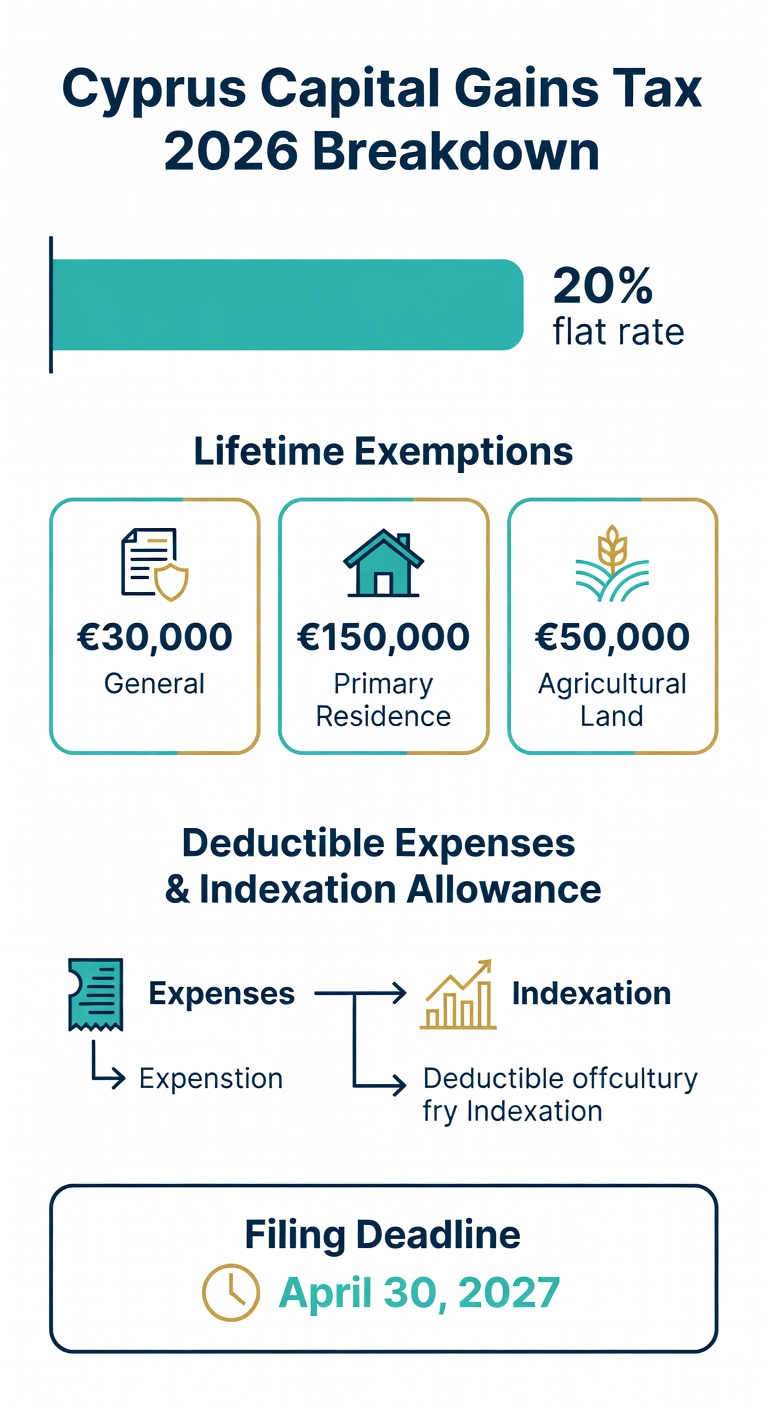
The Cyprus tax reform effective 1 January 2026 brought the most significant improvements to CGT exemptions in decades. The lifetime exemption thresholds — which hadn’t kept pace with rising property values — were substantially increased. Here’s exactly what changed:
| Exemption Type | Before 2026 | From 1 January 2026 | Increase |
|---|---|---|---|
| General property disposal | €17,086 | €30,000 | +75% |
| Primary residence (with conditions) | €85,430 | €150,000 | +76% |
| Agricultural land (professional farmer) | €25,629 | €50,000 | +95% |
These are lifetime exemptions, not per-transaction. This means the total is cumulative across all your property disposals over your entire lifetime. Once you’ve used your €30,000 general exemption across one or several sales, it’s gone — you cannot claim it again.
Primary Residence Exemption: Up to €150,000 Tax-Free
The most valuable exemption is for sellers disposing of their primary residence. Under the updated rules, up to €150,000 in capital gains from selling your main home is exempt from CGT. If your gain exceeds this amount, you pay 20% only on the excess.
To qualify for the primary residence exemption, you must meet these conditions:
- The property must have been used exclusively as your main home
- You must have lived there continuously for at least 5 years immediately before the sale
- The land area is limited to 1,500 square meters (1.5 decares)
- You need documentary evidence of residence: utility bills, bank statements, tax residency records
This exemption is particularly significant for expats and retirees who bought property in Cyprus years ago and are now considering selling. For example, if you purchased a villa in Paphos for €250,000 in 2015 and sell it for €400,000 in 2026, your gross gain is €150,000. After applying the primary residence exemption, your taxable gain would be zero — meaning no CGT at all. Browse current properties for sale in Paphos to understand today’s market values.
How to Calculate Your Capital Gains Tax in Cyprus
Calculating CGT involves several steps. Here’s the methodology:
- Determine the disposal proceeds — the sale price of your property
- Establish the acquisition cost — what you originally paid, adjusted for inflation using the Consumer Price Index (CPI). For properties acquired before 1 January 1980, you can use the market value on that date instead
- Add capital expenditure — any improvements, renovations, or additions you made to the property, supported by invoices
- Deduct allowable expenses — purchase costs (transfer fees, legal fees), sale costs (agent commissions, legal fees)
- Apply the indexation allowance — the CPI adjustment that accounts for inflation between purchase and sale
- Subtract your lifetime exemption — €30,000 general, €150,000 primary residence, or €50,000 agricultural
- Apply the 20% rate — to the remaining taxable gain
Practical Calculation Example
Let’s say you bought an apartment in Limassol in 2018 for €200,000 and sell it in 2026 for €280,000. You spent €15,000 on renovations (with invoices) and paid €8,000 in purchase costs (transfer fees, legal fees). Your sale costs (agent commission, legal fees) total €10,000.
| Step | Amount |
|---|---|
| Sale price | €280,000 |
| Less: Acquisition cost (indexed for inflation) | −€220,000 (approx.) |
| Less: Renovation costs | −€15,000 |
| Less: Purchase costs | −€8,000 |
| Less: Sale costs | −€10,000 |
| Gross gain | €27,000 |
| Less: General lifetime exemption | −€27,000 |
| Taxable gain | €0 |
| CGT payable | €0 |
In this scenario, the gain falls within the €30,000 general lifetime exemption, so no CGT is payable. This is exactly the kind of situation where the 2026 reform makes a real difference — under the old €17,086 limit, you’d have owed 20% on €9,914, which is €1,983.
Capital Gains Tax for Non-Residents Selling Cyprus Property
Non-residents are subject to the same 20% CGT rate and the same exemption rules as Cyprus tax residents. There’s no higher rate or different treatment for foreign sellers. This equal treatment applies to all nationalities.
However, non-residents should be aware of potential double taxation implications. If your home country also taxes capital gains on overseas property, you may be able to claim relief under a double tax treaty. Cyprus has signed treaties with over 65 countries, including the UK, Germany, France, Russia, and most EU member states. These treaties generally provide mechanisms to avoid being taxed twice on the same gain.
For a thorough overview of all tax obligations for property buyers and sellers, see our complete guide to taxes and legalities in Cyprus real estate.
Allowable Deductions That Reduce Your CGT Bill
Several categories of expenses can be deducted from your gross gain before CGT is calculated:
- Purchase costs: Transfer fees, stamp duty, legal fees paid when you originally bought the property
- Improvements and renovations: Any capital expenditure that enhanced the property — extensions, structural work, major upgrades — provided you have invoices as evidence
- Sale costs: Estate agent commissions, legal fees for the sale transaction, advertising costs
- Indexation allowance: Inflation adjustment using the official Consumer Price Index from the date of acquisition to the date of disposal
- Interest on loans: Interest paid on loans used to acquire or improve the property (subject to conditions)
The indexation allowance is particularly valuable for long-held properties. If you bought a property 20 years ago, the CPI adjustment can significantly increase your cost base, reducing the taxable gain. For properties acquired before 1 January 1980, you can use the market value at that date as your cost base — often a far better option than the original purchase price.
Before selling, consider getting an instant property report to understand your property’s current market value and plan your tax position accordingly.
CGT on Property Transfers Between Family Members
Certain family transfers are exempt from CGT:
- Between spouses — transfers between husband and wife are CGT-exempt
- Between parents and children — transfers (including gifts) from parents to children are exempt
- Between relatives up to third degree — subject to specific conditions
However, there’s an important catch: when the recipient eventually sells the property, CGT is calculated based on the original acquisition cost of the person who transferred it — not the market value at the time of the family transfer. The family transfer is essentially “ignored” for CGT calculation purposes, which means the gain could be substantially larger when the property is eventually sold to a third party.
The 0.4% Equal Distribution of Burdens Levy
In addition to CGT, sellers should be aware of the Equal Distribution of Burdens Levy, imposed at a rate of 0.4% on the sale or transfer value of immovable property in Cyprus. This is a separate charge from CGT and applies regardless of whether a gain was made.
For example, on a property sold for €300,000, this levy amounts to €1,200. While relatively small compared to potential CGT, it’s an additional cost that should be factored into your financial planning when selling property.
Filing and Payment: Deadlines and Penalties
Sellers must declare their CGT liability to the Cyprus Tax Department and pay the tax within one month of the disposal. Missing this deadline triggers penalties and interest charges.
From 1 January 2026, penalties for late filing or misreporting have been significantly increased:
- Late filing penalties: Range from €250 to €2,000 for individuals and companies
- Interest on unpaid tax: Accrues from the deadline until payment is made
- Misreporting penalties: Apply if the Tax Department determines that the disposal proceeds or costs were incorrectly stated
Given these penalties, professional advice is strongly recommended. A tax advisor or property lawyer can ensure accurate CGT computation, proper documentation of allowable deductions, and timely filing.
How to Minimize Capital Gains Tax Legally
Several legitimate strategies can reduce your CGT exposure:
- Keep all renovation invoices — every documented improvement reduces your taxable gain. Without invoices, the Tax Department won’t accept the deduction
- Use the primary residence exemption — if you’ve lived in the property for 5+ years, the €150,000 exemption can eliminate most or all CGT
- Consider the timing — if you’re close to the 5-year residence threshold, waiting a few months before selling could save you tens of thousands in tax
- Plan multiple disposals carefully — since exemptions are lifetime limits, the order and timing of selling multiple properties matters. Sell the property with the largest gain first if you still have exemption capacity
- Factor in indexation — for properties held long-term, the inflation adjustment can significantly reduce the taxable gain
- Explore property exchanges — in certain cases, exchanging properties rather than selling outright can offer tax-efficient restructuring opportunities
For investors managing multiple properties, understanding the interaction between these strategies is essential. Our real estate investment guide covers portfolio planning considerations in detail.
Key Takeaways for Property Sellers in Cyprus
Capital gains tax in Cyprus is a manageable and predictable tax when properly understood. The 2026 reforms have made it significantly more favorable for individual sellers, especially those disposing of their primary residence.
Here’s what to remember:
- The rate is a flat 20% on net gains — not on the sale price
- Lifetime exemptions are now €30,000 (general), €150,000 (primary residence), or €50,000 (agricultural land)
- Non-residents pay the same rate as residents — no penalty for being a foreign seller
- Allowable deductions (renovation costs, purchase fees, sale costs, indexation) can substantially reduce your liability
- Family transfers between spouses and parent-child are CGT-exempt, but the original cost base carries forward
- File and pay within one month of disposal to avoid penalties of up to €2,000
- Keep all documentation — invoices, receipts, and proof of residence are essential to claim deductions and exemptions
Whether you’re selling a studio apartment or a luxury villa, understanding your CGT position before listing your property helps you set the right price and avoid surprises at closing. Consider booking a property inspection and getting an instant property report to establish current market value before making any decisions.
This guide provides general information about capital gains tax in Cyprus as of June 2026. Tax legislation can change, and individual circumstances vary. Always consult a qualified tax advisor or property lawyer before making decisions about property disposals.
Keep reading

Larnaca Property Market Surges: Which Areas Are Leading the Price Rise? Larnaca’s property market has experienced a notable surge in prices recently,…

We analysed 66 Tseri, Nicosia listings: 18 apartments, 8 houses and 34 plots. Median 2-bed price is EUR174,000. See prices and what…

We analysed 246 Lakatamia, Nicosia listings: 129 apartments, 52 houses and 46 plots. Median 2-bed price is EUR195,000. See prices and what…