
What this guide covers
- The Cyprus Real Estate Market in 2026
- Who Can Buy Real Estate in Cyprus?
- Property Prices Across Cyprus’ Five Districts
- The Cyprus Property Buying Process, Step by Step
- Costs and Taxes to Budget For
- Financing Your Purchase: Mortgages in Cyprus
- Renting in Cyprus: A Strong and Steady Market
- Investing in Cyprus Real Estate: Returns, Residency and Risk
- How to Search Smart on index.cy
- Final Thoughts
Cyprus real estate has rarely been busier. In 2025 the island recorded a property transaction value of roughly €6.5 billion — up 8% on the previous year — and the momentum has carried straight into 2026, with first-quarter sales sitting close to historic highs. If you are weighing up whether to buy, rent, or invest in real estate in Cyprus this year, this guide pulls the whole picture together: current prices, the rules for foreign buyers, district-by-district costs, the step-by-step buying process, rental yields, and what a smart investment actually looks like in a maturing market.
Whether you are an expat relocating for the Mediterranean lifestyle, an investor chasing rental income, or a first-time buyer trying to avoid overpaying, the Cyprus property market in 2026 rewards people who understand the numbers. Let’s break them down.
The Cyprus Real Estate Market in 2026
After two years of frantic demand and sharp price surges, the Cyprus real estate market has settled into what analysts call a “mature growth” phase — steadier, higher-quality, and more predictable. That is good news for buyers who were priced out by the volatility of recent years.
The headline figures tell the story. Around 11,000 apartments changed hands in 2025, a 9% rise on 2024, while house sales climbed 4% to roughly 4,900 units. Demand for apartments continues to drive the market, particularly in coastal cities where both expats and local buyers compete for well-located stock. In March 2026, property contracts deposited with the Land Registry were up 18% year-on-year, confirming that appetite has not cooled.
Prices have followed a measured upward path. The average apartment across Cyprus sold for about €248,000 in 2025 (up from €240,000 the year before), while the average house reached €356,000. Expressed per square metre, average residential values now sit near €2,600/m². Forecasters expect residential prices to keep rising by roughly 5–7% per year — solid appreciation without the overheating of the recent boom. The Central Bank of Cyprus Residential Property Price Index is the official benchmark for tracking these movements, and our own Cyprus property market 2026 analysis follows the trends quarter by quarter.
Why the durability? Several forces are pulling in the same direction: continued foreign demand from the UK, Europe, the Middle East and beyond; a tight supply of quality, well-located stock; Cyprus’ status as an English-speaking, EU member state with a favourable tax regime; and a lifestyle proposition — 300-plus days of sunshine, low crime, and strong international schools — that keeps relocating families and remote workers arriving year after year.
Who Can Buy Real Estate in Cyprus?
One of the most common questions from overseas buyers is simply whether they are allowed to purchase at all. The answer is yes — but the rules differ depending on your nationality.
EU and EEA citizens can buy property in Cyprus with no restrictions, following exactly the same process as Cypriot nationals: find a property, agree terms, sign a contract, and register the sale with the Department of Lands and Surveys.
Non-EU (third-country) nationals can buy property too, but with two limits. You may own no more than two properties, and each purchase requires a permit from the District Administration in the area where the property is located. In practice this means submitting Form COMM 145 with supporting documents. There is no fee, and approval typically takes two to three weeks — it is rarely refused for ordinary residential purchases.
One development worth watching: in February 2026, the Cyprus Ministry of Interior confirmed it is drafting a revised framework for foreign property ownership, after parliamentary bills sought tighter controls on acquisitions by non-EU buyers, as reported by the Cyprus Mail. Nothing has changed the fundamentals yet, but if you are a third-country national, it is wise to move with good legal advice and keep an eye on the rules. Our complete guide to buying property in Cyprus as a foreigner goes deeper on permits and paperwork.
Property Prices Across Cyprus’ Five Districts
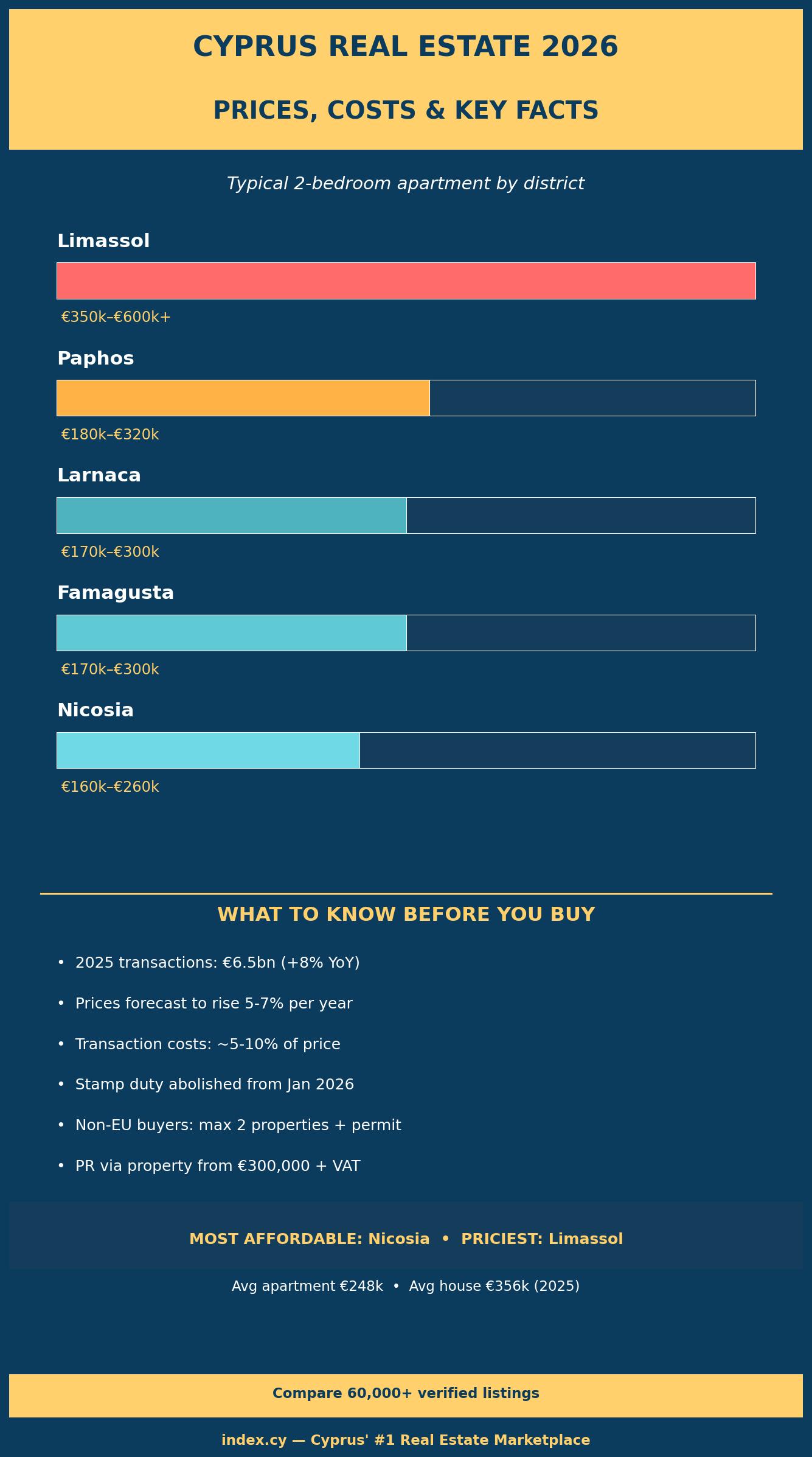
Cyprus is small, but its five districts behave like distinct markets. Where you buy has a bigger impact on price than almost any other factor. Here is a snapshot of typical residential values in 2026:
| District | Character | Typical 2-bed apartment | Best for |
|---|---|---|---|
| Limassol | Premium, business hub | €350,000–€600,000+ | Investors, professionals |
| Paphos | Expat favourite, coastal | €180,000–€320,000 | Retirees, lifestyle buyers |
| Larnaca | Coastal, growing fast | €170,000–€300,000 | Value seekers, airport access |
| Nicosia | Capital, most affordable | €160,000–€260,000 | First-time buyers, renters |
| Famagusta | Emerging, holiday-driven | €170,000–€300,000 | Holiday-home & rental buyers |
Limassol remains the most expensive and most international market, home to the marina, the business district, and the bulk of luxury new-build supply. Paphos attracts a steady stream of European retirees and lifestyle buyers, offering Mediterranean living at far gentler prices. Nicosia, the capital, is consistently the most affordable district and a sensible entry point for first-time buyers, while Larnaca’s airport access and waterfront regeneration have made it one of the island’s fastest-growing value markets.
These ranges are starting points, not appraisals. For live, data-backed figures, check our average prices for a 2-bedroom apartment in Cyprus, which breaks the numbers down district by district and updates as the market moves, or compare against independent benchmarks such as Numbeo’s Cyprus property data. If you are still deciding where to focus, our guide to the best areas to buy property in Cyprus weighs lifestyle against returns district by district.
The Cyprus Property Buying Process, Step by Step
Buying real estate in Cyprus is more straightforward than many newcomers expect, but skipping steps can be costly. Here is the typical path from search to ownership:
- Search and shortlist. Browse verified listings, compare comparable properties, and narrow your options by district, type, and budget.
- Make an offer and pay a reservation deposit. This takes the property off the market while contracts are prepared — usually €5,000–€10,000.
- Appoint an independent lawyer. Your lawyer runs due diligence: confirming the title, checking for mortgages or encumbrances, and verifying planning permissions. Never rely solely on the seller’s or developer’s lawyer.
- Sign the contract of sale. Once terms are agreed, the contract is signed and deposited with the Land Registry to protect your interest.
- Apply for a purchase permit (non-EU buyers only).
- Complete payment and transfer the title deed at the Department of Lands and Surveys.
Costs and Taxes to Budget For
Beyond the purchase price, expect total transaction costs of roughly 5–10% of the property value. The main components are:
- Transfer fees, payable when the title deed is transferred to your name (reduced or waived in cases where VAT applies).
- Legal fees, typically 1–2% of the property value.
- VAT on new properties, charged at the standard rate, with a reduced rate available on a qualifying first home.
There is also welcome news for 2026: stamp duty has been abolished on documents executed from 1 January 2026, trimming one line item off the closing bill. Because the fine print on VAT and transfer-fee relief can shift your final cost meaningfully, due diligence pays for itself many times over. An instant property report and a professional property inspection help you confirm you are paying a fair price before you commit.
Financing Your Purchase: Mortgages in Cyprus
Plenty of buyers pay cash, but Cyprus real estate is also accessible through local mortgage finance — including for many non-residents. Cypriot banks typically lend 60–70% of a property’s value to foreign buyers (sometimes up to 80% for residents), over terms of up to 25–30 years, with the loan usually required to be repaid before the borrower reaches 65–70 years of age.
Interest rates in 2026 are most commonly variable, linked to the Euribor benchmark plus a bank margin, though fixed-rate periods are available. Lenders will assess your income, existing debts, and the property’s valuation, and will expect life and property insurance to be in place. Expect to budget for a valuation fee, bank arrangement fees, and the legal costs already covered above.
A practical tip: get a mortgage pre-approval in principle before you start making offers. It tells you exactly what you can afford, strengthens your negotiating position, and speeds up completion once you find the right home. Our dedicated Cyprus mortgage guide for 2026 covers rates, eligibility, and the application process in full.
Prefer to watch rather than read? This overview walks through the essentials of buying real estate in Cyprus:
Renting in Cyprus: A Strong and Steady Market
Not everyone buys straight away — and for landlords, the rental side of Cyprus real estate is where consistent income lives. Demand for rentals is robust across the island, fuelled by expats, students, seasonal workers, and the growing population of remote professionals on Cyprus’ digital nomad visa.
Long-let asking rents in 2026 run highest in Limassol, where a two-bedroom apartment commonly commands €1,300–€2,000 per month, followed by Larnaca and Paphos in the €850–€1,400 range, with Nicosia offering the best value. Standard leases run 12 months, deposits are typically one to two months’ rent, and furnished units are the norm in the coastal cities.
For buyers, those rents translate into gross rental yields that commonly land in the 4–6% range — competitive by European standards, and stronger still for well-chosen apartments and flats in high-demand neighbourhoods. If income is your priority, a centrally located apartment usually outperforms a larger villa on a yield basis.
Investing in Cyprus Real Estate: Returns, Residency and Risk
Cyprus has long appealed to investors, and 2026 keeps that appeal intact thanks to three things working together: steady capital growth, healthy rental yields, and a clear residency pathway.
On capital growth, the forecast 5–7% annual appreciation, combined with rental income, can produce attractive total returns — particularly in supply-constrained coastal markets. Villas in prime Limassol and Paphos locations have historically held value well and appeal to the luxury rental market.
On residency, foreigners who invest at least €300,000 (plus VAT) in qualifying property — and can show €50,000 in annual income from abroad — can apply for Cyprus permanent residency, a major draw for non-EU buyers seeking a foothold in the EU. Our real estate investing guide on index.cy walks through how to build a Cyprus portfolio from the ground up.
That said, invest with clear eyes. The proposed tightening of foreign-ownership rules, the standard liquidity constraints of property, and the importance of buying in the right micro-location all argue for thorough research and good professional advice. Strong returns in Cyprus come from buying well, not just buying.
How to Search Smart on index.cy
The single biggest advantage you can give yourself in the Cyprus real estate market is good information. As Cyprus’ #1 real estate marketplace, index.cy brings together 60,000+ verified listings from more than 100 companies onto one neutral platform — with no commission bias, because we run a pay-per-listing model rather than earning on sales.
That means you can compare apples to apples: filter by district, property type, and budget; cross-check asking prices against our insights data; and use the instant report and inspection tools to pressure-test a property before you make an offer. In a market this active, the buyers who win are the ones who arrive informed.
Final Thoughts
Cyprus real estate in 2026 offers a rare combination: a market with genuine momentum, but one that has matured past the overheating of recent years. Prices are rising at a sustainable 5–7%, transaction volumes are near record highs, rental demand is strong, and the buying process — now lighter without stamp duty — is well-trodden and transparent.
The fundamentals reward preparation. Understand which district fits your goals, budget the full 5–10% of transaction costs, lean on independent legal advice, and verify every property with real data before you commit. Do that, and whether you are buying a home, building a rental portfolio, or securing residency, real estate in Cyprus remains one of the Mediterranean’s most compelling opportunities. Start your search on index.cy today.
Keep reading

We analysed 576 Pareklisia, Limassol listings: 188 houses, 175 apartments and 122 plots. Median house asks EUR965,000. See prices by size and…
Larnaca Marina Development Set to Move Forward Amid Legal Adjustments The long-awaited development of Larnaca Marina is now on a clearer path…

We analysed 249 Kouklia, Paphos listings: 210 houses, 20 plots and 6 apartments. Median 2-bed house asks EUR397,000. See prices, plots and…