
Moving to Cyprus from the UK is one of the most popular international relocation decisions British nationals make each year — and for good reason. With over 300 days of sunshine, English widely spoken, a familiar legal system rooted in British common law, and property prices well below London and other major UK cities, Cyprus offers a genuinely compelling case for UK buyers and relocators alike.
But post-Brexit, the landscape has shifted. The rules for UK citizens moving to Cyprus are different from what they were a decade ago, and understanding your visa options, property rights, and the costs involved is essential before you commit. This guide covers everything you need to know to plan a successful move in 2026.
Cyprus consistently ranks as one of the top destinations for British expats in Europe, and demand has grown since Brexit reshaped the options for long-term European living. Several factors explain this trend.
Cyprus is an EU member state with a long-standing British community — an estimated 60,000 UK nationals currently live on the island, concentrated particularly in Paphos and Limassol. English is used extensively in business, healthcare, and daily life. The legal system is based on English common law, meaning property transactions, contract law, and dispute resolution feel familiar to UK buyers.
The climate is another major draw. Cyprus averages more than 300 sunny days per year, with mild winters and long, warm summers stretching from April through November. For UK nationals accustomed to grey skies and damp winters, the lifestyle improvement is immediate and significant.
Economically, Cyprus offers strong value compared to the UK. Property prices are a fraction of equivalent homes in most British cities, the cost of living is lower across most categories, and the flat corporate tax rate of 12.5% makes Cyprus attractive for remote workers and business owners. The island’s healthcare system covers legal residents, and private health insurance is affordable.
Finally, travel connections matter. Cyprus is well-served by direct flights from major UK airports including London Heathrow, Gatwick, Manchester, and Birmingham — with flight times typically under five hours.
Since the UK left the European Union, British nationals are no longer EU citizens and cannot use freedom of movement to live and work in Cyprus indefinitely. You will need to apply for residency under Cyprus’s immigration framework, and understanding your options before you move is essential.
The most common path for UK retirees and those with passive income is the Category F immigration permit. This is designed for people who can demonstrate sufficient financial means to support themselves without working in Cyprus.
To qualify, you typically need to show a minimum annual income of approximately €9,568 for an individual, plus additional amounts for dependants. Income can come from pensions, investments, rental income, or other passive sources. You’ll also need to show you have secured accommodation in Cyprus — either through ownership or a rental agreement. The Category F permit is permanent once granted, making it the most stable long-term option for retirees and those with passive income.
Cyprus introduced a Digital Nomad Visa in 2022, designed for non-EU remote workers who earn income from employers or clients outside Cyprus. This visa allows you to live in Cyprus for up to 12 months, renewable for another 12 months. Requirements include proof of remote employment or freelance income above a minimum threshold (currently approximately €3,500 per month), health insurance, and accommodation.
Cyprus’s permanent residency-by-investment programme remains available. Under the current rules, purchasing property worth at least €300,000 (plus VAT) can qualify you for a Category 6(2) permanent residency permit — a popular route for UK buyers who want the stability of long-term residency alongside a property investment. This permit is permanent and extendable to immediate family members.
For detailed guidance on the legal steps and taxes involved, see our complete guide to taxes and legalities in Cyprus real estate.
Cyprus has five districts, each with a distinct character, property price range, and expat community density. Knowing where you’ll be happiest before you commit to a purchase will save you significant time and money.
Paphos is the most popular destination for British expats in Cyprus and has the highest concentration of UK nationals on the island. The city and surrounding areas offer a well-established expat infrastructure: British-style amenities, English-language services, UK-connected healthcare, and a thriving international social scene.
Property prices in Paphos are among the most affordable of any coastal district in the EU. You can find high-quality two-bedroom apartments from around €150,000–€200,000, and villas with pools from €250,000 upward. Browse current properties for sale in Paphos to get a sense of what your budget will buy.
Limassol is Cyprus’s financial and business hub. It attracts a younger, more internationally diverse crowd — including corporate relocators, finance professionals, and tech workers. Property prices here are the highest in Cyprus, with premium apartments near the marina commanding €4,000–€6,000 per square metre or more.
For UK buyers looking for a vibrant urban lifestyle with excellent restaurants, high-end shopping, and strong rental demand, Limassol is the obvious choice. Explore the full range of available properties for sale in Limassol on index.cy.
Larnaca is Cyprus’s main air hub and offers more affordable coastal living, with apartment prices averaging around €1,330 per square metre. It’s ideal for UK buyers who want seaside lifestyle at lower entry cost. Nicosia, the capital, is the most affordable district and suits investment-focused buyers rather than lifestyle relocators. Famagusta — particularly Ayia Napa and Protaras — is an emerging opportunity for holiday-let investors, with exceptional beaches and growing tourism infrastructure.
Since Brexit, UK nationals are treated as non-EU foreign buyers under Cyprus property law — but the rules for foreign ownership are remarkably open. Non-EU buyers can purchase one property in Cyprus without additional restrictions, whether an apartment, house, or villa.
The key steps in buying property as a UK buyer: you’ll need a Cyprus tax identification number (TIC), which your lawyer can help you obtain. You’ll sign a purchase agreement and pay a deposit — typically 10–30% of the purchase price. The contract must be submitted to the Land Registry within 60 days to protect your rights. Transfer taxes apply at the point of title deed transfer: the standard rate is 3% on the first €85,430 of value and 5% above that, though reductions and exemptions often apply.
Before signing anything, commission an instant property report on any property you’re seriously considering. This gives you data-driven analysis of the property’s value, condition, and comparable pricing — essential for negotiating from a position of strength and avoiding overpayment.
For a comprehensive breakdown of the buying process, read our full guide to buying property in Cyprus as a foreigner.
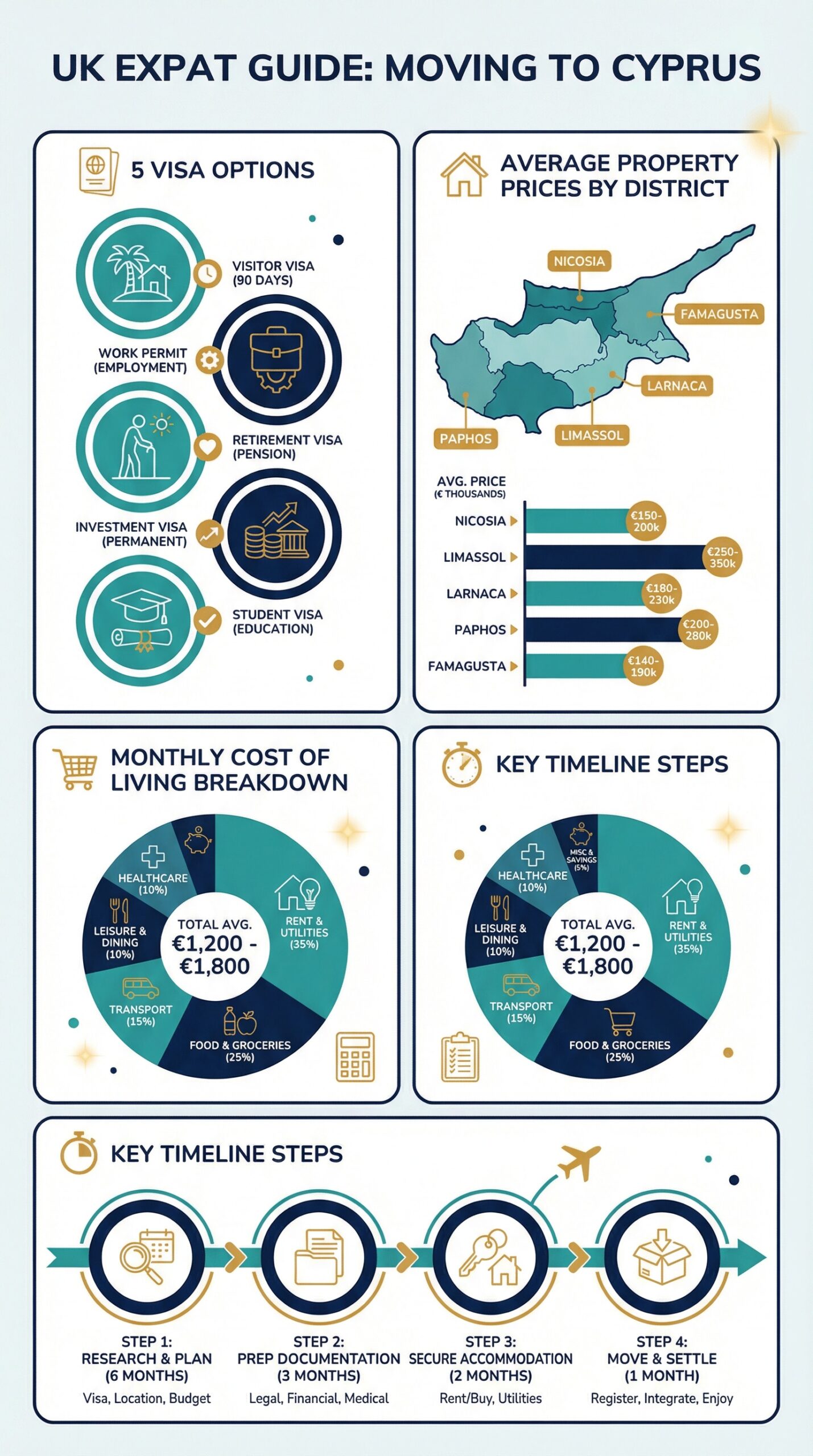
One of the most compelling aspects of moving to Cyprus from the UK is the purchasing power your budget commands. According to average property price data by district, here is what you can expect across Cyprus in 2026:
| District | Avg. Apartment (€/sqm) | 2-Bed Apartment Range | 3-Bed Villa Range |
|---|---|---|---|
| Limassol | €3,000–€5,000 | €250,000–€500,000 | €500,000+ |
| Paphos | €1,800–€2,800 | €150,000–€250,000 | €250,000–€450,000 |
| Larnaca | €1,300–€2,000 | €120,000–€200,000 | €200,000–€380,000 |
| Nicosia | €1,500–€2,200 | €130,000–€210,000 | €200,000–€350,000 |
| Famagusta | €1,200–€1,800 | €110,000–€180,000 | €180,000–€320,000 |
These numbers translate into a striking contrast with UK markets: a budget of €300,000 (roughly £255,000) might buy you a one-bedroom flat in London or Manchester, but in Paphos it comfortably buys a three-bedroom villa with a private pool. In Larnaca or Famagusta, that same budget puts you firmly in the upper tier of the market.
Property purchase aside, day-to-day living costs in Cyprus are generally lower than in the UK — though the gap has narrowed in recent years as inflation has affected the island along with the rest of Europe.
Moving to Cyprus from the UK requires advance planning — particularly around residency paperwork, property searches, and financial logistics. Here is a practical timeline to follow:
Cyprus offers UK nationals a compelling package: Mediterranean climate, English-speaking infrastructure, a familiar legal system, EU membership for residents, strong property value, and a lower cost of living. Post-Brexit, the visa process adds a step that didn’t exist before — but for most UK buyers, it’s entirely manageable with the right professional guidance.
Whether you’re retiring to the sun in Paphos, building a life in cosmopolitan Limassol, or investing in an emerging coastal market, Cyprus delivers on the lifestyle and financial case for UK expats. The right move starts with the right research — and index.cy is Cyprus’s largest and most transparent property marketplace, with 60,000+ verified listings across all five districts.
Start your property search on index.cy and use our instant property report tool to analyse any property before you commit.