
Cyprus’ capital is having a moment. The Nicosia property market has quietly emerged as one of the most compelling opportunities on the island — not because of beachside glamour, but because of something more durable: undersupply, strong local demand, and prices that still lag well behind Limassol.
If you have been watching Cyprus real estate with one eye on the numbers, Nicosia deserves a closer look. In 2026, the city is drawing more first-time buyers and savvy investors who want genuine long-term value rather than a premium coastal address. Here is a detailed look at what is happening, what it costs, and where the smart money is going.
Nicosia sits at the geographic heart of Cyprus and serves as the island’s administrative, business, and commercial capital. Unlike Limassol — which has been turbocharged by international tech companies and high-net-worth expats — Nicosia’s property market is driven primarily by local Cypriots, domestic buyers relocating for work, and a growing segment of EU buyers attracted by the city’s affordability relative to other European capitals.
That local-demand foundation creates a different kind of stability. Prices in Nicosia do not spike as dramatically as coastal markets when international sentiment shifts, but they do not correct as sharply either. This makes the capital particularly attractive for buyers seeking a reliable, inflation-resistant property in a legal, secure EU member state.
The 2026 market shows several clear trends:
Nicosia is the most affordable of Cyprus’ three major urban markets. Compared to Limassol (where 2-bedroom apartments average around €280,000–€320,000) and Larnaca (where similar units sit at €160,000–€200,000), Nicosia offers tangible value for buyers who do not need a sea view.
Here is a realistic price breakdown for the Nicosia market in 2026:
| Property Type | Price Range |
|---|---|
| Studio / 1-bedroom apartment | €80,000 – €130,000 |
| 2-bedroom apartment | €130,000 – €200,000 |
| 3-bedroom apartment | €190,000 – €280,000 |
| Penthouse / premium unit | €250,000 – €400,000+ |
| 3-bedroom townhouse | €200,000 – €320,000 |
| Detached villa (suburban) | €280,000 – €500,000 |
| Villa with pool | €350,000 – €650,000+ |
In central Nicosia and established residential zones, expect to pay €1,500–€2,200 per sqm for apartments. In newer suburban developments, prices typically range from €1,300–€1,800 per sqm. For the latest verified market data, our average house price insights for Nicosia track actual transaction prices across property types.
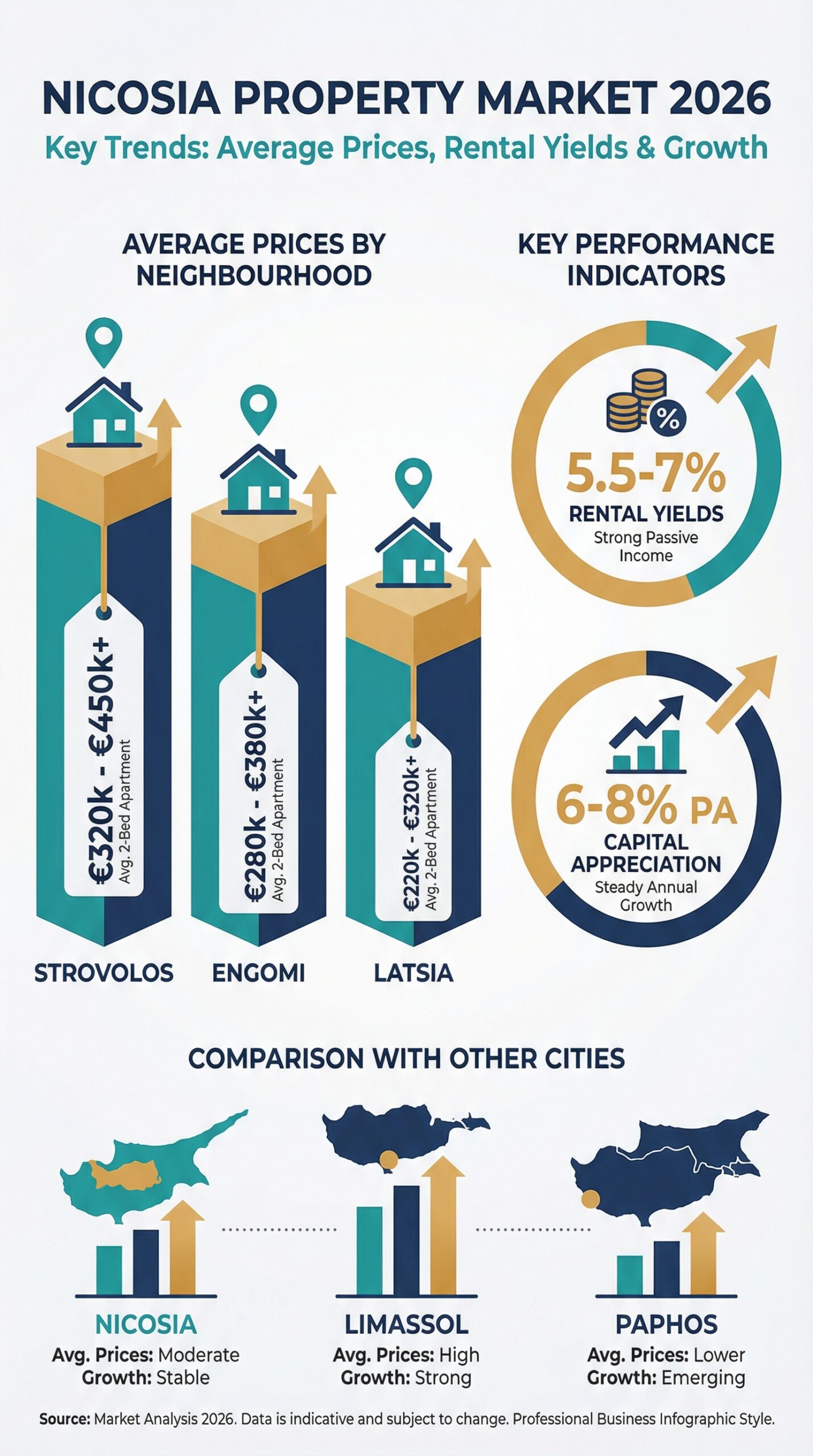
Nicosia is a city of distinct micro-markets, and choosing the right neighbourhood significantly impacts both your quality of life and long-term investment performance. Here are the key areas to understand.
The most popular residential suburb for both buyers and renters. Strovolos is well-connected, commercially developed, and home to a strong expat community of EU professionals and diplomatic staff. Properties here are slightly pricier than outer suburbs but come with strong rental demand.
Engomi is Nicosia’s prestige residential address — tree-lined streets, larger properties, and proximity to the Cypriot Foreign Ministry and international schools. It attracts diplomats, senior executives, and buyers looking for an upscale residential atmosphere without coastal prices.
A growing suburb on the southern edge of Nicosia, Latsia has become popular with first-time buyers priced out of central areas. Newer developments here offer modern specifications at more accessible price points.
Positioned on the northwest edge of Nicosia, Agios Dometios offers a mix of older housing stock and some newer apartment developments. Prices are among the more affordable in the capital, and the area is seeing gradual upgrading as buyers push outward from more expensive central zones.
The historic walled city of Nicosia is a completely different investment thesis. Properties here are typically older, require renovation, and are subject to heritage planning restrictions — but they can be exceptionally characterful, and EU funding for the regeneration of the buffer zone area has been steadily increasing.
Nicosia doesn’t have Limassol’s skyline or Paphos’s sea views, but it offers something coastal markets can’t easily replicate: a deep, locally-driven rental market with a 12-month demand cycle.
Limassol and Paphos are significantly impacted by seasonal tourism and the ebb and flow of international tech company hiring. Nicosia’s market is anchored by a set of structural demand drivers that operate year-round:
Gross rental yields on well-positioned 2-bedroom apartments in Nicosia typically run between 5.5% and 7%, competitive with Limassol (4.5–6%) and substantially above many Western European capitals. You can explore current apartments for sale in Nicosia to get a real-time picture of what is available at current market prices.
Cyprus has a straightforward property purchasing process by European standards, and Nicosia is no exception. Here is a condensed walkthrough for buyers:
The new-build market in Nicosia has expanded significantly over the past two years. Several high-quality residential complexes have launched or are under construction in areas like Strovolos, Latsia, and the southern suburbs, offering modern specifications — energy-efficient systems, underground parking, contemporary layouts — at prices that remain attractive relative to Limassol.
Buying off-plan in Nicosia carries the standard advantages: securing at today’s prices with completion in 12–24 months, phased payments, and a degree of customisation on finishes. The primary risk is developer completion — always check the developer’s track record, verify building permit status, and ensure your legal advisor registers the sale agreement with the Land Registry immediately after signing.
Browse current new complexes and projects in Nicosia to see what is available in the pipeline.
Buyers comparing Nicosia against other Cyprus markets should weigh three dimensions: price, yield, and lifestyle. The comparison below reflects current 2026 market conditions:
| Factor | Nicosia | Limassol | Larnaca | Paphos |
|---|---|---|---|---|
| Avg 2-bed price | €155,000–€195,000 | €280,000–€340,000 | €160,000–€210,000 | €170,000–€240,000 |
| Gross rental yield | 5.5–7% | 4.5–6% | 5–6.5% | 4.5–6% |
| Sea access | None | Excellent | Good | Excellent |
| Capital appreciation | 6–8% pa | 8–12% pa | 5–7% pa | 5–7% pa |
| Lifestyle vibe | Urban/cosmopolitan | Business/luxury | Relaxed coastal | Expat community |
The data is clear: Nicosia offers the best yield relative to price. Limassol wins on capital appreciation but at a steep entry cost. For buyers who want yield efficiency without coastal prices, Nicosia is the rational choice. You can browse properties for sale across all Cyprus districts to compare options directly.
The Nicosia property market in 2026 offers a combination of affordability, yield, and stability that is increasingly difficult to find in coastal Cyprus. Whether you are a first-time buyer looking for an accessible entry point, a yield-focused investor wanting 5.5–7% from a 12-month demand cycle, or a professional relocating to work in the capital — Nicosia deserves serious attention.
The market is not without complexity. Neighbourhood choice matters significantly, new-build due diligence is essential, and Nicosia’s pace is less dramatic than Limassol’s headline-grabbing appreciation. But for buyers who do their homework, the fundamentals are sound.
Start by exploring properties for sale in Nicosia on index.cy — Cyprus’ largest verified property marketplace. If you want an independent condition assessment before making an offer, our property inspection service covers Nicosia-based properties island-wide.