
Commercial property in Cyprus has quietly become one of the island’s most compelling investment stories. While headlines focus on apartments and holiday villas, offices, warehouses, and retail space are delivering some of the strongest and most stable returns on the market. In the RICS Cyprus Property Price Index for Q4 2025, offices posted a gross rental yield of 5.58% — higher than apartments (5.45%) and more than double the return on houses (2.96%). For investors who want income rather than lifestyle, that gap matters.
This guide explains what commercial property in Cyprus actually involves in 2026: the main asset types, where yields are strongest, how the buying process works, and what taxes and risks you need to plan for. As Cyprus’ #1 property marketplace, index.cy lists commercial space from more than 100 verified real estate companies across all five districts, so you can compare the market openly and without commission bias.
The case for Cyprus commercial real estate rests on three forces that have reshaped demand since 2022.
The first is corporate relocation. A wave of international technology and services companies moved regional operations to the island, drawn by a 12.5% corporate tax rate, EU membership, and English-speaking professionals. Firms such as JetBrains, inDrive, and Gett established a footprint here, and dozens of smaller companies followed. Each new arrival needs modern office space, and that steady occupier demand has kept prime offices near full occupancy in Limassol and Nicosia.
The second force is a structural shortage of quality stock. Much of the island’s commercial inventory is older Grade B and Grade C space. Demand for Grade A offices — energy-efficient, well-located, with proper parking and infrastructure — consistently outstrips supply. When tenants compete for a limited pool of good buildings, landlords hold pricing power.
The third is the tax environment. From January 2026, Cyprus abolished stamp duty on property transactions, including commercial purchase and sale agreements. Combined with no annual immovable property tax and a favourable corporate framework, the cost of holding commercial assets has fallen. For a full breakdown of what you’ll owe, see our Cyprus property tax guide.
Commercial property is not a one-way bet — sentiment softened slightly in early 2026 as regional geopolitical tension weighed on investor confidence. But the fundamentals underpinning office and logistics demand remain intact, and index.cy data shows steady interest in commercial property listings across Cyprus.
Commercial real estate is not a single market. Each segment behaves differently, and understanding the distinctions is the first step to investing well.
Returns vary sharply by district and asset type. The table below summarises typical 2026 gross yields and price positioning across the main districts, drawn from RICS/KPMG index data and index.cy market observations. Treat these as guide ranges — actual figures depend heavily on the specific building, lease, and location.
| District | Office rent (Grade A, €/m²/mo) | Typical gross yield | Commercial profile |
|---|---|---|---|
| Limassol | €18–30 | 5.5–7% | Prime offices, retail, shipping & tech hub |
| Nicosia | €12–20 | 6–8% | Government, banking, largest office market |
| Larnaca | €9–15 | 6–8% | Warehouses, logistics, growth potential |
| Paphos | €8–14 | 5.5–7% | Tourism, retail, smaller office demand |
| Famagusta | €8–13 | 6–7.5% | Tourism-led retail, emerging |
Nicosia, as the capital and administrative centre, offers some of the most reliable office demand and often the best yields relative to entry price, since capital values sit below Limassol. Limassol delivers premium rents but at premium prices, so net yields can be tighter despite strong demand. Compare live inventory in Limassol and Nicosia to see how pricing differs in practice.
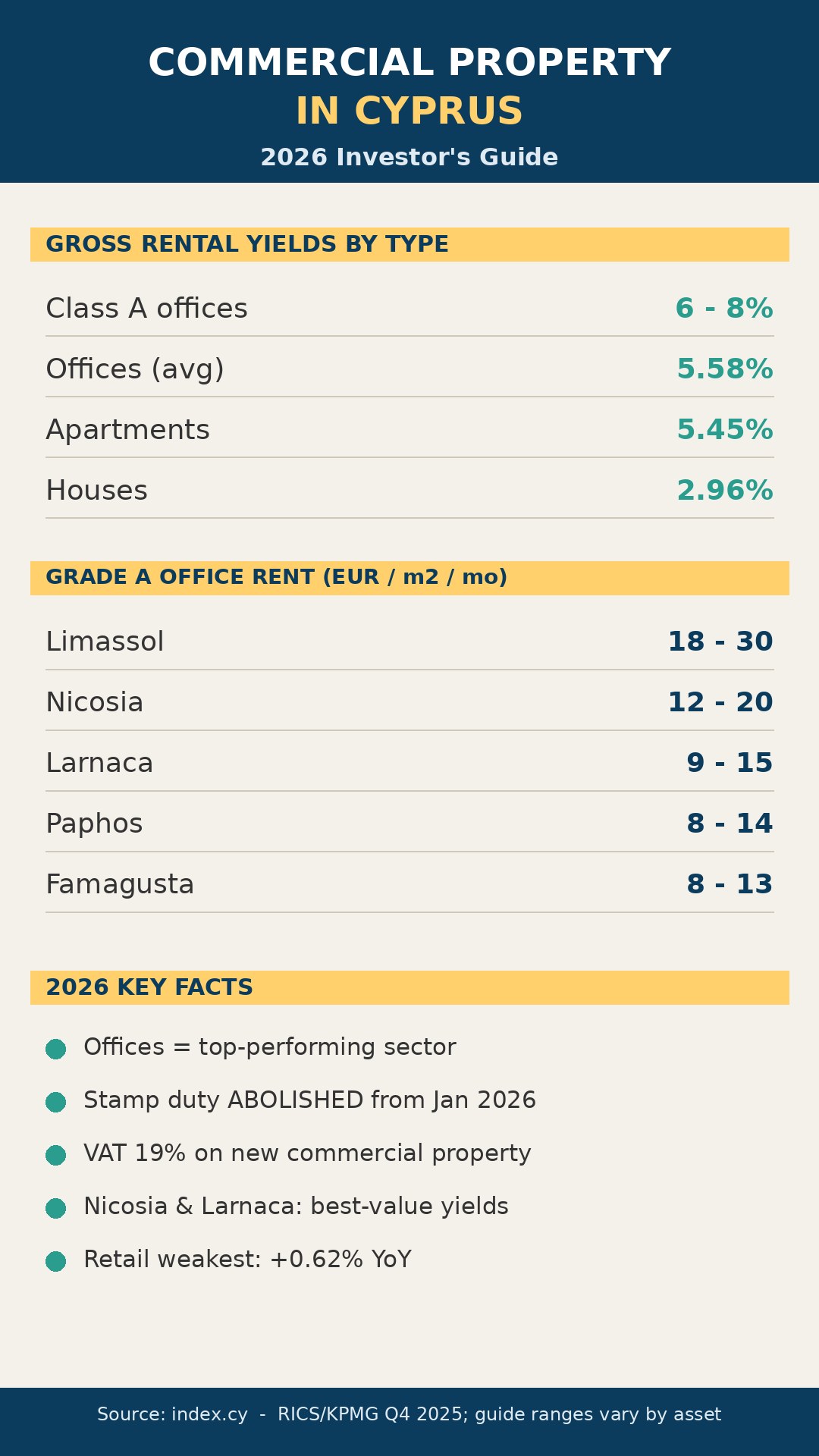
Class A office assets in the strongest locations can produce a stable 6–8% annual return — a meaningful premium over residential, and the core reason investors are rotating capital toward commercial. For the wider context on how commercial fits alongside residential, read our property investment in Cyprus guide.
No segment illustrates the Cyprus commercial story better than offices. The Office sector outperformed every other property category in the RICS index for Q4 2025, and it continued to deliver solid rental-value growth into Q1 2026.
The driver is simple: people follow companies, and companies need buildings. When a mid-sized technology firm relocates 150 staff to Limassol, it needs several thousand square metres of modern office space, parking, and connectivity — and it needs it quickly. The island’s existing stock could not absorb that demand, which pushed rents up and rewarded owners of Grade A buildings.

This has two practical implications for investors. First, quality is everything. A modern, energy-efficient building in a business district will let quickly and hold value; a tired Grade C block in a poor location may sit empty. Second, tenant covenant matters. A five-year lease to an established international company is worth far more than a short lease to an untested startup, because it locks in predictable income.
For buyers priced out of Limassol, Nicosia offers a credible alternative. The capital has the largest office market on the island, driven by government, banking, and professional services, and entry prices are lower — which is why its yields frequently edge out Limassol’s.
Beyond offices, the picture is more selective, and this is where careful analysis separates good deals from value traps.
Retail demands the most caution. With annual value growth of just 0.62% in early 2026 and shifting consumer habits, retail is a stock-picker’s segment. Prime, high-footfall locations tied to tourism or dense residential catchments can still perform, but investors should scrutinise footfall data, tenant mix, and lease terms rather than assume a shop will always let.
Warehousing and logistics is the quieter winner. E-commerce, distribution, and the island’s role as a regional hub have lifted demand for modern industrial space, particularly around Larnaca. Entry prices are lower than prime offices, leases tend to be long, and management is relatively light — an attractive combination for income-focused buyers.
Hospitality assets ride Cyprus’ strong tourism performance but require operational expertise. They suit investors comfortable with running or partnering on a going concern rather than collecting passive rent.
The video below offers a broader look at the Cyprus property market and investment landscape in 2026, useful context whether you are weighing commercial or residential exposure.
The purchase process for commercial property mirrors residential buying but with heavier emphasis on due diligence, because the numbers and the risks are larger.
Non-EU buyers should note that acquiring commercial property, like residential, may require Council of Ministers approval — a routine step your lawyer will handle. Larger commercial or development purchases can also support residency applications; see our Cyprus permanent residence and golden visa guide for the current thresholds.
Understanding the full cost stack is essential to calculating a real net yield rather than a headline gross figure.
The headline change for 2026 is the abolition of stamp duty on property transactions, including commercial agreements — a direct saving on every deal. Cyprus also levies no annual immovable property tax, which keeps holding costs low.
You will, however, need to budget for several other items:
Because commercial VAT treatment and ownership structuring materially affect returns, professional tax advice pays for itself. Our property tax guide covers the framework in more detail, and the wider Cyprus property market 2026 analysis sets out where values are heading.
Every commercial investment carries risk, and honest assessment beats optimism.
The best protection is transparent data. index.cy exists to give buyers a clear, unbiased view of the market — verified listings, real pricing, and comparable properties — so you can decide with evidence rather than pressure.
For income-focused investors, yes — offices yielded 5.58% in late 2025, well above residential, and Class A assets can return 6–8%. Success depends on buying quality space in strong locations with reliable tenants.
Yes. EU citizens buy freely, and non-EU buyers can purchase commercial property subject to routine Council of Ministers approval, which a local lawyer arranges as part of the transaction.
Nicosia and Larnaca often deliver the strongest yields relative to entry price — Nicosia for offices, Larnaca for warehouses — while Limassol offers premium rents at premium prices.
No. Stamp duty on property transactions, including commercial agreements, was abolished from January 2026. You will typically pay 19% VAT on new commercial property or transfer fees on resales.
Browse verified commercial property for sale on index.cy, comparing offices, retail, and industrial space from more than 100 real estate companies across all five districts.