
Property auctions in Cyprus offer one of the few remaining ways to buy real estate below market value on the island. As banks and asset managers work through a large stock of non-performing loans, repossessed apartments, houses, and plots regularly come to auction — often at reserve prices set well beneath what the same property would fetch on the open market. For disciplined investors, discounts of 20–30% are realistic. For the unprepared, an auction can be an expensive mistake.
This guide explains exactly how property auctions in Cyprus work in 2026: who sells at auction, how the process runs, what the new foreclosure rules mean for buyers, the taxes and risks involved, and the due diligence that separates a bargain from a trap. As Cyprus’ #1 property marketplace, index.cy lists verified auction properties across Cyprus alongside 60,000+ conventional listings, so you can compare distressed and open-market pricing side by side.
To understand the opportunity, you need to understand where these properties come from. After the 2013 banking crisis, Cypriot banks accumulated one of the highest ratios of non-performing loans in the eurozone. When borrowers default and restructuring fails, the lender can enforce its mortgage and sell the secured property to recover the debt. That enforcement — foreclosure — is what feeds the auction pipeline.
Two channels dominate the market. The first is the formal foreclosure auction, run under Cyprus’ foreclosure legislation, where a mortgaged property is sold to the highest bidder above a set reserve. The second is the private “real estate owned” (REO) channel, where banks and loan servicers sell properties they have already taken onto their books, either through negotiated sale or their own tender platforms.
The largest sellers are the institutions holding this stock. Bank of Cyprus manages its portfolio through its Real Estate Management Unit (REMU), while specialist servicers such as Altamira (part of the doValue group) and Gordian handle vast loan and property portfolios on behalf of lenders. Together they control thousands of properties, which is why property auctions in Cyprus remain a structural feature of the market rather than a rare event.
The mechanics of a foreclosure auction are set out in law, and knowing them protects you from surprises.
Once a lender decides to enforce, it must serve formal notices on the borrower and any guarantors. Independent valuers — one appointed by the bank, one by the borrower — assess the property’s market value. From that valuation, a reserve price is set at no less than 80% of market value, and the auction notice must be published at least 30 days before the sale date. This transparency is deliberate: it gives buyers time to inspect, research, and arrange finance.
Auctions are increasingly conducted online through electronic platforms, which has opened the market to remote and foreign bidders who no longer need to attend in person. To take part, you generally must:

That final point is critical. Auction purchases are not conditional on financing, so you need cash or pre-approved lending in place before you bid. If you win and cannot complete, you can forfeit your deposit. Anyone weighing borrowing should first read our guide to financing a property purchase in Cyprus.
The rules around foreclosures changed materially in 2026, and every auction buyer should understand the direction of travel. In April 2026, the House of Representatives passed a package of reforms that strengthened protections for distressed borrowers.
The headline measure is a temporary suspension of foreclosure proceedings against primary residences where the outstanding secured debt does not exceed €350,000, in force until 31 December 2026. Creditors must now give at least 45 days’ written notice before starting any foreclosure step, and banks can no longer demand extra collateral or guarantees simply to begin restructuring talks. You can read the wider legal context in this analysis of Cyprus foreclosure law changes for 2026 and in coverage from the Cyprus Mail.
For buyers, the practical effect is a shift in what comes to auction. Protected primary homes under the threshold are largely off the table for now. What remains available — and often more freely — are investment properties, second homes, commercial units, plots of land, and properties held by companies, none of which enjoy the primary-residence shield. If your strategy is buy-to-let or commercial, the reforms narrow the supply of family homes but leave your target segments broadly open. index.cy also tracks the debtor-side of this story in our article on foreclosure court reform in Cyprus, useful background on how contested this area has become.
The reason investors follow auctions is price. Properties sold through auctions and bank tenders typically transact at 20–30% below open-market averages, and occasionally more where a lender is motivated to clear stock or a lot attracts few bidders. Because the reserve is anchored to 80% of an independent valuation, there is a built-in floor — but competition on desirable lots can push the final price back toward market value, so the deepest discounts tend to appear on harder-to-sell properties.
That is both the opportunity and the catch. The bargains often carry complications: an older apartment needing renovation, a plot with access issues, or a property still occupied by former owners. Value at auction is rarely “free money” — it is compensation for taking on complexity that ordinary buyers avoid. Investors who can price and manage that complexity capture the margin.
The table below summarises how auction pricing typically compares with the open market across the main districts. Treat these as guide ranges — every lot is different, and the only reliable figure is the one your own valuation produces.
| District | Open-market apartment (€/m²) | Typical auction discount | Best-suited buyer |
|---|---|---|---|
| Limassol | €4,500–8,000 | 15–25% | Cash investors, renovators |
| Paphos | €2,200–3,000 | 20–30% | Buy-to-let, holiday lets |
| Larnaca | €2,000–3,200 | 20–30% | Value investors |
| Nicosia | €1,700–2,400 | 25–35% | Long-term rental, first buyers |
| Famagusta | €2,000–3,000 | 20–30% | Emerging-market investors |
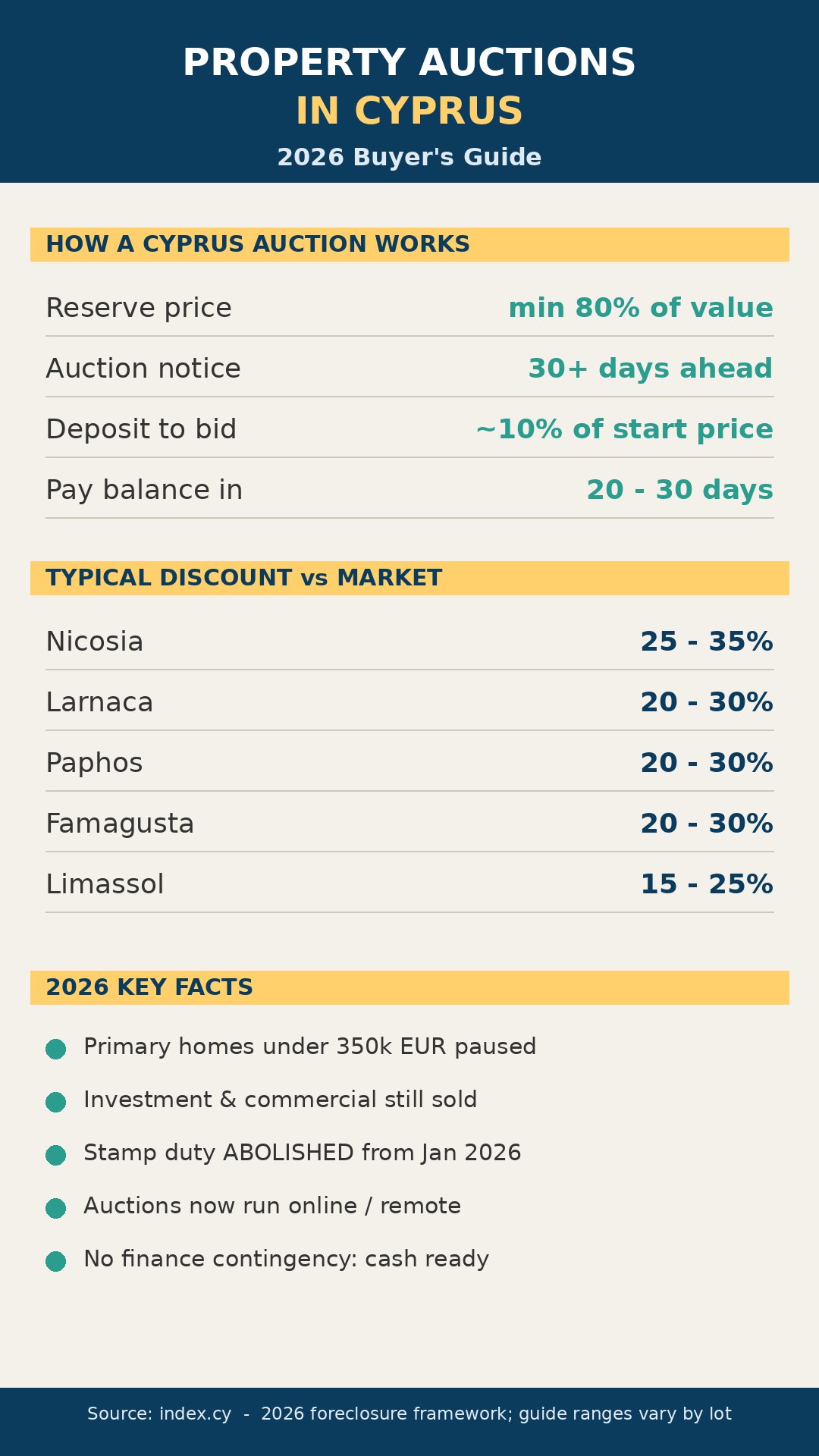
Nicosia, with lower headline prices and less foreign competition, frequently offers the widest gap between auction and open-market value. For context on where prices sit today, our property investment in Cyprus guide and the Cyprus property market 2026 analysis set out the fundamentals district by district.
Because auction sales are final and rarely come with the warranties of a conventional purchase, due diligence is not optional — it is the whole game. The following checks should be complete before you place a single bid.
Engaging an independent Cyprus property lawyer early is essential. A specialist verifies ownership, reviews the auction terms, and flags risks that are invisible from the listing. For a fuller framework, read our comprehensive due diligence guide.
The video below offers a broader look at buying real estate in Cyprus and the checks every buyer should make — helpful context whether you pursue auctions or the open market.
The winning bid is not your total cost. Budget for the full stack before you calculate a real return.
The most welcome change for 2026 is the abolition of stamp duty on property transactions from 1 January 2026, which removes a cost that used to apply to every purchase agreement. Cyprus also levies no annual immovable property tax, keeping holding costs low. You will, however, still face several charges:
Our Cyprus property tax guide breaks these down in detail. Foreign buyers should also note that non-EU nationals typically need Council of Ministers approval to acquire property — a routine step your lawyer handles. EU citizens buy freely. If you are relocating as well as investing, our guide to buying property in Cyprus as a foreigner covers residency and the wider process.
Auctions reward preparation and punish haste. The upside — buying below market — is real and repeatable for investors who do the work. But the risks are equally real, and honesty about them is the mark of a serious buyer.
The biggest risks are occupancy (a property you cannot use or let immediately), condition (repair bills that erode the discount), title complications, and the no-finance-contingency structure that demands ready capital. Add the possibility that a hotly contested lot sells near market value, and it becomes clear that auctions are not a guaranteed bargain — they are a channel where informed buyers can find one.
If you want the discount without the full auction risk, the private REO and bargain channels are a gentler entry point. index.cy aggregates affordable stock in one place, from cheap houses and villas to budget apartments, letting you compare distressed and discounted properties against live market prices without the pressure of a bidding deadline. Whichever route you choose, the principle is the same: buy on evidence, not on the promise of a headline discount.
Auction and bank-tender properties typically sell 20–30% below open-market averages, occasionally more on hard-to-sell lots. Because the reserve is set at no less than 80% of an independent valuation, there is a price floor, and competition on desirable properties can narrow the discount.
Yes. EU citizens buy freely, and non-EU nationals can bid subject to routine Council of Ministers approval, which a local lawyer arranges. Many auctions now run on electronic platforms, so overseas buyers can register and bid remotely.
You generally lodge a security deposit of around 10% of the lot’s starting price to take part, then pay the balance within roughly 20–30 days of winning. Auction purchases are not conditional on financing, so arrange funds before you bid.
No. The reforms suspended foreclosures on primary residences with debt up to €350,000 until the end of 2026, but investment properties, second homes, commercial units, land, and company-owned properties are not protected and continue to come to auction.
Browse verified auction properties in Cyprus on index.cy, where distressed and bank-owned listings sit alongside 60,000+ conventional properties so you can compare pricing openly across all five districts.