
Thinking about living in Nicosia? Cyprus’ capital is the island’s contrarian choice — the one major city without a coastline, and precisely because of that, the one place where you get real Cypriot life, the strongest job market on the island, and the lowest big-city rents, all at once. While expats flock to Limassol and Paphos for the sea, Nicosia quietly offers something the coastal cities can’t: a working capital with universities, embassies, headquarters, and a walled old town that has been lived in for a thousand years.
This guide breaks down exactly what life in Nicosia costs in 2026, which neighborhoods suit different budgets, what the property market looks like, and the honest pros and cons of making the capital your home. Every figure here is backed by current market data so you can decide with confidence.
Nicosia (Lefkosia in Greek) is the capital and largest city of Cyprus, with roughly 200,000 people in its metropolitan area. It sits almost dead center on the island, and it is the last divided capital in Europe — the UN buffer zone, or Green Line, still runs through the historic core. That history gives the city a texture you won’t find on the coast: Venetian walls, restored Ottoman-era lanes, and a genuinely multicultural, working population rather than a seasonal tourist crowd.
The people who move to Nicosia tend to have a reason beyond a sea view. It is the administrative and business heart of Cyprus, home to government ministries, the biggest banks and law firms, and the University of Cyprus. If you want a career on the island rather than remote income or a retirement, this is where the jobs are. Add the most affordable housing of any major Cypriot city and a deeply authentic day-to-day rhythm, and the appeal becomes clear.
English is widely spoken, the international community is well established through the universities and embassies, and the city is compact enough to feel human-scaled. For students, professionals, families relocating for work, and buyers chasing rental yield, Nicosia makes a strong case.
Nicosia is the most affordable of Cyprus’ three largest cities. It has the lowest average rents of the major urban centers — a two-bedroom apartment in the capital typically rents 25–35% below an equivalent unit in Limassol. That gap is the single biggest financial reason people choose the capital over the coast.
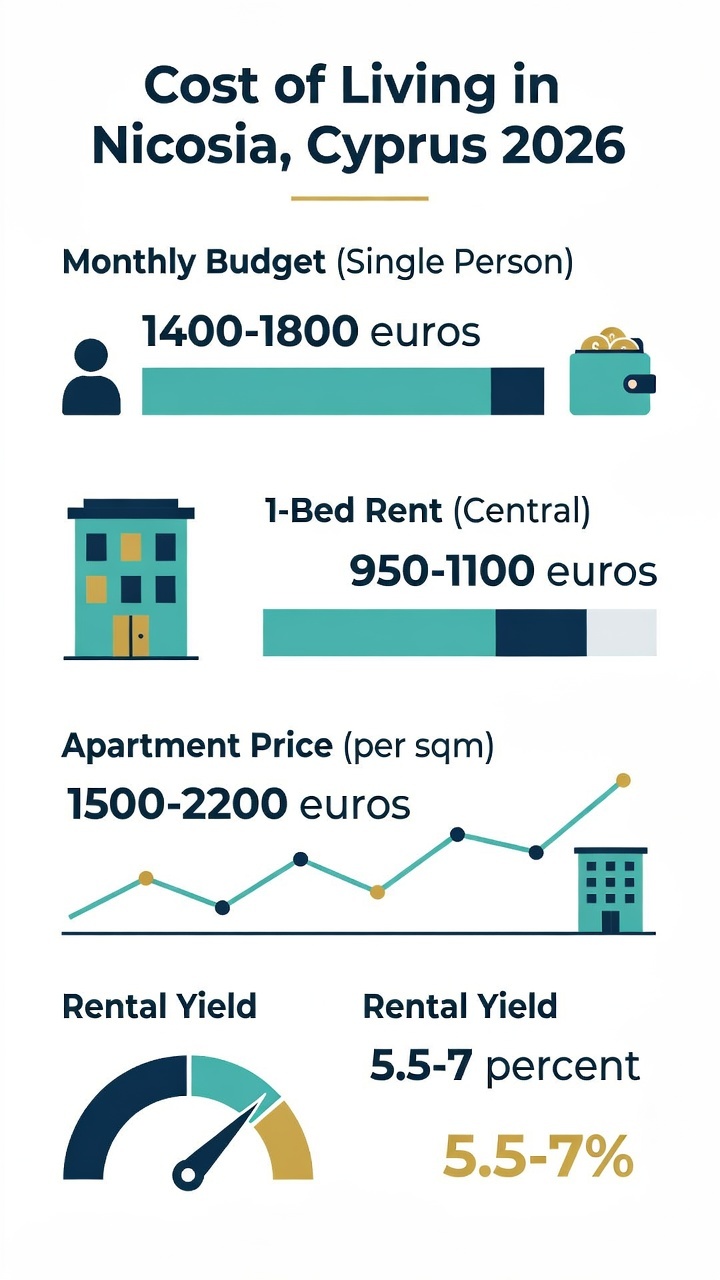
For a realistic 2026 monthly budget, a single professional lives comfortably on €1,400–€1,800, while a couple can live well on €2,200–€2,800. These figures cover rent, food, transport, healthcare, and leisure — a genuinely comfortable life, not a bare-bones one. Most of the variation comes down to how central your apartment is and how heavily you run the air conditioning in summer.
Here is how a typical single-person monthly budget breaks down:
| Expense | Monthly cost (2026) |
|---|---|
| Rent (1-bed, central) | €950–€1,100 |
| Rent (1-bed, outside center) | €750–€850 |
| Utilities (electric, water, cooling) | €90–€170 |
| Groceries | €230–€320 |
| Transport | €50–€120 |
| Internet (fiber) | €30–€45 |
| Leisure & dining out | €150–€300 |
Utilities are the seasonal wildcard. Nicosia is the hottest city in Cyprus in July and August, and running air conditioning through the peak weeks can push a summer electricity bill toward the top of that range. Groceries for one person run about €55–€80 per week, covering fresh produce, meat or fish, dairy, and household basics. You can compare the capital against other European cities on the crowdsourced Numbeo cost-of-living index for Nicosia.
Where you live shapes both your budget and your daily rhythm. Nicosia’s neighborhoods range from the restored old city inside the Venetian walls to leafy family suburbs, so match the area to your lifestyle.
The prestige addresses. Engomi clusters around embassies, the University of Cyprus, and the central business district, and it commands the highest prices in the city — anywhere from €2,800 to €4,200 per square meter. Neighboring Makedonitissa is quieter and favored by families for its proximity to international schools. If budget allows and you want the smoothest professional life, this is the premium end.
Strovolos is the largest municipality in Nicosia and the go-to for families — spacious, well-served by schools and shops, and offering better value per square meter than Engomi. Aglantzia, close to the university and the Athalassa National Forest Park, blends green space with easy access to the center and is another strong family and professional pick.
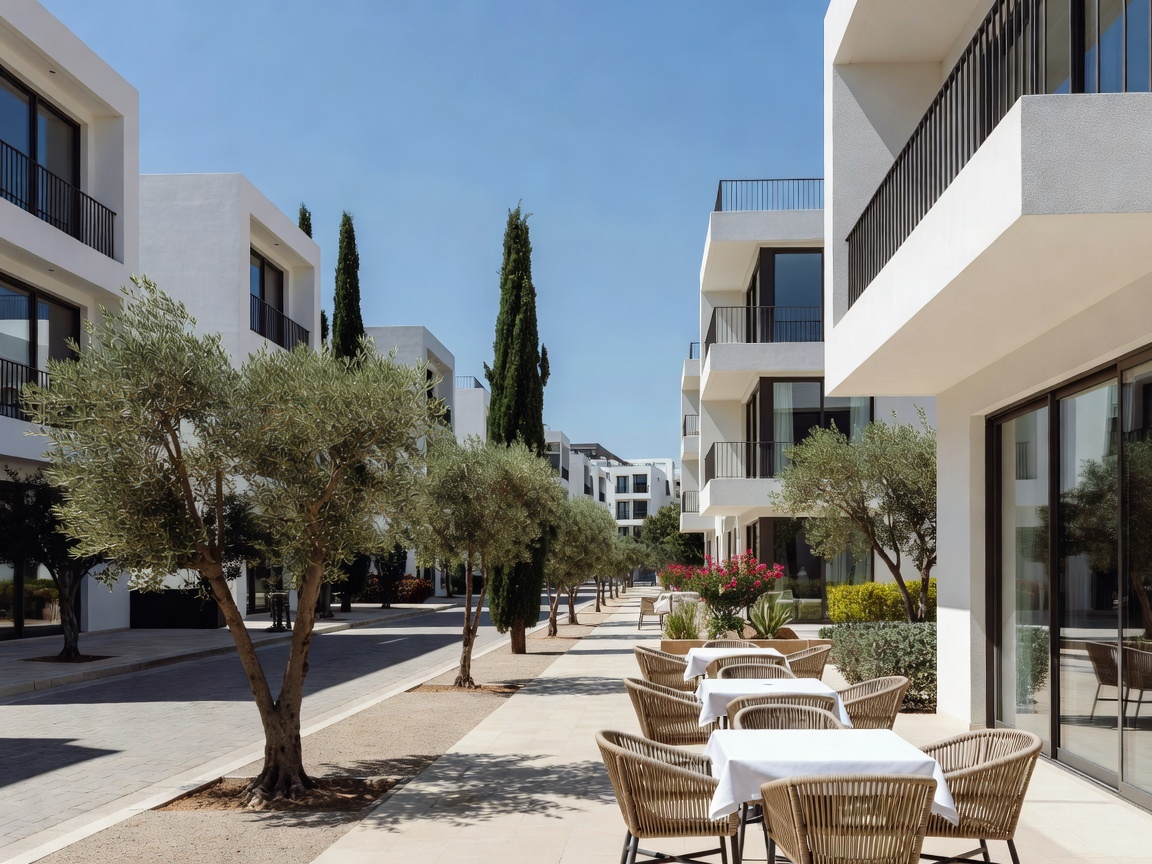
For buyers priced out of Engomi, Agios Dometios is a close-in district that still offers relative value while connectivity keeps improving. Ayios Omologites, wedged near the business districts, is a lively, central choice popular with professionals who want to walk to work and enjoy a blend of traditional charm and modern apartments.
Inside the walls, the restored old city rewards those who want character — historic townhouses, courtyards, and a walkable, café-rich core. Just outside, Kaimakli and Pallouriotissa are among the most affordable areas, at roughly €1,500–€2,000 per square meter, and are steadily gentrifying as younger buyers and renovators move in.
If you’re considering buying rather than renting, the capital offers something the coast rarely does: value plus yield. The median home in Nicosia sits around €220,000 in 2026 — roughly 15% below the average for Cyprus’ coastal cities. Apartments in central and established zones run €1,500–€2,200 per square meter, while newer suburban developments range from €1,300–€1,800.
The market is nuanced. Apartments are appreciating at roughly 2–5% a year, with newer, energy-efficient units in well-connected areas leading the gains, while houses and villas have softened slightly. Around 80% of residential transactions land between €190,000 and €500,000, depending on type, size, and neighborhood.
For investors, the standout number is rental yield. Well-positioned 2-bedroom apartments in Nicosia typically deliver gross yields of 5.5–7% — competitive with Limassol’s 4.5–6% and well above most Western European capitals. Steady tenant demand from students, civil servants, and professionals underpins that income.
| Property type | Typical Nicosia price (2026) |
|---|---|
| Median home | ~€220,000 |
| Central / established apartment | €1,500–€2,200 / m² |
| Suburban new-build apartment | €1,300–€1,800 / m² |
| Premium (Engomi, Makedonitissa) | €2,800–€4,200 / m² |
| Gross rental yield (2-bed) | 5.5–7% |
To explore what’s on the market, browse current properties for sale in Nicosia or check new developments and complexes in Nicosia. For a data-backed view of what you should be paying, our average 2-bedroom apartment prices for Nicosia page tracks the real numbers, and our Nicosia property market guide goes deeper on trends. Before committing to any purchase, an instant property report helps you verify a listing is fairly priced.
Nicosia’s inland position defines its character in every season. With more than 300 days of sunshine a year, it shares the island’s famous climate — but without a coast, the summers bite harder. July and August regularly exceed 40°C, and with no sea breeze, the heat lingers into the evening. Air conditioning isn’t a luxury here; it’s built into daily life and your utility budget. Winters, by contrast, are the coolest of the major cities, with nighttime temperatures that can dip toward 5°C.
What Nicosia lacks in beaches it makes up for in substance. This is the cultural and intellectual capital: the University of Cyprus anchors a large student population, the museums and galleries are the island’s best, and the pedestrianized Ledra Street and Zaha Hadid–designed Eleftheria Square give the center real energy. The food scene runs from traditional tavernas to a growing wave of modern restaurants and specialty coffee, and the old city’s restored quarters buzz after dark with a local, unpretentious crowd rather than tourists.
Take a walk through the capital’s historic old city in this recent tour of Nicosia:
Nicosia is compact, and if you live centrally you can handle much of daily life on foot or by bike. Beyond the core, though, a car is the norm. Public buses cover the city but run infrequently, so most residents in the suburbs drive — and parking and rush-hour traffic around the center are the city’s genuine daily frustrations.
The obvious catch is that Nicosia has no airport of its own. Larnaca International Airport is about 40–45 minutes away by car and handles most travel, with Paphos Airport roughly 90 minutes out. The upside of the central location is that no part of Cyprus is far: you can reach the Larnaca coast in well under an hour, and Limassol or Troodos mountain villages in around an hour, making day trips to the sea entirely realistic even without living beside it.
No city is perfect, and honest expectations make for happier residents. Here’s the balanced view.
The advantages:
The trade-offs:
The calculus is straightforward: if you want a career on the island, a family base with good schools, or a high-yield investment at an affordable entry price, Nicosia is hard to beat. If a daily swim and a beachfront lifestyle are non-negotiable, a coastal city will suit you better.
Living in Nicosia offers a combination the coastal cities can’t match: the island’s best job market, its most affordable big-city housing, strong rental yields, and a culturally rich, authentically Cypriot daily life. For professionals, families, students, and yield-focused investors, the capital is one of the smartest-value moves in Cyprus in 2026.
Here are the key takeaways to carry forward:
If Nicosia is on your shortlist, start by exploring properties for sale in Nicosia and long-term rentals in the capital, or read our broader guide to relocating to Cyprus. For a deeper look at buying in the capital, see our apartments for sale in Nicosia guide. When you find a property you like, book a professional property inspection to make sure you know exactly what you’re buying. With the right data behind you, making Nicosia home is simpler than you might think.