
If you own property in Cyprus, or you are set to inherit some, the first question is almost always the same: how much inheritance tax will the family pay? The short answer is reassuring. Cyprus has no inheritance tax. The government abolished estate duty in 2000, and there is no gift tax and no wealth tax on what you leave behind either.
That makes Cyprus one of the most tax-efficient places in Europe to pass property to the next generation. But tax is only half the story, and it is not the half that trips people up. The rule that actually decides who gets your Cyprus home is forced heirship — a part of the Wills and Succession Law that reserves a fixed share of your estate for close family, whatever your will says.
At index.cy, Cyprus’ #1 real estate marketplace, we help buyers, owners and heirs understand the real costs and rules behind property here. This guide explains what “no inheritance tax” really means in 2026, how forced heirship works, how foreign owners can override it, and exactly how an inherited property passes into your name.
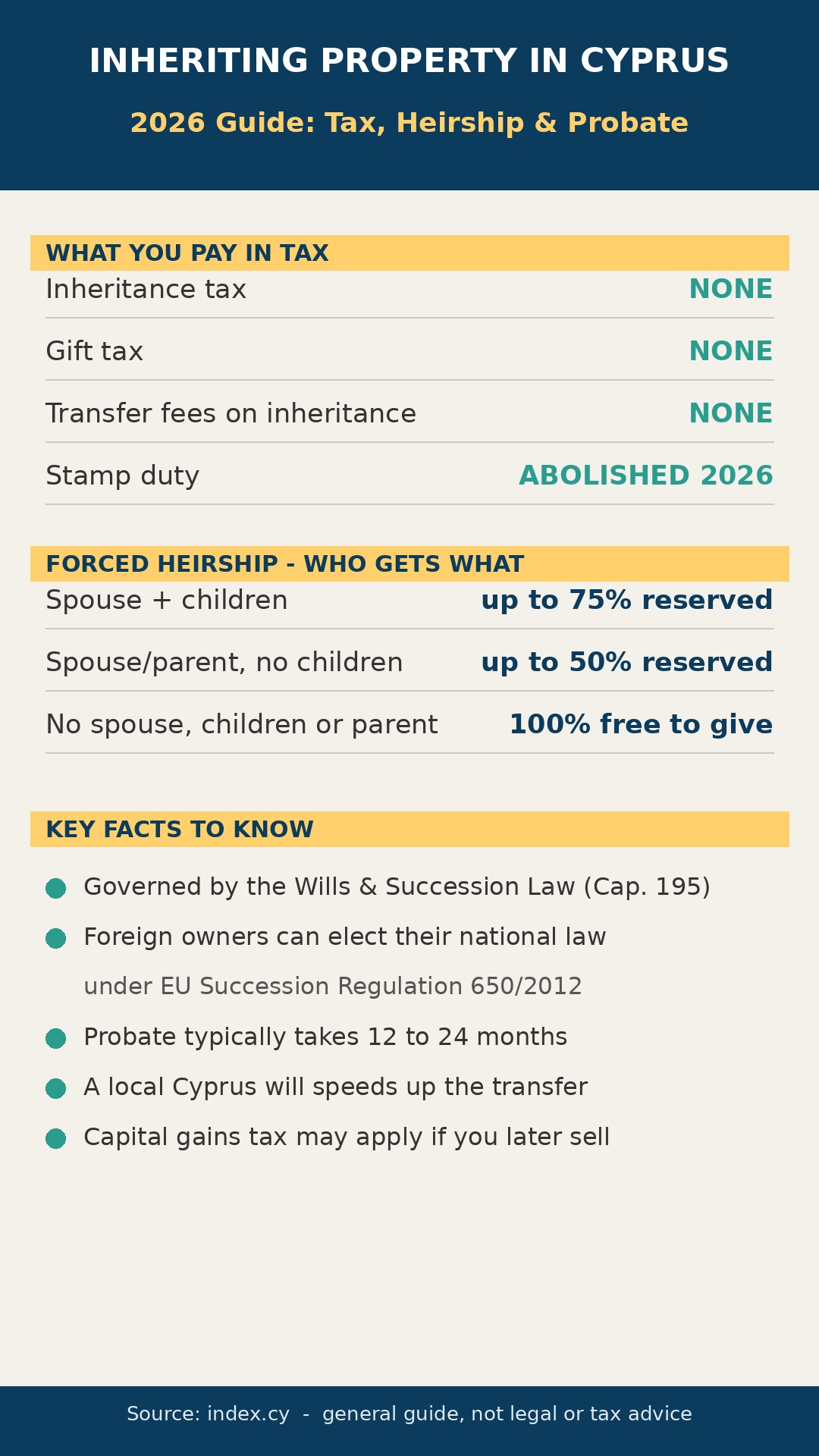
No. There is no inheritance tax, estate tax or death duty in Cyprus. The Estate Duty (Amending) Law abolished the charge in 2000, and successive governments have kept the position unchanged, including through the 2026 tax reforms.
In practical terms, this means:
This is a genuine advantage over many buyers’ home countries. In the United Kingdom, for example, estates above the nil-rate band can face inheritance tax at 40%. A Cyprus villa passing to the children is not touched by any equivalent charge.
There is one important caveat for planning. “No inheritance tax” applies to what Cyprus charges. If you remain tax-resident or domiciled elsewhere, your home country may still tax your worldwide estate, including your Cyprus property. British nationals, in particular, should check their UK domicile position, because UK inheritance tax can follow domicile rather than residence. This is where professional cross-border advice earns its fee.
Here is what surprises most owners. Even with zero inheritance tax, you may not be free to leave your Cyprus property to whoever you choose. Succession is governed by the Wills and Succession Law (Cap. 195), which applies a system of forced heirship.
The law splits every estate into two parts. The statutory portion is reserved by law for close family — your spouse, children and their descendants — and cannot be given away by will. The disposable portion is the share you are free to leave to anyone you like. The size of each depends on who survives you.
| Who survives you | Reserved (statutory) portion | Disposable portion |
|---|---|---|
| A spouse and a child (or descendant of a child), or a child but no spouse | Up to 75% | Up to 25% |
| A spouse and/or a parent, but no child or descendant | Up to 50% | Up to 50% |
| No spouse, no child or descendant, and no parent | None | 100% — full freedom |
So an owner survived by a spouse and children can freely dispose of only a quarter of the estate by will. The remaining three-quarters must pass to the reserved heirs in the shares the law sets. If you write a will that tries to give away more than your disposable portion, the excess is cut back to protect the statutory heirs.
This is very different from the “leave it to whoever you want” freedom that buyers from the UK, Ireland or the US often assume. For a Cypriot family, forced heirship usually reflects what they intended anyway. For a foreign owner with a blended family, a preferred charity, or an unmarried partner, it can produce an outcome they never wanted. Fortunately, as we explain below, foreign nationals have a legal route around it.
If a property owner dies without a valid will, they die intestate, and the estate is distributed entirely according to the statutory rules in Cap. 195. There is no freedom at all — the law decides.
The estate passes to classes of relatives in order of priority. In broad terms:
Intestacy is rarely the outcome anyone would have chosen. It can force a jointly owned home to be shared between a surviving spouse and children who may not agree on whether to keep or sell it. For anyone who owns Cyprus property, making a will is the single most effective step to keep control and avoid disputes. Our guide to navigating taxes and legalities in Cyprus real estate walks through where estate planning fits into the wider ownership picture.
This is the most important section for expat and international owners. Since 17 August 2015, cross-border succession in the EU has been shaped by the EU Succession Regulation 650/2012, widely known as Brussels IV.
The Regulation’s default rule is that your succession is governed by the law of your country of habitual residence at death. But it also gives you a powerful choice. You can expressly elect, in your will, that the law of your nationality governs your estate instead.
For a foreign owner of Cyprus property, that election is the key that unlocks testamentary freedom. A British national, for instance, can state in their will that English law applies to their estate. English law has no forced heirship, so the owner can then leave their Cyprus villa exactly as they wish — to a spouse, a partner, stepchildren, or a charity — free of the Cap. 195 reserved-portion rule. Cyprus courts recognise a properly made choice of law under the Regulation.
Three points make this work in practice:
If you are buying in Cyprus as a non-resident, estate planning belongs on your checklist from day one. Our guide to buying property in Cyprus as a foreigner covers the wider process, and a will with a clear choice of law should be part of it.
When an owner dies, their Cyprus property does not pass to the heirs automatically. The estate has to go through probate — the court-supervised process of proving the will, settling debts, and transferring assets. Succession administration is governed by the Administration of Estates Law (Cap. 189).
The main steps look like this:
How long does it take? Probate in Cyprus typically runs 12 to 24 months, depending on the complexity of the estate and how busy the District Court is. A clear, locally registered will shortens the process significantly; a missing or contested will, or assets spread across several countries, lengthens it.
Because the property cannot be sold or remortgaged until title is transferred, getting the paperwork right early matters. Before you inherit or buy, it is worth understanding the condition and legal status of the property itself — an independent property inspection and an instant property report can flag issues with title, permits or structure that would otherwise surface at the worst possible moment.
With no inheritance tax, the cost of inheriting a Cyprus property is far lower than in most European countries. But “no inheritance tax” does not mean “free.” Here is the realistic picture in 2026.
No inheritance tax. There is nothing to pay on the value of the estate itself.
No transfer fees on inheritance. When title passes to heirs by way of inheritance, the standard Land Registry property transfer fees do not apply. This is a meaningful saving, because on an ordinary purchase those fees run at 3% on the first €85,000 of value, 5% on €85,001–€170,000, and 8% above €170,000. Our dedicated guide to property transfer fees in Cyprus explains how they work on a normal sale.
No stamp duty. Stamp duty was abolished across Cyprus on 1 January 2026, removing another cost that once applied to property-related documents.
Professional and court costs still apply. The real expenses of inheritance are the practical ones: legal fees for the probate application, court fees, the cost of drafting or registering the will, valuation of the estate, and administration. These vary with the size and complexity of the estate, but they are modest compared with an inheritance tax bill.
Costs after you inherit. Once the property is yours, ordinary running costs resume — municipal fees, communal charges, and utilities. If you later sell, capital gains tax may apply to the gain, so it is worth understanding the base cost you inherit at. If you rent the property out, rental income becomes taxable in the usual way, as our Cyprus property tax guide explains.
Whether you already own or are about to buy, a few deliberate steps protect your family and your wishes:
If you are still choosing a property, browsing the market with succession in mind is smart. You can explore houses for sale in Cyprus and villas for sale in Cyprus on index.cy, where every listing is verified and there is no commission bias steering you toward one property over another.
No. Cyprus abolished inheritance tax (estate duty) in 2000, and the position is unchanged in 2026. There is also no gift tax and no wealth tax. Heirs pay no Cyprus tax on the value of what they inherit.
Not automatically. The Wills and Succession Law reserves a statutory portion of your estate for close family through forced heirship — up to 75% where you leave a spouse and children. However, a foreign national can elect the law of their nationality under the EU Succession Regulation to override forced heirship and dispose of their estate freely.
Typically 12 to 24 months, depending on the estate’s complexity and the District Court’s workload. A clear, locally registered will can shorten the process considerably.
No. The standard Land Registry transfer fees that apply to a normal purchase do not apply when property passes to heirs by inheritance. Professional, court and administration costs still apply, but they are far lower than an inheritance tax charge.
Yes, in most cases. A Cyprus will covering only your Cyprus assets keeps the local property out of a foreign probate, speeds up transfer, and gives the Land Registry a clear instruction. Pair it with an express choice of law if you want to override forced heirship.
This guide is general information, not legal or tax advice. Inheritance and succession outcomes depend on your nationality, residence, domicile and family circumstances. Always consult a qualified Cyprus lawyer and a cross-border tax adviser before making a will or acting on an inheritance. Authority sources: PwC Cyprus Tax Summaries and the European Union guide to cross-border inheritance.