
Stamp duty in Cyprus has changed more in one legislative stroke than in the previous six decades. As of 1 January 2026, the tax that buyers paid to “stamp” their property contracts no longer applies. If you are purchasing a home or investment property this year, that is one line item you can remove from your budget.
But the picture is not quite as simple as “stamp duty is gone.” The reform hinges on a single date, older contracts still follow the old rules, and several other property costs remain fully in force. This guide explains exactly what stamp duty in Cyprus was, what the 2026 abolition means, and what buyers still need to plan for.
At index.cy, Cyprus’ #1 real estate marketplace, our goal is to give you the facts so you can budget with confidence — no guesswork, no hidden costs.
Stamp duty in Cyprus was a documentary tax levied on written agreements and legal instruments, including property sale contracts. It was not a tax on the property itself. It was a tax on the document that recorded the transaction.
For property buyers, stamp duty appeared at the contract stage. When you signed a sale agreement and lodged it with the Land Registry, that contract had to be stamped by the Tax Department within 30 days of signing. An unstamped contract could not be produced as evidence in court and could face penalties before it was accepted for registration.
The duty was calculated on the contract value, using a tiered rate. It was separate from VAT, separate from transfer fees, and separate from any annual property taxes. In short, it was one of several transaction costs that shaped the true price of buying property in Cyprus.
The headline change is straightforward. Under Law 239(I)/2025, the Cyprus Stamp Duty Laws of 1963 to 2025 were repealed with effect from 1 January 2026. Documents executed from that date are no longer subject to stamp duty under the old regime.
This applies directly to property sale contracts. If your agreement is signed on or after 1 January 2026, no stamp duty is due on it. The Department of the Registrar of Companies and Intellectual Property has also confirmed that documents submitted to it no longer require stamping from the same date.
The reform is part of Cyprus’ wider 2026 tax modernisation package, designed to reduce transaction friction and align the country with more competitive European markets. For a property buyer, the practical result is fewer formalities and a cleaner contract-signing stage. One mandatory cost and one administrative step have simply disappeared.
For context, this sits alongside the other property taxes buyers should understand. Our guides to VAT on property in Cyprus and property transfer fees cover the costs that remain in place.
To understand what buyers are saving, it helps to see the old system. Before 2026, stamp duty on a property contract was calculated on a tiered scale based on the contract value.
| Contract value | Stamp duty rate |
|---|---|
| Up to €5,000 | 0% (nil) |
| €5,001 – €170,000 | 0.15% |
| Above €170,000 | 0.20% |
| Maximum per contract | Capped at €20,000 |
Consider a €300,000 apartment purchase under the old rules. The first €5,000 was free. The portion from €5,001 to €170,000 was taxed at 0.15%, producing roughly €247. The remaining €130,000 above the €170,000 threshold was taxed at 0.20%, adding €260. The total stamp duty came to about €507.
For a €1,000,000 villa, the bill rose to roughly €1,908. The €20,000 cap only affected very high-value contracts — those above €10 million. Most residential buyers paid a few hundred to a few thousand euros.
These amounts were never the largest cost in a purchase, but they were real money and one more thing to remember. From 2026, they are gone for new contracts.
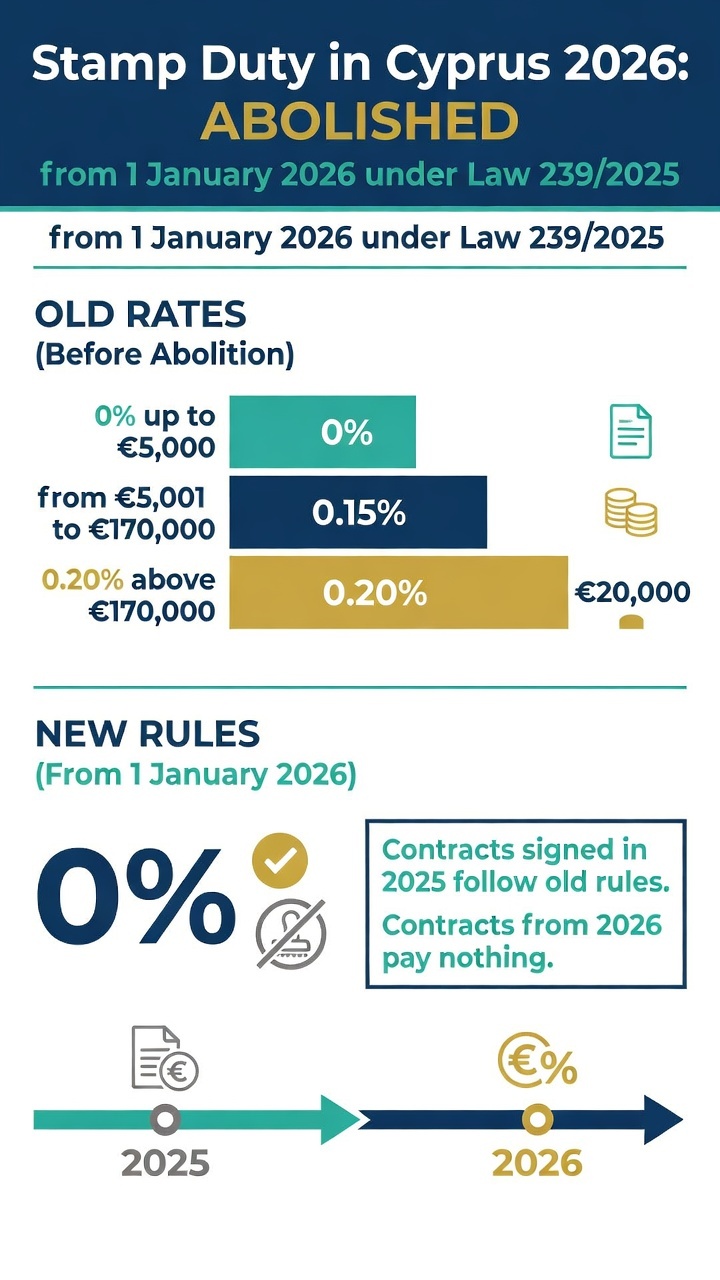
Here is the detail that matters most for anyone whose transaction straddles the year-end. The abolition of stamp duty in Cyprus turns on the execution date of the document — the day it is drawn up and signed — not the completion date.
Contracts executed on or after 1 January 2026: stamp duty is abolished. No duty applies under the repealed regime.
Contracts signed up to 31 December 2025: these generally remain under the previous rules, even if the sale completes in 2026. A document signed by at least one contracting party before the cut-off still falls within the old framework.
So a buyer who signed a reservation and sale contract in December 2025 but completes the purchase in spring 2026 is still working under the old stamp duty rules. Timing, not intent, drives the outcome. If you are coordinating a signing across borders, in counterparts, or on different dates, align the mechanics early with your lawyer so there is no ambiguity about when the contract was executed.
This nuance is especially relevant for international buyers and corporate structures, where documentation sets are larger and signing can happen in several places at once. Before making any assumptions, it is worth confirming the exact position for your specific contract.
For most buyers, the change is unambiguously good news. Here is how it plays out in practice.
Lower upfront friction. Stamp duty was a compliance step tied to the contract. Removing it means fewer formalities and a smoother signing stage — particularly welcome for first-time buyers navigating a Cyprus purchase for the first time.
Simpler budgeting. A property purchase involves several line items: legal fees, banking costs if you are financing, Land Registry steps, insurance, and — depending on the deal — VAT or transfer fees. With stamp duty out of the picture, the contract-stage budget is cleaner and easier to forecast.
Smoother cross-border transactions. International buyers who sign remotely or in counterparts benefit from having one fewer Cyprus-specific documentary step to manage. The workflow is simply lighter.
None of this changes the fundamentals of buying well. You still need to confirm the property is fairly priced, the title is clean, and the seller can deliver what they promise. Our comprehensive due diligence guide walks through the checks that protect your investment — checks that matter far more than the modest stamp duty ever did.

Stamp duty abolition simplifies the contract stage. It does not remove the main taxes and fees that shape the total cost of a purchase. Buyers should still plan carefully around three areas.
VAT on new property. VAT is one of the most important cost areas for buyers of new-build property. The standard rate is 19%, with a reduced 5% rate available on a qualifying primary residence up to certain thresholds. VAT treatment depends on the property type, how the transaction is structured, and your circumstances — so it is worth clarifying early. See our full guide to VAT on property in Cyprus for the detail.
Transfer fees on resale property. Transfer fees are separate from stamp duty and remain in place. They typically apply to resale properties where VAT was not paid, and are calculated on a tiered scale with a 50% reduction that has applied to many transactions. Our property transfer fees guide explains how they are calculated and when they apply.
Legal and due diligence costs. Contract drafting, legal searches, title deed checks, and deposit handling all continue as before. If you later sell, capital gains tax may apply to the profit. None of these are affected by the stamp duty reform.
The video below offers a helpful overview of the taxes and fees involved in a Cyprus property purchase for buyers planning their budget.
Once you understand the full cost picture, you can browse the market with clarity. index.cy lists apartments for sale across Cyprus and properties in Limassol, with verified listings from more than 100 companies.
If you signed a contract or any legal document before the end of 2025, there is one more practical change to know about. From 1 April 2026, the Cyprus Tax Department introduced a new procedure for stamping original documents that still fall within the old regime.
These legacy documents are now handled through the Tax For All (TFA) system before being presented to the relevant District Offices of the Tax Department. In other words, the compliance route has changed even though the underlying obligation for pre-2026 documents has not.
For property buyers, this mainly affects those whose contracts were signed in 2025 but not yet stamped. If that is your situation, the document still needs to be dealt with under the previous stamp duty rules, using the new administrative process. When timing or structure is not straightforward, a document-by-document review with a professional is the safest approach.
Is stamp duty abolished in Cyprus? Yes. Cyprus repealed the Stamp Duty Laws of 1963 to 2025 under Law 239(I)/2025, effective 1 January 2026. Documents executed from that date, including property sale contracts, are no longer subject to stamp duty under the old regime.
How much was stamp duty in Cyprus before 2026? It was charged on the contract value: nil up to €5,000, 0.15% from €5,001 to €170,000, and 0.20% above €170,000, capped at €20,000 per contract. A €300,000 purchase attracted roughly €507.
I signed my contract in 2025 but complete in 2026 — does stamp duty apply? Generally yes. The key factor is the execution date. Documents signed up to 31 December 2025 usually remain under the previous rules, even if completion happens later.
Does the abolition change VAT or transfer fees? No. VAT and transfer fees are separate regimes and still apply. Stamp duty abolition only removes the documentary tax at the contract stage.
Who benefits most from the change? International buyers signing remotely, corporate buyers with larger documentation sets, and anyone combining a property purchase with relocation or investment planning all benefit from the simpler process.
The abolition of stamp duty in Cyprus from 1 January 2026 is a genuine, if modest, win for property buyers. Contracts signed this year carry no stamp duty, the signing stage is simpler, and budgeting is cleaner. The one detail to watch is the execution date: contracts signed in 2025 still follow the old rules and may need stamping through the new Tax For All process.
Just remember that stamp duty was never the biggest cost in a Cyprus purchase. VAT, transfer fees, and thorough legal due diligence remain the factors that truly shape your total outlay and protect your investment. Understand those, and you are buying from a position of strength.
Ready to explore the market? Browse verified listings across all five districts on index.cy, Cyprus’ #1 real estate marketplace, and make your next move with the full cost picture in front of you.
This guide is for general information and reflects the position as of July 2026. It is not legal or tax advice. Confirm the treatment of your specific contract with a qualified Cyprus lawyer or tax adviser. Official guidance is available from the Cyprus Tax Department and the Tax For All portal. For a detailed analysis of the reform, see IBCCS TAX’s overview for property buyers.