
Thinking about buying a holiday home in Cyprus? You’re in good company. Cyprus consistently ranks among Europe’s top destinations for holiday property investment—warm Mediterranean climate year-round, English widely spoken, low crime rates, and property prices significantly below comparable Spanish or Italian coastal markets. But there’s a lot to understand before you commit, from choosing the right district to navigating the legal process and understanding your rental income potential.
This guide covers everything you need to know about buying a holiday home in Cyprus in 2026: where to buy, how much to budget, what the buying process looks like, and how to maximise the return on your investment.
Cyprus offers a combination of factors that few Mediterranean markets can match for holiday home buyers. The island receives over 300 days of sunshine annually, beaches consistently rated among Europe’s cleanest, and a mature expat infrastructure built over decades. For UK buyers specifically, the post-Brexit transition preserved many practical advantages: English is an official working language, the legal system is based on British common law, and direct flights from major UK airports run year-round.
Property prices tell an equally compelling story. The average price per square metre for a villa in Paphos sits around €2,200–€2,800—comparable properties on the Algarve or Costa del Sol often start at €3,500–€4,500 per square metre. That gap represents real purchasing power for buyers working with a defined budget.
The holiday rental market is also strong. Cyprus attracted 4.7 million tourists in 2024, the highest figure in the island’s history, and government projections point to continued growth through 2026. That’s a large pool of visitors who need accommodation—and increasingly prefer private villas or apartments over hotel rooms.
Paphos is the most popular district for UK holiday home buyers. The city and surrounding areas host the largest English-speaking expat community in Cyprus, with English-language GP surgeries, supermarkets, and community clubs. Paphos International Airport operates year-round direct flights to over 30 UK airports.
Rental demand is strong throughout the year. A two-bedroom villa with a private pool in Paphos typically generates €18,000–€28,000 per year in short-term rental income, depending on proximity to the beach and management quality. The town centre, Kato Paphos, Chloraka, and Peyia are the most sought-after areas within the district.
Browse properties for sale in Paphos to compare current listings across your target price range.
Limassol is Cyprus’s most dynamic property market. The city has attracted significant foreign investment over the past decade, driving a premium price tier—but also stronger capital appreciation and high occupancy rates for well-positioned rentals. Beachfront apartments and marina-adjacent properties command the highest prices on the island.
A two-bedroom apartment near Limassol marina averages €320,000–€450,000 in 2026. If your budget allows, Limassol offers excellent long-term appreciation potential and strong short-term rental yields. See what’s currently available in Limassol properties for sale.
Larnaca is Cyprus’s most underrated district for holiday home buyers. Prices are 25–35% lower than Limassol for comparable properties, while Larnaca International Airport connects directly to a wide range of European destinations year-round. The McKenzie Beach area and Mazotos coastline are popular for villa purchases, with a quieter, more residential atmosphere than Paphos or Limassol.
For buyers with a budget of €150,000–€250,000, Larnaca offers the best value-for-money equation in Cyprus right now. Explore Larnaca properties for sale to see what’s available in your price range.
If maximising short-term rental revenue during the peak July–September season is your primary goal, the Famagusta district—particularly Ayia Napa and Protaras—delivers some of the highest occupancy rates in Cyprus. These areas attract a younger, high-volume tourist demographic. However, the rental season is shorter and more seasonal than Paphos or Larnaca, and the market is more heavily oriented toward holiday lets than permanent residency.
Buyers targeting this market typically purchase two or three-bedroom apartments or townhouses in the €180,000–€280,000 range. Check out Famagusta properties for sale for current listings.
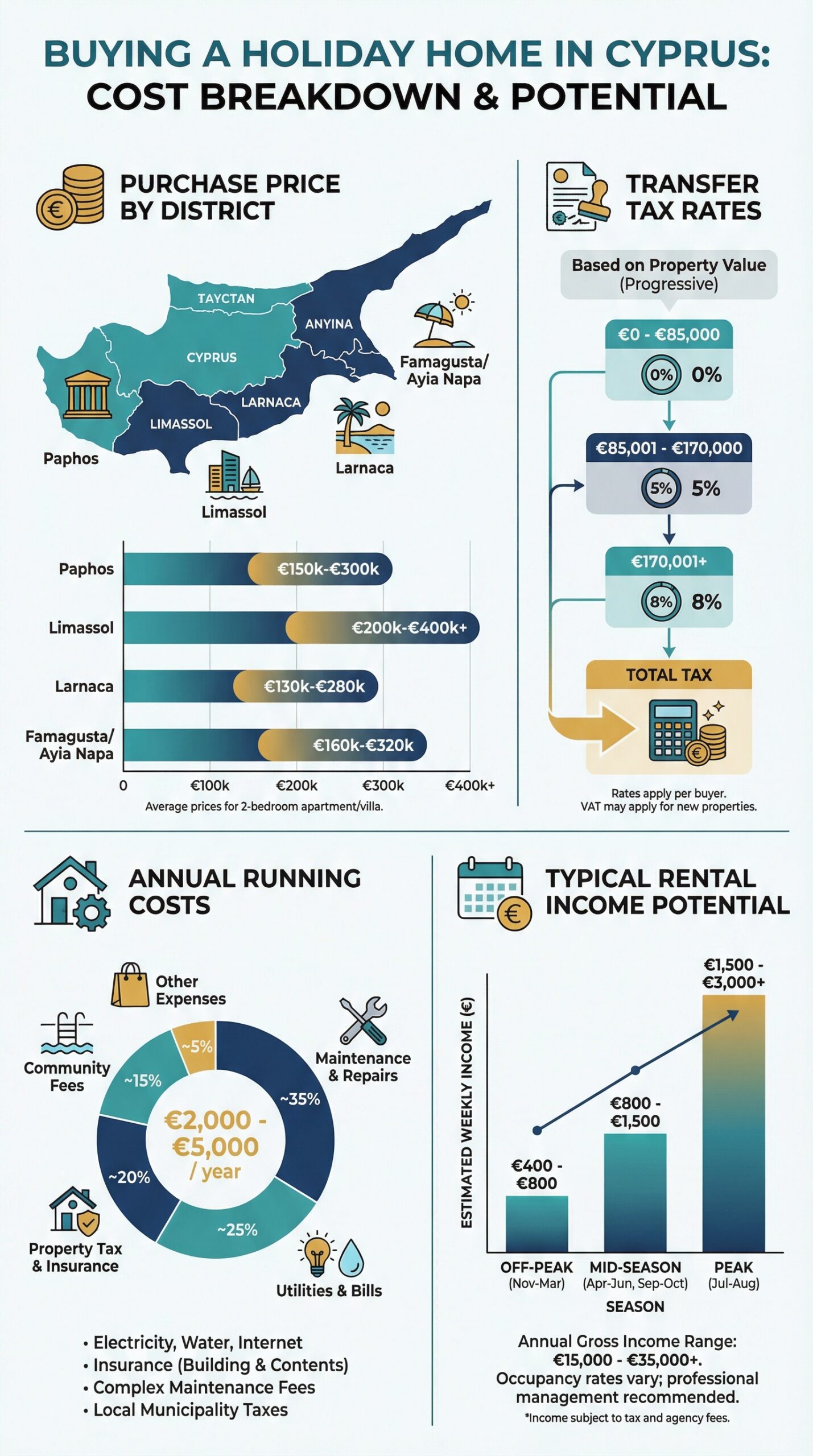
Price ranges vary significantly by district, property type, and proximity to the sea. Below is a realistic framework based on current market data. For real-time benchmarks, our average house prices in Cyprus insights page pulls data directly from active listings and recent transactions.
| Property Type | Paphos | Larnaca | Limassol | Famagusta |
|---|---|---|---|---|
| 1-bed apartment | €95,000–€150,000 | €75,000–€120,000 | €150,000–€250,000 | €100,000–€160,000 |
| 2-bed apartment | €130,000–€220,000 | €100,000–€170,000 | €220,000–€380,000 | €140,000–€230,000 |
| 2-bed villa | €220,000–€380,000 | €180,000–€300,000 | €350,000–€600,000 | €200,000–€340,000 |
| 3-bed villa with pool | €320,000–€550,000 | €250,000–€420,000 | €500,000–€900,000 | €300,000–€500,000 |
The purchase price is only part of the total investment. When buying a holiday home in Cyprus, budget for these additional costs:
Our comprehensive taxes and legalities guide breaks down every cost category with worked examples for different buyer types.
For UK and international buyers, the process of purchasing a holiday home in Cyprus is more straightforward than many expect—particularly given Cyprus’s British-influenced legal framework. Here is a complete overview. For detailed guidance on each stage, read our comprehensive due diligence guide before making any offer.
Most holiday home buyers in Cyprus aim to cover at least part of their annual running costs through short-term rental income. The good news: Cyprus’s tourist market is deep enough to support reasonable occupancy rates even for new entrants, particularly in Paphos and the Famagusta coast.
A realistic breakdown for a two-bedroom villa with private pool in Paphos: peak season (July–August) generates €1,400–€2,200 per week at 90%+ occupancy; mid-season (May–June and September–October) €900–€1,400 per week at 65–80% occupancy; and low season (November–April) €500–€700 per week at 30–50% occupancy. Gross annual income typically reaches €18,000–€28,000.
After management fees (20%), cleaning, maintenance, and utilities, net income typically comes to €12,000–€18,000—a 4–6% net yield on a €300,000 property. That’s competitive with European alternatives.
For a detailed analysis of the short-term rental market, occupancy data, and platform strategies, read our Airbnb Cyprus investment guide.
Rental Registration Requirement: Cyprus requires all short-term holiday lets to be registered with the Cyprus Tourism Organisation (CTO). Registration involves a safety inspection and compliance check. Operating without registration carries fines and can affect your insurance cover.
Cyprus welcomes foreign property ownership and has a clear legal framework for non-EU buyers. UK nationals post-Brexit fall under the third-country national category but face no practical restrictions on buying residential property for personal or holiday use.
Council of Ministers Approval: Non-EU nationals are technically required to apply for approval to purchase property in Cyprus. In practice, this is a rubber-stamp process for residential holiday home purchases—approval is routinely granted, and your lawyer handles the application as standard. See our guide to buying property in Cyprus as a foreigner for full details.
Title Deed Importance: Many properties built between the 1990s and 2010s still lack separate title deeds. This doesn’t make them unsellable, but requires careful due diligence. For new developments since 2015, issuance timelines have improved significantly. Always verify title deed status before signing a contract.
Capital Gains Tax: Cyprus charges 20% CGT on profits from the sale of Cyprus real estate. The first €17,086 of lifetime gains is exempt. For a holiday home held as an investment, you’ll be liable for CGT on profits when you sell. Our taxes and legalities guide covers this in full.
Most UK buyers of Cyprus holiday homes purchase with cash or equity released from a UK property. Cyprus-based mortgages for non-residents are available from the main banks (Bank of Cyprus, Hellenic Bank) but typically require a 30–40% deposit, come with higher interest rates than UK equivalents, and involve a lengthier approval process.
For buyers seeking financing, our property financing guide covers mortgage options from Cyprus banks, international mortgage brokers specialising in overseas property, and how to structure currency exchange to minimise sterling/euro risk.
Cyprus’s property market entered 2026 on strong footing. Prices across the island rose an average of 6–8% in 2025, with coastal and resort areas outperforming the national average. Foreign buyer demand has recovered strongly since 2022, and the rental market continues to benefit from record tourist arrivals.
The combination of relatively low entry prices compared to Western European alternatives, a strong rental market, and a stable EU-member economy with a well-established legal framework for foreign buyers makes Cyprus a compelling case. For buyers in the £200,000–£450,000 range, Cyprus offers better value and equivalent or higher rental returns than most comparable Southern European markets.
That said, buying any overseas property involves risks—currency fluctuations, legal complexity, and the management overhead of a rental property. Do your research, appoint good professionals, and use data rather than emotion to drive your decision.
Whether you’re drawn to the expat community of Paphos, the investment credentials of Limassol, or the value proposition of Larnaca, Cyprus offers a viable and well-established market for holiday home buyers. The key is making the right decisions early: choosing the right district for your goals, understanding the true all-in cost, and having proper legal support throughout the process.
Browse villas for sale across Cyprus or search apartments for sale in Cyprus to explore what’s currently on the market. When you find a property you’re serious about, use our instant property report to benchmark its price against comparable recent sales before making any offer.