
Selling property in Cyprus is very different from buying one. As a seller, you control the price, the timing, and the presentation — but you also carry the tax bill, the legal paperwork, and the risk of a deal collapsing at the Land Registry. Get those pieces right and a sale can complete in two to four months. Get them wrong and your listing can sit for a year while comparable homes around it sell.
This guide walks through exactly how selling property in Cyprus works in 2026: when to sell, how to price accurately, the step-by-step process, what it costs, the capital gains tax rules, and the documents you must have ready. Whether you are an expat exiting a holiday home, an investor realising a gain, or a family upsizing across the island, you will finish knowing what to prepare before your property goes on the market.
Timing affects both how quickly you sell and the price you achieve. The Cyprus property market entered 2026 with prices still rising across most districts, supported by steady foreign demand, limited new supply in prime areas, and a stable economy. For sellers, that means a generally favourable backdrop — but conditions vary sharply by district and property type.
Limassol remains the highest-value market, where prime apartments and seafront units command the strongest premiums. Paphos and Larnaca draw consistent expat and lifestyle demand, while Nicosia moves on local owner-occupier and rental fundamentals rather than tourism. Famagusta sits at the more affordable, emerging end. Before you set a price, check current data for your area — our house price insights for Cyprus show average values you can benchmark against, and our analysis of the wider Cyprus property market in 2026 explains where demand is heading.
The practical takeaway: a well-priced, well-presented property in a district with active demand sells faster in 2026 than the island-wide average. An overpriced listing in a slow micro-market can stall regardless of how strong the headline figures look.
Pricing is the single biggest decision a seller makes. Price too high and the listing goes stale, attracts no viewings, and eventually sells for less than a realistic asking price would have achieved. Price too low and you leave money on the table. The goal is an evidence-based figure that reflects genuine market value, not hope.
Start with comparable evidence. Look at what similar properties — same district, size, condition, and floor or sea view — have actually sold for, not just what they are listed at. Asking prices in Cyprus are frequently negotiated down, so closed sales are a far better guide. Our property valuation guide explains how to build a comparable analysis step by step.
For an objective second opinion, use a data-driven tool rather than a single agent’s estimate. An agent who wants your listing has an incentive to quote a flattering number; a neutral assessment does not. An instant property report analyses comparable listings and market data to show what your property is realistically worth, which helps you set an asking price you can defend during negotiation.
Three factors move Cyprus valuations more than sellers expect:
The legal mechanics of selling property in Cyprus follow a clear sequence. Understanding it up front prevents the delays that frustrate so many sellers.
A straightforward sale with deeds in place often completes within two to three months. Complications — missing title deeds, an outstanding mortgage, or inheritance issues — extend the timeline, so identify them early.
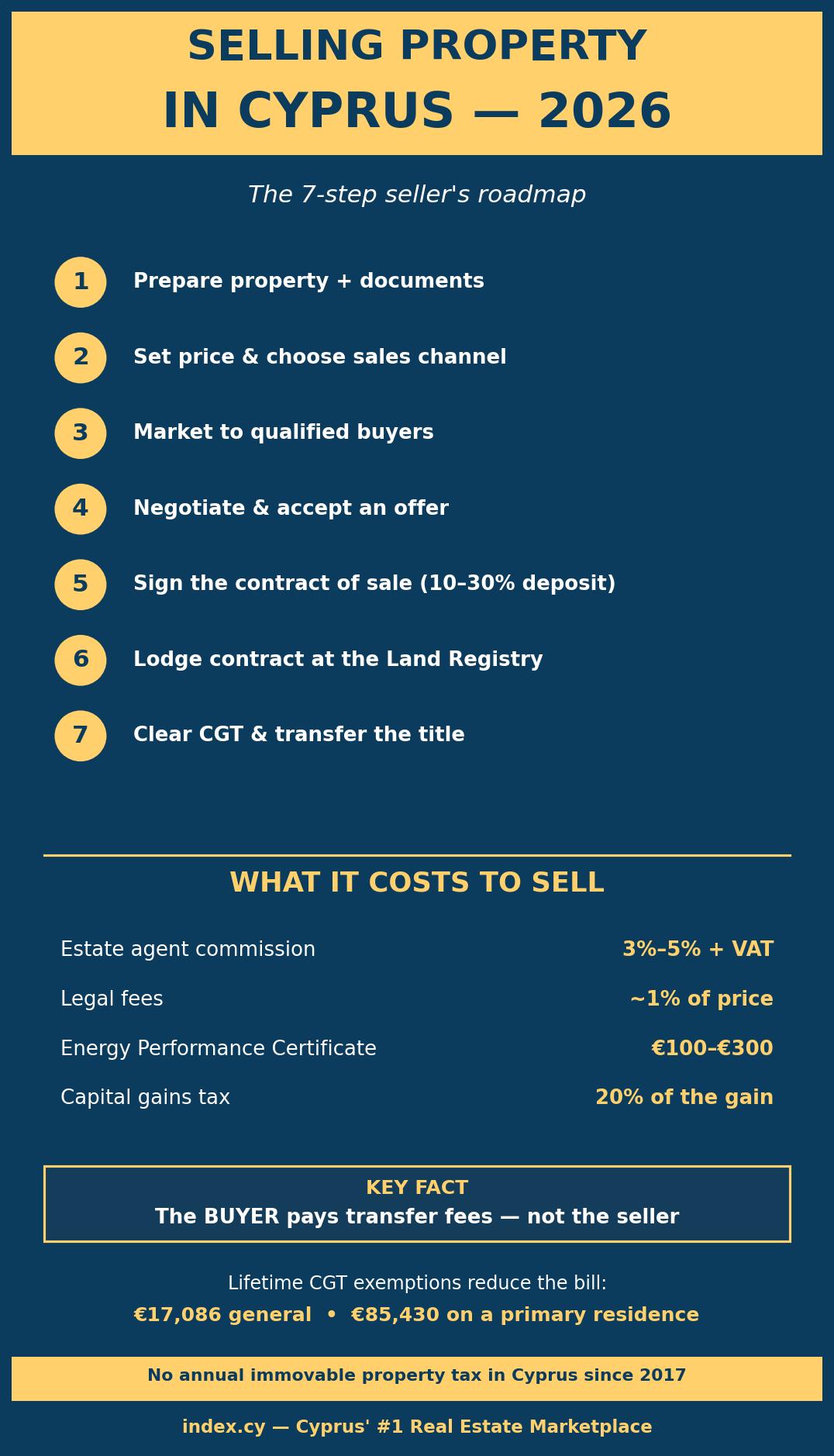
Many sellers focus only on the sale price and are surprised by the costs that come out of it. Budgeting for these up front protects your net proceeds. The main costs of selling a property in Cyprus are:
| Cost | Who pays | Typical range (2026) |
|---|---|---|
| Estate agent commission | Seller | 3%–5% + VAT (licensed agent) |
| Legal fees | Seller | ~1% of sale price, or a fixed fee |
| Energy Performance Certificate | Seller | €100–€300 depending on size |
| Capital gains tax | Seller | 20% of the taxable gain (after exemptions) |
| Mortgage redemption | Seller (if applicable) | Balance + any early-settlement charge |
| Transfer fees | Buyer | Not a seller cost |
Note the last line. Property transfer fees in Cyprus are paid by the buyer, not the seller — a frequent point of confusion. As a seller, your controllable costs are commission, legal fees, the energy certificate, and capital gains tax.
One structural advantage worth knowing: Cyprus abolished the annual immovable property tax in 2017, so there is no recurring national property tax to clear on sale (though small municipal charges may apply). That keeps the holding and exit costs of Cyprus property lower than in many comparable markets.
Tax is the cost that catches sellers out most often, so it deserves careful attention. The key levy is capital gains tax (CGT), charged at a flat 20% on the gain from disposing of immovable property situated in Cyprus.
Crucially, CGT applies to the gain, not the full sale price — and several deductions and lifetime exemptions reduce it substantially:
So a couple selling a long-held primary residence can often shelter a large share of the gain through combined exemptions and indexation. By contrast, an investor selling a second property after rapid appreciation may face a meaningful CGT bill. Our dedicated capital gains tax in Cyprus guide works through the calculations with examples, and the broader taxes and legalities guide covers the rest of the closing picture.
Because exemptions, indexation, and allowable expenses are specific to your situation, confirm your liability with a Cyprus tax adviser before completion — CGT must be cleared for the title to transfer. The independent PwC Worldwide Tax Summaries for Cyprus provide an authoritative overview of the current rates and exemptions.
Cyprus will not let a sale complete without the right paperwork, and gaps here are the most common cause of delay. Have these ready before you list:
Selling without title deeds deserves a specific warning. It is legally possible and happens regularly in Cyprus, but it narrows your buyer pool and lengthens negotiations because the buyer’s lawyer must verify the chain of ownership and any developer obligations. If your deeds are pending, start resolving the position with your lawyer well before marketing. For the full legal sequence — from contract to transfer at the Department of Lands and Surveys — keep a Cyprus property lawyer involved from the first offer.
Once your price and paperwork are sorted, exposure determines speed. A property only sells as fast as the pool of qualified buyers who actually see it — so where and how you list matters enormously.
Sellers in Cyprus typically choose between three routes, and many combine them:
Whichever route you choose, presentation drives results. Professional-grade photos, an honest and detailed description, and a realistic asking price consistently outperform a higher price with weak marketing. Buyers browsing houses for sale in Cyprus or apartments across the island compare dozens of listings side by side — yours has to earn the click and the viewing.
If you are a developer or agency selling at volume, listing your inventory where serious buyers already search is the fastest route to qualified leads; index.cy’s information for agencies explains how the marketplace model works for professional sellers.
Selling property in Cyprus rewards preparation. The sellers who achieve the best price in the shortest time are the ones who price on evidence, gather their documents before listing, understand their capital gains tax position, and put their property in front of the widest pool of qualified buyers.
To recap the essentials: benchmark your price against real market data, budget for commission, legal fees, the energy certificate, and CGT, get your title deed and EPC ready early, and choose a sales channel that maximises exposure. Remember that the buyer — not you — pays the transfer fees, and that generous lifetime exemptions can shelter much of your taxable gain.
Start with an honest valuation. Run an instant property report to see what your home is realistically worth in today’s market, then list it where Cyprus’ most active buyers are searching. With the right price, the right paperwork, and the right exposure, a successful sale is well within reach in 2026.