
What this guide covers
- How Much Does Electricity in Cyprus Cost in 2026?
- Understanding Your EAC Bill: What Each Line Actually Charges You
- EAC Tariffs Explained: Which One Fits Your Property?
- What a Typical Cyprus Electricity Bill Looks Like
- Water and Sewerage Bills: The Other Half of Your Utilities
- Setting Up Utilities When You Buy or Rent in Cyprus
- For buyers
- For tenants and landlords
- Seven Ways to Cut Your Electricity Bill in Cyprus
- Frequently Asked Questions About Electricity in Cyprus
- How often does the EAC send bills?
- Can I change my electricity supplier in Cyprus?
- Why is my Cyprus electricity bill so high in summer?
- Do I pay electricity as a tenant or does the landlord?
- What happens to the supply when I buy a property?
- Is electricity in Cyprus getting cheaper?
- The Bottom Line on Electricity in Cyprus
Electricity in Cyprus is one of the largest running costs of owning or renting a home here — and one of the most misunderstood. Buyers budget carefully for the purchase price, transfer fees and legal costs, then get their first bi-monthly bill in August and discover the air conditioning has quietly added a few hundred euros.
The good news: Cyprus recorded the largest household electricity price decrease in the entire EU in the second half of 2025, at -14.7% year on year, according to How Much Does Electricity in Cyprus Cost in 2026?
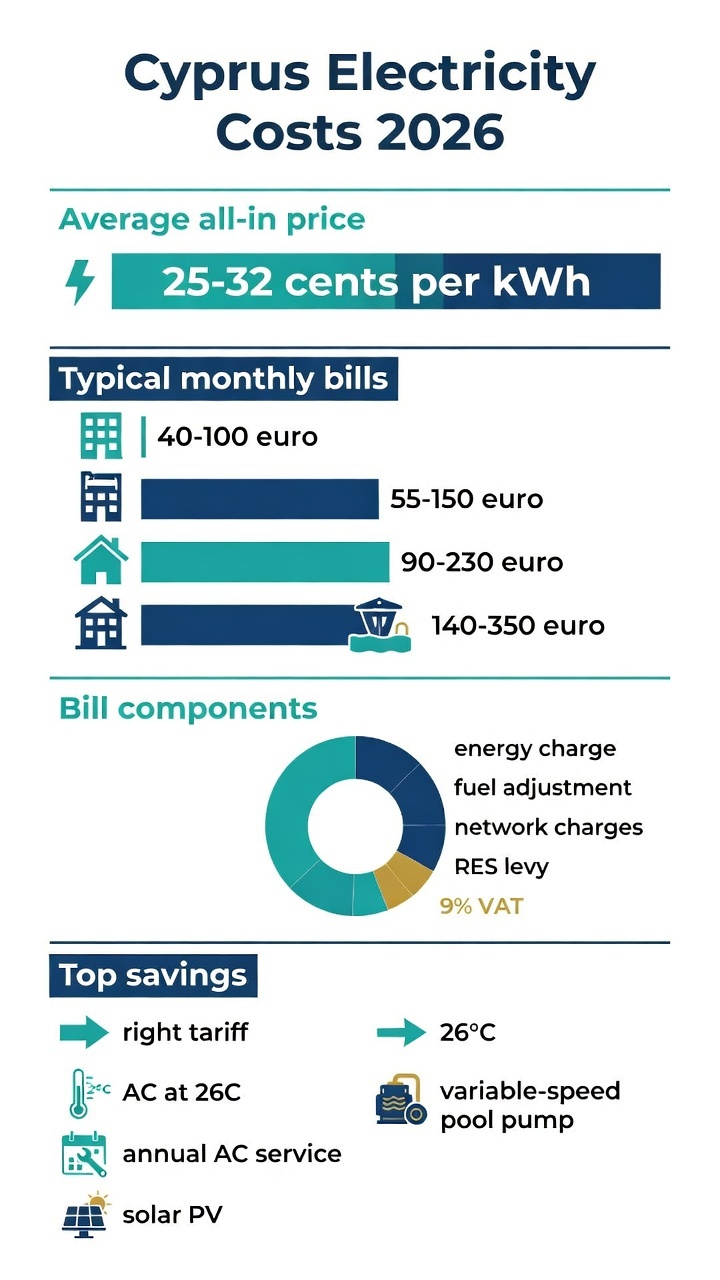
Household electricity in Cyprus costs roughly 25-32 euro cents per kilowatt-hour all-in, once energy, network charges, the fuel adjustment, public service levies and VAT are combined. For a typical household using 300-500 kWh per month, that works out to approximately €85-€160 per month, or €170-€320 on the bi-monthly bill the EAC issues. That headline range hides enormous variation. The single biggest driver is not the tariff you are on — it is your building and your cooling habits. A well-insulated two-bedroom apartment in Nicosia with efficient inverter air conditioning can run at €60 a month. A four-bedroom villa in Limassol with a pool pump, electric water heating and older split units can exceed €300 a month across July and August. For context, the EU average household electricity price in the second half of 2025 was €0.2896 per kWh including all taxes. Ireland (€0.4042), Germany (€0.3869) and Belgium (€0.3499) were the most expensive; Hungary (€0.1082), Malta (€0.1282) and Bulgaria (€0.1355) the cheapest. Cyprus sits in the upper-middle of that spread, but the direction of travel has been favourable — the -14.7% annual fall was the steepest of any EU member state, driven largely by lower fuel adjustment costs and the rapid build-out of solar generation. If you are budgeting a move, read this alongside our full breakdown of the cost of living in Cyprus, which puts utilities in the context of rent, groceries, healthcare and transport. The Electricity Authority of Cyprus is the state-owned utility that supplies the overwhelming majority of homes on the island. Its bills are itemised, and the itemisation matters — because roughly half of what you pay is not the electricity itself. Two lines deserve particular attention. The fuel adjustment is why your bill can swing sharply without your consumption changing at all. Cyprus generates most of its power from imported heavy fuel oil and diesel, so international fuel prices feed through to households with a short lag. The Cyprus Energy Regulatory Authority (CERA) approves the adjustment coefficients periodically. When oil falls, Cypriot bills fall — which is precisely what produced the 2025 decrease. The reduced 9% VAT rate on electricity is a policy measure, not a permanent feature. The government has extended it to 31 March 2027. If it lapses and the standard 19% rate returns, a household paying €120 a month would see roughly €11 added — worth factoring into any long-term running-cost projection. The EAC offers several domestic tariff codes. Choosing correctly is one of the cheapest optimisations available to a homeowner, because switching costs nothing and can save 5-15% depending on your usage pattern. Tariff 01 — standard domestic. A single rate applied around the clock, currently around 10.34 euro cents per kWh on the energy component before network charges, levies and VAT. This is the default and suits households with evenly spread or unpredictable consumption. Tariff 02 — two-zone (day/night). Roughly 10.76 c/kWh during the day (09:00-23:00) and 9.44 c/kWh overnight (23:00-09:00) on the energy component. The night discount is meaningful only if you can genuinely shift load: running the washing machine, dishwasher, water heater and pool pump after 23:00. Households that cannot shift consumption often end up worse off, since the daytime rate exceeds the flat rate. Tariff 08 — vulnerable consumers. An average effective cost around 8.48 c/kWh, typically 18-22% below standard domestic rates. Eligibility is means- and circumstance-tested, covering categories such as low-income pensioners, recipients of certain benefits and households with members who have specific disabilities. Applications go through the EAC with supporting documentation. A practical rule of thumb: if more than about 40% of your consumption can realistically move to the overnight window, the two-zone tariff wins. Below that, stay on the standard tariff. Check your current tariff code on any recent bill before assuming you are on the right one — many buyers simply inherit whatever the previous owner had. The full official rate schedule is published in the EAC domestic tariffs document, updated when CERA approves changes. Averages are less useful than examples. Here is what electricity in Cyprus realistically costs across common property types, assuming standard domestic tariff and normal occupancy: Three factors explain most of the variance between two apparently similar homes: This is exactly the kind of thing worth establishing before you commit to a purchase. A professional property inspection will document the age and condition of air conditioning units, water heating, insulation and glazing — the four variables that determine whether you inherit a €900-a-year property or a €3,000-a-year one. Water in Cyprus is administered locally rather than nationally, so charges vary by district and municipality. Bills typically arrive quarterly, unlike the EAC’s bi-monthly cycle. The structure is progressive: the more you consume, the higher the rate per cubic metre. Typical parameters across Cypriot water boards in 2026: In practice, a family of four in an apartment consuming roughly 0.6 m³ per day pays around €25-€30 per month. The same family in a house with a lawn and a pool consumes closer to 0.8 m³ per day and pays around €40-€45 per month. Water is a genuine constraint in Cyprus, not merely a cost. The island is among the most water-stressed in Europe, and consumption above roughly 1 m³ per day pushes you into materially higher tariff bands. Gardens planted with drought-tolerant Mediterranean species rather than lawn, and drip irrigation on timers rather than sprinklers, make a substantial difference to both the bill and the summer stress on supply. Getting connected is straightforward, but the sequence trips people up — particularly buyers who expect the supply to transfer automatically at completion. It does not. In Cyprus, utility accounts are usually put in the tenant’s name, with the tenant paying bills directly. Confirm this explicitly in the lease and take dated meter photographs on move-in day. Our guide to renting property in Cyprus covers deposit protection, notice periods and the rest of the tenancy framework. For landlords and investors, utility setup, meter readings between tenancies and common-expense liability are recurring operational costs that erode gross yield. Factor them into your projections — our buy-to-let guide works through the full net-yield calculation. One further point for owners: check that your home insurance policy covers electrical fire and power-surge damage to appliances. Cyprus’s grid is reliable, but summer demand peaks and occasional storm outages make surge protection worth having. These are ordered by return on effort, not by size of saving. Every two months for most domestic customers, based on meter readings taken at the start and end of each period. Estimated readings are used occasionally and reconciled on the following bill. The Cypriot retail electricity market has been liberalising, with alternative suppliers entering under CERA’s competitive framework. In practice, the EAC still serves the large majority of domestic customers, and switching options for households remain limited compared with mature European markets. Air conditioning. Cooling load in July and August routinely doubles or triples a household’s kWh consumption compared with the shoulder seasons. Higher consumption also pushes some households into less favourable effective rates once fixed charges are spread. Almost always the tenant, with the account in the tenant’s name. Common expenses for shared areas in a complex are usually the landlord’s responsibility unless the lease says otherwise — read that clause carefully. It does not transfer automatically. You must open a new account at your district EAC office with your contract or title deed, ID and tax number, and pay a refundable deposit. Do the same at the local water board. It has been. Cyprus posted the largest household price decrease in the EU in the second half of 2025 at -14.7% year on year, according to Eurostat, driven by lower fuel costs and expanding solar generation. Future direction depends on international fuel prices, the pace of renewables build-out and whether the reduced 9% VAT rate is extended beyond March 2027. Electricity in Cyprus is a manageable cost once you understand what drives it. The tariff you are on matters less than the building you are in, the age of your cooling equipment and how you use it. A household that gets those three things right pays half what an equivalent household pays getting them wrong — and the corrective measures are mostly cheap or free. If you are still choosing a property, treat running costs as part of the purchase decision rather than an afterthought. Ask for the last twelve months of EAC bills. Check the age of the air conditioning. Confirm whether there is a working solar water heater. Look at glazing, shading and orientation. These questions cost nothing to ask and can be worth €1,500 a year for the entire time you own the property. Browse verified listings across the island — from efficient new-build apartments to family villas — on index.cy, Cyprus’s largest property marketplace, and use our instant property report to understand what you are buying before you commit. This guide is for general information. Electricity tariffs, levies and VAT rates change; confirm current figures with the EAC and your local water board before relying on them for budgeting.Understanding Your EAC Bill: What Each Line Actually Charges You
Bill component What it pays for Approximate weight Energy charge The electricity you actually consumed, at your tariff rate Largest single line Fuel adjustment Monthly variable reflecting the weighted average fuel price Highly volatile Distribution network charge Local cables, transformers, maintenance, repairs ~3.66 c/kWh Transmission system charge High-voltage network, substations, system operator ~0.87 c/kWh Ancillary services Grid balancing and operational reserves Small Public Service Obligation (PSO) Government-mandated social and policy costs Small RES & Energy Conservation Fund levy Co-finances solar and efficiency schemes 0.5 c/kWh VAT Reduced rate on electricity 9% of subtotal EAC Tariffs Explained: Which One Fits Your Property?
What a Typical Cyprus Electricity Bill Looks Like
Property type Winter (per month) Summer peak (per month) Annual estimate 1-bed apartment, single occupant €40-€60 €70-€100 €650-€950 2-bed apartment, couple €55-€85 €100-€150 €900-€1,400 3-bed house, family of four €90-€130 €160-€230 €1,500-€2,200 4-bed villa with pool €140-€200 €250-€350+ €2,400-€3,500 
Water and Sewerage Bills: The Other Half of Your Utilities
Setting Up Utilities When You Buy or Rent in Cyprus
For buyers
For tenants and landlords
Seven Ways to Cut Your Electricity Bill in Cyprus
Frequently Asked Questions About Electricity in Cyprus
How often does the EAC send bills?
Can I change my electricity supplier in Cyprus?
Why is my Cyprus electricity bill so high in summer?
Do I pay electricity as a tenant or does the landlord?
What happens to the supply when I buy a property?
Is electricity in Cyprus getting cheaper?
The Bottom Line on Electricity in Cyprus
Keep reading

Record-Breaking Property Sales in Cyprus This September The Cyprus real estate market demonstrated robust growth in September 2026, with a total of…

Cyprus Property Sales Soar to New Heights in September 2026 The Cyprus real estate market continues its impressive upward trajectory, with 1,681…

We analysed 46 Xylofagou, Larnaca listings: 16 houses, 18 plots and 11 apartments, most 3-bed houses near EUR305,000. See prices and what…