What this guide covers
- What “Houses for Sale in Nicosia” Covers in 2026
- 2026 Nicosia House Prices by Area
- The Best Nicosia Areas for House Buyers
- Strovolos — The Default Family Suburb
- Engomi — The Embassy Zone
- Aglantzia — Universities and Green Space
- Lakatamia — Value and New Build
- Tseri and Geri — Bigger Plots, Lower Per-sqm
- Nicosia Old Town — Restoration Opportunity
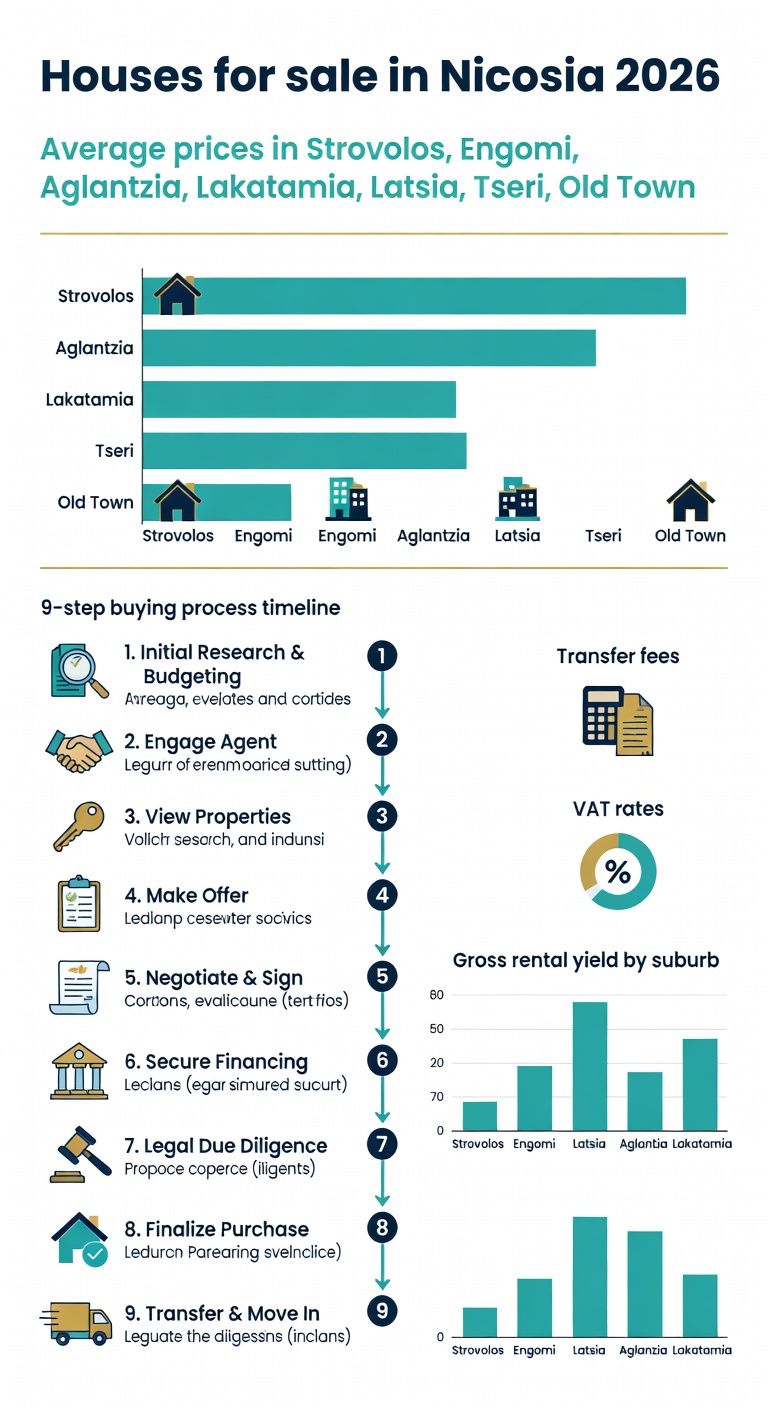
- How to Buy a House in Nicosia: Step-by-Step
- Taxes, Fees and Total Cost of Buying a Nicosia House
- Foreign Buyers: Permits, Residency, and Mortgages
- Rental Yield: What a Nicosia House Earns You
- What to Watch For When Viewing a Nicosia House
- Should You Buy a House in Nicosia in 2026?
Nicosia is the only Cyprus district where you can still buy a 3-bedroom detached house, with a garden and a quiet residential street, for under €350,000 inside the urban limits. It is also the district with the deepest local-buyer market: roughly 65% of all transactions inside the Nicosia district are between Cypriot residents, against just 30% in Paphos and Famagusta.
If you are searching for houses for sale in Nicosia, you are looking at the most balanced and most overlooked house market in Cyprus — one driven by stable salaries, government and corporate jobs, and Cyprus’ largest year-round rental demand, rather than by foreign holiday buyers. This 2026 guide walks through what a “house in Nicosia” actually means, what you should pay in each suburb, how the buying process works, what taxes and fees apply, and how rental yields compare to coastal districts.
What “Houses for Sale in Nicosia” Covers in 2026
Nicosia is both the capital and the largest district by population in the government-controlled area of Cyprus. When you filter for Nicosia properties for sale, you are looking across roughly 50 villages, six contiguous urban municipalities (Strovolos, Aglantzia, Engomi, Lakatamia, Latsia, and Nicosia Municipality itself), and a wide ring of suburban towns from Tseri in the south to Geri and Dali in the southeast.
A “house” in Nicosia typically falls into one of four categories:
- Detached house with garden — 130–280 sqm built on a plot of 250–700 sqm, usually 3–4 bedrooms, the dominant family-home product in suburbs like Strovolos and Lakatamia.
- Semi-detached house — 110–180 sqm, shared side wall, smaller plot, common in Latsia, Tseri and Engomi.
- Townhouse / row house — 90–150 sqm on three levels, narrow plot, found mostly in older Nicosia neighbourhoods like Pallouriotissa and Kaimakli.
- Village stone or traditional house — 80–250 sqm in surrounding villages like Lythrodontas, Pera Chorio, or Analiontas, often sold for renovation from €120,000.
Most active 2026 listings describe a “house in Nicosia” as a 3-bedroom detached or semi-detached property in a suburban municipality with a garden, covered parking, and a fully transferable title deed. That is the product you will see most often when you filter houses for sale in Cyprus by Nicosia.
2026 Nicosia House Prices by Area
Nicosia house prices have followed a steadier trajectory than Limassol or Paphos. According to Central Bank of Cyprus Residential Property Price Index data, Nicosia detached houses appreciated at a compound annual rate of roughly 4–5% between 2020 and 2025 — meaningful, but well below the 8–11% recorded in Limassol over the same period. That gap is the core reason Nicosia is the only district where a typical Cypriot family on two median salaries can still buy a stand-alone house without a 50% deposit.
| Nicosia area | Typical 3-bed house price (EUR) | Price per sqm (EUR) | Primary buyer profile |
|---|---|---|---|
| Engomi | €420,000 – €850,000 | €2,400 – €3,800 | Diplomats, professionals, embassy zone |
| Aglantzia | €380,000 – €720,000 | €2,200 – €3,400 | University staff, families |
| Strovolos | €330,000 – €620,000 | €2,000 – €3,000 | Cypriot families, dual-income buyers |
| Lakatamia | €280,000 – €520,000 | €1,800 – €2,600 | First-time buyers, growing families |
| Latsia | €260,000 – €460,000 | €1,700 – €2,400 | Value buyers, new builds |
| Tseri | €240,000 – €420,000 | €1,500 – €2,200 | Suburban families, larger plots |
| Geri / Dali | €220,000 – €380,000 | €1,400 – €2,000 | Budget buyers, longer commute |
| Nicosia Old Town | €180,000 – €450,000 | €1,500 – €2,800 | Restoration buyers, central living |
| Surrounding villages | €140,000 – €320,000 | €1,000 – €1,800 | Lifestyle, country house buyers |
These are 2026 asking-price ranges from the houses for sale in Cyprus listing pool, filtered for Nicosia, and cross-checked with Department of Lands and Surveys transaction data published in Q1 2026. Final sale prices on Nicosia houses typically settle 5–8% below the asking price for resale stock and 0–3% below for new-build product. For a fully data-backed view of where you stand, our insights page on the average price of a house in Nicosia is updated quarterly from live listings and recent comparables.
If you want the lighter, higher-volume end of the market, filter for cheap houses and villas in Cyprus and apply a Nicosia filter; you will see most of the inventory below €300,000 sits in Latsia, Tseri, Geri, and the surrounding villages.
The Best Nicosia Areas for House Buyers
Different parts of the district suit very different buyers. The first decision most house buyers face is whether to live inside the urban ring (Strovolos, Aglantzia, Engomi) where commute times to the city centre stay below 15 minutes, or in the outer suburbs (Tseri, Geri, Dali, Lakatamia) where the same budget buys 30–40% more square metres but adds a 20–25 minute drive.
Strovolos — The Default Family Suburb
Strovolos is the largest municipality in the Nicosia district and the practical default for Cypriot families buying their first or second house. It offers the deepest inventory at every price point, full urban infrastructure, three large public schools, and 8–12 minute access to both the city centre and the Strovolos commercial belt. Expect 3-bed detached houses from around €330,000 in older sections, rising to €620,000 in newer pockets like Acropolis and Dasoupolis. Strovolos is the area to start in if you want a balanced combination of family infrastructure, daily convenience, and reasonable price per square metre.
Engomi — The Embassy Zone
Engomi is the most international neighbourhood in Nicosia. It is home to most foreign embassies, the University of Cyprus campus, and a high concentration of dual-language schools (English, French, Russian). Expect 3-bed detached houses from €420,000 for older 1990s stock, up to €850,000 for renovated modern homes with pool. If your decision to buy in Nicosia is connected to an embassy, university, or international employer, this is usually the first area on the shortlist.
Aglantzia — Universities and Green Space
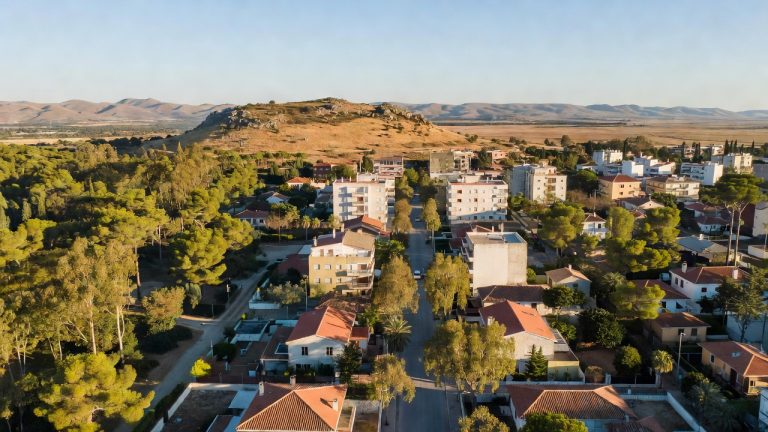
Aglantzia sits on the eastern edge of the urban area, adjacent to the University of Cyprus and the Athalassa National Forest Park. It is the suburb most strongly associated with academic and professional buyers. Houses average €380,000–€720,000 in the residential core, with a long-term rental market driven by university staff and PhD students that supports gross yields of 4.5–5.5% — among the highest in Nicosia.
Lakatamia — Value and New Build
Lakatamia has been the main new-build belt for Nicosia houses over the last decade. The municipality issued more new house permits than any other Nicosia suburb between 2020 and 2025, according to the Department of Town Planning. Entry prices for a 3-bed new-build with a small garden start near €280,000 — the lowest in any urban Nicosia municipality. Buyers who want a brand-new house with title deed on delivery, modern energy efficiency standards, and short commute to the city centre should focus their search here and in adjacent complexes and projects in Nicosia.
Tseri and Geri — Bigger Plots, Lower Per-sqm
Tseri and Geri are both 12–18 minutes south of Nicosia city centre. They offer the largest plots inside the metropolitan ring, with 3-bed detached houses from €220,000–€420,000 sitting on plots of 350–600 sqm. Both suburbs have grown roughly 20% in registered population since 2015, driven by a steady inflow of dual-income Cypriot families priced out of Strovolos and Engomi.
Nicosia Old Town — Restoration Opportunity
Nicosia Old Town, inside the Venetian walls, is unique in Cyprus. It is the only urban core where you can still buy a small, traditional, two-storey stone house for €180,000–€280,000, often with the original floor tiles and inner courtyard intact. Restoration costs typically run €1,000–€1,500 per sqm, and the area has been the focus of EU-funded urban regeneration grants since 2022. The trade-off is parking — most Old Town houses have no on-site parking, and the buyer pool is narrower (mostly architects, professionals, and lifestyle buyers).
How to Buy a House in Nicosia: Step-by-Step
The legal process for buying a house in Nicosia is the same as anywhere else in the government-controlled area of Cyprus, but the supply and timing dynamics are different. Properties in Nicosia tend to sit on the market longer (median time-to-sale of 110–140 days, against 60–80 days in Limassol), which gives buyers more negotiating room. Here is the process most local and foreign buyers follow.
- Get a budget anchor. Add 8–12% to the headline price for transfer fees, legal fees, VAT (if new build), inspection, and contingencies. Use the average price per sqm for a house in Cyprus page to sanity-check listings.
- Pre-approval if financing. Banks in Cyprus will issue an in-principle decision in 5–10 working days. Our Cyprus mortgage guide covers eligibility, rates, and documents for both residents and foreign buyers.
- Shortlist and view. Walk through 5–10 properties before making any offer; the Nicosia inventory is deep enough that a comparable house is almost always available within 2 km.
- Make an offer subject to contract. In Nicosia, a verbal or short-form written offer is standard — most sellers will not accept a binding offer until full inspections are done.
- Hire an independent property lawyer. The Cyprus Bar Association maintains a public register of licensed property lawyers; choose one who has no commercial relationship with the seller or seller’s agent.
- Order a property inspection and title check. We strongly recommend a professional property inspection service and a same-day Land Registry title check before any deposit changes hands. Our comprehensive due diligence guide walks through every check that should happen before signing.
- Sign the sale contract and pay deposit. The standard Cyprus deposit is 10% of the purchase price. Your lawyer will lodge the contract with the Land Registry within 7 working days under the Specific Performance Law to protect your purchase.
- Apply for Council of Ministers permit (foreign buyers only — see next section). This is administrative, not discretionary, and usually takes 4–8 weeks.
- Pay balance and transfer title. Final transfer happens at the District Land Registry. Keep proof of every payment — Cyprus Capital Gains Tax later is calculated on the gain over your declared purchase price.
The full process from offer to title transfer takes 8–14 weeks if all paperwork is clean and no Council of Ministers permit is required, and 12–20 weeks if it is.
Taxes, Fees and Total Cost of Buying a Nicosia House
The headline price of a house in Nicosia is rarely the final number you pay. The most common surprise for first-time buyers is how transfer fees, VAT, and legal costs interact, and how a brand-new house is taxed differently from an identical resale next door. Our taxes and legalities guide goes deeper, but here is the 2026 short version for a Nicosia house buyer.
Transfer fees (resale houses, no VAT): 1.5% on the first €85,000, 2.5% on €85,001–€170,000, and 4% on the balance above €170,000. On a €350,000 resale Nicosia house, that totals roughly €10,475. There is also a 50% transfer-fee discount currently in force on most resale transactions, set out in the Cyprus Department of Lands and Surveys schedule.
VAT (new-build houses only): 19% standard rate, reduced to 5% on the first 130 sqm of an applicant’s main residence (subject to conditions including a 10-year owner-occupier requirement). On a €350,000 new-build Nicosia house, that is €17,500 of reduced-rate VAT plus €0–€10,000 of standard-rate VAT on any built area above 130 sqm.
Stamp duty: 0.15% of contract value up to €170,000, 0.20% on the balance, capped at €20,000. On a €350,000 house, around €615.
Legal fees: 0.8–1.2% of purchase price plus VAT. Budget €3,500–€5,000 for a €350,000 Nicosia house, including title search, contract review, and Land Registry filings.
Property inspection and survey: €500–€1,500 depending on house size and report depth.
Annual immovable property tax: abolished at national level since 2017. The only ongoing taxes are municipal property tax (€100–€300/year for most Nicosia houses) and sewerage tax (€100–€250/year).
For a typical €350,000 resale house in Strovolos, expect total acquisition costs of roughly €366,000–€370,000 once all fees are settled. For a €350,000 new-build in Lakatamia with a 5% reduced-rate VAT, expect €373,000–€380,000.
Foreign Buyers: Permits, Residency, and Mortgages
Cyprus is one of the most foreign-friendly property markets in the EU, but there are still rules every non-Cypriot buyer needs to know.
EU citizens can buy any number of properties in Cyprus on equal footing with Cypriot nationals, with no upper limit on plot size and no special permits. Non-EU citizens need a one-off Council of Ministers permit for each property purchase. The permit is administrative — the standard rejection rate has been below 1% for the last decade — but it must be filed and granted before the title transfer can complete. There is also a soft cap of 4,014 sqm of land per non-EU buyer (one house plus one apartment, broadly).
Mortgages are available to both residents and foreign buyers. Cyprus banks typically lend 60–70% loan-to-value to non-residents, against 80% for residents, at 2026 fixed rates in the 4.0–5.0% range for 5-year fixed periods. Cypriot banks generally require proof of stable income, a debt-service ratio under 35–40%, and a Cyprus bank account in the borrower’s name. Our financing your property purchase in Cyprus article walks through eligibility for foreign buyers in detail.
Buyers who want to use a Nicosia house purchase as part of a residency strategy should read our permanent residence in Cyprus through property investment guide. Nicosia houses qualify under the Category 6.2 fast-track Permanent Residency programme provided the purchase price is at least €300,000 plus VAT for a single new-build property — a threshold that excludes most resale houses but is met by a meaningful share of new builds in Lakatamia, Latsia, and Engomi.
Rental Yield: What a Nicosia House Earns You
Nicosia is not a holiday-rental market. There is no airport in the district, no beach, and a year-round Mediterranean inland climate that is hotter in summer than the coast. What Nicosia does offer is the largest, most stable long-term rental market in Cyprus, driven by government workers, embassy staff, professionals, and university students at the University of Cyprus and European University Cyprus.
A typical 3-bedroom detached house with a garden in Strovolos or Aglantzia rents for €1,400–€2,000 per month long-term in 2026. Against an asking price of €380,000–€500,000, that produces a gross long-term rental yield of 4.0–5.5% — meaningfully better than the 3.0–4.0% you typically see on a comparable Limassol house, where headline prices are 60–80% higher but rents only 30–50% higher.
Houses in Engomi, particularly those near embassies, command 10–15% rental premiums and longer tenancies (typically 24–36 months against 12–18 months in mainstream Strovolos). Rental in Latsia, Tseri, and Geri tends to follow a more local-family pattern with lower rents (€900–€1,400 per month for a 3-bedroom) and higher tenant stability.
If your buying decision is investment-led rather than owner-occupied, Nicosia’s combination of low capital cost and high tenant stability is the most underrated yield story in the Cyprus market. Our property investment in Cyprus guide covers the full district-by-district yield comparison.
What to Watch For When Viewing a Nicosia House
A Nicosia house viewing should focus on issues that are particular to the district. Three deserve specific attention.
Title deed status. Nicosia has the highest concentration of older houses in Cyprus, and a non-trivial share of pre-1990 properties have title deed irregularities — most often a missing certificate of approval or a planning amnesty case still working through the system. Always ask your lawyer to pull the full title file, not just the title certificate, before any deposit. Our title deeds in Cyprus guide covers what to do if the deed is not yet issued.
Earthquake reinforcement. Cyprus building code introduced mandatory seismic reinforcement standards in 1992 and tightened them again in 2008. A house built before 1992 will not meet the current code; a house built between 1992 and 2008 may need targeted reinforcement. This is one of the most common findings on a professional property inspection report for older Nicosia houses.
Heating and cooling. Nicosia is the hottest district in Cyprus in summer (regularly 38–42°C) and the coldest in winter (frost in January is normal). A house that does not have ducted air conditioning, modern double glazing, and proper roof insulation will cost €1,800–€2,800 per year more in energy than a properly upgraded house. Ask for the past 12 months’ EAC electricity bills as part of the offer process.
For a fast, fully data-backed view of any specific Nicosia house, run the address through our free instant property report tool. The report pulls comparable sales, price-per-sqm benchmarks, and any flags from the Land Registry into one PDF in under 60 seconds.
Should You Buy a House in Nicosia in 2026?
Nicosia is the right answer for buyers who want value, stability, and long-term rental demand rather than coastal lifestyle and tourist-driven yield. The district trades at 30–45% lower headline prices than equivalent Limassol stock, has the largest year-round tenant pool in Cyprus, and is the only district where a typical Cypriot dual-income family can still buy a standalone detached house without unusual savings.
The trade-offs are real: you give up the beach, the airport, and the holiday-rental upside that Paphos and Famagusta offer, and you accept a slower price-appreciation curve. For owner-occupiers and long-term landlords, those trade-offs are usually worth it. For pure short-term rental investors chasing 8–10% yields, Nicosia is rarely the right choice — the coastal districts dominate that segment.
Whatever your strategy, start your search on the Nicosia properties for sale page and use our comprehensive due diligence guide to walk through every check before you sign. With around 1,300 active listings updated daily on index.cy and 100+ Cyprus real estate companies feeding the database, you will find houses for sale in Nicosia at every price point from a €180,000 traditional Old Town stone house to an €850,000 modern Engomi family home.
More about Nicosia
We analysed 319 Aglantzia, Nicosia listings: 155 apartments, 34 houses and 38 plots. Median 2-bed costs EUR257,500. See prices, rents and what…
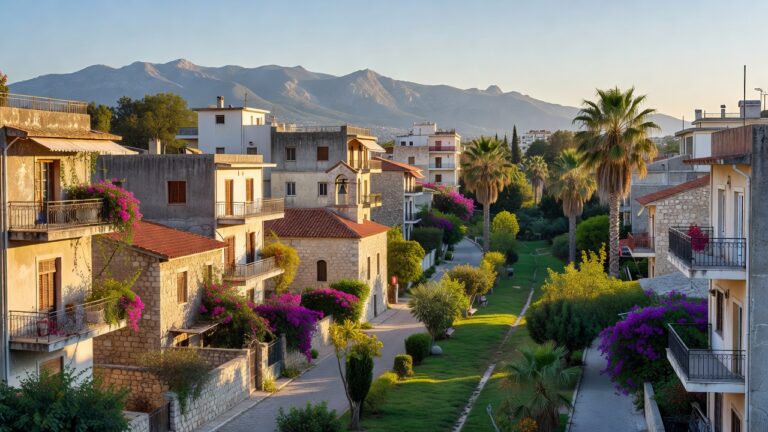
We analysed 87 Kaimakli, Nicosia listings: 42 apartments, 9 houses and 13 plots. Median 2-bed costs EUR190,000. See prices, rents and what…
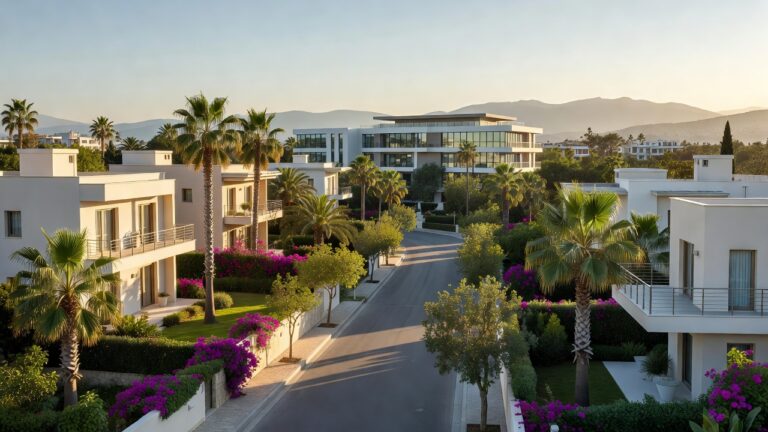
We analysed 387 Egkomi (Engomi), Nicosia listings: 169 apartments, 73 houses and 99 rentals. Median 2-bed costs EUR285,000. See prices, rents and…
Keep reading
Cyprus Affordable Housing Scheme: Current Progress and Financial Insights The Cyprus Interior Ministry recently reported that just over €2.2 million has been…

We analysed 208 Trachoni, Limassol listings: 170 apartments, 19 houses and 12 plots. Median apartment asks EUR260,000. See prices by size and…

We analysed 576 Pareklisia, Limassol listings: 188 houses, 175 apartments and 122 plots. Median house asks EUR965,000. See prices by size and…