
If you are buying a home or relocating to the island, understanding healthcare in Cyprus is as important as understanding property prices. The good news: Cyprus runs a modern, universal public system called GESY that covers roughly 99% of legal residents, backed by a well-regarded private sector. Most expats are surprised by how accessible and affordable it is.
This guide explains exactly how healthcare in Cyprus works in 2026 — what GESY covers, what it costs, who qualifies, and when you need private health insurance. Whether you are retiring to Paphos, moving your family to Limassol, or buying a holiday home, you will know precisely what to expect before you arrive.
Healthcare in Cyprus operates on two tiers: the public General Healthcare System (known as GESY, or ΓεΣΥ in Greek) and a strong private sector. Both work together, and many residents use a mix of the two.
GESY launched its outpatient phase on 1 June 2019 and extended to full inpatient (hospital) care in June 2020. It is managed by the Health Insurance Organisation (HIO), while state hospitals are run by the State Health Services Organisation (OKYPY). The system is funded through income-based contributions rather than upfront fees, which is why residents pay very little at the point of care.
The private tier runs in parallel. Cyprus has a dense network of private clinics and hospitals — the American Medical Center, German Oncology Center, Apollonion, Mediterranean Hospital, and Aretaeio among them — where you can pay directly or use private insurance. Many doctors trained in the UK, Greece, or elsewhere in Europe, and English is widely spoken across both tiers.
For expats, this dual structure is a genuine advantage. You get universal public coverage from the moment you register, plus the option to add private cover for faster specialist access or a specific hospital.
Eligibility for GESY is based on legal residence, not citizenship. Anyone habitually resident in the government-controlled areas of Cyprus can register and become a beneficiary.
Here is how it breaks down by resident type:
Because eligibility follows residence, healthcare in Cyprus for expats is straightforward: secure your residence status, register with the HIO, choose a personal doctor, and you are in the system. This is one reason the island is so popular with international buyers — access does not depend on private wealth or an employer scheme. If you are still planning your move, our relocating to Cyprus guide walks through the residency steps that unlock GESY registration.
Note that GESY applies only to the Republic of Cyprus (the government-controlled areas). It does not operate in the north.
GESY provides comprehensive coverage. As a registered beneficiary, you are entitled to a broad range of services with only small co-payments at the point of use. Covered services include:
Contributions are deducted automatically based on income. In 2026 the headline rates are 2.65% for employees, 2.90% for employers, 4.00% for the self-employed, and 2.65% on pension, rental, dividend, and interest income. Contributions are capped at €180,000 of annual income, so high earners pay no more than roughly €4,770 per year on the 2.65% band.
At the point of care, you pay modest co-payments rather than full fees. The table below summarises the main 2026 charges.
| Service | Co-payment (2026) |
|---|---|
| Personal doctor (GP) visit | Free |
| Specialist visit with referral | €6 |
| Specialist visit without referral | €25 |
| Laboratory test | €1 per test |
| Prescription item | €1 per item |
| Accident & emergency | €10 |
| Inpatient / hospital stay | No co-payment |
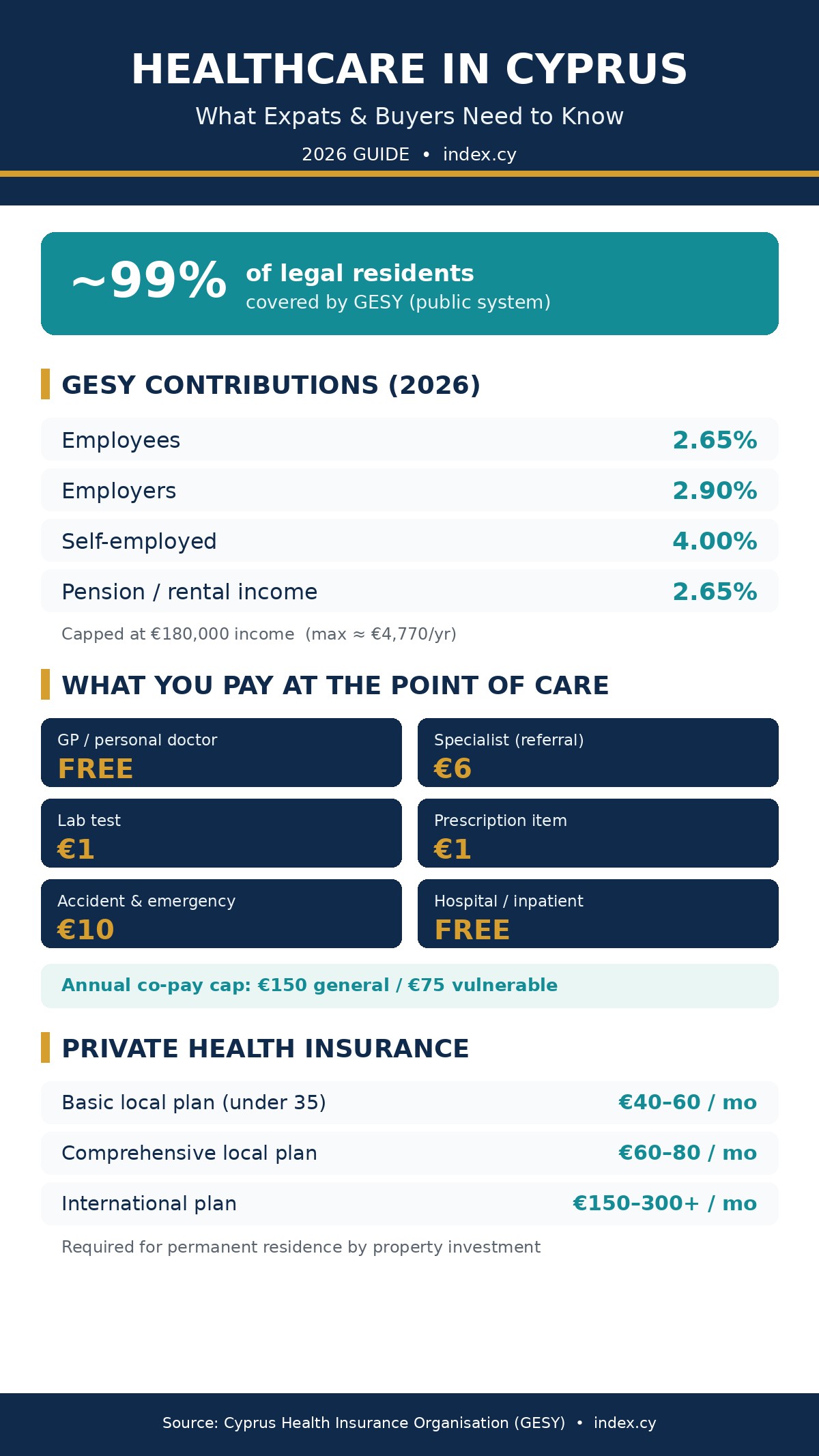
To protect residents from large bills, annual co-payment ceilings apply. General beneficiaries are capped at €150 per year, while vulnerable groups — recipients of the Guaranteed Minimum Income, low-income pensioners, and children up to age 21 — are capped at €75 per year. Once you hit the ceiling, further outpatient co-payments for the year are waived.
For most households, this means predictable, low healthcare costs — a factor worth building into your overall budget alongside our cost of living in Cyprus guide.
Even with universal GESY coverage, many expats add private health insurance in Cyprus. Private cover buys speed and choice: shorter waits for elective specialist appointments, access to specific private hospitals, and services that sit outside the public scheme.
Private healthcare in Cyprus is also more affordable than in many Western European countries. Typical 2026 monthly premiums look like this:
| Plan type | Approx. monthly cost (2026) |
|---|---|
| Basic local plan (under 35) | €40–€60 |
| Comprehensive local plan | €60–€80 |
| International plan | €150–€300+ |

Local plans generally cover private treatment within Cyprus, while international plans extend cover across borders — useful if you split your time between countries or want treatment options abroad. Premiums rise with age and with the breadth of cover, so compare plans carefully.
There is one situation where private cover is not optional but required. Applicants for permanent residence through property investment must hold private health insurance as part of their application, alongside owning or renting qualifying accommodation. If a residency route is part of your plan, read our permanent residence in Cyprus guide to see exactly where health insurance fits in the process.
For international buyers, healthcare and property decisions are closely linked. Your residence status determines your GESY eligibility, and some residency routes carry their own health insurance conditions.
If you are buying property to obtain permanent residency, budget for a private policy from the outset — it is a documented requirement, not an afterthought. Retirees relying on pension income should factor GESY contributions (2.65% on pension income) into their monthly planning; our retire to Cyprus guide covers how pensions and residency interact.
Location also matters more than many buyers expect. The main public and private hospitals cluster around the cities — Nicosia, Limassol, Larnaca, and Paphos — so proximity to a hospital can be a genuine consideration when choosing where to buy. Paphos, with its large and established British and European community, is well served by private clinics and English-speaking practitioners, which is one reason it remains a favourite for retirees. You can browse properties for sale in Paphos or compare options in Limassol, the island’s largest healthcare hub.
Before committing to any home, it is worth checking the wider picture of a property’s value and location. An instant property report gives you data-backed context on price and area so healthcare access can sit alongside your other criteria.
If you are visiting before you buy, or waiting for your residence permit to be issued, you are not left uncovered — but the rules differ from resident coverage.
EU visitors with a valid European Health Insurance Card (EHIC), and UK visitors with a Global Health Insurance Card (GHIC), are entitled to medically necessary state healthcare on the same terms as a Cypriot patient. In practice that means free or low-cost treatment at state hospitals and GESY-contracted providers, with only the small standard co-payment.
Two limitations are important. First, an EHIC or GHIC is not travel insurance — it does not cover private clinics, repatriation, or non-urgent care, so comprehensive travel insurance is still strongly recommended. Second, the EHIC and GHIC are not valid in the northern part of the island.
Travellers who need a visa to enter Cyprus face a firmer rule: consulates require proof of travel medical insurance covering the full stay, with a minimum of €30,000 for emergency treatment, hospitalisation, and repatriation. Britain’s official Cyprus travel-health advice is a useful reference for UK nationals before a trip.
New arrivals moving from Britain will find the transition well documented — our moving to Cyprus from the UK guide explains how GHIC cover bridges the gap until you register for GESY, and remote workers can check the health requirements in our digital nomad visa guide.
Registering for GESY is a simple, one-time process. Once you have legal residence, follow these steps:
Most residents complete registration within a short visit or online. If you are still weighing up whether Cyprus is the right fit, our living in Cyprus guide puts healthcare in the context of daily life, climate, and community. And because your tax residence can affect contributions and obligations, it is worth reviewing our Cyprus tax residency guide alongside your healthcare planning.
Public healthcare in Cyprus is not entirely free, but it is very affordable. Registered GESY beneficiaries pay income-based contributions and only small co-payments at the point of care — for example, €6 for a specialist visit with a referral — with annual co-payment ceilings of €150 for general beneficiaries.
Yes. GESY eligibility is based on legal residence, not citizenship. EU nationals working in Cyprus qualify from day one, and non-EU residents can register once they hold a valid residence permit.
Not for basic access — GESY provides comprehensive coverage. However, private health insurance is required for permanent residence applications through property investment, and many residents add it for faster specialist access and private hospital choice.
Yes, for visitors. An EU EHIC or UK GHIC entitles you to medically necessary state healthcare on the same terms as locals. It is not travel insurance and is not valid in the north, so separate travel cover is still advisable.
Healthcare in Cyprus is one of the quieter advantages of buying property or relocating here. The universal GESY system delivers comprehensive coverage at low cost, eligibility follows residence rather than wealth, and a strong private sector fills any gaps for those who want faster access or specific hospitals. For expats and property buyers, that combination removes one of the biggest uncertainties of moving abroad.
As you plan your purchase, treat healthcare as part of your location decision — proximity to hospitals, the size of the local expat community, and your residency route all interact with it. Start by exploring listings and getting a data-backed instant property report on any home you are considering, so your next move is informed by the full picture.
This guide is general information, not medical, legal, or financial advice. Healthcare rules, contribution rates, and co-payments can change — always confirm current details with the official Cyprus Health Insurance Organisation and a qualified adviser before acting.