What this guide covers
- Where Kiti Is, and Which Authority Actually Governs It
- Kiti Sells Flats, But It Is Not a Flat Town
- The €350,000 Ceiling: Kiti’s Flat Market Has No Top End
- The Discount Widens With Every Bedroom
- One Municipality, One Market? Only Half the Time
- Rental Yields in Kiti: One Number We Can Publish, Two We Cannot
- What the Larnaca District Data Adds
- The Short Version for Buyers and Investors
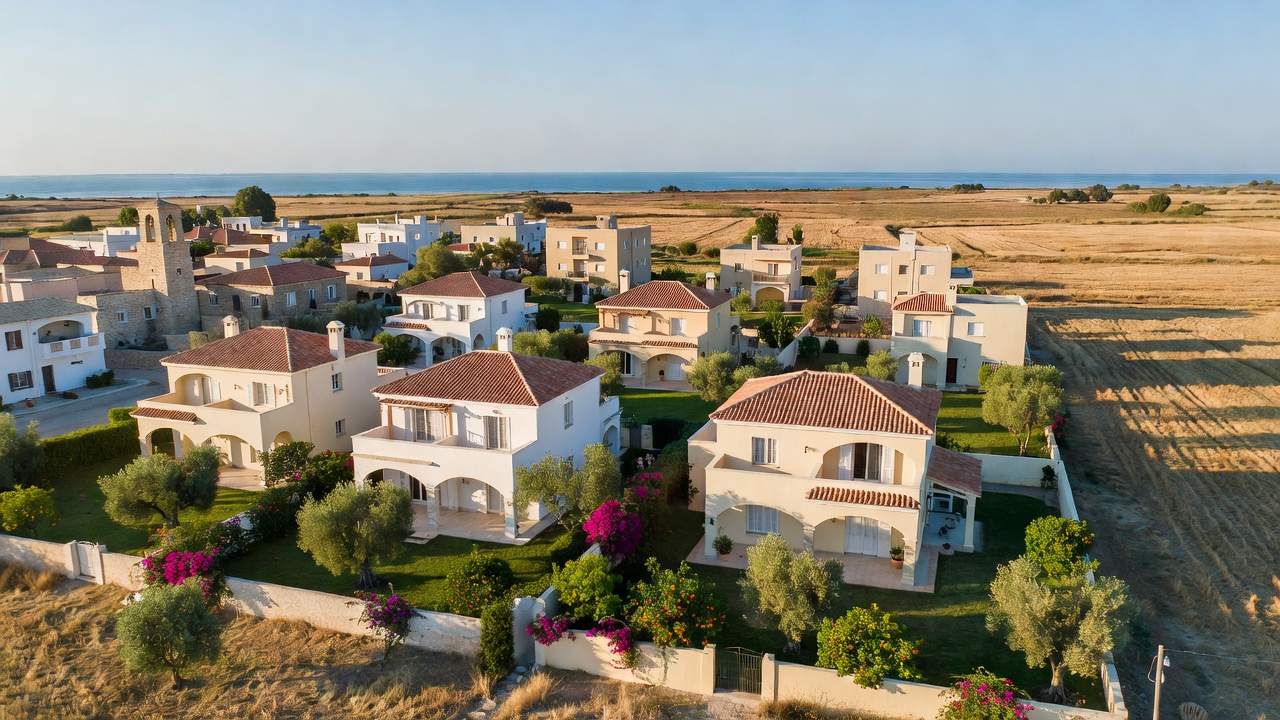
Kiti is the village buyers reach for when Larnaca itself has priced them out. It sits 11 kilometres southwest of the city, it has a Byzantine church that draws visitors from across the island, and it is widely described as “good value” by people who have never checked the number against anything.
We checked. We pulled every index.cy listing tied to Kiti — 474 priced records covering sales and rentals across apartments, houses and plots — and ran the same analysis against the four Larnaca localities Kiti is usually compared with: Livadia, Aradippou, Oroklini and Dromolaxia.
“Good value” turns out to be true, but not evenly, and the unevenness is the whole point. Against its closest neighbour the discount is 13 per cent on a two-bedroom house and 52 per cent on a five-bedroom one. It grows with every bedroom you add. A buyer who carries one blanket “Kiti is about 20 per cent cheaper” rule across the whole market will underbid on small properties and leave a great deal of money on the table on large ones.
There is a second finding that matters just as much, and it concerns what Kiti does not sell. Here is what the listings show.
Where Kiti Is, and Which Authority Actually Governs It
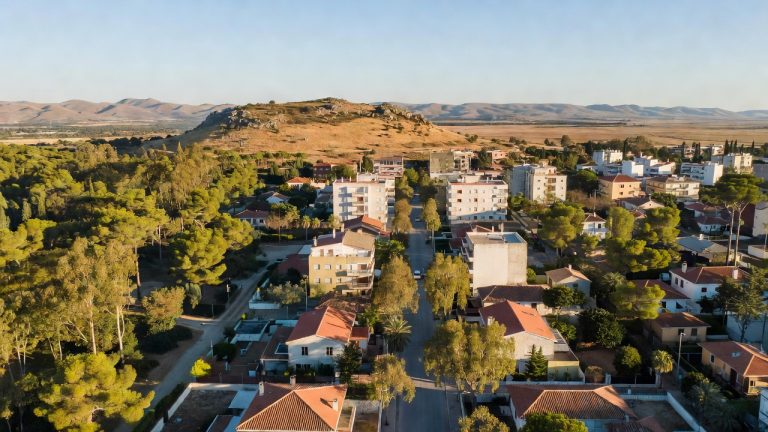
Kiti is a village on the flat coastal plain southwest of Larnaca, close enough to the airport that the runway approach is part of daily life. The 2021 census recorded 5,136 residents. Its landmark is the Byzantine church of Panagia Angeloktisti — “Our Lady Built by Angels” — whose sixth-century mosaic is among the most important early Christian survivals in Cyprus. Local tradition holds that residents of ancient Kition moved inland here to escape Arab raids, which is a reasonable summary of why the village sits where it sits.
One administrative fact does real work for buyers. Kiti is no longer a community with its own authority. Under the local government reform that came into force on 1 July 2024, the former communities of Kiti, Pervolia and Tersefanou were merged with the quarters of Dromolaxia and Meneou to form Dromolaxia–Meneou Municipality, a municipality of 17,026 residents. Kiti is one of its municipal districts.
That gives you a clean, falsifiable test of whether property advice you are being given is current. Anyone who refers you to “Kiti Community Council” as the planning authority is working from information at least two years out of date. It also means the comparison that follows is not academic: Kiti and Dromolaxia now sit inside the same municipality, under the same council, and we can ask directly whether one municipality means one market.
Kiti Sells Flats, But It Is Not a Flat Town
Of the 463 Kiti properties listed for sale in our dataset, 336 are apartments, 98 are houses and 22 are plots of land. That is 73 per cent apartments — a clear majority, but a very different balance from the apartment suburbs closer to the city.
| Locality | Sale listings | Houses | Flats | Plots |
|---|---|---|---|---|
| Kiti | 463 | 21% | 73% | 5% |
| Livadia | 1,761 | 9% | 89% | 1% |
| Aradippou | 1,006 | 5% | 88% | 5% |
| Oroklini | 587 | 40% | 52% | 6% |
| Dromolaxia | 72 | 54% | 28% | 15% |
Kiti sits in the middle of its cohort: four times more house-weighted than Aradippou, half as house-weighted as Oroklini. It is a village that builds apartments rather than an apartment suburb with a few houses left over, and that mix is why the two halves of its market can behave so differently without either one being a rounding error.
Within the apartment stock, the concentration is familiar from elsewhere in the district:
- 211 are two-bedroom — 63 per cent of every flat on the market
- 96 are one-bedroom — 29 per cent
- 29 are three-bedroom — 9 per cent
So 91 per cent of Kiti’s apartment stock is one or two bedrooms. Want a three-bedroom flat here and you are choosing from 29 listings, with very little leverage. If you want a two-bedroom flat you have 211 competing sellers, and you have a great deal.
The €350,000 Ceiling: Kiti’s Flat Market Has No Top End
This is the most unusual number we have measured in this series, and it is worth stating plainly.
Of the 336 apartments listed for sale here, exactly zero are priced above €350,000. The most expensive one asks €350,000 on the nose. One listing out of 336 — 0.3 per cent — clears €300,000.
Set that against the neighbours and the gap is not subtle:
| Locality | Flats listed | Above €300k | Above €350k | Most expensive flat |
|---|---|---|---|---|
| Kiti | 336 | 0.3% | 0.0% | €350,000 |
| Livadia | 1,565 | 35.8% | 20.4% | €3,265,000 |
| Oroklini | 306 | 18.6% | 8.2% | €645,000 |
| Aradippou | 882 | 13.7% | 4.3% | €650,000 |
Livadia has 320 flats on the market above the price of the single most expensive flat in Kiti. Kiti has none.
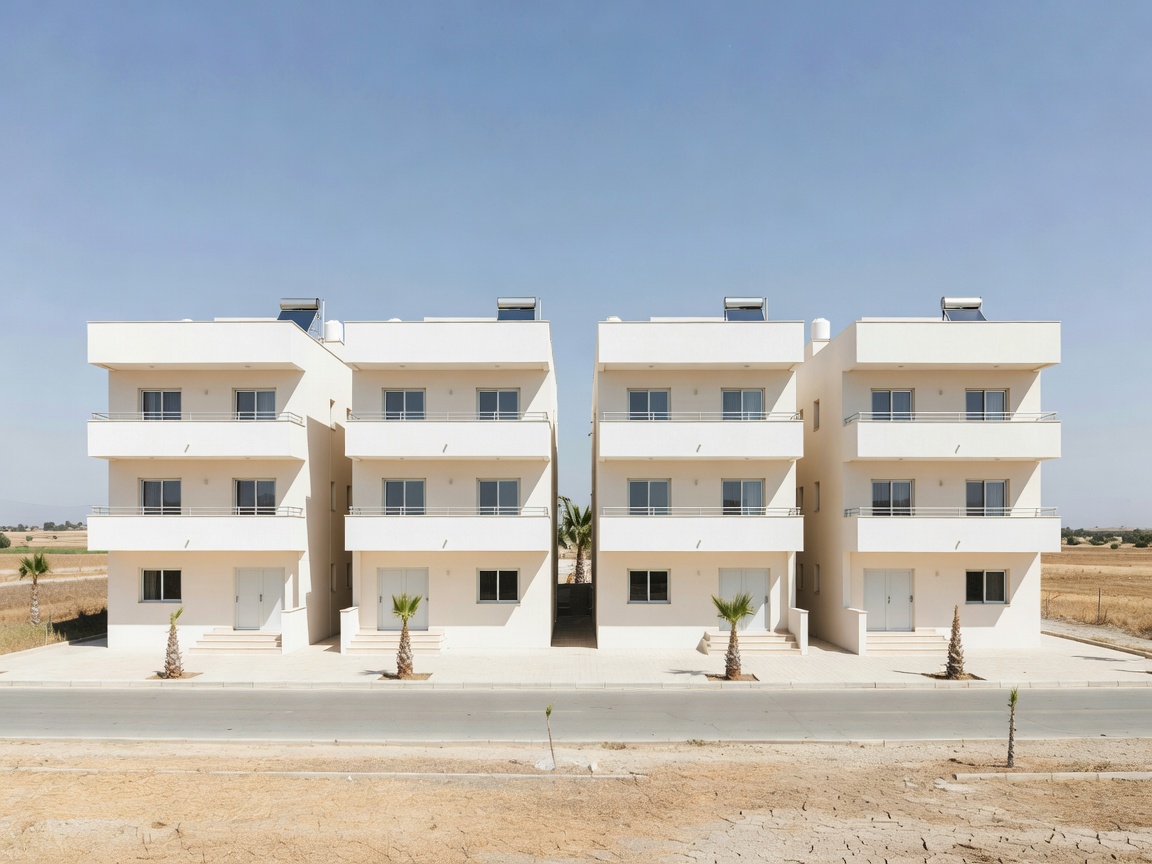
The consequence is a market of unusual uniformity. The 25th percentile flat asks €179,000 and the 75th asks €247,000 — an interquartile ratio of 1.38, the tightest apartment market we have measured anywhere in Cyprus. In a market that clustered, the median is not a statistical convenience; it genuinely describes the property you will be shown. When we say the median Kiti flat asks €222,000, that is a real number about a real, repeatable apartment.
The houses are the opposite. Their interquartile ratio is 2.24, the median asks €340,000, and the most expensive runs to €2,650,000. The same village contains the most uniform flat market and one of the widest house markets in its district. Any valuation approach that treats “Kiti” as a single price level will be wrong about one of them.
The Discount Widens With Every Bedroom
Here is the finding a buyer can actually use. The village is cheaper than Oroklini at every house size — and the gap grows monotonically as the houses get bigger.
| Bedrooms | Kiti median | vs Oroklini | vs Livadia | vs Aradippou |
|---|---|---|---|---|
| 2-bed house | €230,000 | −13% | −37% | — |
| 3-bed house | €340,000 | −23% | −25% | −11% |
| 4-bed house | €550,000 | −37% | −16% | −1% |
| 5-bed house | €570,000 | −52% | −33% | −48% |
Medians shown where at least five listings exist. Oroklini house samples: 11, 144, 49 and 25 listings by bedroom count; Kiti: 30, 33, 10 and 20.
Against Oroklini the progression is clean and uninterrupted: −13, −23, −37, −52. Against Livadia and Aradippou the discount is present at every size but does not climb in a straight line, so we will not claim it does. The monotone version of this finding belongs to the Oroklini comparison specifically.
The magnitude at the top is the part worth pausing on. A five-bedroom house in Oroklini asks a median €1,200,000. The same specification here asks €570,000. That is not a trim — it is less than half. Twenty five-bedroom listings sit behind the Kiti figure, so this is not one odd cheap house dragging an average down; the cluster runs from €400,000 to €630,000 before a handful of larger properties lift the top of the range.
Flats behave differently. The village runs only 3 to 6 per cent below Aradippou and Oroklini on one- and two-bedroom apartments — close to a rounding difference:
| Bedrooms | Kiti median | vs Oroklini | vs Aradippou | vs Livadia |
|---|---|---|---|---|
| 1-bed flat | €160,000 | −6% | −3% | −20% |
| 2-bed flat | €230,000 | −3% | −6% | −22% |
| 3-bed flat | €255,000 | −18% | −6% | −40% |
So the practical rule is the opposite of a flat percentage. On small apartments the village is priced almost exactly like its neighbours and there is little to be gained by driving out of town. On large houses it is in a different price universe. If you are buying a two-bedroom flat, location choice inside this cohort is close to a lifestyle decision. If you are buying a five-bedroom house, it is the single largest financial decision in the transaction. You can browse the full range of houses for sale across Cyprus to see how that pattern repeats elsewhere.
A walk through the older village core. Worth noting that the housing visible in footage like this is the historic centre — not the newer apartment stock on the edges that sets the flat prices analysed above.
One Municipality, One Market? Only Half the Time
Kiti and Dromolaxia have shared a council since July 2024. If municipal boundaries told you anything about pricing, these two should move together.
For houses, they do. The five-bedroom medians are €570,000 on both sides — identical, on 20 and 18 listings respectively. At four bedrooms the village asks 10 per cent more, on ten and eleven listings. For large houses, this genuinely is one market.
For flats, they do not. A two-bedroom apartment asks €230,000 in Kiti and €187,000 in Dromolaxia — Kiti is 23 per cent more expensive, inside the same municipality, under the same council. Dromolaxia’s flat sample is small at 20 listings, so treat that figure as indicative rather than settled, but the direction is unambiguous.
The lesson is not that municipal boundaries are meaningless. It is that they are meaningless until you check, and that the answer changes by property type within a single administrative unit. A comparable-sales analysis that draws its cohort from “the municipality” will be defensible for houses here and misleading for apartments.
Rental Yields in Kiti: One Number We Can Publish, Two We Cannot
Our dataset contains 11 rental listings for the village. That is enough for one calculation and not enough for three.
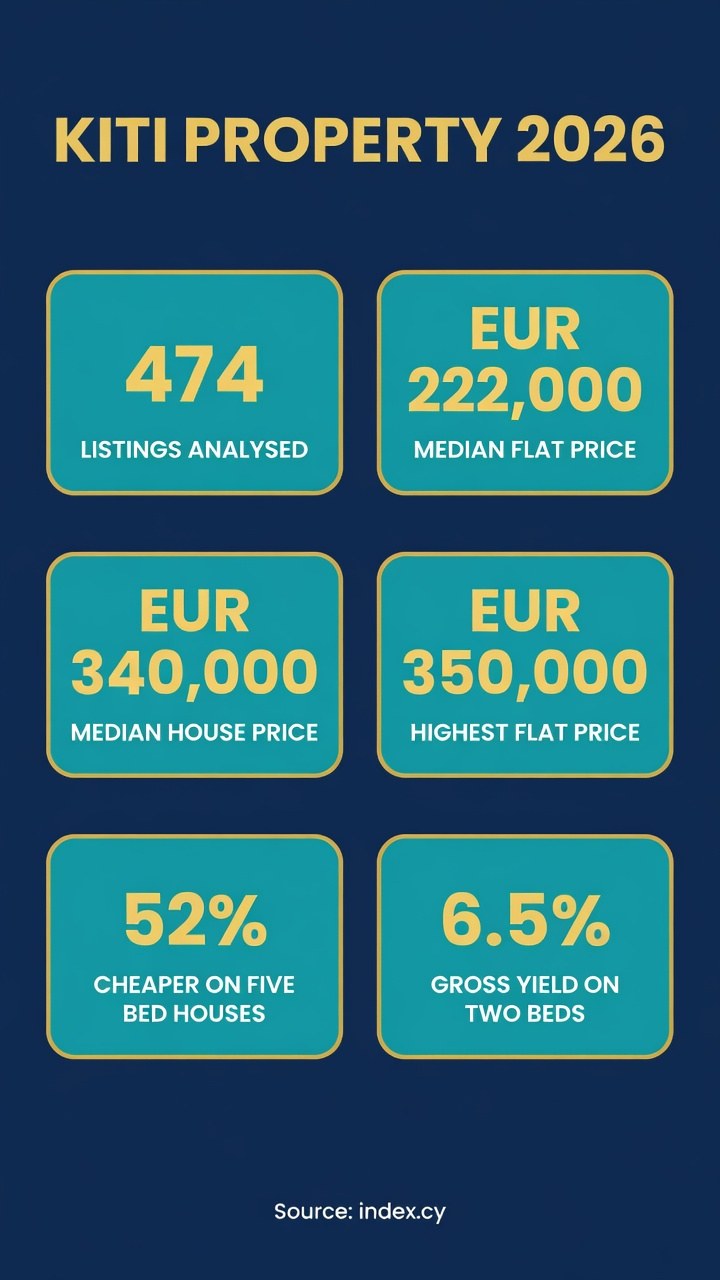
Two-bedroom apartments: the median asking rent is €1,250 a month against a median asking price of €230,000 — a gross yield of 6.52 per cent. That rests on eight rental listings against 211 sale listings. Eight is a thin sample and we would not publish it on its own, but the rents cluster tightly — six of the eight sit between €1,250 and €1,300 — which is consistent with the unusual uniformity of the sale market.
One-bedroom and three-bedroom apartments: we found no rental listings at either size. We are not going to interpolate a yield from zero observations, so we are not publishing one.
The comparison is the useful part. That 6.52 per cent is the highest gross yield we have measured anywhere in this Larnaca cohort — above Livadia’s two-bedroom figure of 5.69 per cent and Aradippou’s 5.39 per cent. The cheaper entry price is not being offset by correspondingly cheaper rents, which is precisely the condition that produces a superior yield.
Two honest caveats. These are asking figures on both sides, not achieved ones, and the spread between asking and achieved is not necessarily equal for rents and sales. And a gross yield ignores management, vacancy, maintenance and the municipal charges that follow the 2024 reform. Treat 6.52 per cent as a ceiling to work down from, not a return to bank. If you want to test a specific property against comparables rather than a village median, an instant property report will do that on the individual listing.
What the Larnaca District Data Adds
Village-level listings tell you about asking prices. District transaction data tells you whether anyone is paying them, and here the picture is strong.
Larnaca was the standout district of August 2026, recording 299 contracts of sale against 221 a year earlier — a 35.3 per cent gain, the largest monthly increase any district posted in 2026. Its eight-month total reached 2,898 contracts, up 13 per cent, within a national figure of 13,288 that was the strongest eight-month opening on record. Roughly 46 per cent of Larnaca contracts were signed by non-Cypriot buyers.
On prices, the Central Bank of Cyprus Residential Property Price Index rose 7.5 per cent year on year in the first quarter of 2026, and Larnaca led all five districts at 8.9 per cent. Beneath that average, in the report’s words, “the two halves of the market have separated”: apartment prices climbed 10.8 per cent over the year while house prices rose 3.0 per cent.
That last split reframes everything above. The deepest discounts are in large houses — the half of the market appreciating at 3.0 per cent. Kiti’s near-parity pricing is in apartments — the half appreciating at 10.8 per cent. The village is cheap precisely where the market is slowest, which is a considerably less exciting story than “Kiti is undervalued,” and a more accurate one. If you want the large house, you are being paid to accept the slower-moving asset class. That may be an excellent trade if you intend to live in it. It is a different proposition if you expect the discount to close.
Financing conditions support the demand either way: new housing loans reached €152.1 million in June 2026 at an average rate of 4.04 per cent, and only 10.9 per cent of new housing loans now carry a variable rate, against close to 100 per cent at the start of 2022.
The Short Version for Buyers and Investors
Five things the 474 listings actually establish about property in Kiti, Cyprus:
- The discount grows with size. Against Oroklini it runs 13 per cent cheaper on a two-bedroom house and 52 per cent cheaper on a five-bedroom one, widening at every step. Do not apply a single percentage across the market.
- The flat market has a hard ceiling. Not one of 336 apartments asks above €350,000. If your budget is above that and you want a flat, the village has nothing to sell you, and no amount of searching will change that.
- The flat market is unusually uniform. An interquartile ratio of 1.38 means the €222,000 median describes a genuinely typical apartment — rare enough that it makes comparables here more reliable than in most Cypriot localities.
- The yield is the cohort’s best, on a thin sample. 6.52 per cent gross on two-bedroom flats, from eight rental observations. Better than Livadia and Aradippou; still asking-price based, still gross.
- Sharing a municipality does not mean sharing a market. Kiti and Dromolaxia price large houses identically and two-bedroom flats 23 per cent apart, under one council.
The honest summary is that the village rewards a specific buyer very well: someone who wants a large house, has no expectation of rapid capital growth, and would rather own five bedrooms outright in a village than three in a suburb. For the apartment buyer, the case is thinner — the saving against Aradippou or Oroklini is a few per cent, and the ceiling is real.
Every figure here comes from asking prices on live index.cy listings collected in September 2026, not from completed transactions. Asking prices run ahead of achieved prices almost everywhere in Cyprus, which is a reason to negotiate — not evidence that any locality is overpriced.
Browse current properties for sale in Larnaca to see the district range, or compare against our data on average two-bedroom apartment prices in Cyprus before you decide which village your budget actually belongs in.
Keep reading
We analysed 217 Erimi, Limassol listings: 105 apartments, 81 houses and 24 plots. Median 2-bed flat EUR295,000. See prices, the repeat-advert trap…
We analysed 319 Aglantzia, Nicosia listings: 155 apartments, 34 houses and 38 plots. Median 2-bed costs EUR257,500. See prices, rents and what…
We analysed 387 Egkomi (Engomi), Nicosia listings: 169 apartments, 73 houses and 99 rentals. Median 2-bed costs EUR285,000. See prices, rents and…