
Searching for houses in Cyprus in 2026? You’re looking at one of the Mediterranean’s most resilient property markets. Whether you want a detached villa near the sea, a townhouse in a quiet suburb, or a long-term family home to rent, houses in Cyprus span a wide range of prices, locations and styles. This guide pulls together current 2026 market data, district price ranges, the buying process, the true costs involved, and rental options—so you can decide with confidence rather than guesswork.
Cyprus offers something most island markets don’t: stable prices, English widely spoken, EU membership, and a transparent (and recently simplified) legal process. Houses here range from €150,000 inland resale properties to multi-million-euro seafront residences. The trick is knowing where value sits and what you’ll actually pay once taxes, fees and upkeep are added.
Demand for houses in Cyprus remains strong heading through 2026, driven by a mix of local buyers, returning Cypriots, and a large international community. The Central Bank of Cyprus Residential Property Price Index rose roughly 7% year-on-year in late 2025 and continued climbing into early 2026, confirming a market that has fully recovered and pushed past pre-crisis records.
There’s an important nuance, though. Apartment prices have been rising faster (close to 10% year-on-year) while houses have grown more modestly—around 3% year-on-year. For buyers, that’s good news: detached and semi-detached homes offer better relative value right now than apartments in many districts.
Several factors keep the house market healthy. Cyprus enjoys 320+ days of sunshine, a low cost of living relative to Western Europe, and an established expat population, particularly from the UK, Russia, Israel and Northern Europe. Add the year-round rental potential in coastal districts and the appeal of land ownership, and houses remain a cornerstone of the Cyprus property market.
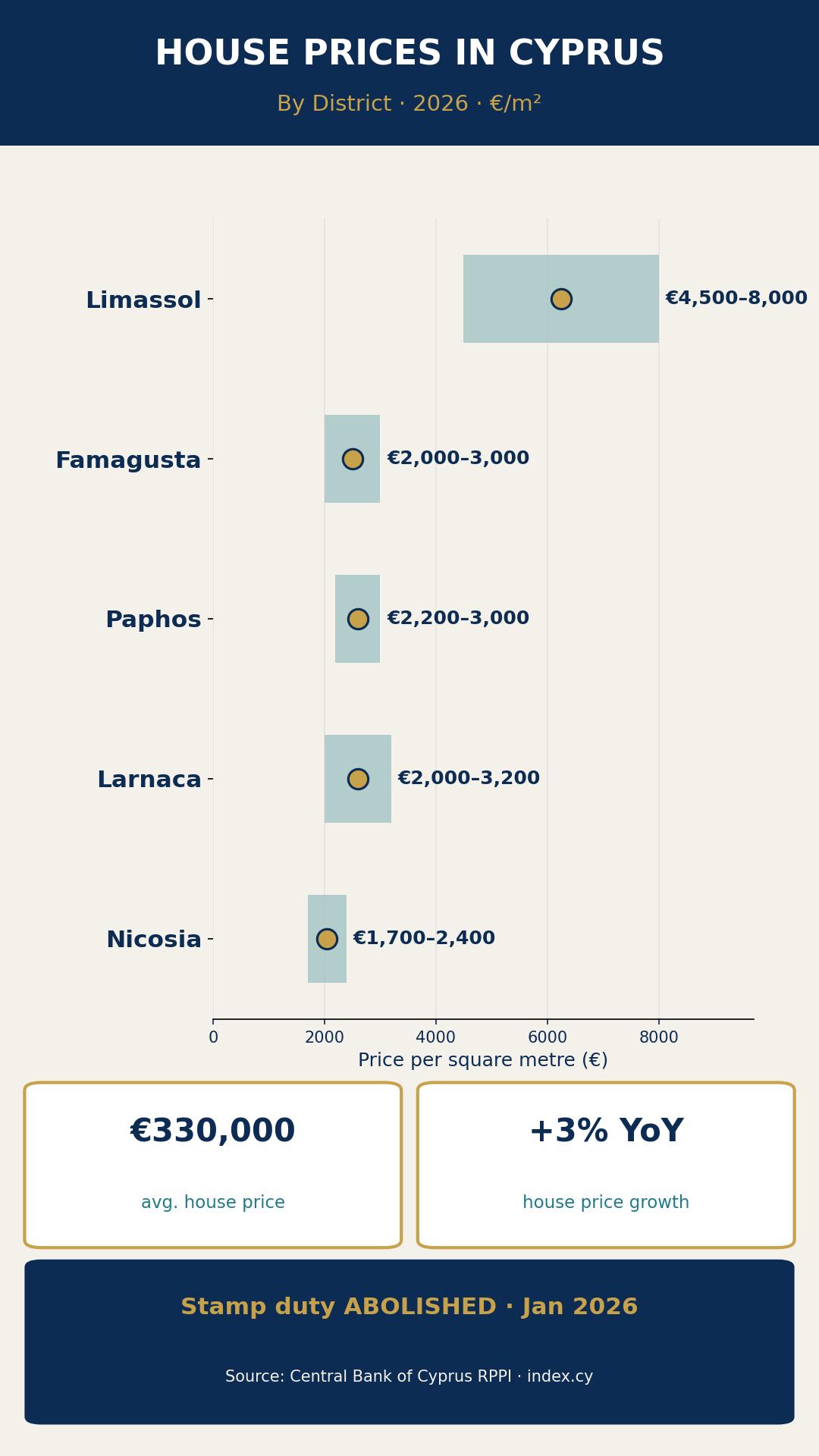
House prices vary enormously across the island’s five districts. As a national benchmark, the average house in Cyprus sells for roughly €330,000, or around €1,850 per square metre—notably lower than the apartment average of about €2,600 per square metre, since houses include land and tend to sit away from prime city centres.
The table below shows typical 2026 price-per-square-metre ranges for houses by district. Coastal and prime areas command the top of each range; inland and resale homes the bottom.
| District | Typical house price/m² (2026) | Market notes |
|---|---|---|
| Limassol | €4,500–€8,000+ | Most expensive; seafront and Marina-adjacent homes command premiums |
| Paphos | €2,200–€3,000 | Strong expat demand, good value coastal villas |
| Larnaca | €2,000–€3,200 | Fast-rising; airport and marina regeneration |
| Nicosia | €1,700–€2,400 | Capital and best value; suburban family homes |
| Famagusta | €2,000–€3,000 | Resort areas (Protaras, Ayia Napa) drive prices |
Limassol is consistently the priciest district and recorded the strongest annual price growth in Cyprus through late 2025. Nicosia, the inland capital, remains the best-value district for buyers who don’t need a coastal location. For a deeper district-by-district breakdown, see our full guide to house prices in Cyprus, and check live per-square-metre data on the average house price insights page.
When you’re ready to browse real listings, you can filter houses for sale in Cyprus by district, price and features on index.cy.
“House” covers several distinct property types in Cyprus, each suited to a different buyer. Knowing the categories helps you search efficiently and compare like with like.
Detached villas are the most sought-after. They sit on their own plot, usually with a private garden and often a pool. Coastal villas in Paphos and Limassol attract holiday-home buyers and investors; you can explore villas across Cyprus to compare.
Semi-detached and link-detached houses share one wall with a neighbour and offer a balance of space and affordability—popular with families in suburban Nicosia and Larnaca.
Townhouses are multi-storey homes in terraced rows, common in resort developments and town centres. They typically cost less than detached homes while still offering private outdoor space.
Bungalows (single-storey homes) appeal strongly to retirees and downsizers who want step-free living. They’re widely available around Paphos and Larnaca.
Country and stone houses in traditional villages offer character and large plots at low prices, though they often need renovation and may sit far from amenities.
The process of buying a house in Cyprus is straightforward and well-protected, especially since the legal framework was simplified in 2026. Here are the key stages.
For a detailed walkthrough with timelines, read our dedicated guide on how to buy a house in Cyprus. Foreign buyers should also review the rules in our guide to buying property in Cyprus as a foreigner.
Before you commit, always verify the property’s condition. An independent property inspection can flag structural issues, damp or unpermitted extensions that aren’t obvious on a viewing.
The sticker price is only part of what you’ll pay. Budget for these additional costs, which typically add 6–12% on top of the purchase price for a resale home, and less for a new build where VAT is already included.
Transfer fees are tiered at 3%, 5% and 8% across price bands. Crucially, resale properties get a 50% reduction, and there are no transfer fees at all if you paid VAT on the property.
VAT applies to new builds at the standard 19%, but a reduced 5% rate applies to the first 130 square metres of your main residence—a significant saving for owner-occupiers.
Stamp duty was abolished on 1 January 2026 under Law 239(I)/2025, removing a cost that previously applied to all purchase contracts. This is one of the most buyer-friendly changes the market has seen in years.
Legal fees run about 1–2% of the purchase price, and you should also budget for surveyor fees, mortgage costs if applicable, and the first year of property-related charges.
For sellers and investors, note that capital gains tax of 20% applies to profits on sale, with generous lifetime exemptions for individuals. Use our instant property report tool to estimate a fair price before you negotiate.
Not ready to buy? Renting a house in Cyprus is a smart way to test a district before committing—and the rental market is deep, especially for families wanting space and a garden.
Long-term house rents vary by district and size. As a rough 2026 guide, a three-bedroom house rents for roughly €1,400–€2,500 per month in Limassol, €1,000–€1,800 in Paphos and Larnaca, and €900–€1,500 in suburban Nicosia. Coastal and newly built homes with pools sit at the top of these ranges.
Standard long-term leases run 12 months with one to two months’ deposit. Rents have risen 3–6% over the past year, tracking the wider market. You can browse current houses for rent in Cyprus and compare options across districts.
If you’re weighing renting against buying, our complete guide to houses for rent in Cyprus breaks down what to expect as a tenant, including your rights and typical contract terms.
Owning a house in Cyprus comes with ongoing costs that are modest by Western European standards but worth planning for.
Annual running costs include municipal taxes (a few hundred euros depending on the property), refuse collection, and—if you’re in a managed development—communal fees. Houses with a private pool add maintenance of roughly €60–€120 per month, plus water and electricity.
Buildings insurance is recommended and inexpensive. If you let the property or leave it empty seasonally, factor in a property manager to handle keys, cleaning and emergencies. Homes near the coast also need occasional attention to salt-air wear on exterior fittings.
The upside: Cyprus has no annual immovable property tax (it was abolished in 2017), so the recurring tax burden of owning a house here is genuinely light compared with the UK or much of the EU.
For many buyers, a house in Cyprus is both a lifestyle purchase and a sound asset. Capital growth has been steady and broad-based, and the market’s recovery has pushed prices past pre-crisis peaks.
That said, be realistic about yields. Rental returns on houses and villas average around 3% gross—lower than the 5%+ typical for apartments, because houses cost more per rental euro. Where houses shine is in capital appreciation, lifestyle value, and holiday-let income in tourist hotspots like Paphos, Protaras and Ayia Napa, where short-term rates can be high in season. (See the Global Property Guide Cyprus analysis for yield benchmarks.)
If pure rental income is your goal, an apartment may serve better. If you want space, land, privacy and long-term appreciation—plus a home you’d actually enjoy living in—houses in Cyprus are hard to beat. To compare the full picture, see our broader guide to homes for sale in Cyprus and check the latest price-per-square-metre data for houses.
The average house in Cyprus costs around €330,000, or roughly €1,850 per square metre. Prices range from about €150,000 for inland resale homes to several million euros for seafront villas in Limassol. Nicosia offers the best value; Limassol is the most expensive district.
Yes. EU citizens buy on the same terms as Cypriots. Non-EU buyers can purchase a house but need permission from the Council of Ministers, which is a routine formality for residential property. Your lawyer handles the application as part of the process.
Transfer fees (3–8%, halved on resales and waived if VAT was paid) and VAT on new builds (19%, or a reduced 5% on the first 130m² of a main residence). Stamp duty was abolished on 1 January 2026, removing a previous cost.
Renting lets you test a district with low commitment and costs €900–€2,500 a month for a typical family house, depending on location. Buying makes sense if you’re staying long term, want capital growth, and can cover the 6–12% in upfront costs. Many buyers rent first, then purchase.
Houses in Cyprus offer a rare combination in 2026: a recovered, stable market; relative value compared with fast-rising apartments; a simplified buying process with stamp duty now abolished; and lifestyle benefits that few markets can match. Whether you’re buying a family home, a coastal villa, or renting to test the waters, the key is solid data and proper due diligence.
Start by exploring verified houses for sale in Cyprus across all five districts, compare prices on our insights pages, and run an instant property report before you make an offer. With the right preparation, finding your house in Cyprus is more straightforward than you might think.