
What this guide covers
- What Is the Cyprus Land Registry (Department of Lands and Surveys)?
- What the Cyprus Land Registry Does: Core Services
- Cyprus Land Registry Offices by District
- How to Do a Cyprus Land Registry Search
- Using the DLS Portal: Online Land Registry Services
- Title Deeds and the Cyprus Land Registry
- How the Land Registry Protects Buyers: Specific Performance
- Registering and Transferring Property Through the Land Registry
- Frequently Asked Questions
- What is the Cyprus Land Registry called officially?
- How do I check who owns a property in Cyprus?
- Can foreigners register property at the Cyprus Land Registry?
- Is there an online Cyprus Land Registry search?
- Conclusion: Make the Cyprus Land Registry Work for You
The Cyprus Land Registry is the single most important institution in any property transaction on the island — yet most buyers barely know it exists until a lawyer mentions it. Officially the Department of Lands and Surveys (DLS), it records who owns what, holds every title deed, and can make or break a purchase through one document: the search certificate.
If you are buying, selling, or investing in Cyprus property, understanding how the land registry works protects you from the costliest mistakes in the market. This guide explains what the Department of Lands and Surveys does, how to run a land registry search, where the district offices are, and how the system legally protects you as a buyer in 2026.
What Is the Cyprus Land Registry (Department of Lands and Surveys)?
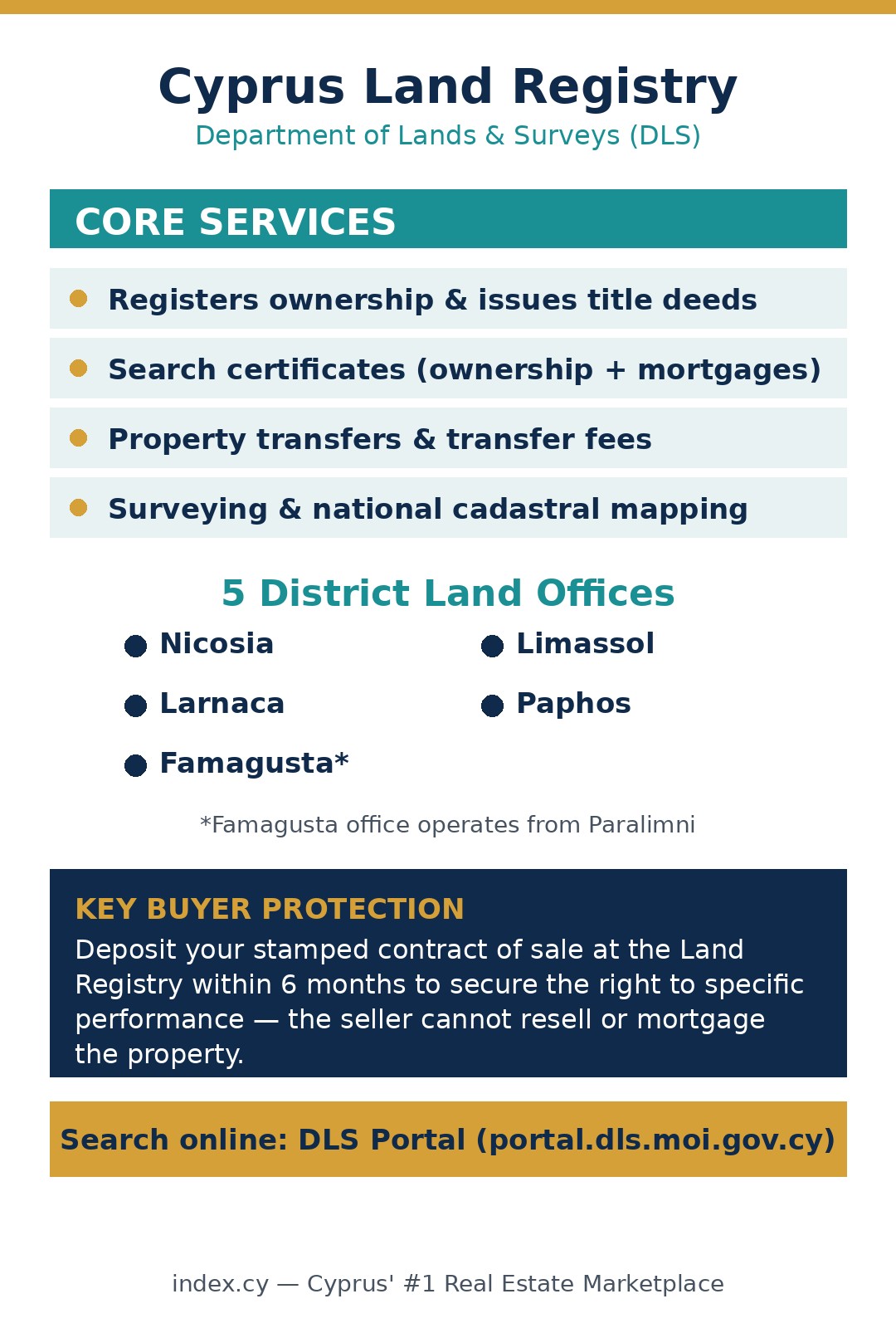
The Cyprus Land Registry is officially known as the Department of Lands and Surveys, a government body under the Ministry of Interior. It maintains the definitive public record of every plot, building, and unit in the government-controlled areas of the Republic.
In practice, the DLS does three things that matter to you. It registers ownership and issues title deeds. It records encumbrances — mortgages, charges, memos, and legal claims tied to a property. And it carries out property transfers when ownership changes hands.
Because the land registry is the official source of truth, a property is only truly “yours” once the transfer is registered in your name at the DLS. A signed contract is a promise; registration is ownership. That distinction sits at the heart of every safe transaction in Cyprus.
What the Cyprus Land Registry Does: Core Services
The Department of Lands and Surveys handles far more than filing deeds. Its core services touch every stage of the property lifecycle, from first survey to final sale.
The main functions include:
- Title registration — issuing and updating the Certificate of Registration (the title deed) for each property.
- Land registry searches — providing search certificates that reveal ownership, mortgages, and encumbrances.
- Property transfers — completing the legal change of ownership and collecting transfer fees.
- Surveying and cadastral mapping — measuring plots and maintaining the national cadastre.
- General Valuation — assigning an official value to each property, used as a base for taxes and fees.
- Mortgage registration and removal — recording bank charges and releasing them once loans are repaid.
For anyone doing due diligence, the search and valuation functions are the ones to focus on. They turn the land registry from a bureaucratic office into a genuine buyer-protection tool.
Cyprus Land Registry Offices by District
The DLS operates eleven offices in total, headquartered in Nicosia, with a District Land Office (DLO) serving each of the island’s districts. Two offices are displaced: because of the 1974 division, the Famagusta (Ammochostos) office now operates from Paralimni, and the Kyrenia (Keryneia) office operates from Nicosia.
Here are the main District Land Offices you will deal with when buying in the government-controlled areas:
| District | Land Registry Office Location | Telephone |
|---|---|---|
| Nicosia | Nikou Kranidioti Str., Egkomi, Nicosia | 22400600 |
| Limassol | 54 Demokratias Str., Limassol | 25804800 |
| Larnaca | Konstantinou Kavafi Str., Larnaca | 24803300 |
| Paphos | New Governmental Offices, Paphos | 26804160 |
| Famagusta | Operating from Paralimni | 24803109 |
If you are searching for property in a specific region, your transaction is handled by that district’s office. Buyers browsing properties for sale in Paphos deal with the Paphos DLO, while those looking at Limassol property listings go through the Limassol office. Each office keeps the records for its own district, so a Paphos plot is registered only in Paphos.
How to Do a Cyprus Land Registry Search
A Cyprus land registry search means requesting a search certificate from the Department of Lands and Surveys for a specific property. The certificate shows the registered owner, the plot’s size and boundaries, its official value, and any encumbrances — mortgages, charges, or legal claims. It is the fastest way to verify that a seller actually owns what they are selling.
You can request a search in two ways. The traditional route is to apply in person at the relevant District Land Office. The modern route is online through the DLS Portal, which lets you submit applications electronically once you are registered.
Search certificates carry a small statutory fee at the office — historically around €10 per registration — while some online searches are provided at no charge. Fees change, so always confirm the current schedule with the DLS before you apply.
For buyers, the search certificate is non-negotiable. Never pay a deposit before you have seen a recent search that confirms clear ownership and reveals any hidden mortgage. This single check is the backbone of proper due diligence when buying property in Cyprus, and it is exactly the kind of verification our instant property report is built to support.
Using the DLS Portal: Online Land Registry Services
The Department of Lands and Surveys has moved a large share of its services online through the official DLS Portal. The portal provides information, application forms, and a growing list of electronic services, so many tasks no longer require a trip to the office.
Through the portal and its cadastral map viewer you can view interactive maps, identify individual parcels, and access free data layers — parcels, buildings, planning zones, aerial photos, and each property’s General Valuation value. To submit applications electronically, such as requesting a search certificate or a copy of a title deed, you register with the government’s CYLOGIN (Ariadni) authentication system.
For international buyers who cannot visit an office in person, these online services are a genuine convenience. They let you check cadastral details, planning zones, and property data from anywhere before you ever set foot on the island.
Title Deeds and the Cyprus Land Registry
A title deed — formally the Certificate of Registration of Immovable Property — is the document the land registry issues to prove ownership. Each deed is tied to a specific plot or unit and records the owner, location, dimensions, share of ownership, and any encumbrances registered against it.

The title deed is the strongest form of proof you can hold. When a property has a separate, clean title deed in the seller’s name, ownership is straightforward to verify and transfer. Problems arise with properties that have no issued title deed yet — common with newer developments — because ownership then rests on contracts rather than a registered deed.
This is why buyers should always confirm the title status at the land registry before committing. Our dedicated Cyprus title deeds guide explains how to handle properties with and without issued deeds, and what to do if a developer’s mortgage sits over your unit.
How the Land Registry Protects Buyers: Specific Performance
One of the strongest buyer protections in Cyprus law runs directly through the land registry. Under the Sale of Property (Specific Performance) Law, depositing your stamped contract of sale with the Department of Lands and Surveys — generally within six months of signing — gives you the right to specific performance.
In plain terms, once your contract is lodged at the land registry, the seller cannot resell the property to someone else, mortgage it, or otherwise dispose of it without your consent. You can compel the seller to complete the transfer even if they refuse or go bankrupt, and your claim ranks ahead of most later third-party claims.
Recent reform strengthened this further. Law N.132(I)/2023 amended the specific performance framework so that the transfer proceeds once the buyer meets their contractual obligations. It also requires the seller to attach a land registry search certificate no older than five working days to the contract — a rule that forces fresh disclosure of any mortgage before you sign.
Where the property is already mortgaged, the land registry will only lodge your contract after a signed declaration from the lender and the seller confirming you were informed of that mortgage in writing. Depositing the contract on time is one of the most important steps in the whole process, so agree it with your lawyer at signing rather than afterwards.
Registering and Transferring Property Through the Land Registry
The final step of any purchase is the transfer of title at the District Land Office. Both parties — or their appointed representatives acting under power of attorney — attend the office, the DLS confirms the records, transfer fees are paid, and the deed is registered in the buyer’s name.
Before a transfer can complete, the land registry requires tax clearance. Form N.313, issued by the Tax Department, confirms that any capital gains tax and outstanding property-related dues are settled. Note that the annual Immovable Property Tax paid to central government was abolished in 2017, so this clearance today mainly covers capital gains tax and local charges rather than a yearly national levy.
Transfer fees are calculated by the land registry on a progressive scale based on the property’s value, with important exemptions — including no transfer fees where VAT was paid on a new property, and a standing reduction on others. Because the numbers shift with policy, we cover them in detail in our property transfer fees guide rather than repeating them here.
For plots and development sites, the same registration principles apply, and land buyers should be especially careful about boundaries and planning zones shown in the cadastre. You can explore current plots of land for sale and always cross-check each parcel’s details against the land registry map before making an offer.
Frequently Asked Questions
What is the Cyprus Land Registry called officially?
The Cyprus Land Registry is officially the Department of Lands and Surveys (DLS), a government department under the Ministry of Interior. It registers ownership, issues title deeds, records mortgages and encumbrances, and carries out property transfers across the government-controlled areas.
How do I check who owns a property in Cyprus?
Request a search certificate from the relevant District Land Office or through the DLS Portal online. The certificate names the registered owner and lists any mortgages, charges, or legal claims on the property. This is the standard way to verify ownership before paying a deposit.
Can foreigners register property at the Cyprus Land Registry?
Yes. Non-Cypriot buyers can own and register property, though buyers from outside the EU typically need Council of Ministers approval, which is generally a formality. The property is registered in the buyer’s name at the DLS once the transfer completes. See our guide for foreign buyers in Cyprus for the full process.
Is there an online Cyprus Land Registry search?
Yes. The DLS Portal at portal.dls.moi.gov.cy offers electronic services, including cadastral maps and applications for search certificates and title deed copies. You register with the government’s CYLOGIN (Ariadni) system to submit applications online.
Conclusion: Make the Cyprus Land Registry Work for You
The Cyprus Land Registry is not just an administrative office — it is your best protection in a property transaction. Every important safeguard, from verifying ownership to enforcing your contract, runs through the Department of Lands and Surveys.
Three habits will keep you safe. Always obtain a recent land registry search before paying anything. Confirm the title deed status so you know exactly what you are buying. And deposit your contract of sale at the land registry on time to secure your right to specific performance.
Do those three things and the land registry shifts from a source of anxiety to a source of confidence. When you are ready to move from research to real listings, browse verified properties across every district on index.cy and run an instant property report to check the numbers before you commit.
This guide is general information, not legal advice. Always work with a licensed independent lawyer for your specific transaction.
Keep reading

We analysed 387 Egkomi (Engomi), Nicosia listings: 169 apartments, 73 houses and 99 rentals. Median 2-bed costs EUR285,000. See prices, rents and…
Addressing Dangerous Buildings in Cyprus: The Need for Proactive Management Concerns about the safety of jointly owned buildings in Cyprus have sparked…

Jointly Owned Buildings Bill Nears Final Review in Cyprus Cyprus is advancing toward crucial legislative reforms on the management of jointly owned…